One Perfect Spring Day

One perfect spring day, Carolina came to me and said that she wanted to go looking for dogwoods.  She had a spot in mind, near the western edge of the Pineywoods.  My response, unsurprisingly, was an eager “let’s go!”.  So we set out into the woods, and what we found was a beautiful spring paradise beyond anything I could have expected.  Seeing Flowering Dogwood, with its blossom laden branches painting the forest understory in white, is reward enough for a day’s wanderings.  But the dogwoods were just a precursor to the botanical, entomological, and mycological treasures to be discovered.

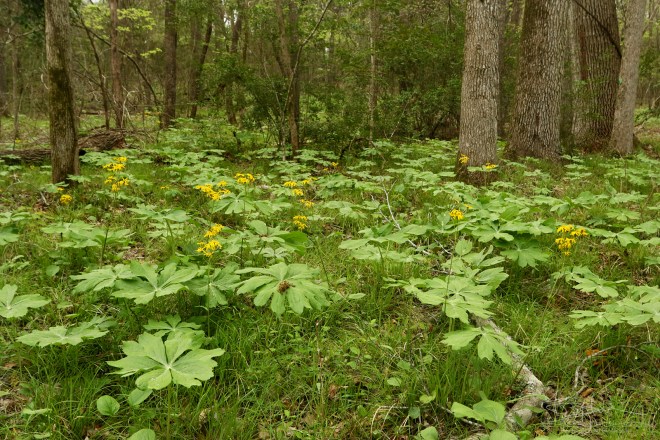
Deep in the forest we came across a gentle slope in the mesic floodplain of a small stream.  My attention was immediately captured by a sea of Mayapple (Podophyllum peltatum) leaves.  Scattered Golden Groundsel (Packera obovata) blooms rose from beneath the surface, adding a splash of yellow to the forest floor.  It was a beautiful scene for certain.

4N1A4686

Vernal Forest

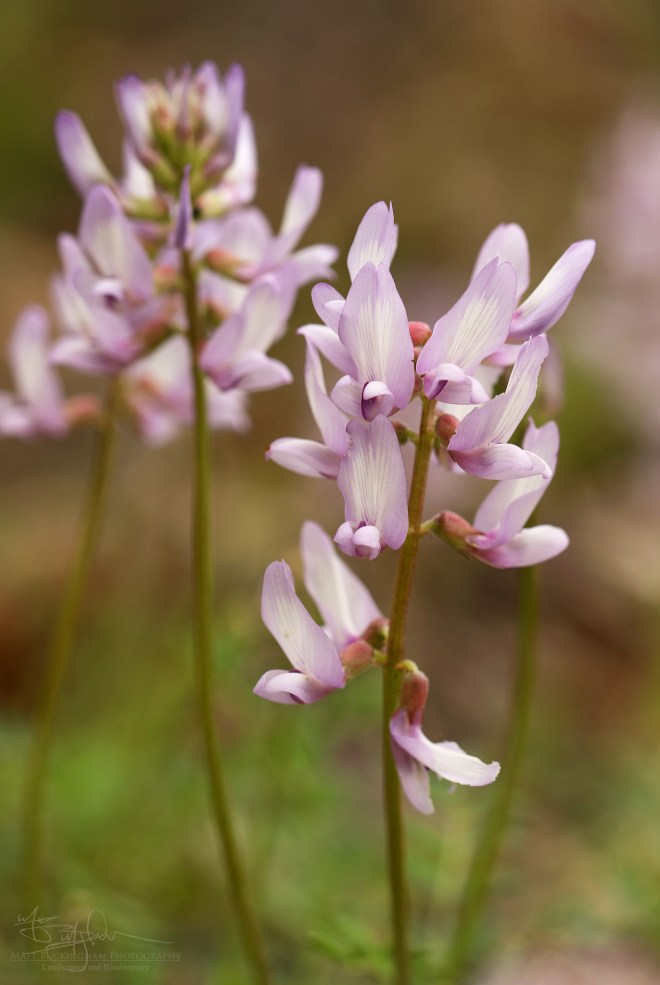
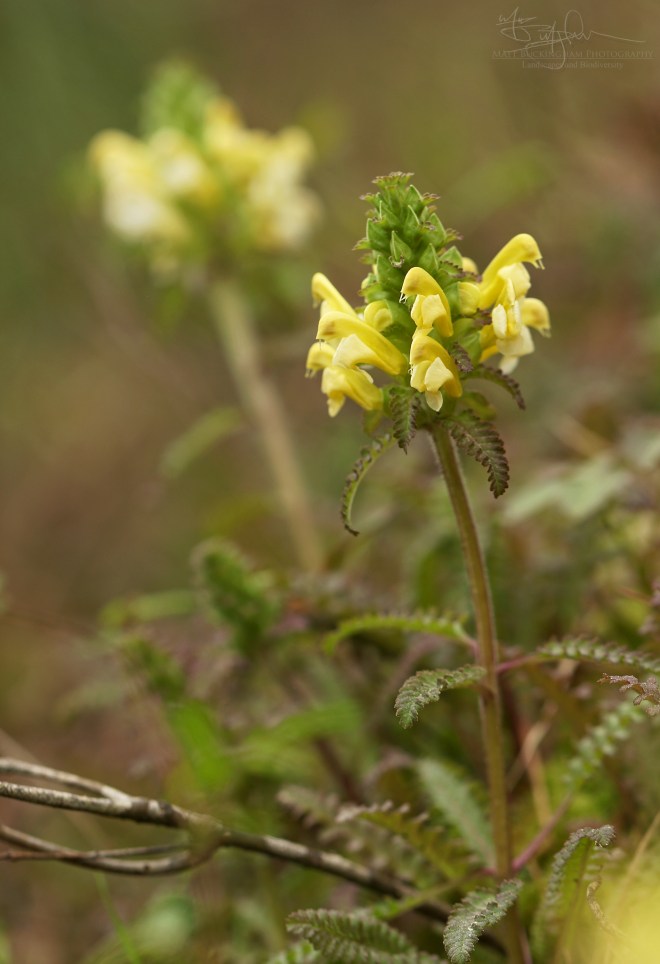
But the true treasures of this forest were revealed on closer examination.  Carolina spotted the leaves of White Trout Lily (Erythronium albidum), and Solomon’s Seal (Polygonatum biflorum), scattered low to the ground.  Both species are quite rare in Texas.  Moving further upslope, I began noticing more interesting blooms, including scattered colonies of Ozark Milkvetch (Astragalus distortus), Violet Woodsorrel (Oxalis violacea), and Lousewort (Pedicularis canadensis), also known as Wood Betony.

4N1A4779

Ozark Milkvetch

4N1A4836

Violet Woodsorrel

4N1A5009.jpg

Lousewort

On the slopes drier upper reaches I encountered a couple of species that are much more common further west, where chalky, calcium rich soils are more common.  There were several Prairie Celestials (Nemastylis geminimflora) blooming alongside Nuttall’s Death Camas, which was still in tight bud.

Though it superficially resemble a lily, and is often called the “Celestial Lily”, Nemastylis geminiflora is, in fact, a member of the Iris family.  They thrive on calcium rich soils, and as the soils of the Pineywoods are generally acidic, they are seldom encountered here.  Finding them alongside the calciphilic Toxicoscordion nuttallii, communicated to me that we were dealing with a calcareous forest, and that other interesting things were likely near.

4N1A4802.jpg

Prairie Celestial

4N1A4798

Prairie Celestial

While I was admiring some blooming thing, Caro called out that she had found what is, in my opinion, a serious contender for the most beautiful animal in the country: the Luna Moth (Actias luna).  Seeing one of these massive silkworm moths in the wild is an experience not easily forgotten, and each encounter leaves me awestruck.  This striking male had clearly just emerged from its pupa, where it overwintered hidden among the leaf litter at the base of a large shortleaf pine.

It was a male, as evidenced by its large, feathery antennae.  It was no doubt awaiting nightfall, when it would take to the air in search of a female’s pheromone trail.  The females advertise their location using these chemical cues, and males will fly all night to find them.  It seems a tragic tale, as both sexes are born without feeding mouth parts, and live only for a week or so.  Their only purpose is to find a mate so that they may parent the next generation of Luna Moths.

4N1A4913a

Luna Moth

When I had my lens trained on a different flower, Carolina called out that she had found an interesting fungus.  And she had.  I had heard that the elusive holy grail of fungi could be found in East Texas, but in nearly two decades of wandering I had never seen one.  That all changed this day.  Caro had found a Pineywoods morel.  More specifically, a Yellow Morel (Morchella esculenta).

Morels may be THE most sought after wild edible in the country.  Though common in some areas, they seem quite scarce in East Texas.  I had long dreamed of finding and photographing one, but the possibility hadn’t crossed my mind as we set out that morning.  These mushrooms are renowned for their rich flavor, and there is no way of knowing how many thousands of pounds are harvested each year.  It is said that this harvest is not harmful to the plant, as only the above ground reproductive structure of the organism is removed.  This is true in a sense, however removing them prior to the release of spores can still impact local populations.  Due to their unique beauty and scarcity in the region, I could not bring myself to pick any, and after capturing their likeness , I left them to the forest.

4N1A4939

Yellow Morel

After returning from an incredible day, Caro drafted a narrative of the mushrooms’ discovery which sums up a common interaction in such situations.  I share it here, as a tribute to one perfect spring day.

Loving the idea of helping him because it means he needs me I always keep my eyes wide open to any opportunity. I have good sight, but those were hard to recognize because they look similar to the leaves on the ground. Suddenly, I could recognize them; they were those fungi that he loves. I start to talk to him, well, interrupting him from the shooting. Like any other husband in this world, he starts to sound interrupted and makes noises right before the question: what is it?! After, breaking the special connection man-plant I could explain myself, but still wife-annoyed and mumbling secret words to the universe he knelt and asked again: what is it? But this time with a resigning attitude and makes an effort to not rise the voice, so I couldn’t detect the obvious and by using husband-diplomacy; he said “what?”. It took me a moment to make him understand what I was talking about and even longer to show the respective subjects. Then, he jumped and started to claim this species was something he always wanted to see and take photos, so the mystic connection moment restarted again.
4N1A4978a.jpg

Yellow Morels

Spring in the Desert Part 2: The Super Bloom

4N1A3087.jpg

Texas Rainbow Cactus

In the absence of rain, this place may seem some endless sea of stone, only occasionally broken by scattered shrubs, cacti, or other thorny things.  In the hottest and driest of times it is easy to think that life shuns this place.  But such thoughts could not be farther from the truth.  The Chihuahuan Desert in the Big Bend region is one of the most biodiverse arid places on the planet.  Perhaps there is no better time to witness this biodiversity than early spring following a wet fall and winter.  Fueled by life-bringing moisture, countless billions of seeds germinate and send up a staggering array of flowers from the parched soil.  Perennial species, including cactus, also react to the increased moisture by concentrating energy into blooming en masse, painting the desert in a rainbow of colors, and shattering its stereotype as a barren wasteland.

After an incredible day exploring Black Gap, Caro and I set out early to Big Bend National Park in order to avoid the spring break crowds.  We arrived at the Panther Junction visitor center right as it opened so that we could explore the book store and refill some of our water bottles.  Within 30 minutes, the place was overrun with a variety of characters, all from different walks of life, seeking different experiences, yet united in their admiration for this incredible place.

Wanting to avoid the bulk of the crowds, we opted to explore some remote 4X4 roads, which would offer ample opportunities to explore a variety of habitats.  It was a good choice, and aside from a few vehicles before lunch, we had countless acres of wilderness to ourselves.

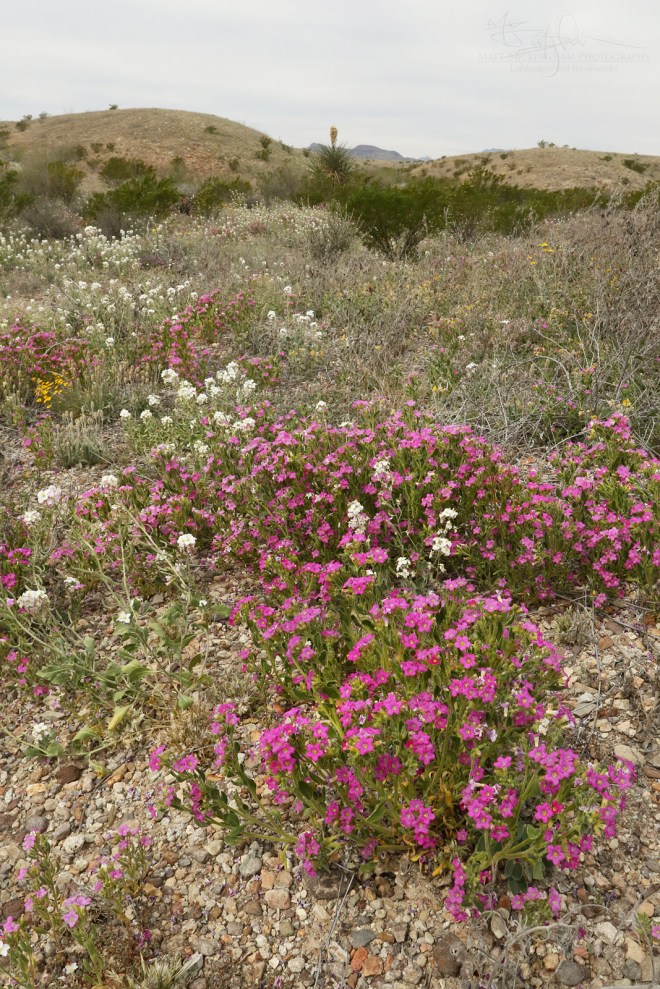
As the day began, we stopped to admire an explosive bloom of Bicolored Mustered (Nerisyrenia camporum) in the dry bed of Tornillo Creek.  The blooms are strongly fragrant and filled the spring air with their sweet aroma.

4N1A2848.jpg

Nerisyrenia camporum Super Bloom

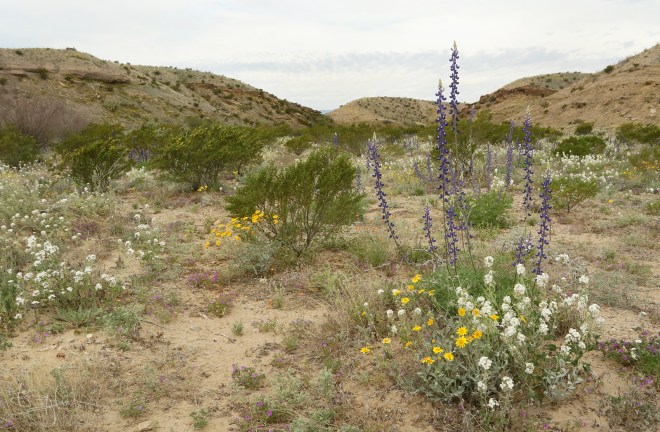
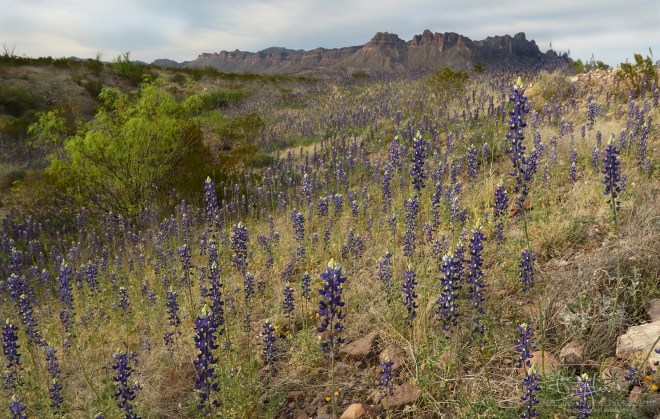
In areas adjacent to the creek we found the mustard blooming alongside some towering Big Bend Bluebonnets (Lupinus havardii) and a variety of other wildflowers, offering a varied sampling of the palette that the desert was soon to provide.

4N1A2877

Spring in the Desert

We had seen our fair share of Big Bend Bluebonnets in Black Gap, but Big Bend provided a whole new perspective to this striking plant.  The sky was overcast all day, providing a soft light that made landscape photography a challenge, but provided excellent opportunities to capture intimate portraits of many of the incredible wildflowers that we encountered.  Some of the bluebonnets we encountered were approaching four feet in height, and sported racemes bearing dozens of flowers.

4N1A2999

Big Bend Bluebonnet

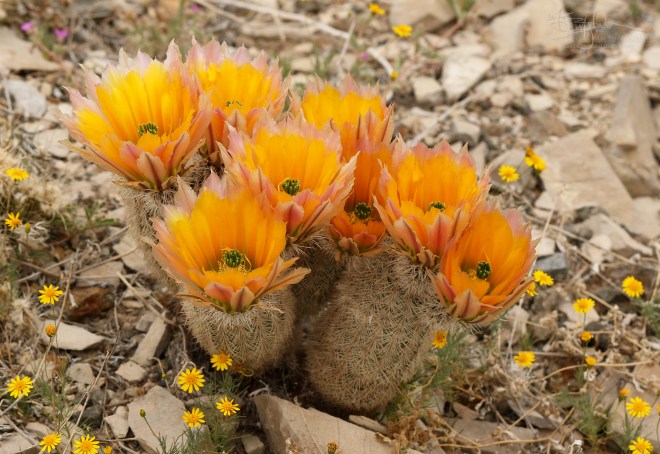
While passing adjacent to a series of gypsic hills, Carolina shouted for me to stop.  This is usually a good thing, and means that she has spotted something interesting.  And indeed she had.  She pointed to bright yellow spot on a hillside hundreds of meters away.  How she spots these things, I’ll never know.  Moving closer to investigate, it soon became evident that it was a healthy Texas Rainbow Cactus (Echinocereus dasyacanthus).  This is a species that I included in my list of biodiversity goals.  I have seen the plant many times, but had never experienced the splendor of its blooms.  I was concerned that we were too early, but I was very wrong.  We would find many plants in full, glorious bloom in the lower elevations of the park.

4N1A3111.jpg

Texas Rainbow Cactus

I had always presumed these cacti had a preference for limestone, but we saw them in a variety of substrates throughout the day.  They have some of the most striking blooms of any cactus.  They are generally lemon yellow with green throats, and may approach 4 inches across.

4N1A3108

Texas Rainbow Cactus

Interestingly, their common name is not derived from their stunning flowers, but rather the rusty-colored bands decorating their stems.  Seeing many old, multi-stemmed individuals in such a remote setting was certainly one of the highlights of the trip.

4N1A3117.jpg

Texas Rainbow Cactus

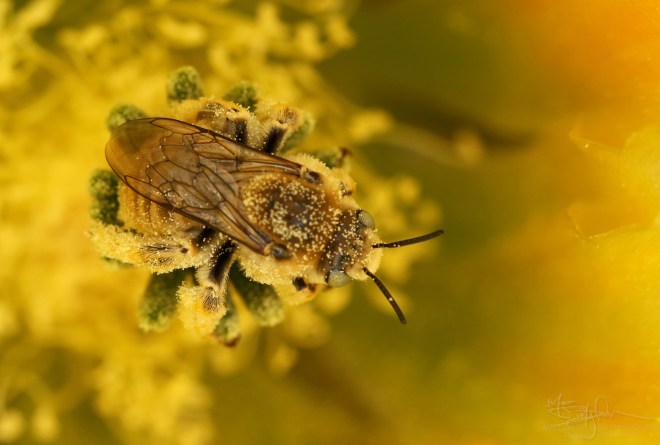
A few of the plants contained Cactus Bees (Diadasia sp.) feeding on nectar from deep within the blooms.  The bees’ hairy exoskeleton served as the perfect vessel for trapping pollen, ensuring that the insects would play their part in propagating future generations of Texas Rainbow Cactus.

4N1A2893

Cactus Bee

There were other species of cactus in bloom as well.  Perhaps the most conspicuous were the large colonies of Purple Prickly Pears (Opuntia azurea), which were just coming into flower.  The blooms of most cactus species open in late morning or early afternoon, and close by late afternoon.  It was a wonderful thing to see these prickly pear flowers open to reveal their bright red centers to the world.

4N1A3023

Purple Prickly Pear

While it was easy to get lost in the grandeur of endless expanses of blooming wildflowers, pausing to admire more subtle, intimate scenes proved just as rewarding.  I photographed the Edward’s Hole-in-the-Sand Plant (Nicolletia edwardsii) and Sand Bells (Nama hispidum) just after the latter’s flowers opened for the day.

4N1A3043.jpg

Edward’s Hole-in-the-Sand plant and Sand Bells

The combination of wildflowers was endless.  Below Pope’s Phacelia (Phacelia popei) can be seen blooming alongside Bicolored Mustard along an ephemeral drainage.

4N1A3152.jpg

Pope’s Phacelia and Bicolored Mustard bloom along an ephemeral drainage.

The kaleidoscope of colors continued in this rocky wash, where I spotted several nice clumps of Havard’s Fiddleleaf (Nama havardii), known in the United States only from the Big Bend region.

4N1A3160

Havard’s Fiddleleaf and Bicolored Mustard bloom in a gravelly wash.

It seemed like around every bend in the road there was some new fusion of color to be discovered.  One of my favorites was the combination of the yellows of Desert Marigold (Baileya multiradiata) and the purples of Nama hispidum blooming among scattered Ocotillo and Creosote Bush.

4N1A3169

Baileya multiradiata and Nama hispidum bloom in profusion.

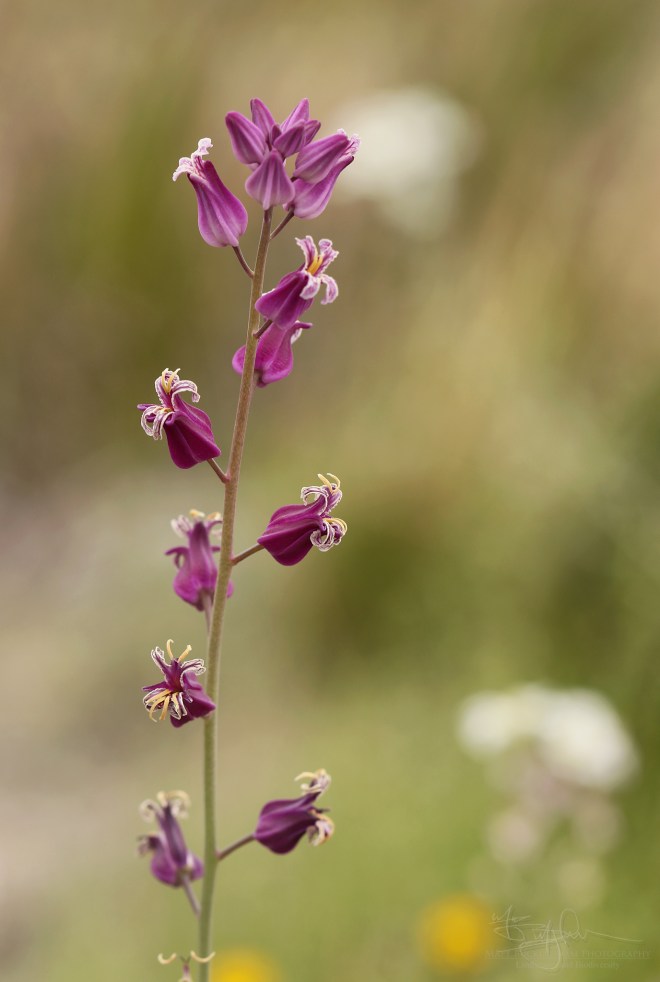
Deep in the interior of the park, we explored a series of limestone ridges and shale slopes on hills rising from the Rio Grande.  Here we found many interesting, uncommon species like the Lyreleaf Jewelflower (Streptanthus carinatus).  This denizen of the desert southwest bares purplish blooms in Texas, but they are primarily white and yellow as one moves further west in their range.

4N1A3208a.jpg

Lyreleaf Jewelflower

We found several Candelilla (Euphorbia antisyphilitica) plants growing in the same general area.  This interesting succulent has a long history of use by human cultures.  As the specific epithet suggests, it was long used to treat sexually-transmitted diseases.  It has also been extensively harvested for a wax produced from its leaves.  This wax has been used for a variety of applications, including use as a food additive for glazing agents, as an ingredient in lip balm, and perhaps most famously as a binder for chewing gum.

4N1A3218

Candelilla

On one of the limestone slopes Caro spotted a beautiful Texas Rainbow Cactus that sported bright orange flowers as opposed to the more typical lemon colored blooms.  We saw a few of this color, and even a few with a pinkish tinge.

4N1A3232.jpg

Texas Rainbow Cactus

4N1A3245.jpg

Texas Rainbow Cactus

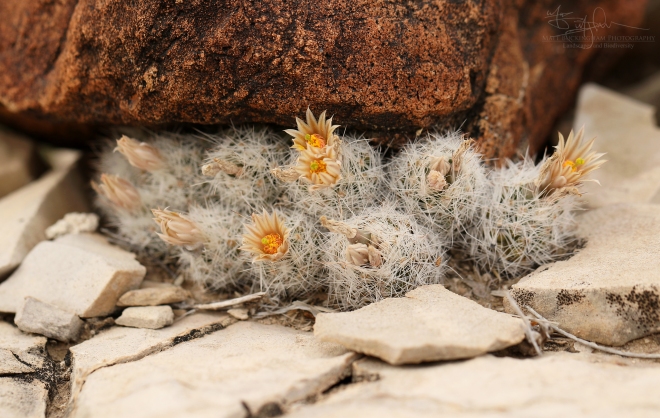
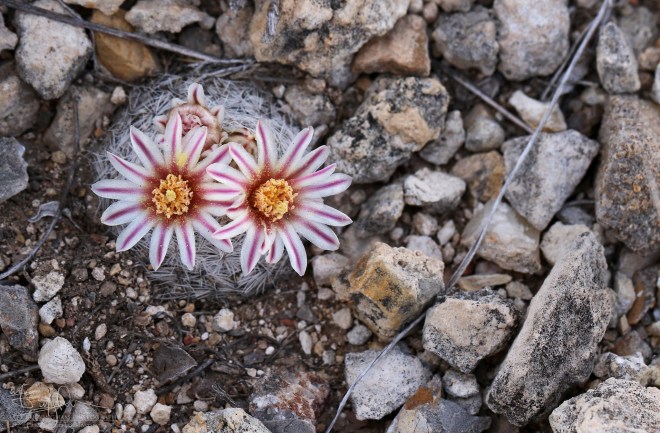
Caro’s sharp eyes also spotted the diminutive Duncan’s Foxtail Cactus (Escobaria duncanii), a rare cactus is primarily confined to a very narrow range near the Rio Grande in Big Bend and adjacent Mexico, though there is an isolated population in New Mexico.  This cryptic cactus grows from fissures and crevices in the limestone and is one of the first cacti to bloom in spring.  By our visit in early March, many of the blooms were already spent.

4N1A3279.jpg

Duncan’s Foxtail Cactus

4N1A3294.jpg

Duncan’s Foxtail Cactus

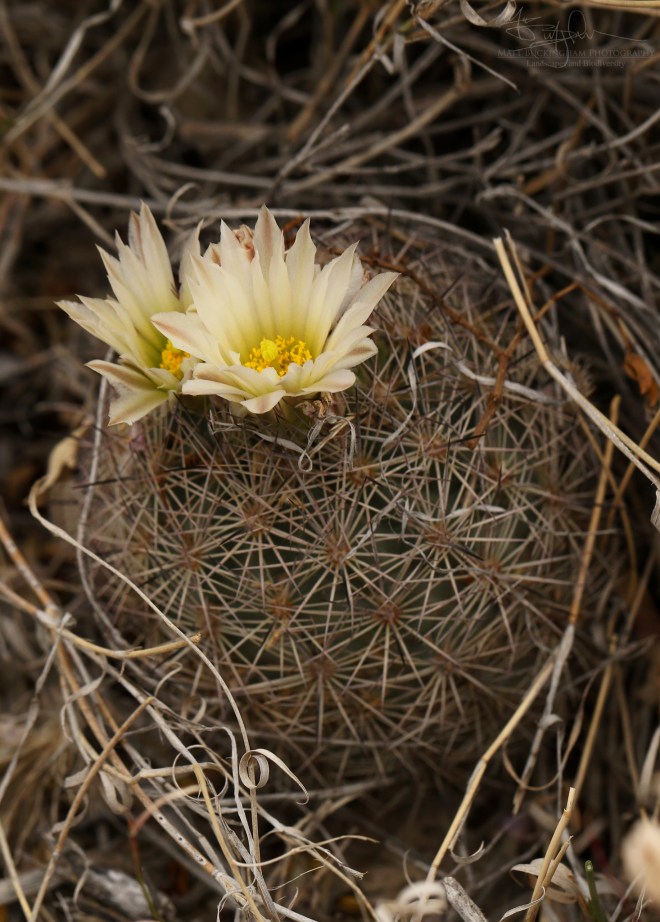
Another cactus I had really hoped to see was Warnock’s Pineapple Cactus (Echinomastus warnockii), named for the famous botanist and pioneer of the flora of the Trans-Pecos, Barton Warnock.  We actually saw several with closed blooms in the early afternoon, however this species opens later than most and we couldn’t wait around.  Fortunately Caro spotted one growing in a clump of dried grass on one of the limestone slopes a couple hours later.  Like many cacti of the region, E. warnockii is known only from West Texas and adjacent Mexico.

4N1A3329.jpg

Warnock’s Pineapple Cactus

Those limestone hills were full of a diversity of cactus!  Caro spotted another rare, early-blooming species, the Silver-Lace Cob Cactus (Escobaria albicolumnaria).  Consider by some to be a variety of Escobaria sneedii.  When investigating the cacti of Texas, one notices a pattern: many species are confined only to the Big Bend region.  In fact, this (relatively) small area in West Texas has the highest diversity of Texas in the United States.  E. albicolumnaria is another early bloomer, and sports pink flowers that never open fully.

4N1A3356.jpg

Silver-Lace Cob Cactus

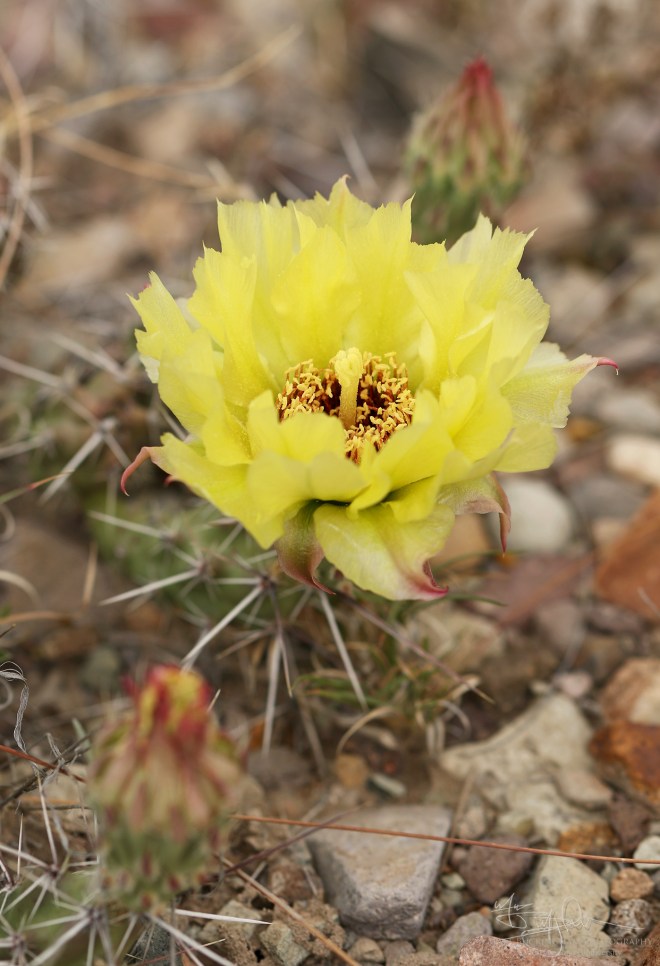
Throughout the day we had seen several clumps of Big Bend Prickly Pear (Grusonia aggeria), another species whose U.S. range is confined to far West Texas.  A type of “dog cholla”, this cactus sports very sharp, strong spines that can become the bane of any desert wanderer.  Fortunately the bright yellow blooms make up for their pricklier side.

4N1A3383.jpg

Big Bend Prickly Pear

As the day neared its end we found some clumps of Purple Prickly Pear loaded with blooms and developing buds.  Their beauty combined with that of a carpet of composites and Nama, and the Chisos Mountains as a backdrop created a dramatic scene that I felt privileged to witness.

4N1A3452.jpg

Desert Abloom

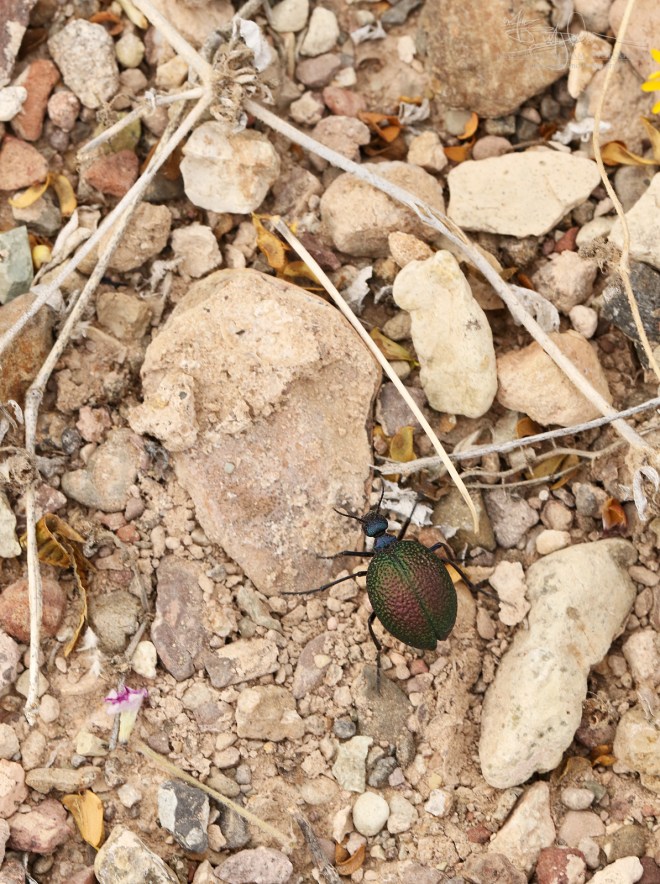
Throughout the day we saw several blister beetles (Cysteodemus wislizeni) scurrying across the desert floor.  These chunky, iridescent beetles are flightless, and their elytra (outer wings) are partially fused.  They were constantly in motion, providing a challenge to photography, but it was a challenge I welcomed as I chased after them, camera in hand, uttering colorful phrases in my frustration.

4N1A3486.jpg

Cysteodemus wislizeni

4N1A3058.jpg

Cysteodemus wislizeni

While I was busily tending to the beetles, Caro came rushing over to me with her hands cupped one over the other.  What she revealed was a large grasshopper, which I believe to be a female Toad Lubber (Phrynotettix robustus).  I placed it adjacent to a few plants of the diminutive Matted Fiddleleaf (Nama torynophyllum).

4N1A3507.jpg

A Glimpse of the Desert Floor

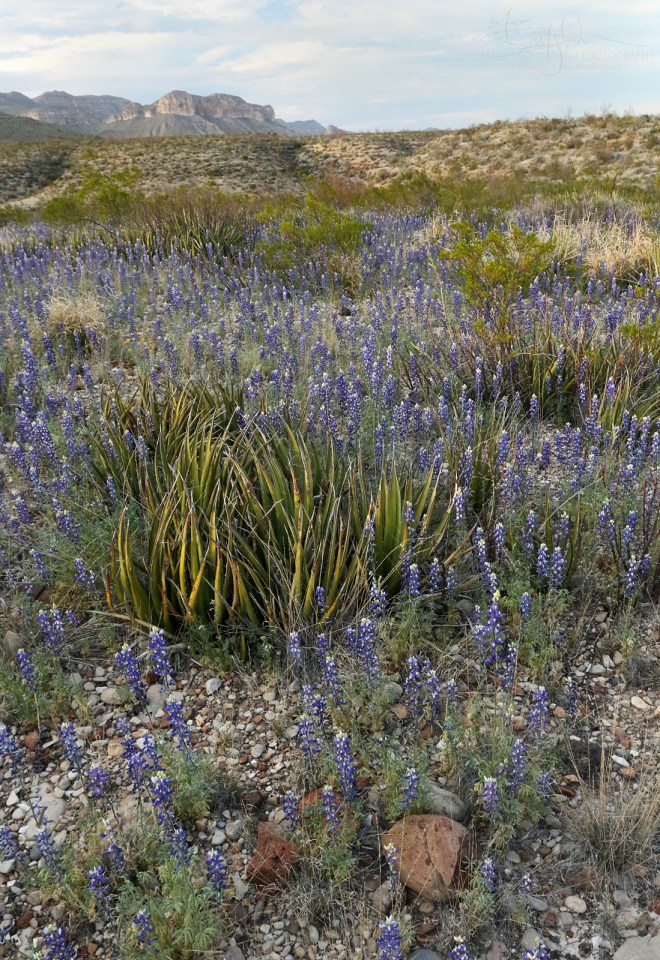
As afternoon turned to evening we once again found ourselves among the overwhelming beauty of vast expanses of Big Bend Bluebonnet.  For the briefest of moments the sun broke through the wall of clouds, and illuminated the bluebonnet laden slopes and distant Chisos Mountains.

4N1A3591a.jpg

Land of the Blue

As the light began to fade I thought back on one of the most incredible days I had spent in the desert.  Just as I was expecting photography to wind down, I caught a flash of pink in a sandy desert wash.  It was a species that I had very much hoped to find: Havard’s Ipomopsis (Ipomopsis havardii), another generally uncommon species unique to the region.  I quickly went about photographing it, as daylight was fading fast.

4N1A3649.jpg

Havard’s Ipomopsis

Though they are small, the colorful blooms are among the most interesting that I have seen.

4N1A3673.jpg

Havard’s Ipompsis

As I finished photographing the Havard’s Ipompsis, the light faded fast.  We spent last light driving through an expanse of volcanic tough that looked like some alien landscape.  As darkness set in we still had 10 miles until we would reach pavement.  It was an eerie feeling driving through some of that terrain in total darkness.  The eeriness did not diminish after we returned to pavement.  Shortly after doing so we pulled into a parking area to stretch our legs.  Immediately after leaving the truck we heard a pair of Coyotes sounding off.  Now I have spent many evenings being serenaded by the mournful calls of “God’s Dog”, and they often deceive one into thinking they are much closer than they actually are.  But these were CLOSE.  Caro suggested that I turn on the headlights, and as I did we could see the pair just at the edge of the beam’s reach.  They trotted across the road and continued into the vast desert beyond.

The experience rounded out a most spectacular day.  I leave you with a parting shot, of a splendid Texas Rainbow Cactus in all its glory, thriving in the desert flats below the venerable Chisos Mountains.

4N1A3400.jpg

Texas Rainbow Cactus

Spring in the Desert Part 1: The Beauty of Black Gap

4N1A2650

A monolith of rock rises from the desert floor in Maravillas Canyon

My first trip to Big Bend Country was over 20 years ago, in 1997, having spent just a month as a Texan.  We went in August, and it was hot.  Hot, intimidating, and seemingly inhospitable – at least in the surface.  But despite all of this I quickly fell in love with the land.  We watched a curious Gray Fox from the balcony of our room at the Chisos Mountain Lodge.  I chased Tarantula Hawks, velvet ants, and Horse Lubbers; and I found the glittering remains of a departed Glorious Jewel Beetle.  I marveled at the significant respite from the heat that the mountains provided, and the monsoonal rains that seemed so out of place in this arid landscape.

Since that day I have returned many times, and have been rewarded with incredible discoveries and remarkable experiences.  Yet in all these years I had never visited in the spring, one of the most spectacular times to be immersed in the Chihuahuan Desert.  I have long wanted to, but have always been somewhat intimidated by the crowds.  One thing I love about Big Bend is its remoteness, and the feeling of isolation and insignificance that comes with it.  During spring break, which generally coincides with the peak wildflower bloom, the park is flooded with visitors from all around the Lonestar State and beyond.

This year, however, I could not resist.  I began seeing reports that Big Bend was experiencing one of the most spectacular Big Bend Bluebonnet (Lupinus havardii) blooms in recent memory.  After a short conversation, Carolina and I made the decision to make the trek.  I consulted my friend Michael Eason, author of Wildflowers of Texas, and resident of the region.  He recommended that we spend a day in Black Gap Wildlife Management Area.  Black Gap is just northeast of the park, and we would come to find that it sports a diversity of life and quality of scenery on par with that of the park.

Though I highly recommend exploring Black Gap, I will add a word of caution.  At just over 100,000 acres, it is huge and it is very remote.  Access to the interior is via high clearance gravel and rock roads, and there are no services and very few visitors.  Despite being at the peak time for visitation to the region, we only saw one other vehicle all day.  There is no cell phone service, and it would be easy to become stranded, so visitors should come prepared.

Fortunately our visit went smoothly.  We arrived mid afternoon to the Stillwell Store.  Stillwell’s boasts a large camping area with well-spaced sites that offer a truly isolated feel, despite the large number of spring breakers.  They say that they never fill, and will accommodate all campers by opening additional property if necessary.  While the store and showers were packed every evening, from our campsite we could barely hear another soul.  Stillwell’s is directly adjacent to Black Gap and only 8 miles from the north entrance to Big Bend National Park, and provided the perfect base for our adventures.

We quickly made camp, and ventured into Black Gap.  Bicolored Mustard lined the roads and filled the desert air with their sweet aroma.  It wasn’t long until we began seeing our first Big Bend Bluebonnets roadside.  Once in Black Gap we began exploring desert washes painted by the blooms of millions of wildflowers.  The highlights were two species endemic to the Big Bend region of Texas and adjacent Mexico: Phacelia infundibuliformis and Streptanthus cutleri.

4N1A1933.jpg

Phacelia infundibuliformis

4N1A1955

Streptanthus cutleri

There were many more blooms to be seen, but it was growing dark.  We returned to the truck and continued on to the river.  I had to drive slow, as Collared Peccaries and Mule Deer crossed the road before us, and our headlights reflected in the eyes of countless Common Poorwills sitting in the roadway.

Tired from a long day, we returned to camp where we took advantage of the Stillwell Store’s showers and I boiled hot dogs for dinner.  As I was cleaning after dinner I heard Caro call out to me.  I knew from the sense of urgency in her tone that she had found something interesting, and she had!  In the light of her flashlight I could see a kangaroo rat casually foraging on the desert floor.  It was not concerned in the least as I approached with my camera.  Unfortunately just after I captured this image it made its way beneath a massive Tasajillo, so close but out of reach of my lens.

I believe it to be a Merriam’s Kangaroo Rat (Dipodomys merriami).  This species is very similar to the Ord’s Kangaroo Rat (Dipodomys ordii), and both species occur in this region.  Morphologically they are quite similar and are most easily separated by counting toes – Merriam’s have four toes on their hind feet while Ord’s have five.  I did not have the luxury of counting its toes, unfortunately, however it is also reported that the two species have slightly different habitat preferences, with Merriam’s occuring on rocky, gravelly soils and Ord’s occurring in areas of loose sand.

4N1A1988.jpg

Merriam’s Kangaroo Rat

Where there are rodents, invariably there are things that eat rodents.  This large Kansas Glossy Snake (Arizona elegans elegans) had extensive scarring on its head and appeared to be blind in one eye.  In spite of all this, it seemed very healthy.  It would be the only live snake we would see this trip, though we found a freshly hit Western Diamondback Rattlesnake and Western Coachwhip nearby.

4N1A2787.jpg

Kansas Glossy Snake

That night a few raindrops fell – just enough to draw the smell of earth from the desert and serenade us with a gentle pattering on the rainfly.  We woke early the next morning, and made our way into Black Gap.  We opted to spend the morning exploring along the paved FM road down to La Linda.  There is an old closed bridge across the Rio Grande there, a sign of more prosperous times when it served to transport flourite into the U.S. from mines in Coahuila.  Today the bridge is in ruins and La Linda is a ghost town.

While the evening before we had seen a few Big Bend Bluebonnets lining the roadside, today we saw them sprawling across the hillsides in a carpet of blue.  It was a sight to behold, and though I knew they could never do this view justice, I couldn’t resist taking a few pictures.

4N1A2021.jpg

Big Bend Bluebonnets in Black Gap

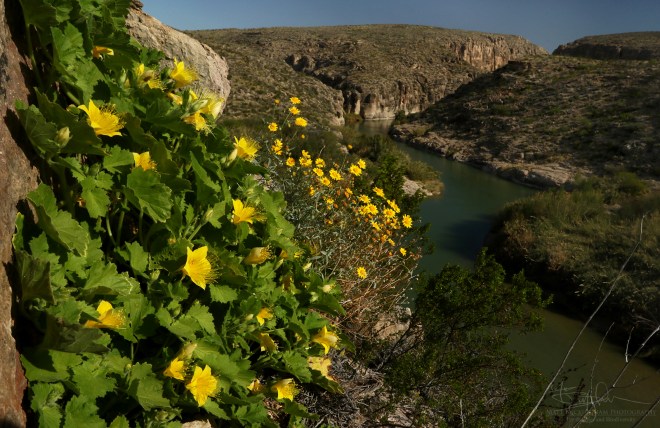
A short hike from the road provided a spectacular view of the lower canyons of the Rio Grande.  Here we found Yellow Rocknettle (Eucnide bartonioides) clinging to the cliffs above the river.  Below I watched a group of Cinnamon Teal floating lazily downstream.  Taken in by the grandeur of it all, I paused a moment to lose myself in contemplation – a pastime that I find trips to wide open places greatly enhance.

To capture the image below I had to lie precariously on my stomach on a narrow ledge and lower my camera a few feet.  I relied on the LCD screen to compose the shot.  It may not have been the golden hour for photography, but I was not willing to pass up the opportunity to capture such an incredible moment in time.

4N1A2093a

Yellow Rocknettle blooms above the Lower Canyons of the Rio Grande.

The Yellow Rocknettle was incredible!  We found several large groups blooming on sheer cliff faces.  While most were high on canyon walls, well out of reach, a few were low and safe enough to approach.  The large, showy flowers may appear virtually any time of year when there is sufficient rainfall.

4N1A2145a

Yellow Rocknettle

4N1A2184.jpg

Yellow Rocknettle

As the sun rose higher in the sky, cactus blooms began to open to the world.  We would end up finding 9 species in flower over the course of the trip.  In Black Gap, however, we only observed one species blooming – the Lacespine Nipple Cactus (Mammillaria lasiacantha).  Like the Big Bend Bluebonnet and Yellow Rocknettle, this was one of the biodiversity goals on my list when I first started this blog.  Though I was able to photograph this species sans flowers in October 2017, this was my first time seeing the spectacular, albeit miniature, blooms.

4N1A2252.jpg

Lacespine Nipple Cactus

4N1A2258

Lacespine Nipple Cactus

As late morning turned to early afternoon, a thin veil of clouds began passing in front of the sun, creating one of my favorite qualities of light.  I took the opportunity to photograph more Big Bend Bluebonnets, whose cobalt hues mirrored the sky.

4N1A2127.jpg

Big Bend Bluebonnets in Black Gap

Michael had suggested that we drive into the interior of Black Gap to experience Maravillas Canyon, and I’m glad he did.  In my opinion, the scenery here was on par with that in the National Park.  We left the pavement mid afternoon and ventured down the 4X4 road that led into the canyon.  It is 18 miles one way to the river, and though we found the road to be easily passable in my truck, it was rough.  I never put it into four-wheel drive, however high clearance was a must.

The road was lined with botanical wonders that only became more interesting and more numerous as we approached the river.  Here we found more proliferations of Big Bend Bluebonnet blooming among Lechuguilla, Candelilla, and Creosote.

As the sun vanished down behind the distant canyon walls, we made the long trek back to the pavement in the dark.  It was a somewhat eerie feeling being out in the night in the middle of so much nothingness, but I welcomed it.  It may seem counter intuitive, but I never feel more alive than those times when I’m reminded just how fragile and insignificant my life is, in the grand scheme of things.

4N1A2724.jpg

Big Bend Bluebonnets and Lechuguilla

4N1A2755

Big Bend Bluebonnets and Candelilla with Maravillas Canyon in the background

4N1A2716

Big Bend Bluebonnets and other desert flora in Maravillas Canyon

Exploring Black Gap was an experience I will never forget, and one I hope to repeat.  It really is the perfect playground for one who loves biodiversity, dramatic landscapes and solitude.  That night we arrived to our campsite late and completely drained, but we took in the moonless night sky where the brilliance of countless stars cast shadows across the desert floor.  It was another in a long list of humbling experience that the day offered.  The next morning we would venture into the park to experience a wildflower bloom, the abundance and diversity of which hardly seemed possible in such an unforgiving landscape.

Spring in the Desert: Prologue

4N1A3591a.jpg

Lupinus havardii blooms in profusion in the low desert of Big Bend National Park, with the Chisos Mountains looming in the background

Over the next several days I’ll be posting a series of accounts from a spur the moment trip that Carolina and I took to the Big Bend region of Texas.  This year the area is experiencing a phenomenal wildflower bloom thanks to ample rain that fell in the fall and winter.  It is a trip that I have wanted to make for a long time, and the experience was truly incredible.  During our trip I was able to locate and photograph the following biodiversity targets:

Texas Rainbow Cactus (Echinocereus dasyacanthus)

Warnock’s Fishook Cactus (Echinomastus warnockii)

Yellow Rocknettle (Eucnide bartonioides)

Big Bend Bluebonnet (Lupinus havardii)

These species and many others will be presented in three chapters:

The Beauty of Black Gap

The Super Bloom

The Marathon Basin

I look forward to sharing our finds, experiences, and of course my photographs of a very special spring in this important, biodiverse region.

An Encounter with a Vanishing Prairie Icon

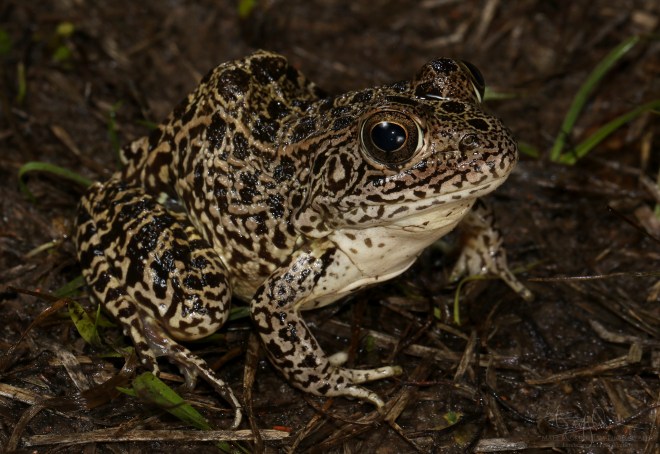
Target Species: Crawfish Frog (Rana areolata)

4N1A0838a

Crawfish Frog

When General Manuel de Mier y Teran crossed the Pineywoods, East Texas was a patchwork of habitats.  Pine-dominated forests were largely restricted to upland ridges, while gentle slopes and stream floodplains were dominated by hardwoods.  And situated within this matrix of woodlands, where soil conditions and disturbance regimes were just right, existed prairie patches that supported plants and animals typical of the great tallgrass prairies that extended from the Texas coasts into southern Canada.

Less than hundred years after Teran’s famous expedition, the Pineywoods would be forever changed – scarred by the saw, and later the steam engine and the dozer.  Virtually all of the magnificent virgin forests were cut.  Pockets of prairie were converted to pasture and agriculture, or developed for human habitation.  As their habitat disappeared, so did many of the prairie obligate species that depended on them.

The conversion of prairie habitat is not unique to East Texas.  It has occurred, and continues to occur throughout the country, and many species continue to experience precipitous declines as a result.  Some grassland dependent songbirds, for example, appear to have declined by over 90% in a matter of decades.  It has become evident that if drastic measures are not taken, some of these species may be lost forever.

There is a ray of hope in this story of doom and gloom, however.  Within the past few years, a prairie amphibian that had not been recorded from the heart of East Texas for decades was relocated by Toby Hibbitts and other herpetologists in a concentrated survey effort across its historic range in Texas.  The characteristic “snore” of the Crawfish Frog (Rana areolata) was once again heard in the Pineywoods.

Like the grassland songbirds, the Crawfish Frog has been experiencing sharp declines in the past several decades and is considered a species of conservation concern in most states where it occurs.  Its strongholds in Texas are in the western reaches of the coastal prairies and marshes and portions of the Post Oak Savannah and Blackland Prairies.  Hibbitts, et. al. discovered that they were still hanging on in isolated populations in the Pineywoods.

I never thought I would see one of these enigmatic prairie dwellers in the Pineywoods.  I imagined it had gone the way of the Jaguar and the Black Bear – something lost to my generation.  So when suitable conditions presented themselves this spring Carolina and I set out one misty evening with our good friends James and Erin to see if we might find one.

In all honesty my hopes weren’t all that high.  It has been a weird spring this year, with a lot of moisture and wildly fluctuating temperatures.  But within 30 miles of our house, we spotted a mottled form on the pavement in front of us.  I rushed from the car and found before me a mangled mix of frog skin and guts.  It was a roadkill Crawfish Frog.  It was a bittersweet feeling for sure.  I had seen a Pineywoods areolata, but it was dead.  Freshly dead at that, as its rear legs were still twitching.  I was at the same time disappointed and encouraged.

As I took the frog in my hands and soaked in the tranquility of the evening, I could feel my ears perk as they drew in a distant sound.  In that moment Erin turned off the engine and the night came to life.  The ratcheting call of Cajun Chorus Frogs reached me first, followed by the cackling song of Southern Leopard Frogs.  Then I heard it, fainter and more distant than the rest – the nasal snore of the Crawfish Frog.

We bagged the dead frog in order to send to Toby for his research.  I then wandered down the road, flashlight in hand.  After a while I noticed a turn for a side road heading in the direction of one of the frog choruses.  The night was very dark and a thin veil of mist hang suspended in the air.  With my light I could only see where the road began.  I turned down this road, and soon found myself walking a two track gravel pathway pushing out into what looked like a pasture.  I could not see any “No Tresspassing” signs or purple paint, and there were no lights anywhere on the horizon.  Convinced that it was not private property, I continued.  The chorus grew louder.  I scanned my flashlight in all directions.  There was a fence to my left, and to my right there were several granite pillars emerging from the fog.  It became clear that I was wandering through a graveyard.

Despite the eeriness of the situation, I felt comfortable, and continued on joined by the rest of the party.  We soon realized that the frogs were calling in a pasture beyond the fence, in a place we could not reach.  So we decided to continue down the road, but first made our way through the cemetery toward its exit.  I swept the beam of my flashlight across the ground, and to my surprise caught glimpse of a reticulated, spotted thing resting among emerging shoots of grass and prairie forbs.  It was a Crawfish Frog.  I couldn’t help but smile.  We found one.

It was a beautiful animal, and a female of decent size.  Immediately after seeing us she arched her back and inflated her mid section in order to appear larger, more threatening.  This defensive posture also presents potential predators with a more difficult-to-swallow prey item.

4N1A0816.jpg

Crawfish Frog in defensive posture

Crawfish Frogs are dependent on prairie communities, where they spend most of their lives in or around crayfish burrows.  In this part of the state they may utilize burrows of the Texas Prairie Crayfish (Fallicambarus devastator), a species endemic to a handful of counties in East Texas.  We would see many that night.  Research has shown that the frogs utilize both primary and secondary burrows.  They spend most of the year at primary burrows, while they utilize secondary burrows while migrating to and from breeding sites, and perhaps to a lesser degree while foraging during prolonged periods of rain outside the breeding season.  Crawfish Frogs breed in ephemeral wetlands formed in prairie depressions and in fishless manmade ponds located within suitable habitats.  They have a prolonged breeding period in Texas, but generally breed en masse following warm rains in early spring.

Interestingly, these frogs are able to persist in heavily grazed areas.  Presumably, it is because they are heavily dependent on the condition of the soil rather than the structure of vegetation.  It is important that the soil column and crayfish burrows remain in tact.  In areas where the soil is tilled or otherwise disturbed, the frogs quickly disappear.

4N1A0859a.jpg

Crawfish Frog

She would be the only Crawfish Frog we would see that night, though we did hear a few more choruses.  It was an incredible experience.  While encountering a seemingly thriving population in the Pineywoods certainly gives me hope, it does not change the fact that this species is on the decline and highly susceptible to the loss of our prairies.  We need to “want” to have this species around, and make a serious effort to conserve its habitat, or the story of its status in the Pineywoods fifty years from now may be a very different one.  Fortunately there seems to be a genuine interest in research and conservation of the Crawfish Frog in the Lonestar State, and I remain hopeful that when the conditions are just right on warm, rainy spring nights, future generations of East Texans will continue to hear the peculiar snore of this special prairie denizen.

Hidden Denizens of the Columbia Bottomlands

4N1A0003

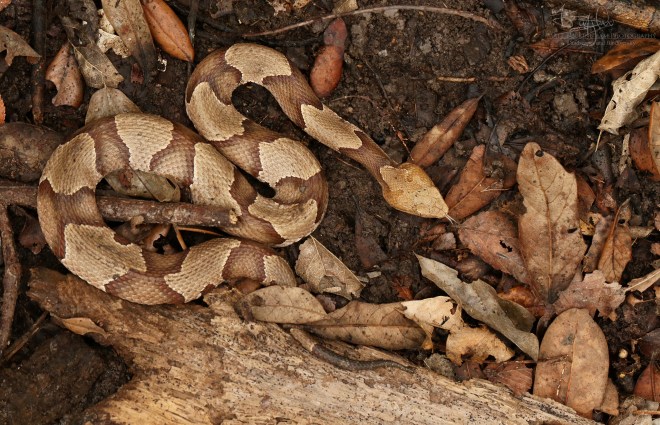
Copperhead

Austin’s Woods were vibrant.  On that gray spring day in late February, the forest came to life.  Recent rains had vitalized the Resurrection Ferns and mosses that coated the trunks and arching limbs of ancient oaks.  The Roughleaf Dogwood was beginning to bloom and fresh leaves were emerging from the swamp privet and Possumhaw in the understory.  In the distance a Gray Tree Frog called half-heartedly.  The day was warm enough to encourage snakes and lizards from their refugia, and cool and cloudy enough that the cardinals, chickadees, and other resident birds remained active throughout the day.  Beetles scoured the forest floors, yet a recent cold snap kept the mosquitoes at bay.

I put myself in the boots of Stephen F. Austin, and other early anglo explorers to the region.  Unlike most of the forested regions of Texas, much of the remaining Columbia Bottomlands is old growth, and still looks much as it did two-hundred years ago – despite the absence of Jaguars, Pumas, Red Wolves, Black Bears, Ivory-billed Woodpeckers, Carolina Parakeets, and other species that have long-since been banished by our hand.  These forests were largely spared the saw due to the poor growth form and low timber value of trees in the region combined with the difficulty of accessing many areas with logging equipment.  That is not to say that these forests are safe, however, as huge tracts are lost every year to urban sprawl and the increasing pressure for development in the greater Houston area.  Fortunately, the United States Fish and Wildlife Service, Texas Parks and Wildlife, The Nature Conservancy, and other local conservation organizations have been successful at protecting thousands of acres of habitat in the region.

4N1A0411.jpg

Columbia Bottomland Forest in the Nature Conservancy’s San Bernard Woods Preserve

The Columbia Bottomlands is so named because Stephen F. Austin established his first colony here, which would become the first “capitol” of Texas.  It was known as East Columbia.  This influential figure in Texas history also lends the region another name: Austin’s Woods.  Prior to anglo settlement these woods were home to the Karankawa and Tonkawa Peoples.

These unique forests occur in the broad interconnected floodplains of the Brazos, San Bernard, and Colorado Rivers and their many tributaries in southeast Texas.  They approach within a few miles of the coast in many areas, and are one of the few forested communities within the broader Gulf Coast Prairies and Marshes ecoregion.  Indeed, the region encompassing the Columbia Bottomlands was historically a patchwork of forested bottoms and prairie uplands.

ColumbiaBottomlands

Map of the Columbia Bottomlands.  Source: Texas Parks and Wildlife

The forest here supports a diversity of oaks, which are the primary overstory species in most areas.  Perhaps the most iconic characteristic species is the Coastal Live Oak, which can reach truly massive proportions here.  They occur alongside Water Oak, Willow Oak, Shumard Oak, and Nuttall Oak.  Burr Oak occurs sporadically.  These oaks share the overstory with Cedar Elm, American Elm, Sugarberry, and Green Ash.  In some areas stands of large Eastern Redcedar can be found, growing in areas much wetter than their typical preferred habitat.  The understory is typically open, influenced by the presence of standing water and saturated soils through much of the year.  In some areas dense layers of dwarf palmetto form nearly impenetrable thickets, and there are curious trunked palms present in isolated patches.  Historic accounts indicate that vast “canebrakes” or Giant Cane thickets were once present.  These conditions combine to create a primeval forest that appears out of place among the surrounding prairies.

4N1A0383

Columbia Bottomland Forest in the Nature Conservancy’s San Bernard Woods Preserve

It was my good fortune to spend a wonderful spring day in those woods with my good friend John Williams.  We spent the day exploring various units of the San Bernard National Wildlife Refuge, and the Nature Conservancy’s San Bernard Woods Preserve, which was accessed with permission.  That day we were fortunate, and observed many of the forest’s seldom seen inhabitants, including twenty snakes.

A mere few minutes into our adventure we encountered three Southern Copperheads (Agkistrodon contortrix contortrix).  These would prove to be the most commonly encountered species of the trip, and we found nine before the day was over.  The animals here are variable, and seem to show some influence from the Broad-banded Copperhead (Agkistrodon controtrix laticinctus), which occurs further south and west.

4N1A0030.jpg

Southern Copperhead

While wandering through chest-high palmettos, John spotted a Gray Treefrog (Hyla versicolor) clinging to one of the fronds.  It was perhaps the prettiest individual of this species that I had ever seen.  Subtle variation in the shades of gray and lichen green combined with hints of lime green to produce a truly beautiful animal.

4N1A0081.jpg

Southern Copperhead

At one particularly productive spot we found a Texas Coral Snake (Micrurus tener).  Though its skin was dulled by an impending shed, I could not resist the opportunity to photograph this beautiful Elapid.  Though they are highly venemous, these snakes are inoffensive and extremely reluctant to bite, and envenomation from them is exceedingly rare.  They have an entertaining defense mechanism, where they slightly curl and raise their tail in order to confuse predators into thinking it is the snake’s head.  They sway it back and forth and then jerk their body from side to side, seemingly flopping about.

4N1A0157.jpg

Texas Coral Snake

In close proximity to the coral snake we found four more copperheads, four Texas Brown (Dekay’s) Snakes (Storeria dekayi texana), and four Ribbon Snakes (Thamnophis proximus).  One of the ribbon snakes was so large that we momentarily mistook it for an Eastern Garter Snake (Thamnophis sirtalis sirtalis), a snake that is quite uncommon in Texas and generally restricted to the forests and prairies of this region.

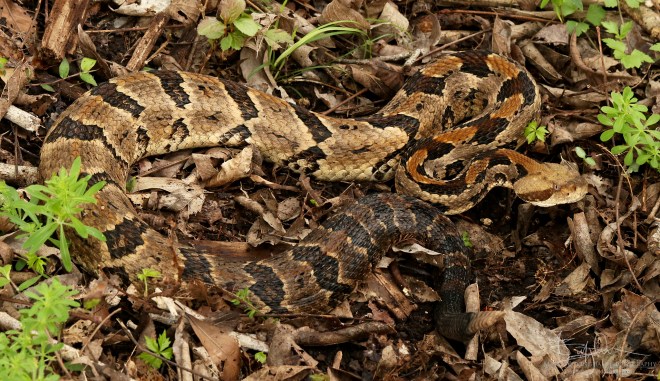
A bit deeper into the woods we encountered a most spectacular organism, and the highlight of the day.  I heard John say “Holy $#!+!”, and looked to see a large Timber (Canebrake) Rattlesnake (Crotalus horridus).  This iconic pit viper approaches the southwestern extent of their range in the Columbia Bottomlands.  The snake looked to have recently shed, and was quite literally glowing.  It was a large snake, probably around three and a half feet, and though it did rattle its displeasure at us, it was docile and non-aggressive throughout our encounter.  Spending time with these woodland snakes is truly one of the most enjoyable experience that a forest dweller like myself can experience.

4N1A0193

Timber Rattlesnake

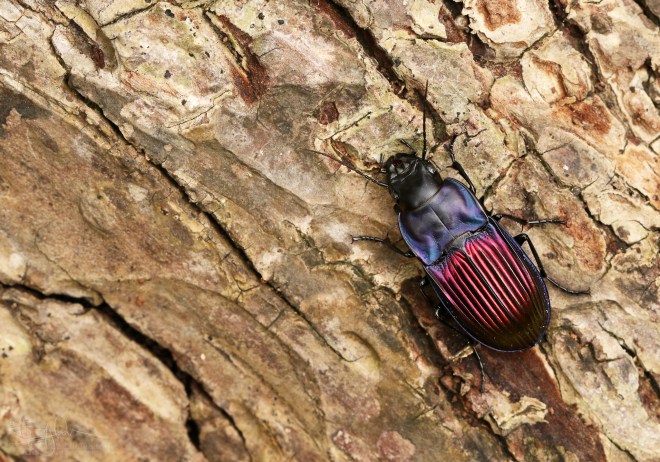
Snakes were certainly the topic of the day.  We did, however, encounter some of the forest’s smaller, more easily overlooked denizens.  Coming in a close second to the Timber Rattlesnake for the day’s highlight was Dicaelus purpuratus, a ground beetle adorned with a brilliant iridescent blue and purple exoskeleton.  Though this species has a broad range across the eastern United States, it is my experience that they are generally infrequently encountered.  In the Columbia Bottomlands, however, they are quite common and we found several that day.  D. purpuratus has large, powerful mandibles that are specially adapted for crushing the shells of small snails, their primary prey.

4N1A0319a.jpg

Dicaelus purpuratus

We ended the day in the San Bernard Woods Preserve.  This preserve protects crucial bottomland hardwood and riparian forests and serves as an important component to provide connectivity to other protected areas in the Columbia Bottomlands.  It is another of the many examples of the fine work that the Nature Conservancy in Texas does to protect our states wild places, and biodiversity.

The Columbia Bottomlands are unlike any other forested community that I’ve been to.  They provide an important link to the natural and cultural history of Texas, and will forever hold a special place in my heart.  I look forward to visiting Austin’s Woods again soon, and experience the little wonders that contained within this primeval forest.

Wintering Waterfowl in North-Central Texas

4n1a3226b

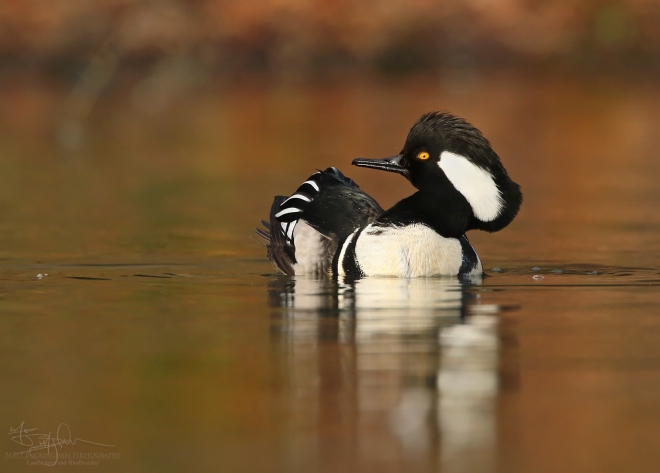
A Hooded Merganser swims through water reflecting remnant fall color in Post Oaks lining a wetland in North-Central Texas.

“Why am I doing this?” I couldn’t help but ask myself as I lay flat on my side in the muck, piles of duck feces inches from my face.  I was cold and wet, and tired – so very tired.  We woke up at 3:30 that morning and were on the road by 4, just so that we could arrive at our destination at first light.  I had come all this way and endured all this suffering for the chance to take pictures of ducks.  To many, ducks are those familiar, pesky waterbirds that harass them during a day at the park or a picnic near a pond.  To me, however, they are a diverse, fascinating group of some of the most beautiful birds on the planet with incredible life histories full of harrowing journeys, dramatic performances and tales of incredible hardship.  Yes, the world of ducks extends beyond the familiar Mallard and its domesticated descendants.  In this blog I will explore a slice of the diversity of ducks that spend the winter in North-Central Texas.

In Texas, the northern portion of the Blackland Prairies and Cross Timbers serves as an important wintering ground for a variety of waterfowl.  Wetland complexes adjacent to the Red and Trinity Rivers provide excellent habitat within a matrix of woodlands and prairies.  It is also located near the boundary of the Central and Mississippi flyways.  These factors help make the region a haven to ducks and geese that have traveled from as far as the Arctic Circle.

So this winter, I took three trips to the region in hopes of observing and photographing some of these beautiful birds.  I researched the region extensively, looking for promising locations.  We took our first trip on a grey, bitterly cold day in late December.  We would end up seeing many ducks at a few different locations, but the light was not with us.

Disappointing light aside, I did leave with a few image of one of my favorite ducks, and a species I had long wanted to photograph – the Canvasback (Aythya valiseneria).  With it’s long, broad black bill, characteristically sloping forehead, rusty head and bright white wings and flanks, the drake Canvasback is one of our most elegant ducks.  A black bib and tail help complete its dapper plumage.

There are four basic tribes of ducks: dabbling (Anatini), diving (Aythyini), sea (Mergini), and stiff-tailed (Oxyurini) ducks.  Canvasbacks are diving ducks.  Members of this tribe have legs set farther back on their bodies to aid in diving.  They feed by diving and foraging from the bottom of waterbodies.  Canvasbacks feed heavily on underwater tubers as well as snails, mollusks, and other aquatic invertebrates.  Most Canvasbacks winter in and around the Chesapeake Bay, and are generally uncommon elsewhere along the coast and inland.

4n1a2834

Drake Canvasback

4n1a2912a

Drake Canvasback

On our next trip in early January, Caro and I were up and out hours before the sun came up.  My main target for this trip was the Hooded Merganser (Lophodytes cucullatus), my favorite duck and in my opinion, one of the most beautiful birds in the country.  We arrived at our first location, a forested pond in the Cross Timbers, for the day just as the sun was cresting the horizon.  Sure enough, there we spotted a pair of mergansers along the distant shoreline.

I made my way to the water’s edge and lied in wait.  Unfortunately, the drake never warmed up to my presence, and stayed well away.  The image below is the only time he ever raised his crest, and after just a few minutes he took off and never returned.

4n1a3384ab

Drake Hooded Merganser

The hen remained, however, and eventually she and the other ducks in the pond became accustomed to my presence.  She swam in close and provided several nice looks at her understated plumage.

4n1a3530a

Hen Hooded Merganser

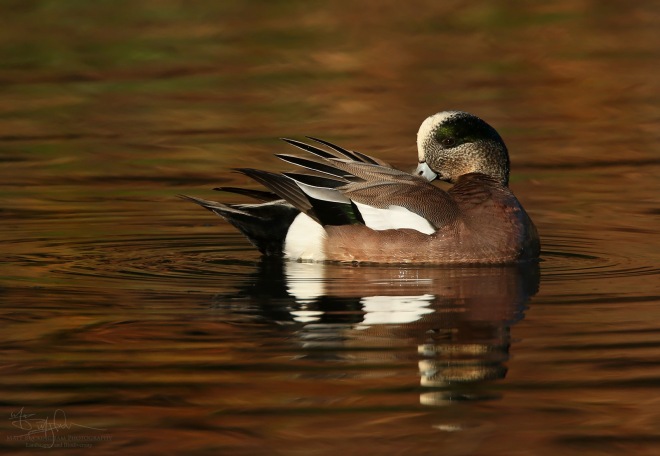
As I was admiring the merganser, a group of American Wigeon (Anas americana) flew in.  I had recently photographed these stunning ducks near Austin on Christmas Day.  Not one to pass up a good photo op, I captured the drake below mid-preen, as he showed off his wing coverts, scapulars, tertials, and just a hint of that iridescent speculum.

4n1a3494a

Drake American Wigeon

The sky was cloudless that day, and soon the sun was too high and the light too harsh for photography.  So we grabbed lunch and traveled east, to a series of prairie ponds.  Here we found a variety of ducks, including both of our Scaup species.

Scaups can be tricky to differentiate, but there are a few good characteristics to look for.  Despite bearing the descriptors “Lesser” and “Greater”, size is generally not a reliable method to differentiate species, unless they are seen together.

In general, the Lesser Scaup (Aythya affinis) is smaller, however it is more readily identified by head shape and plumage detail.  Lessers generally have a more raised forehead, often having a crest-like appearance with the point near the back of the head.  The barring on Lesser Scaup’s feathers also extend all the way down its flanks.  Other, less reliable characteristics for identification include the iridescent sheen on the head, which is generally purple in Lesser Scaups, and the black at the tip of the bill, which is generally less extensive in Lessers.

Lesser Scaups are a common winter resident on waterbodies throughout the Lonestar State.  I photographed the drake below as it swam through waters reflecting the brilliant blue skies, with the muted browns of prairie grass in the background.

4n1a3600a

Lesser Scaup

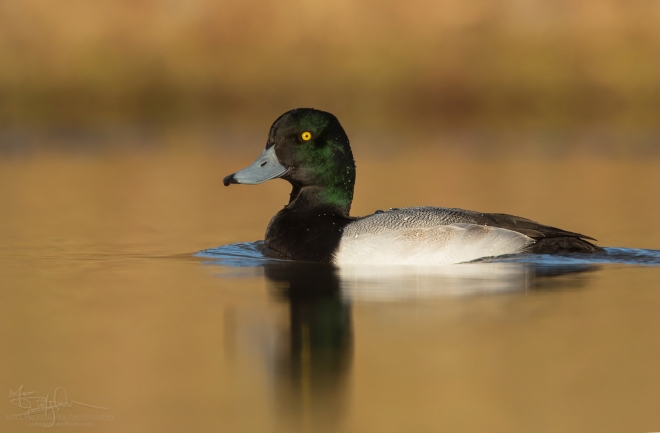
Much less common a winter visitor is the Greater Scaup (Aythya marila).  In Texas, they can be found sporadically along the coast in winter.  Inland, they are only observed with any regularity in a small area in north-central and northeast Texas.  They have journeyed here from the far north, where they breed in small ponds on the tundra and in the boreal forest.

True to their name, they are larger than Lesser Scaup, though this is only a useful diagnostic when both species are observed together.  They are more reliably differentiated by their more rounded heads, pure white flanks, broader bill with more prominent black marking at the tip, and greenish sheen to the feathers on their heads.

After spending some time among the scaups, and fruitlessly stalking a Bufflehead pair, we returned home, tired but satisfied from a long day in the field.

4n1a3971b

Greater Scaup

An alternate name for this blog post could have been “My Quest for a Hooded Merganser”.  Since I was a child I have been enamored with this peculiar yet spectacular sea duck.  They lack the brilliant colors and iridescence of other species, but their bold black, white, and chestnut patterns along with that remarkable crest that is raised during courtship rituals sets them ahead of the pack.  It also doesn’t hurt that they are one of just a few duck species to breed in forested wetlands and nest in tree cavities.

I don’t see Hooded Mergansers very often, and most sightings consist of them rapidly disappearing on the wing after having spotted me at a great distance.  Though I had captured a few images on my previous visit, I wasn’t successful in getting the image I wanted – a drake with his crest raise, displaying the full glory of his breeding plumage.  So despite already having made the 6-hour round trip just twice in as many weeks, I rose again before 4 AM, and hit the road to the Cross Timbers.  This time I was joined by my good friend and photo buddy James Childress.

We arrived before first light, to a shallow pond nestled within a Post Oak – Cedar Elm woodland.  We donned our camo and settled in, laying flat in the mud at the water’s edge.  It wasn’t long before the ducks started coming in.  And sure enough, we spotted a lone drake Hooded Merganser.  Unfortunately he was sitting at rest, eyes barely open and crest laid flat.  Much to our disappointment, he would spent most of the morning in this state.

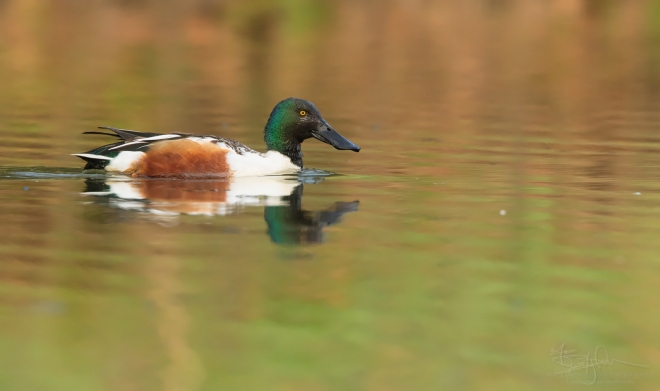
But he was not alone.  And there were plenty of other gorgeous ducks to occupy our time.  One of the most striking was the Northern Shoveler (Anas clypeata).  A few drakes passed by fairly closely in waters reflecting the browns of dried leaves and greens of evergreen vines lining the shore.

4n1a6036a

Northern Shoveler

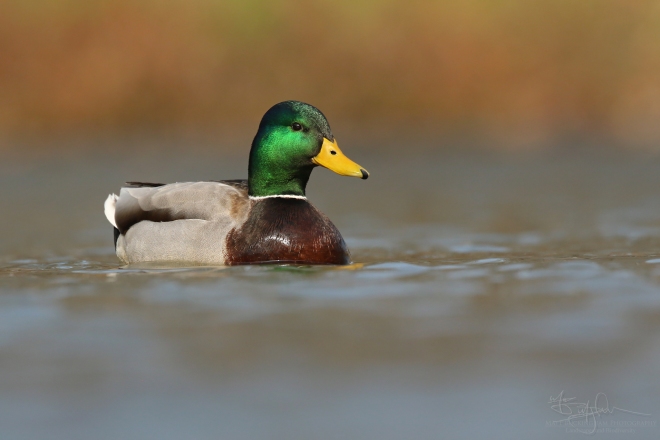
I also took this opportunity to photograph a species I had long avoided, the ever present Mallard (Anas platyrhynchos).  It’s not a lack of beauty that kept me from photographing them, as they are undeniably striking birds.  Instead, it was the prevalence of domestic ducks, descendants of Mallards bred in captivity that have since escaped, or been released, and are now naturalized throughout much of the country.  I simply have no interest in photographing feral domestic descendants, and many are virtually indistinguishable from the wild type.  There are still plenty of wild Mallards in the country, however, though there are concerns that the gene pool is being diluted by these free ranging domestics.  The birds we saw that day seemed to fit into the wild phenotype, and I was fairly confident and hopeful that the animals I photographed were from wild, naturally migrating populations, but there is really no way to be sure.

4n1a6260

Mallards

4n1a7184

Mallards

The real star of the morning however, was the American Wigeon.  Some of the beautiful drakes passed close providing us with a variety of settings in which to photograph them, each better than the last.  Wigeons are known for their bully-like behavior, and despite being much smaller than the Mallards, they chased them out of the best feeding grounds.  In some cases they act like pirates, stealing hard-earned meals from diving ducks who, unlike the wigeons, are equipped to swim to the bottom of the pond to choose the most succulent, nutrient rich aquatic plants like Wild Celery (Vallisineria americana) We enjoyed their antics and the constantly whistle like call of the drakes.

4N1A7327.jpg

American Wigeon

4n1a7349

American Wigeon

4n1a6800

American Wigeon

The sun was getting high, pushing the envelope of what I consider good light and I was beginning to worry that I would again be heading home without a decent Hooded Merganser shot.  But just as we were starting to give up hope a second drake flew in.  This caught the attention of our first male, and both became active, diving in search of prey, and actively preening.  In the same moment a wispy veil of clouds crossed the sun, creating one of my favorite qualities of light.  I captured them in some truly bizarre, yet interesting poses.

4n1a6615

Hooded Merganser

4N1A6848.jpg

Hooded Merganser

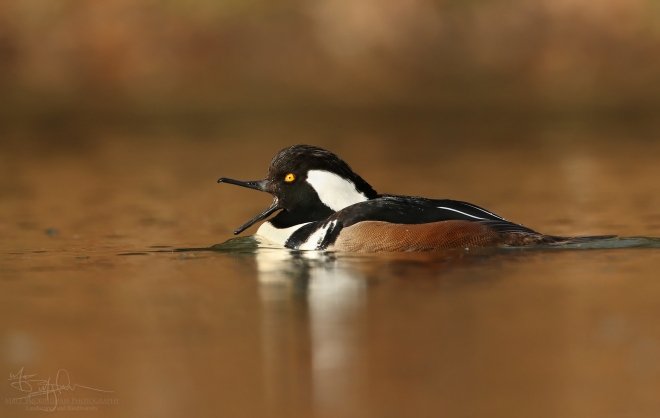
I captured one of the drakes as he yawned, showing of the narrow, serrated bill specially adapted for capturing fish, crustaceans, and small aquatic animals.  I was certainly capturing some memorable images, but I still had failed to capture a pose with the crest raised.  I missed out on two opportunities as my camera’s auto-focus failed to lock onto the subject.

4n1a7020

Hooded Merganser

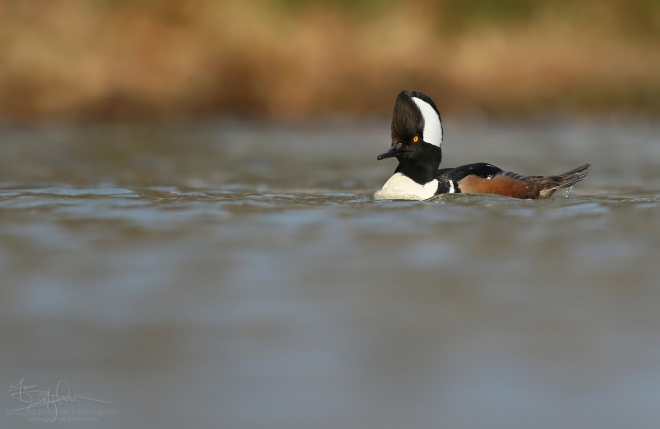
And then it happened.  After a short preening session, one of the drakes raised its crest and began to really show of its spectacular plumage.  It continued to preen and raise up to flap its wings and dry off its feathers.  I was thrilled to check off a subject that has been on my photographic bucket list for years.

4n1a7215a

Hooded Merganser

4n1a7256ab

Hooded Merganser

4N1A7260.jpg

Hooded Merganser

While one drake was putting on a show in the distance, the other passed by close, and I was able to capture the image below in still, flat water – perhaps my favorite of the trip.

4n1a6882

Hooded Merganser

“That’s why I’m doing this!” I thought to myself with a smile.  It’s easy to lose sight of the prize while suffering in the cold and wet, and while every muscle in your body is screaming from the awkward contorted position you’ve taken up to get the perfect angle on one of the ducks.  But all of the misery seems to fade away while these beautiful animals appear within range of the lens, and the suffering seems a small price to play for these images that we may enjoy and reflect on for a lifetime.  I dare say, that these moments of unpleasantness only serve to enhance the experience, and I don’t think I would be rid of them, even if I could.

Looking Back: 2018 Highlights in Biodiversity

This year I did not focus on my biodiversity list with the same gusto that I did in 2017.  That is not to say, however that I gave up on my quest for biodiversity!  Lists aside, 2018 was one of my best years yet as a biologist, naturalist, and photographer.

I did, however manage to check a few species off my list including:

Tapertip Trillium (Trillium viridescens)

Downy Yellow Violet (Viola pubescens)

Clasping Jewelflower (Streptanthus maculatus)

Eastern Beach Tiger Beetle (Habroscelimorpha dorsalis)

Ringed Salamander (Ambystoma annulatum)

Rich Mountain Salamander (Plethodon ouachitae)

These addition of these species puts me at over half of my list complete (45 of 80 species).

2018Goals

Beyond the list, this year I was able to photograph nearly 100 species that I had not previously photographed before, at least not to my current photographic standards.  In doing so I made many incredible observations, had good times in the field with family and friends, and found innovative new ways to photograph many familiar species.  It was hard to whittle down such a productive year, but I did my best to select a few highlights:

Perhaps the most exciting venture of 2018 was getting back into bird photography, thanks in part to my friend James Childress.  In January, James, his wife Erin and I found ourselves pursuing birds along the Upper Texas Coast.

IMG_9871

Blue-winged Teal

IMG_0337

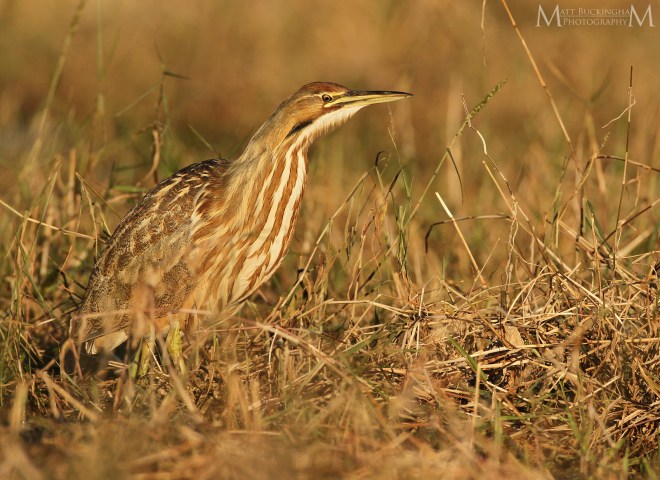
American Bittern

We also spent some time chasing after local birds.

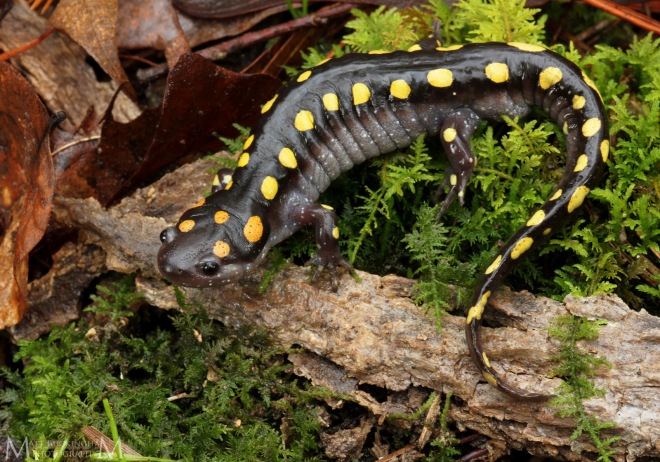
In early February, as winter began to slowly turn to spring, my friend Scott and I found this beautiful Spotted Salamander (Ambystoma maculatum).

IMG_4760a

Spotted Salamander

Many of my favorite spring ephemeral wildflowers begin to appear by mid February.  Bloodroot (Sanguinaria canadensis) may be my favorite of these fleeting beauties, and each year I try to find different ways to photograph them.

IMG_5185

Bloodroot

In March, Caro and I traveled to the Lower Rio Grande Valley with James and Erin.  During our trip James and I were able to photograph many South Texas specialties, as well as other more widespread species.

IMG_8914

Altramira Oriole

IMG_9629

Cactus Wren

IMG_7175

Reddish Egret

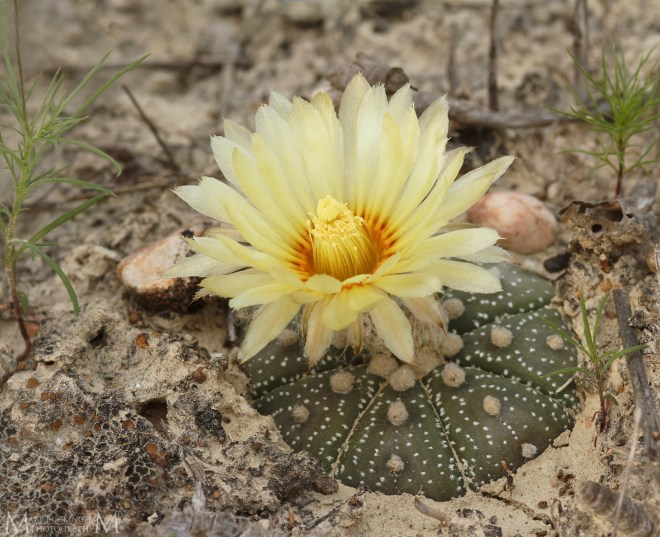
During this trip I was also able to finally see the Federally Endangered Star Cactus (Astrophytum asterias) in bloom.

IMG_0130

Star Cactus

We also had the opportunity to photograph a beautiful old Texas Tortoise (Gopherus berlandieri).

IMG_2217

Texas Tortoise

Back in East Texas, Carolina and I spent many a spring day exploring the Pineywoods.

IMG_2690

Mirkwood

We were rewarded for our efforts on many occasions, such as this group of Kentucky Lady Slippers (Cypripedium kentuckiense).

IMG_3303a

Kentucky Lady Slippers

In 2018 I made a concentrated effort to visit several of our great state’s ecoregions.  For the first time we explored the Cross Timbers and Prairies.  We found many beautiful landscapes in the Grand Prairie and Lampasas Cut Plain.

IMG_5938

Light Paints the Prairie

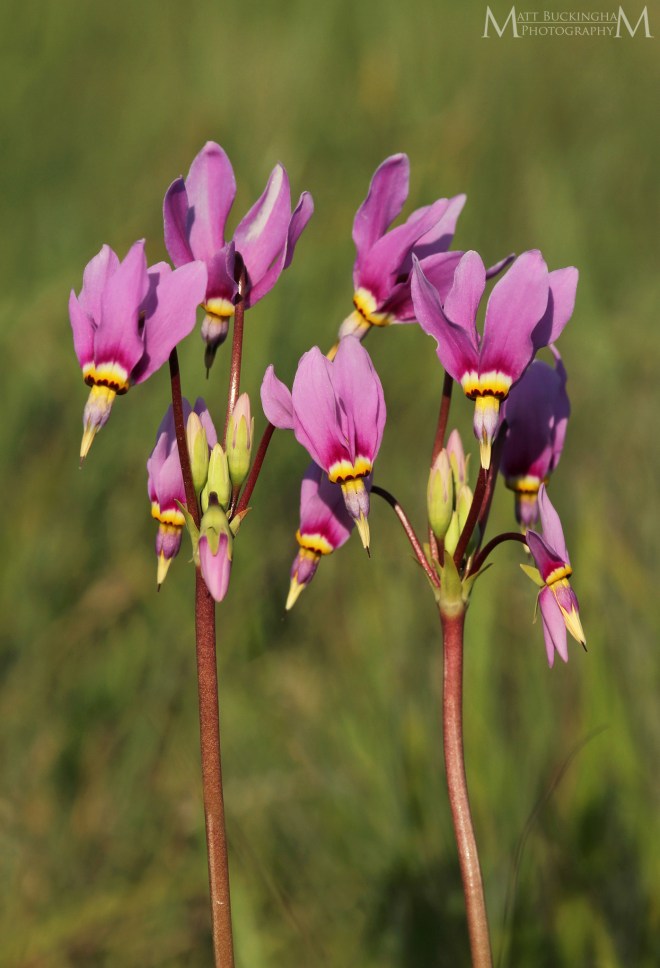
This region is home to some of the most spectacular displays of wildflowers in the country.  A highlight was finding several populations of Eastern Shooting Star (Dodecatheon meadia).

IMG_6578

We also found several large colonies of Nuttall’s Death Camas (Toxicoscordion nuttallii) on limestone ridges.

IMG_6553a

Death Comes to the Prairie

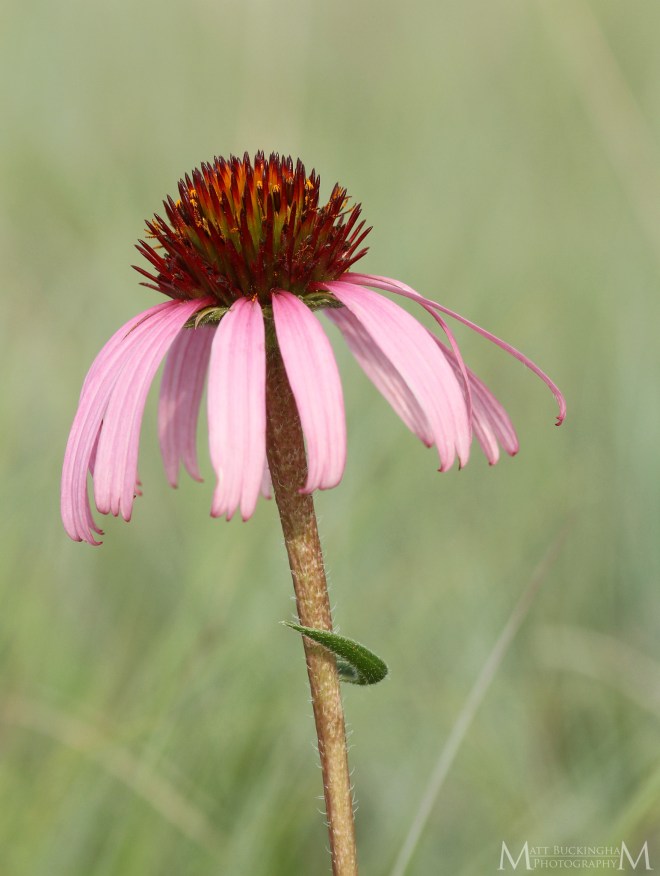
And on a later visit we found fields of Narrow-leaved Purple Coneflower (Echinacea angustifolia), a species characteristic of the Great Plains.

IMG_7409

Narrow-leaved Purple Coneflower

As the weather warmed, we found ourselves taking several trips to the Upper Texas Coast, where I spent time on my belly photographing the local bird life.

IMG_8026

American Avocets

IMG_8456

Purple Gallinule

I have been fascinated with beetles since childhood, and few are more impressive than the Ox Beetle.  The animal below is Strategus aloeus, one of two local species of Ox Beetle.

IMG_9046

Ox Beetle

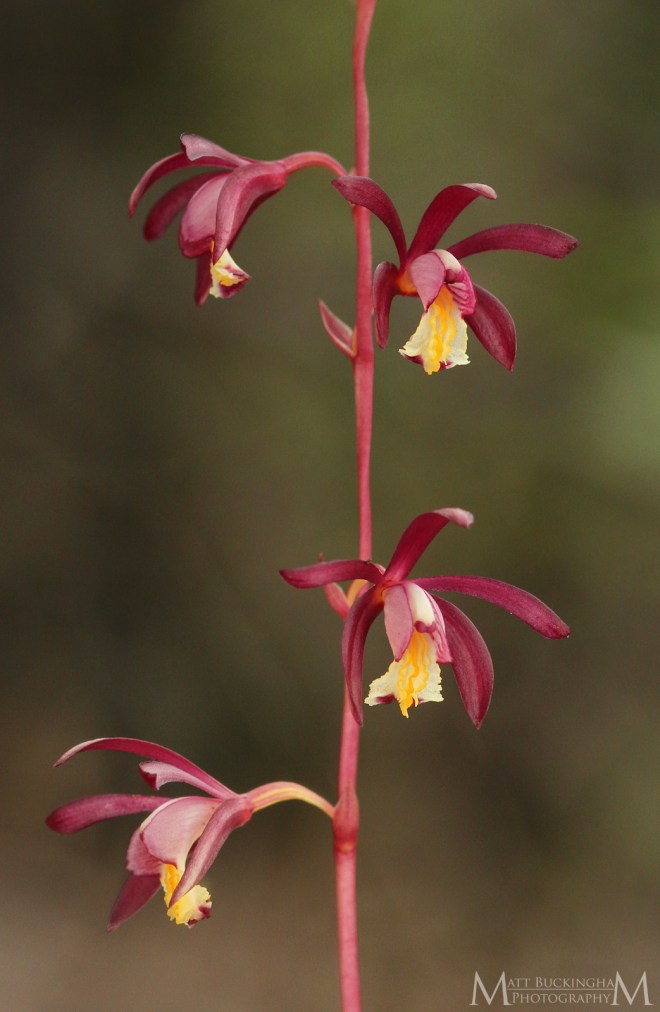
In July we met long time Flickr friends Jim Fowler and Walter to help them check a couple orchid species of their bucket list.  The species were the Texas Crested Coralroot (Hexalectris warnockii), also known as the Texas Purple Spike…

IMG_9403a

Texas Crested Coralroot

…and the Giant Coralroot (Hexalectris grandiflora), which we found deep in the Davis Mountains of West Texas.

IMG_9772

Giant Coralroot

In the semiarid grasslands at the base of the Davis Mountains I was able to photograph several Pronghorn (Antilocapra americana).

IMG_0465

Vigilant

Back in East Texas we sought out orchids, like the Crested Fringed Orchid (Platanthera cristata) pictured below.

IMG_0878

Crested Fringed Orchid

In early September I had a chance encounter on a river sandbar with a Spotted Sandpiper (Actitis macularius) in basic plumage.

IMG_3883

At the end of September, after many failed attempts over several years, I was finally able to find and photograph an adult Ringed Salamander (Ambystoma annulatum).

IMG_4107

Ringed Salamander

When I forgot my camera on a visit to James and Erin’s farm, James was kind enough to lend me his when we found this Carolina Mantis (Stagmomantis carolina) hunting Common Eastern Bumblebees (Bombus impatiens)

3J0A3034

Seconds from Disaster

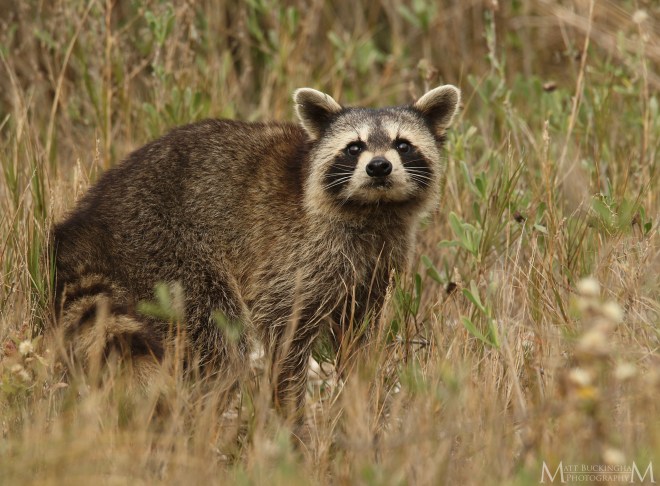
In December I was lucky enough to photograph a Northern Raccoon (Procyon lotor) on a trip to the Upper Texas Coast with Caro, James, and Erin.

4N1A0962

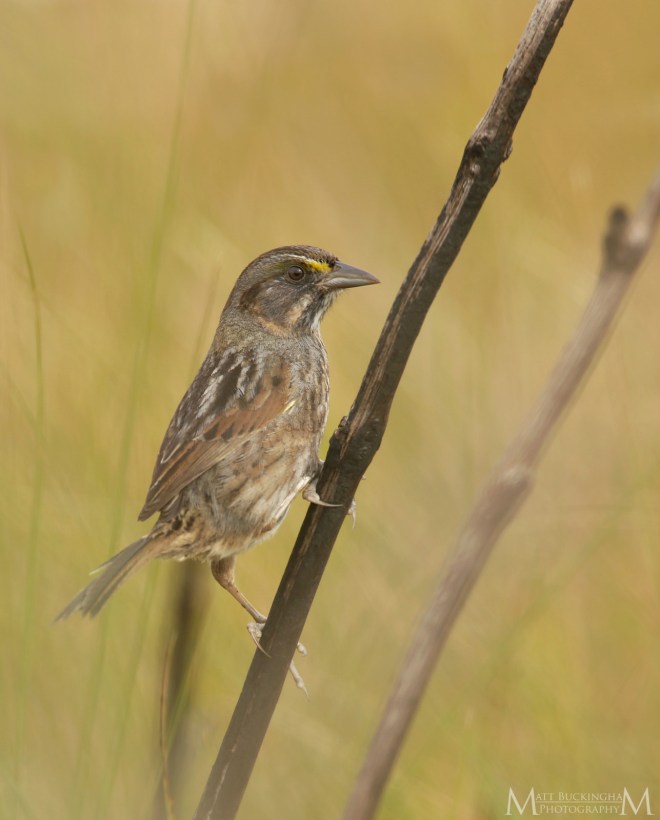
During that trip we also encountered several cooperative Seaside Sparrows (Ammodramus maritimus).

4N1A0999a

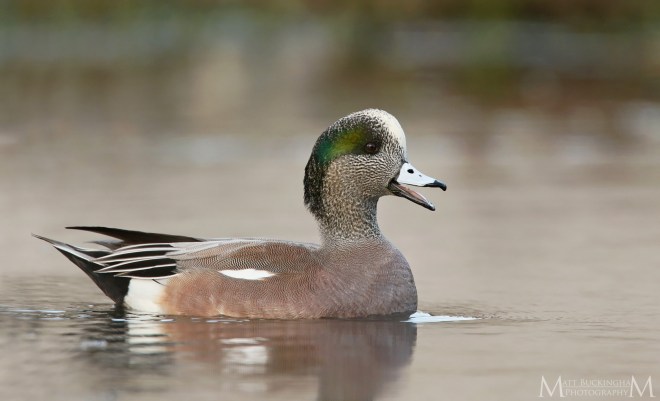
My year reached its pinnacle on Christmas Day, when I shared a pond with some American Wigeons (Anas americana).

4N1A2168ab

American Wigeon

2018 will be a hard year to top, but I intend to give it my all in 2019.  I wish all of you the best in this new year.

Autumn in the Pineywoods

IMG_7234

East Texas Waterfall

As I write this, on a cold and rainy day at the end of December, all but a handful of brave trees have cast their leaves in preparation for the darkness and cold that winter brings.  Days like this it’s easy to long for the milder days and brilliant colors of fall.  This year was a particularly beautiful autumn in the Pineywoods, with many species putting on displays of color that I had not seen for some time.  To fight off the gloom of this winter’s day, I decided to live vicariously through my memories as I chronicle my autumn explorations here.

We’ll start on my birthday.  At the start of October, the days have become shorter and the temperatures begin to cool.  October has always been one of my favorite months here in Texas.  The colors begin to turn, and the climate is mild.  Cool enough that it is pleasant to be outside, yet warm enough that many winter-adverse species such as reptiles and insects are still active.  A number of interesting fall-blooming plants are also on display in this month of the Hunter’s Moon.

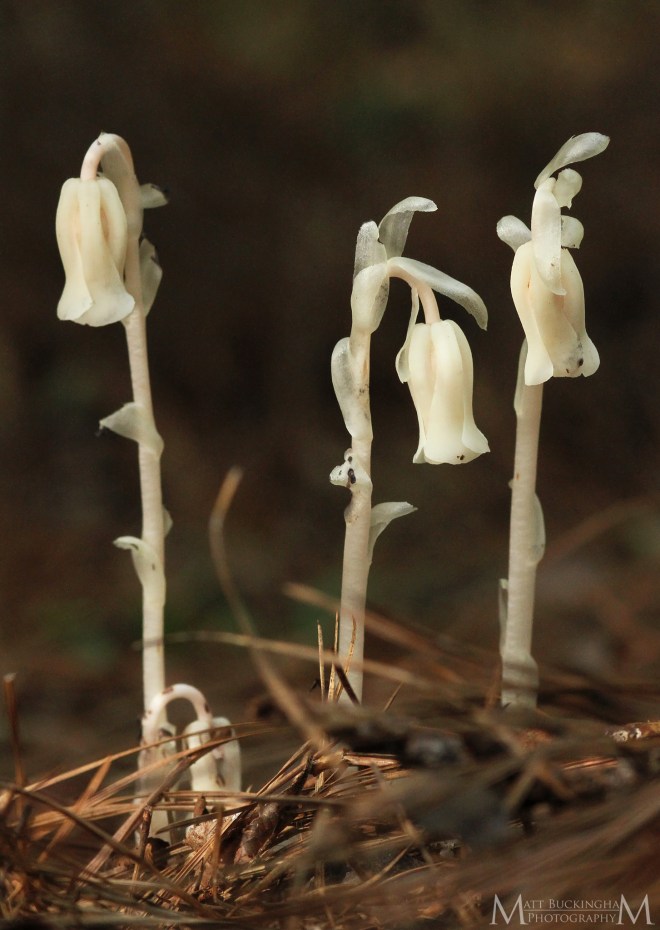
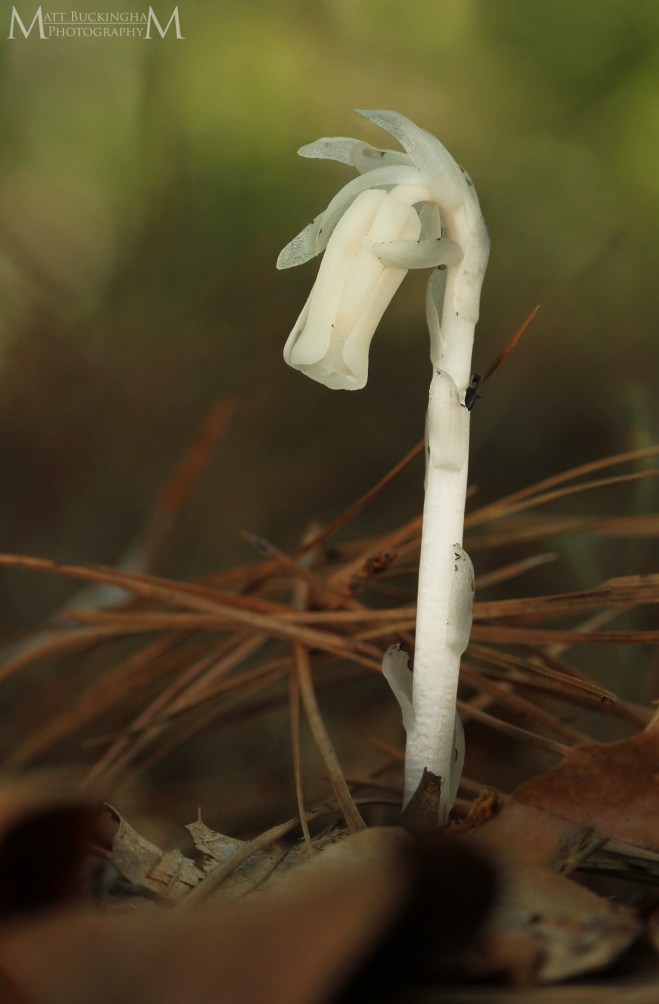
On my birthday we set out to find a few such plants.  The first that we came across was the Indian Pipe (Monotropa uniflora), also known as the Ghost or Corpse Plant.  This interesting fungus-eating plant is a member of the blueberry family, of all things.  It does not produce chlorophyll like most traditional plants, but rather obtains its energy and nutrients from the mycorhizzal fungi of tree roots.  In Texas they may begin to bloom in late August or early September, and I have seen them as late at January (late in the sense that it is at the end of the blooming season for this species).  The flowers’ superficial resemblance to a pipe as inspired stories in Native American folklore, including the idea that these plants mark the graves of old chiefs, and provide them a vessel with which to smoke from the afterlife.
IMG_4664

Indian Pipes

IMG_4680

Indian Pipes

Growing near the Indian Pipes, in the shade of American Beech was a rare treat, Tall Rattlesnake Root (Prenanthes altissima).  Though it may line the roadsides further east, it is known from only a few isolated locations in extreme eastern Texas.  Here it grows on steep hillside springheads and the banks of springfed streams in mature hardwood forests.

IMG_4632

Tall Rattlesnake Root

Ample rains in September fueled a profusion of fungi, whose fibrous filaments draw moisture from the earth and feed on the ample detritus beneath the leaf litter.  Fungi are fascinating, beautiful organisms.  They lead most of their lives hidden below ground, but grace us with a spectacular display when their fruiting bodies form.  Perhaps my favorites are the many varieties of coral fungus.  Each is unique, and contain an intricate maze of protrusions that seem crafted by some avant-garde architect.

IMG_4590

Coral Fungus

Many species of fungus are quite toxic to humans, but there are some that are said to be delicious.  I personally have never been brave enough to try wild mushrooms.  It seems like for every edible species there is a lethal, or at least debilitating look-alike.  One species that is favored by foragers is the Indigo Milk Cap (Lactarius indigo) which an be found in hardwood bottoms in late summer and early fall.

IMG_4747

Indigo Milk Cap

Fungi come in a staggering array of shapes and colors.  They are also fun to photograph, and lead the mind to find interesting angles and compositions with which to present them.

IMG_4764

Fungi (I believe these are chanterelles)

IMG_4797

Fungi

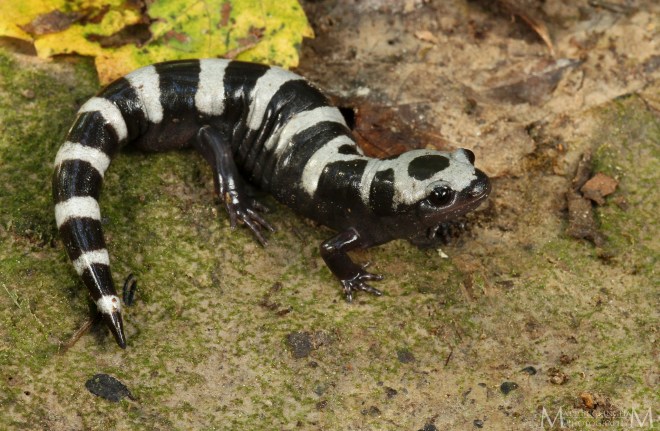
Autumn also signals the beginning of the salamander breeding season in East Texas.  In mid-October conditions were right for Marbled Salamanders (Ambystoma opacum) to make their annual breeding migrations.  Unlike most members of the family Ambystomatidae, which breed in the water during late winter and early spring, the Marbled Salamander breeds on dry land, and the females lay their eggs under woody debris within dry vernal pool basins.  They will then guard the eggs as they wait for winter rains to fill the pools and disperse and hatch their offspring.  By doing this they get a leg up on the competition, so to speak, which comes in the form of other amphibian larvae that won’t begin to develop for another couple of months.
IMG_4882

Marbled Salamander Male

Marbled Salamanders are one of relatively few amphibian species that are sexually dimorphic.  The males (pictured above) have bright silvery white dorsal patterns while the females (pictured below) have duller silver to coppery markings.  The males also display a swollen cloaca at the base of their tail during the breeding season.

IMG_4891

Marbled Salamander

In late October Caro and I spent a damp autumn day in the woods with our friends James and Erin.  It provided a chance to capture more images of interesting fungi, like these Earthstars, which look like little puff balls wearing tutus.

IMG_5087

Earthstars

We also observed a number of insects like these seemingly affectionate Six-spotted Flower Longhorn Beetles (Strangalia sexnotata).

IMG_4986

Six-spotted Flower Longhorn Beetles

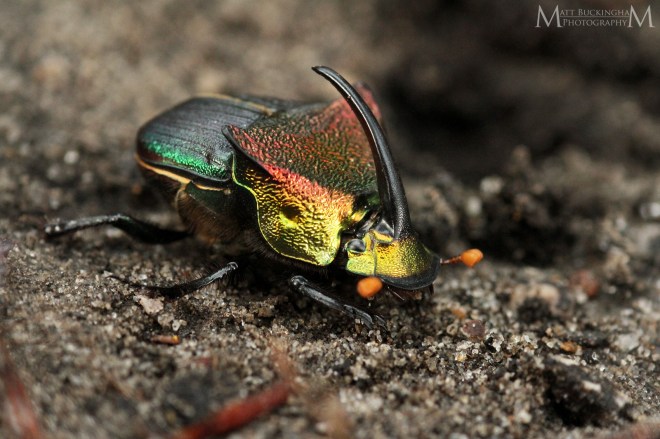
We also found a few Rainbow Scarabs (Phanaeus vindex), a spectacular beetle that I highlighted in a previous blog post.
IMG_5247

Rainbow Scarab

And then there were the Indian Pipes.  We found hundreds in a remnant Longleaf Pine savannah, pushing up through the dense carpet of needles and cones.  It became somewhat of a game seeing who could spot the most.  Per usual, Caro won by a landslide.

IMG_5274

Indian Pipes

One October day I received a call from my wife that she had found a recently hit Gray Fox next to the road. Being eccentric biologist types, we decided that we wanted to try to get its skeleton for study and admiration. So we called James and Erin, who own a large tract of land, and asked if we could set it out there to decompose. Being a couple of biologists themselves, they gladly agreed and we loaded the fox carcass in the bed of my truck and set out on the half-hour or so journey to their farm.

Just after we arrived, I heard my wife call out, “Look at this!” No surprise really, as she has an uncanny talent for spotting creatures, plants, and any other thing that remains invisible to most. She had found a large adult female Carolina Mantis (Stagmomantis carolina), hiding among the goldenrod blooms near the Childress cabin.

3J0A2949

Carolina Mantis

Of course, in our haste to make our morbid delivery I had forgotten my camera.  Fortunately James was kind enough to lend me his. We approached the scene and I tried to formulate a plan on how to best photograph this spectacular insect. As we drew near we noticed the carcasses of Common Eastern Bumblebees (Bombus impatiens) scattered about the ground, dismembered and drained of their juices. Oblivious to the danger, there were several more bees nectaring on the goldenrod just inches from the mantis. So I found a good angle and waited to see if I might capture some action. I set the lens on a bee that was slowly creeping closer and closer to this devourer of pollinators. The bee brushed against the mantis’s leg, yet still the predator remained still. Its head slowly cocked and it’s antennae twitched ever so slightly. Deliberately and methodically it crept toward the ravenous bumble bee. Its movements were almost imperceptible. I captured the image below as it zeroed in on the bee and prepared its strike.

Seconds after I captured this image the mantis did strike, though I only managed to record a blur of green. It missed, and the bee flew to a distant part of the same plant to continue feeding. Later we would see the mantis in the middle of devouring another unfortunate Bombus impatiens, though we missed the strike. In all it would seem that this ruthless hunter his doing quite well on the goldenrod she has staked claim to.  She remained on that withering goldenrod well into December.

3J0A3034

Seconds from Disaster

A few days before Halloween, Caro and I set out to look for signs of fall along backroads and deep in the forest. Colors were beginning to change, with vines like Virginia Creeper and Poison Ivy putting on a brilliant display. Elms, hickories, and even some red maples were beginning to lose their chlorophyll while baldcypress was nearing peak color.  Monarchs are passing through en masse, and were joined at fall blooming plants by Gulf Fritillaries, Buckeyes, and American Ladies.

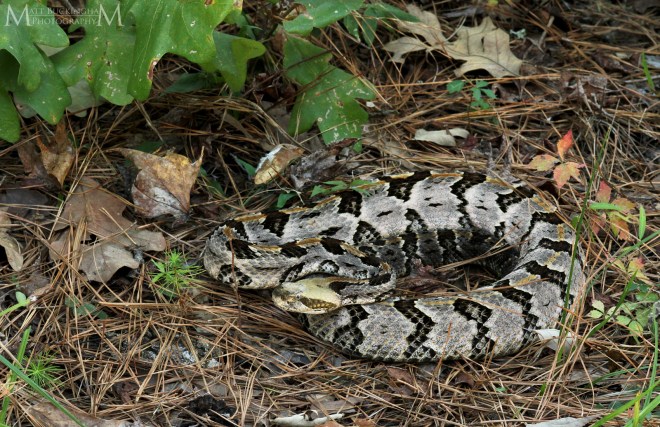
In the late afternoon we came across a stunning Canebrake Rattlesnake (Crotalus horridus) taking in the Sun’s fading warmth. It was one of the lightest snakes I’ve seen, with narrow bands of almost pure white along its chevrons. I would put it at a bit under three feet in length, a decent size. And like most of its kind that I’ve encountered it rattled only briefly, and was incredible docile and non-aggressive throughout our interaction.
IMG_5424

Canebrake Rattlesnake

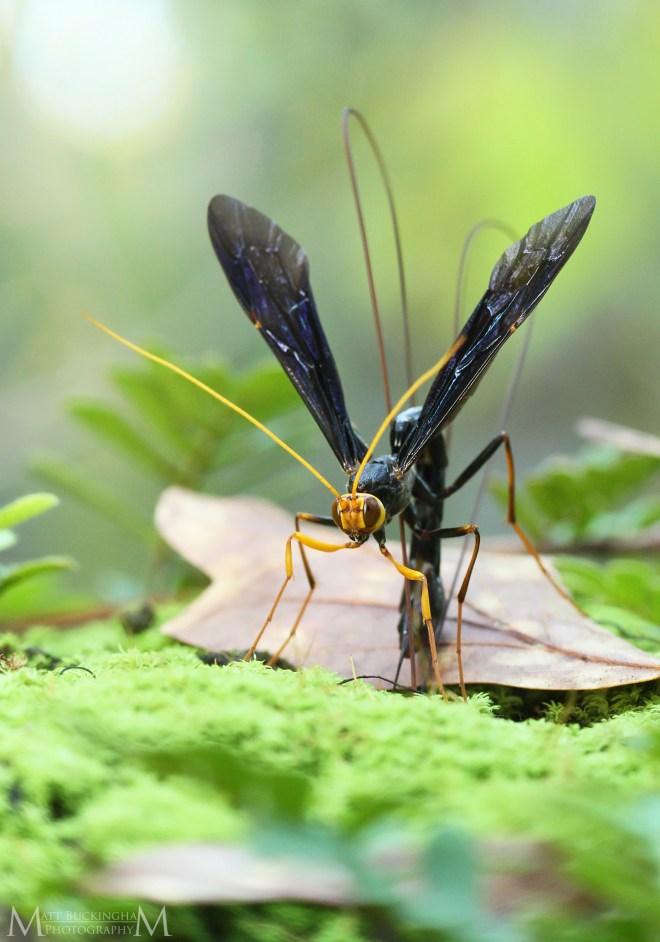
After spending some time with this spectacular denizen of the deep woods, we were able to turn up a couple of Marbled Salamanders and Southern Leopard Frogs adjacent to a series of ephemeral wetlands. I then noticed a large fallen tree, its branches arching above the forest floor. While admiring the verdance of the mosses and Resurrection Fern coating the bark, I glimpsed an unusual creature swaying back and forth. It was a huge Megarhyssa atrata (a type of giant ichneumon) busy probing the chambers of horntail wasp larvae with her ovipositor. She lays her eggs in the soft flesh of these larvae, where they will hatch and consume their host as they develop. This downed tree was literally swarming with Megarhyssa atrata and M. macrurus. Though they may be “creepy” looking, these large insects are harmless and fascinating.
IMG_5470

Megarhyssa atrata

In early November we set out to look for Long-lipped Ladies’ Tresses (Spiranthes longilabris) a rare orchid of fire-maintained Longleaf Pine Savannahs.  A species of the coastal plain, they reach the western extent of their range in East Texas.  Uncommon to rare throughout their range, in Texas they are known from only a handful of sites in the Big Thicket.

IMG_5483a

Long-lipped Ladies’ Tresses

Another East Texas rarity is the Kidney-leaved Grass-of-Parnassus (Parnassia asarifolia).  To my knowledge, they only persist along a single drainage in the Pineywoods.

IMG_5552

Kidney-leaved Grass-of-Parnassus

A favorite past time of Carolina and me is wandering around Ellen Trout Park here in Lufkin.  There are usually a variety of interesting things to be seen, including several resident Great Egrets (Ardea alba).

IMG_5585

Great Egret

The star attraction of the park, however, is a pair of Bald Eagles (Haliaeetus leucocephalus) that nest there each year.  It wasn’t so long ago that Bald Eagles were nearing extinction, but a variety of factors including the banning of DDT and Federal regulations like the Endangered Species Act and Bald and Golden Eagle Protection Act brought them back from the brink.

While most of East Texas’s species suffered greatly from the construction of large reservoirs, this is one of a few species that has actually benefited. The damming of the major rivers of the region created tens of thousands of acres of suitable habitat for the large raptors.  In East Texas, Bald Eagles prefer to nest near the top of large pine trees adjacent to large water bodies. I composed the image below to capture the essence of this habitat.

IMG_5720a

Bald Eagle

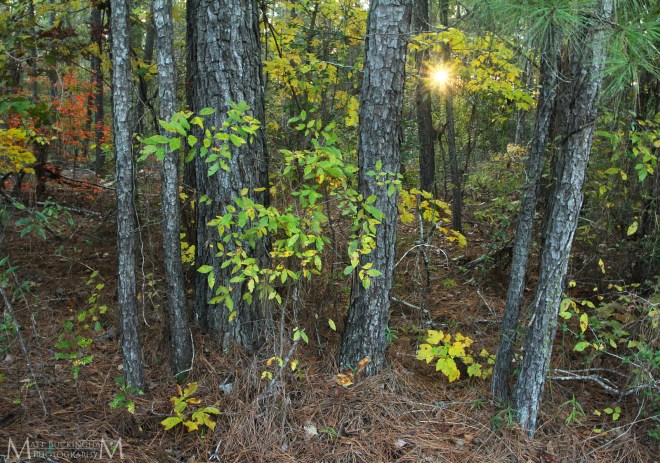
By late November, fall color had begun arriving in earnest.  One one of our frequent evening drives, I spotted the stereotypical Pineywoods scene below along the backroads.
IMG_6674

Florida Maple (Acer floridanum) generally displays a brilliant golden yellow during autumn.  This year they put on quite a show on slopes and along riverbanks.

IMG_6711a

Florida Maples

IMG_6724

Florida Maples

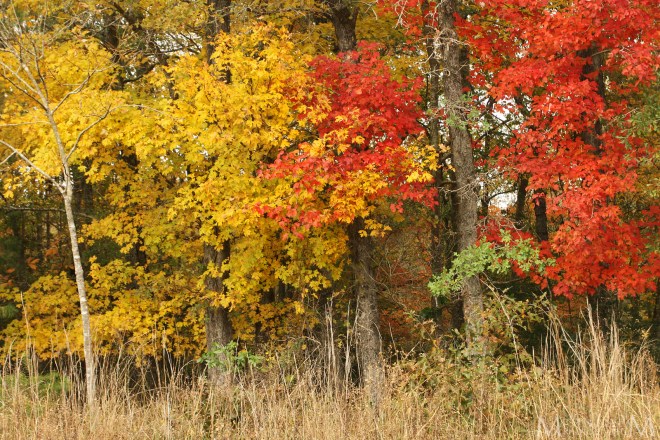
In some areas Florida Maples can be found growing alongside Red Maples (Acer rubrum).  In the fall, Red Maple comes in a variety of colors, including yellow, orange, and red.  In the image below it held up to its namesake, and provided an excellent contrast to the bright yellows of the Florida Maple next door.
IMG_6738.jpg

A Meeting of Maples

The Pineywoods of East Texas are known for their towering forests. While breathtaking in their own right, the abundance of trees blocks the horizon, and there are not many places in East Texas that offer broad views of the landscape. There are a few exceptions on high ridges, however, like this spot east of Nacogdoches. Here the crowns of pines and a diversity of hardwoods creates a beautiful fall palette of greens, oranges, and yellows.

IMG_6755

Bird’s Eye View

Many species of butterfly remain active well into the fall.  One of the most common is the Gulf Fritillary (Agraulis vanillae).  We often see them nectaring alongside other species on fall blooming wildflowers like these asters.

IMG_6822

Gulf Fritillary

In late November, Carolina and I made our way north to explore the forests of Cherokee and Smith Counties.  Here we found countless beautiful scenes, of which I attempted to capture just a small fraction of their brilliance with the images below.
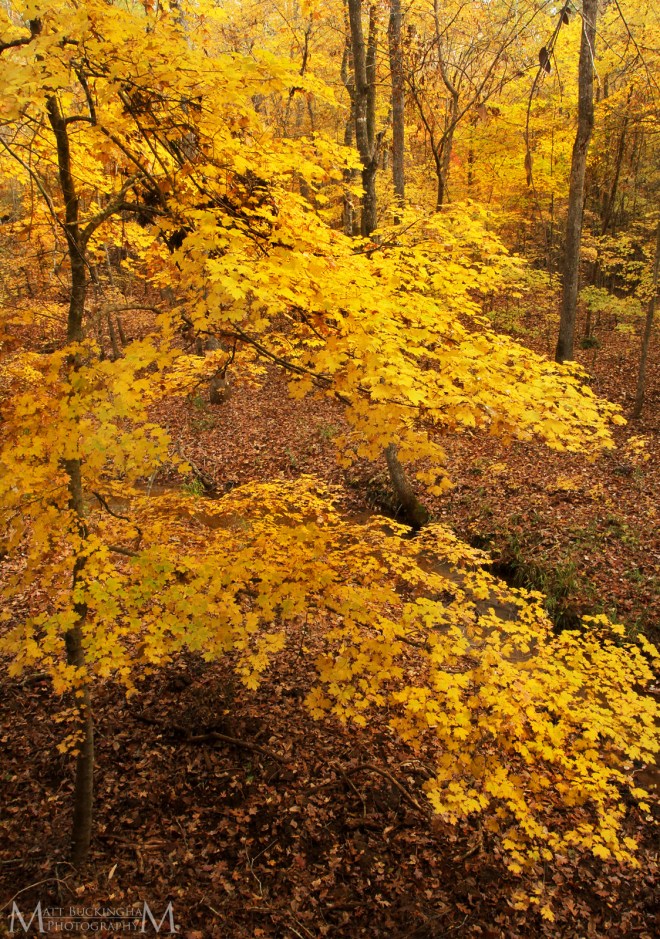
IMG_6899

Dressed in Gold

IMG_6912

Autumn Exposure

During this day trip, we visited Tyler State Park for the first time.  The State Park system of Texas protects a multitude of important and interesting natural and cultural features.  The park was beautiful, with ample fall color among mature mixed pine-hardwood forests and infrastructure created by the Civilian Conservation Corps.

I generally avoid including man-made elements in my images, however the road through the state park seemed to be asking to be photographed.  I captured the image to remind me of one of my favorite past times – driving quiet back roads in fall…

IMG_6942

The Road to Autumn

…and hiking in the autumnal forest.  If you look closely in the image below you can see a hiker’s footbridge beneath Flowering Dogwoods with foliage aflame.
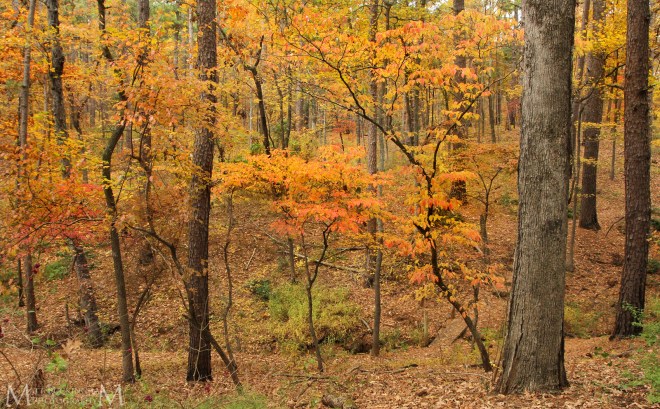
IMG_6976

Tyler State Park Trail

The color of the day was definitely orange, a deviation from the standard yellows and occasional reds typical further south.  The Red Maples in particular were glowing.  We enjoyed our time in the park, and will likely be making a repeat visit soon!

IMG_6993.jpg

Autumn’s Orange

IMG_7010a

Maples in the Midstory

Some autumn scenes display a more subtle beauty.  I captured the scene below in the floodplain of the Neches River.  The Inland Sea Oats blanketing the ground had turned brown.  The bark of Sugarberries added contrast while the fall foliage of distant elms added a splash of color.
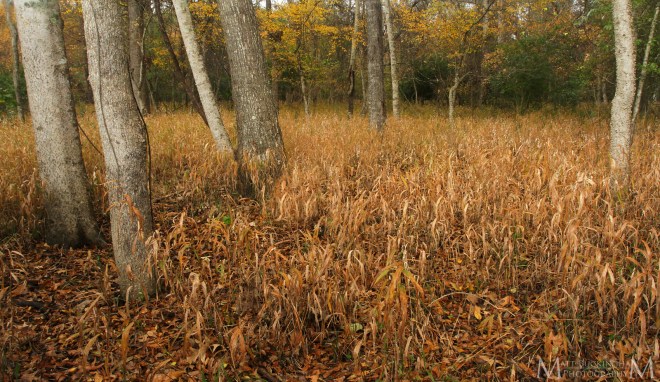
IMG_7028

All that Remains

Perhaps the most spectacular fall scene would not reveal itself until December, when I went to visit a waterfall recently discovered by my friend Scott.  This waterfall is hidden deep forest in an area where steep ravines funnel water, whose power carves shallow canyons into the erodible mudstone of the Wilcox Formation. The slopes that grade down to this stream are decorated with the golden autumn foliage of American Beech and likely harbor a vernal flora rich in peripheral species of the great Eastern deciduous forests.
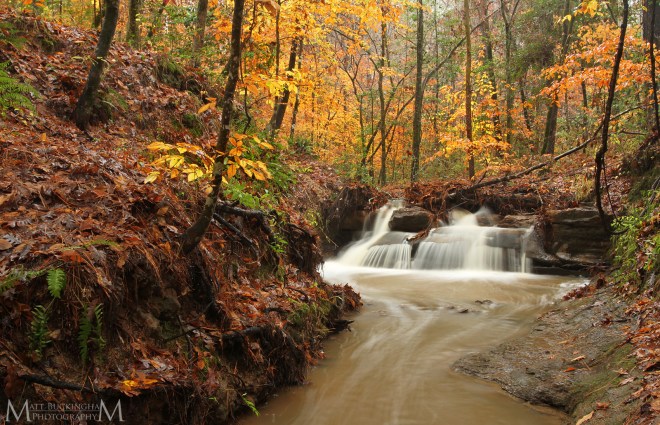
IMG_7240

There are few things that bring me more joy than a walk in the autumn woods, and though the season has turned, it’s hard to fret too much.  Winter resident birds have arrived and salamanders have begun to breed.  Though winter may seem the bleakest of seasons, there is lots of life for those willing to look.  So for now, I will look forward to the winter and spring, and say, “until next time, autumn!”

Christmas with the Quacks

Sometimes the best Christmas gifts are not items, but rather experiences.  And sometimes they come from no giver in particular, but happenstance.  This year I received some of these intangible gifts, on a level I had not experienced before.  That’s not to say that I didn’t also receive many wonderful gifts from my family.  This year I was lucky enough to get a fantastic new camera backpack and some other accessories, a few excellent books, a blow gun, and another year’s supply of socks.  But the unique nature of some photo opportunities this Christmas, and their relevance to the nature of my blog has prompted this special holiday post.

For Christmas Eve, Carolina and I stayed in Lufkin.  We made a hearty breakfast, took a pleasant walk in the morning, and enjoyed each other’s company throughout the day.  In the late afternoon, Caro suggested that we visit some local ponds to look for ducks.  This in and of itself was a Christmas in my eyes!  So we went to a local pond where a large group of Gadwall (Anas strepera) has been spending the winter.  The birds were skittish at first, taking flight at our initial response.  But they regrouped at the opposite end of the pond, and I was able to take advantage of some old willows lining the pond’s edge to creep closer.  I found a break in the trees where I could lay flat and capture a few images of a spectacular drake.  The Gadwall is perhaps our most underrated species of duck.  It lacks the bold colors of many species, but the subtle intricacies of its plumage and varying tones of brown and gray make it a beautiful thing to behold.  That evening Caro prepared a delicious meal, and we toasted the season and built a fire in the yard.

4N1A1377

Gadwall

The next morning we woke early and set out for Austin, where we would be celebrating Christmas Day at my brother Seth’s girlfriend’s house.  After arriving, visiting, and enjoying some snacks that she had prepared, his girlfriend, Jen, informed us that there was a detention pond in the back of her neighborhood that often had ducks on it.  Naturally, I couldn’t resist the opportunity, so we took a family walk to see what was there. Sure enough, upon arriving I spied a large group of American Wigeon (Anas americana), a few Gadwall, and a lone Ringneck Duck. I tried to circle wide and creep up on some of the wigeon.  I have long wished for an opportunity to capture good images of this spectacular duck, but they had thus far eluded my lens.  Unfortunately the birds proved initially skittish, and due to the steep banks grading into the pond I was unable to get a shot from a suitable angle. I tried a few different methods of approaching until they finally flew off for good. Or so we thought… After a few minutes of wandering around we decided it was time to head back.  It was in that precise moment that the wigeons returned to the opposite end of the pond. So my brother and I opted to remain.  We formulated a plan of attack.  I skirted wide, using the pond’s berm to hide my approach, while my brother approached from the opposite side, obscured by dense vegetation.  I then belly-crawled to the edge of the detention pond where I was at least partially hidden by cattails and dried stalks of Powdery Alligator Flag. I was at a good angle, but unfortunately I was unable to get a clear shot through wetland vegetation.  So I decided to start crab-walking into the pond itself, as one does, until i was submerged to my waist. To my surprise, I found the ducks to be much more tolerant of my presence when I was actually in the water. Instead of flushing, they only swam to the other side of the pond, just out of photo’s reach.

Enter Seth. He crept up behind the vegetation on that side and started shaking some of the plants and making some bizarre noises that I could only describe as a mix of a wounded duck and disturbed house cat. It did the trick, however, and the wigeons came toward me, at times approaching too close for me to focus, and I was finally able to capture some fine images of this beautiful species.  I couldn’t believe it.  There are those times as a photographer where everything just seems to fall into place.  It is a rare thing, made all the more special for me that I was able to share the experience with my brother on Christmas Day.

I don’t think my family was surprised when I returned soaking wet and covered from head to toe in mud and bits of wetland vegetation, as they have become desensitized to my antics over the years.  I cleaned up and we enjoyed a delicious Christmas dinner.  It was certainly not your most traditional Christmas experience, but a fitting one, and one that I will never forget.

4N1A2168ab

American Wigeon

4N1A2181

American Wigeon

4N1A2226

American Wigeons