The Jewel of the Weches Formation

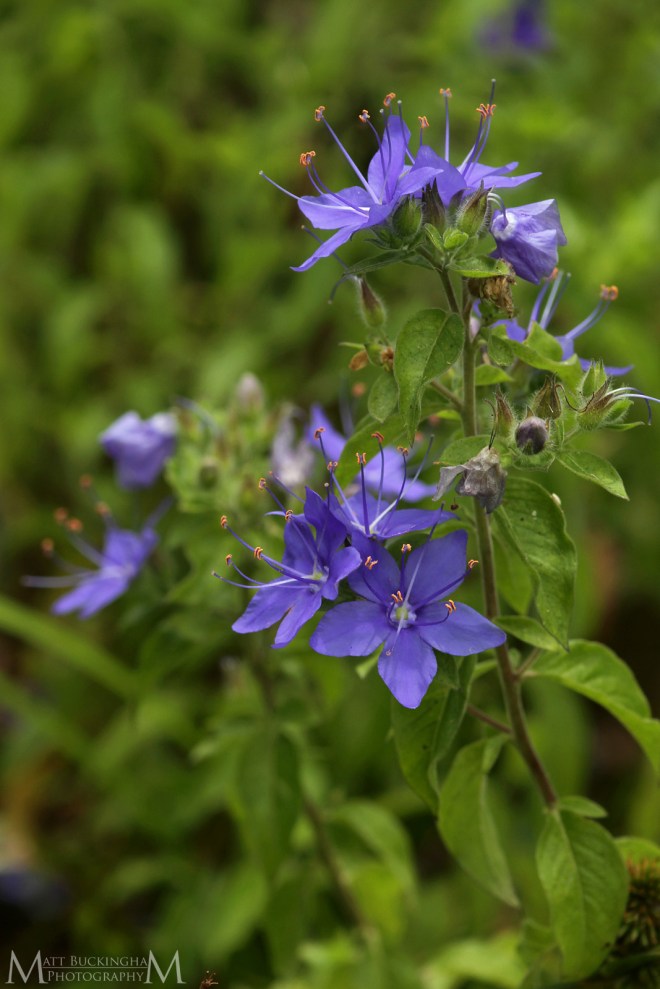
Target Species: Clasping Jewelflower (Streptanthus maculatus)

IMG_7078

The bad news is that I’ve fallen way behind in my blogging.  The good news, however is that the last few months have been full of incredible experiences in the natural world that I look forward to sharing.  So as we are sweltering under near record heat waves, I will share a few posts from this spring, and reminisce about cooler times.

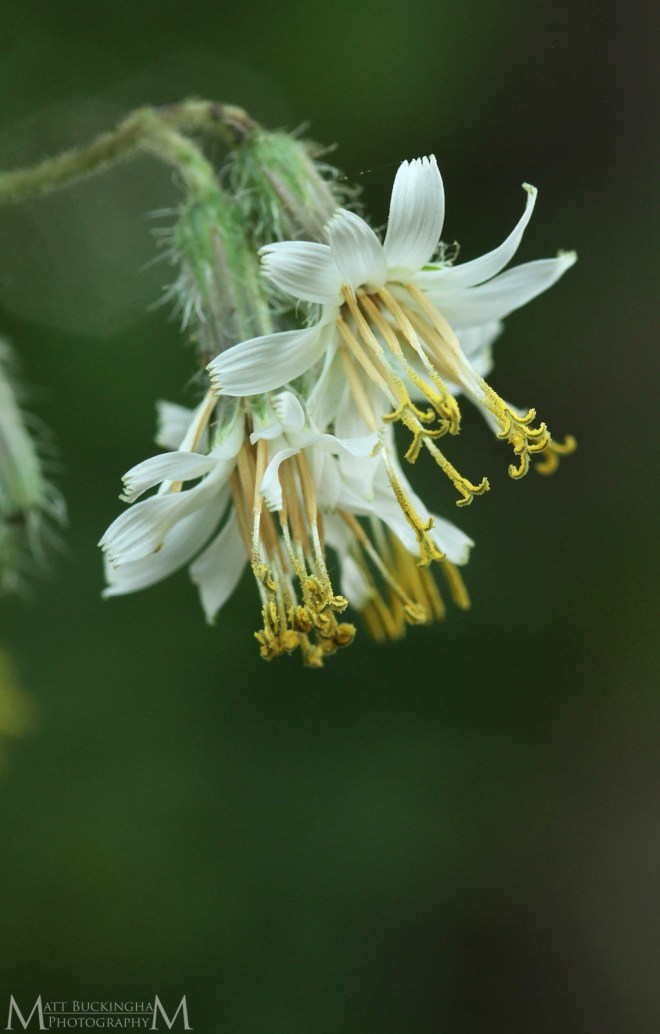
This first post addresses the third, and unfortunately last species from my list of biodiversity goals that I have checked off this year.  In early May I photographed the spectacular Clasping Jewelflower (Streptanthus maculatus) in East Texas.  This member of the mustard family (Brassicaceae) is very rare in Texas, known from only a few sites over the Weches formation in the eastern part of the state.  Here it occurs in a few scattered populations where the iron-rich formation has been exposed.  I learned of this particular population near the Anderson/Henderson County line from my friend Trey Anderson who had found them a few years ago while performing some work in the area.  They occur on a steep exposed hill with a mix of artificial clearings and stunted forest over gravelly Weches substrate.  This soil is extremely rich in iron and it shows in the color of the hillside.

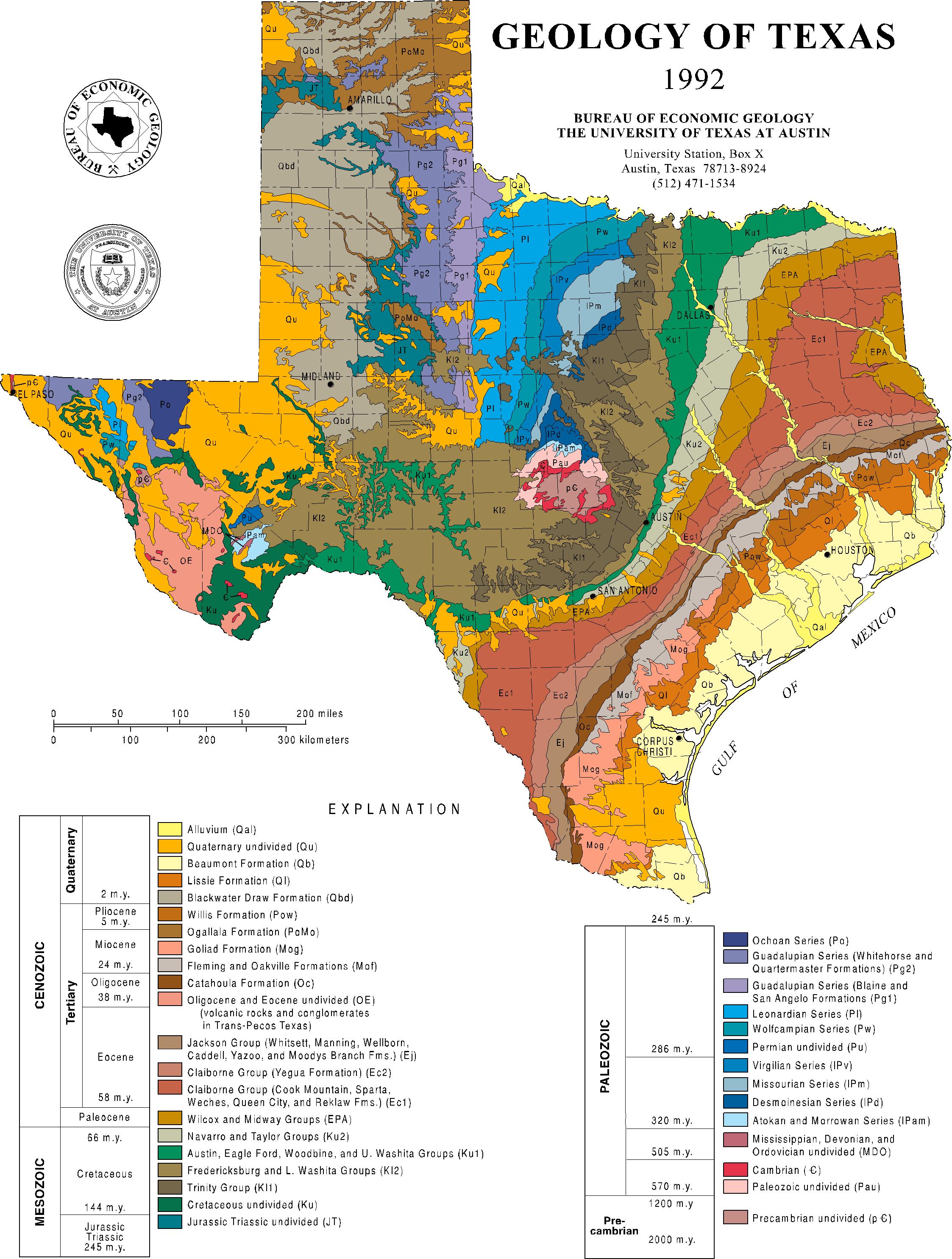
The Weches Formation is part of a broader collection of geologic formations known as the Claiborne Group.  This group also includes the Yegua, Cook Mountain, Sparta, Queen City, and Reklaw Formations.  These occur along with the Weches Formation as a matrix in a broad area that encompasses a narrow band that stretches from Cass, Marion, Harrison, Rusk, Nacogdoches, San Augustine and Sabine Counties in the east along a curve down to Webb and Zapata Counties in South Texas.  (See a map here).

I have previously written a blog post about Weches Glades, a unique vegetative community that occur at a few sites in Nacogdoches, San Augustine, and Sabine Counties.  Streptanthus maculatus once occurred here as well, and can probably still be found at a few existing sites.  Many populations have been lost, however, to land use conversion and extensive glauconite mining.  Elsewhere in its range S. maculatus occurs over similarly iron-rich deposits in eastern Oklahoma and western Arkansas.

I was a bit late in seeking these jewels out this year, as most were already spent or in fruit.  The individual pictured was the only one I found in decent shape.  I’m not complaining though, for it gives me something to look forward to next year, and will afford me another visit to the unique, disappearing communities of the Weches Formation.

Hidden Wonders in the Forests of Northeast Texas

IMG_4141

Rich Hardwood Forest

Target Species: 

Tapertip Trillium (Trillium viridescens)

Downy Yellow Violet (Viola pubescens)

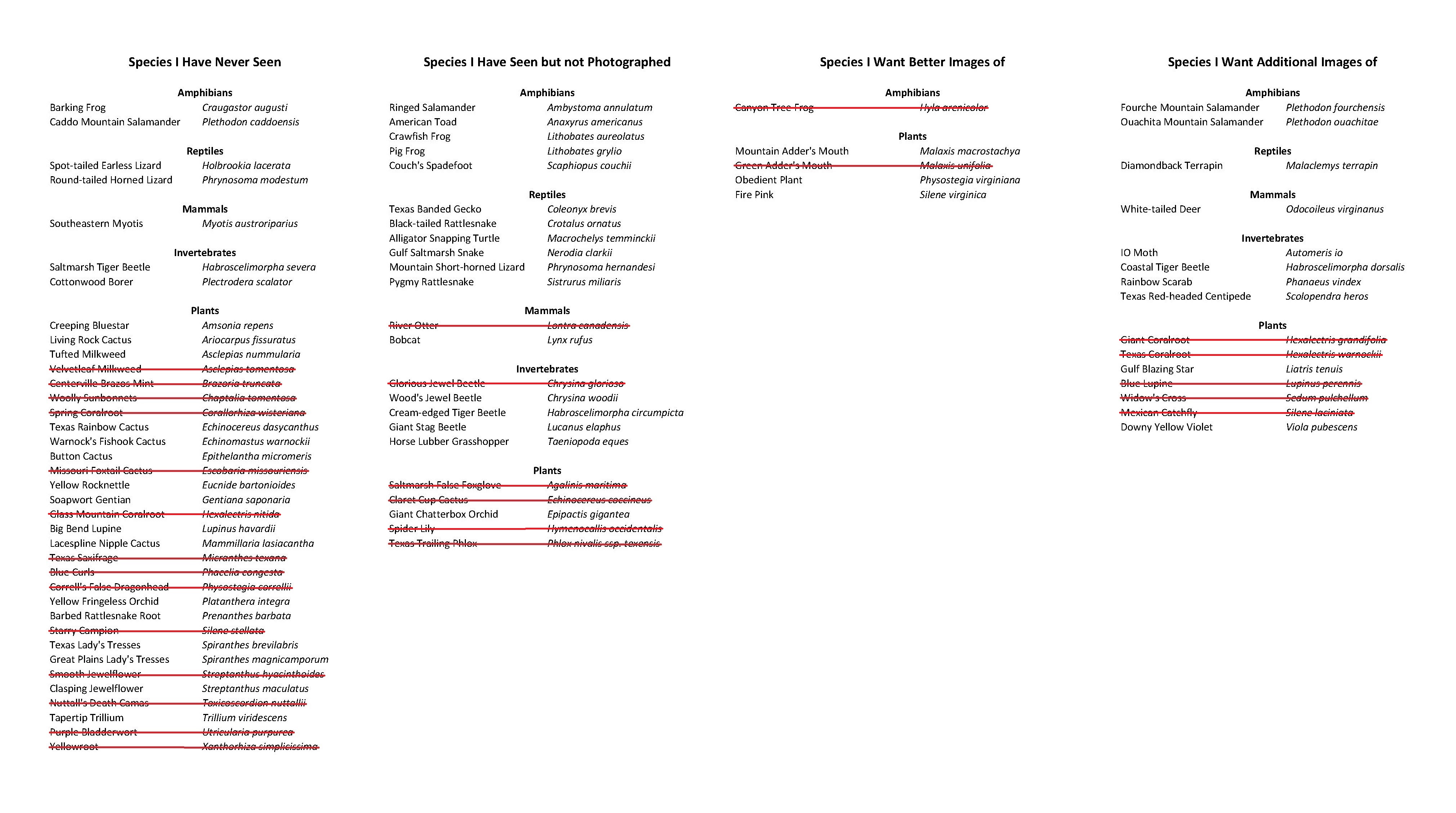
It’s been some time since I’ve posted about one of my “Biodiversity Targets”, those species that I included on my 2017 list of biodiversity goals.  At the end of 2017, I had only tracked down around half of the species on that list, but along the way I amassed a wealth of incredible observations, adventures, and experienced more of our states biodiversity than I ever could have imagined.  So I decided that instead of creating a new list or adding to the existing list, I would work over the next couple of years to finish the list I made at the start of 2017; a list that was a bit more ambitious than I had anticipated.

In early April 2018 my pursuit of these species would take me to the far northeast corner of Texas, near the Oklahoma border in search of two species that I have long wanted to see in the state.  Joining me in this quest was my friend Scott Wahlberg.  We set out early, in the gray of a perfect spring morning.

The counties of far northeast Texas feature a mingling of habitats typical of both the Post Oak Savannah and Pineywoods.  Some communities, like the rich hardwood forests of the Sulphur River and Red River and their tributaries are unique to this part of Texas, and more similar to the forests of the Ouachita Mountains of Oklahoma and Arkansas than they are to those of the heart of the Pineywoods in Deep East Texas.  Here a sweet of species reach the southwestern limit of their range.  Among these are several species that are either absent from, or are very scarce elsewhere in the Pineywoods.  Examples of these include trees like Silver Maple (Acer saccharinum), Black Oak (Quercus velutina), Shingle Oak (Quercus imbricaria), and Nutmeg Hickory (Carya myristiciformis).  Examples also include woodlands forbs such as Fire Pink (Silene virginica), Rue Anemone (Thalictrum thalictroides), Downy Yellow Violet (Viola pubescens), Tapertip Trillium (Trillium viridescens), and more.

The latter two were the focus of this trip.  In Texas, Trillium viridescens occurs in rich hardwood forests on steep river bluffs and in the damp alluvium of  riparian woodlands.  Here we found it growing among other interesting woodland forbs like Mayapple (Podophyllum peltatum), Veiny Pea (Lathyrus venosus), Wild Hyacinth (Camassia scilloides), and White Trout Lily (Erythronium albidum).

Trillium viridescens is a species of the central United States, primarily occurring in the Ozark Plateau, and the Boston and Ouachita Mountains. It barely enters Texas in northeastern portion of the state. The plants in the northern portions of its range generally have petals that grade from purple at the base to bright greenish yellow at the tips. Most Texas individuals, however, tend to be solid maroon to greenish purple.


IMG_3723

Tapertip Trillium

The sessile-flowered trilliums can be a tricky group. In Texas, three species, T. gracile, T. ludovicianum, and T. viridescens are superficially similar in many ways, however when I first saw T. viridescens in the field it was immediately clear that this species was obviously different from the other two. The T. viridescens plants we observed were much larger and more robust than any T. gracile or T. ludovicianum I had ever seen. Their faintly mottled, broadly ovate leaves were much different than the state’s other trillium species, which have narrower, more heavily mottled leaves. The petals were also much larger. There are other characteristics that can be used to differentiate T. viridescens from the other two species such as a scabrous vs glabrous scape and a number of differences in flower morphology.

Seeing Trillium viridescens in the field certainly left a lasting impression.   It was a special moment for me, as it was the last of our state’s five species of trillium that I had left to see.  Like all of our other trillium species, T. viridescens is at risk, and is likely declining from a number of factors such as climate change and land use conversion.

Viola pubescens another characteristically eastern species that barely enters Texas in the far northeastern part of the state.  It is a yellow-flowered violet that occurs through most also occurs in parts of central United States as far west as the Black Hills of western South Dakota and eastern Wyoming.  While I have seen and photographed this species in the southern Appalachians, I had long wanted to see it in Texas.

On that fine spring day, we found it in a mature riparian forest along a small order stream.  Shaded by an overstory of Silver Maple, Red Maple, Shumard Oak and Sweegtum,  we found it growing alongside a variety of other woodland herb including Podophyllum peltatum, Packera glabella, Packera obovata, Viola sororia, and Erythronium albidum.

IMG_3991

Downy Yellow Violet

IMG_4090

Downy Yellow Violet

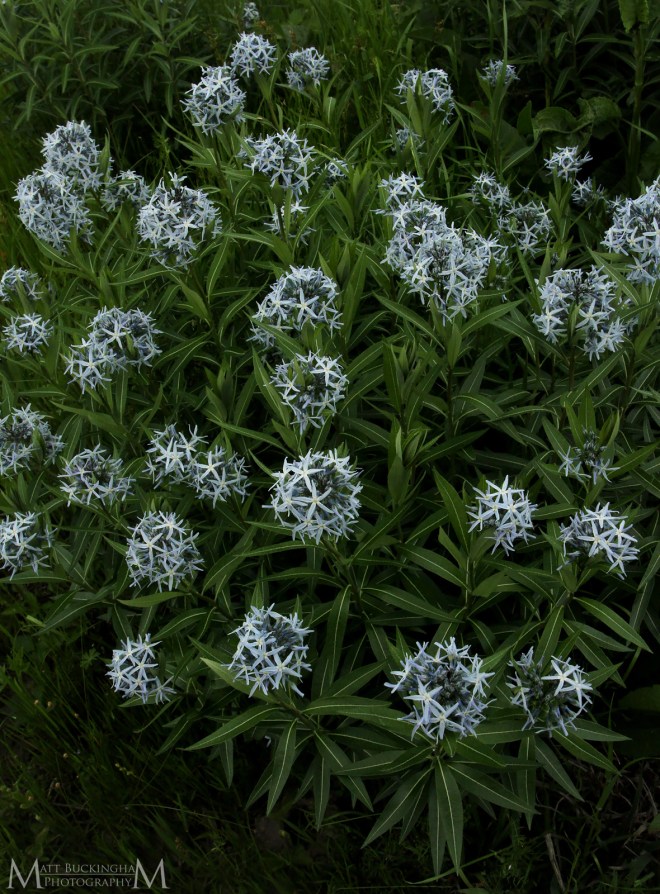
While exploring the backgrounds of northeast Texas we spotted several large clumps of Eastern Bluestar (Amsonia tabernaemontana) growing in a remnant prairie.  Scott and I stopped a moment to photograph them, and discussed what the area must have looked like before the hand of man left it forever changed.  We also pondered the possibility that prairie species like the Southern Crawfish Frog might just still hang on here.  Though I haven’t spent much time in this part of the state, I quickly gained an appreciation of just how diverse it really is.

IMG_3935

While most of northeast Texas remains rural and relatively undeveloped, there is little public land, and most of these populations are on private land and vulnerable. There is still hope, however.   Through conservation efforts with and by private landowners there is hope that these lovely members of our flora remains for future generations to enjoy.

The Biodiversity of the Rio Grande Valley Part 2: The Cacti

IMG_7947

Peyote

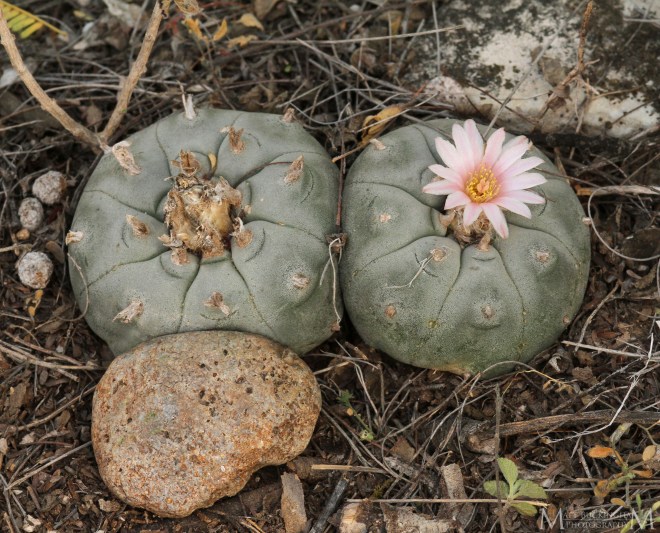
Spring in the Tamaulipan Thornscrub is a beautiful, albeit deceiving thing.  When the chaparro, huisachillo, and guayacan bloom above a carpet of wildflowers, its easy to forget just what a harsh, unforgiving land this can be.  I was bleeding through my jeans when I sat a moment to rest in the shade of a mesquite tree.  I don’t think that Carolina, James, or Erin had fared much better.  Despite being early March, it was pushing 90 degrees, and the sun was beating down.  After taking a long draw from my water bottle, I got up and continued my search.  I winced as I pushed through the allthorn, and felt the tasajillo spines pierce my skin.  It’s safe to say at that point my spirits weren’t at their highest.  But then I heard the voice of my wife as she called out, “I found one, with a flower!”  In that moment, pain seemed like an insignificant consideration as I pushed through the tangle of thorns that lay between me and my succulent quarry.  I saw Carolina squatting down looking at the base of a large shrub.  There, under the shade and protection of a condalia I could see the iconic Peyote in bloom.

Despite being very un-cactus like, the Peyote may be the famous of all cacti.  Once fairly common in parts of south and west Texas, decades of over-harvest, poaching, and habitat loss of significantly reduced the populations to the point that today they are a rare sight among the thornscrub.  The reason that it has been so persecuted is the psychoactive compound mescaline contained within its flesh.

In fact, Peyote is one of the most well known psychoactive plants.  It has been utilized for centuries by native peoples for both its medicinal and hallucinogenic effects. Today Peyote is a controlled substance in the United States due to its use as a recreational drug. It is, however, legal for many native tribes to harvest and consume for ritualistic purposes.  And though it may be illegal to harvest or possess, poachers continue to devastate Peyote populations to sell them on the black market.

In the United States Peyote is known only from extreme southern and western Texas. Here it occurs in desert scrub and arid brushland, typically growing beneath dense shrubs. It is one of three spineless cacti in Texas. We were lucky enough to observe some in bloom on an extensive private ranch in the Tamaulipan Thornscrub of South Texas, with the help of our dear friends Toby Hibbits and Connor Adams.

IMG_7834

Peyote

In our pursuit of Peyote we observed several other species growing beneath the shelter of their nurse plants.  We seemed to catch the Heyder’s Pincushion Cactus (Mammillaria heyderi) in full bloom.  This small cactus grows low to the ground, and like many species with this growth habit, is very difficult to spot when not in bloom.  In the early spring a single plant may put on a dozen or more flowers, generally organized in a ring along the top of the cactus.  It occurs from Mexico through south and central Texas west across eastern and southern New Mexico into southern Arizona.

IMG_7849

Heyder’s Pincushion Cactus

IMG_7912

Heyder’s Pincushion Cactus

While the Heyder’s Pincushion Cactus may be difficult to spot when not in bloom, the Hair-covered Cactus (Mammillaria prolifera) is difficult to spot even when in flower.  This species is tiny, with individual stems not much larger than an egg, though they may occasionally form large clumps.  The Hair-covered Cactus is known in the United States only from Texas, where it occurs in only a handful of counties in southern and south-central Texas, most of them along the Rio Grande.

IMG_1960

Hair-covered Cactus

Though it is superficially similar to the Mammillaria prolifera, the Runyon’s Pincushion Cactus (Coryphantha pottsiana) is easily differentiate when in flower.  Like many species of cactus, the taxonomy for Coryphantha pottsiana is a bit cloudy.  It has variably been known as Coryphantha robertii, Mammillaria robertii, Mammillaria bella, Escobaria bella, Escobaria runyonii, and Escobaria emskoetteriana.  Some authorities still use the latter, though Coryphantha pottsiana seems to be more widely accepted.  The Runyon’s Pincushion Cactus is known from northern Mexico and a few Texas Counties along the Rio Grande, where it is generally uncommon.
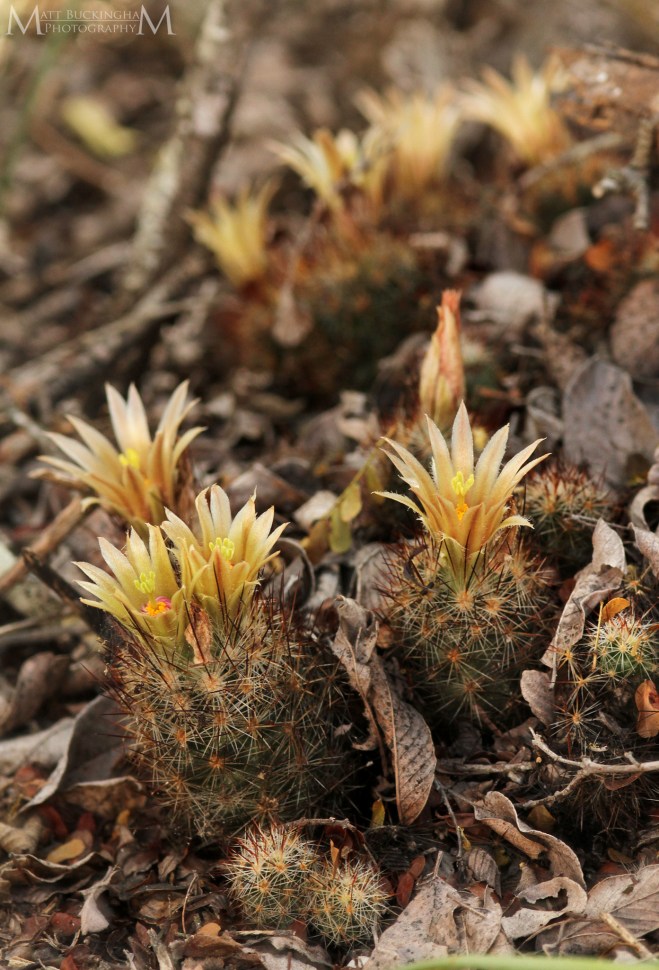
IMG_7803

Runyon’s Pincushion Cactus

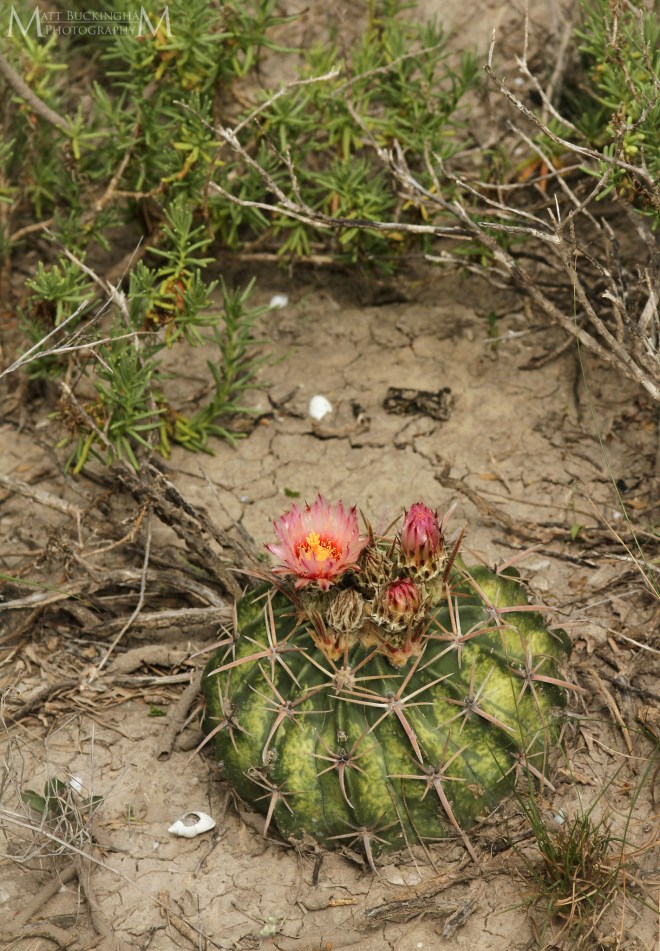
While the previous cacti are generally small, the Horse Crippler (Echinocactus texensis) can reach much larger proportions.  While most seem to be about the size of a basketball, we saw some that were easily 3 or 4 times as large.  They tend to occur in looser soil including sandy alluvium.  They are also frequently found growing in the open, away from nurse plants, though its likely that many plants get their start in the less hostile microclimate of a nurse plant.  Their impressive spines seem to be an effective deterrent against mammalian predators.

IMG_0687

Horse Crippler

IMG_0356

Horse Crippler

Among the most beautiful of all cacti are the hedgehog cacti of the genus Echinocereus, a few of which are endemic to the Tamaulipan Thornscrub of South Texas and northern Mexico.  This year our trip coincided with the peak bloom of Echinocereus fitchii, the Fitch’s Hedgehog Cactus.  Though they are generally hard to find, in the right habitat they can be abundant, and we saw dozens, blazing the thornscrub with their pink blooms.  Like Coryphantha pottsiana and so many other cactus taxa, the taxonomy of Echinocereus fitchii is murky at best.  It is considered by many to be a subspecies of the more broadly distributed Echinocereus reichenbachii.  For anyone interested in the topic I strongly recommend reading “A hard-to-manage taxon: The Black Lace Cactus (Echinocereus fitchii ssp. albertii)“.  Though it discusses the Fitch’s Hedgehog Cactus’s Federally Endangered cousin, it includes a good discussion on the taxonomy of E. fitchii and E. reichenbachii, including characteristics used to distinguish the two.

IMG_1214

Fitch’s Hedgehog Cactus

IMG_9920

Fitch’s Hedgehog Cactus

In my opinion, the Lady Finger Cactus (Echinocereus pentalophus) is perhaps the most spectacular cactus native to the United States.  Confined to northern Mexico and extreme southern Texas, they can form huge mats under the shade of mesquite and other trees and large shrubs.  They have even been found growing upon protected ridges adjacent to the Laguna Madre.  Their bright blooms shine neon pink under the midday sun.

IMG_2006

Lady Finger Cactus

IMG_1971

Lady Finger Cactus

The bizarre Pencil Cactus (Echinocereus pentalophus) seems less a cactus and more a tangle of dried branches resting at the base of some thorny shrub.  That is, until it’s giant pink blooms open in the early spring and betray its presence to the world.  Unlike most other members of its genus, the Pencil Cactus produces a massive tuberous roots that aid in water storage.

IMG_1274

Pencil Cactus

The highlight our South Texas cactus hunt, however, was finding the Federally Endangered Star Cactus (Astrophytum asterias) in peak bloom, an experience which I will share in my next blog post.

IMG_0644

Star Cactus

One in the Hand, Two in Tobusch

IMG_5898

Tobusch Fishhook Cactus

This past weekend I spoke at the Native Plant Society of Texas Spring Symposium about photographing the biodiversity of Texas.  The symposium was in Austin, and happened to occur during the blooming period of the Federally Endangered Tobusch Fishhook Cactus (Sclerocactus brevihamatus ssp. tobuschii).  Though the cacti do not occur particularly close to Austin, it was the closest we would get for the foreseeable future, so Carolina and I decided we would stay an extra night in the Hill Country and try for the cactus the day after the symposium.

We arrive in Austin on Friday afternoon and took the day to explore the city.  While big cities are certainly not my thing, I really enjoyed visiting the Texas State Capitol building.  Plumes of Cedar Waxwings danced and buzzed among the many trees that decorated the capitol lawn and the redbuds were just coming into bloom.  Inside we marveled at the architecture and artwork, and took in the history of the place.

Saturday we rose early and made our way to the symposium.  We thoroughly enjoyed the event.  I saw some old friends and met a lot of friendly, interesting people.  The symposium was over by 3 or so, so Carolina and I took some time to explore the area.  Early spring wildflowers were just coming into bloom and Texas Spiny Lizards (Sceloporus olivaceus) were out basking on the limestone, though they did not take kindly to our approach.

In one of the many tributaries of the Colorado River we spotted a pair of Texas Map Turtles (Graptemys versa).  The Texas Map Turtle is one of a number of species of turtles endemic to central Texas.  This beautiful, fascinating species is restricted to the Colorado River basin.  The females are significantly larger than the males, and each sex has specialized head morphology to utilize different food sources.  Males feed primarily on aquatic insect larvae and other invertebrates, while adult females feed primarily on mollusks, shell and all.  We spotted the pair basking on some rocks, but the tiny male soon sank into the cool clear water.  The female allowed a slow approach as she took in the warmth of an early spring afternoon.

IMG_5564

Texas Map Turtle

That evening we made our way to San Antonio.  I wanted to show Carolina some of the old Spanish and German architecture of the city, and we would be closer to the cacti.  We spent some time exploring downtown, and grabbed a hotel on the outskirts of town.  The next morning we slept in.  Generally speaking, cacti flowers open midday in order to take advantage of the peak of pollinator activity.  Our destination was an hour and a half or so west of the Alamo City.  The path took us through the scenic country of the western Edwards Plateau, over oak and juniper hilltops, and down through rocky river valleys, where crystal clear water cut through limestone.

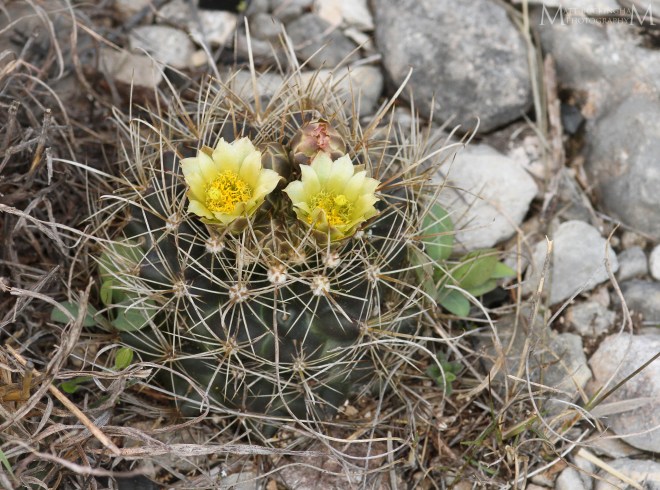
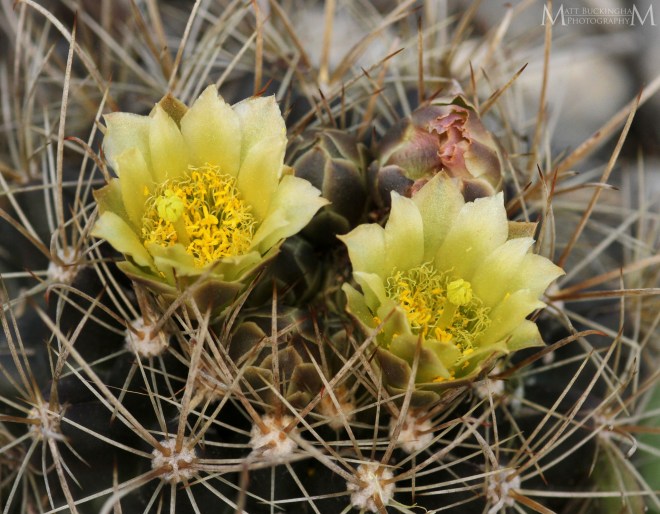
We finally arrived at a Tobusch Fishhook Cactus population that I had access to.  We began exploring.  It wasn’t long until I spotted the first cactus, and it was in bloom!  They were smaller than I had expecting, most being only a few inches across.  This cryptic species is extremely difficult to spot when not in bloom.  In late winter/early spring, however, they bloom, and their striking, albeit tiny, yellow flowers make them ever so slightly more conspicuous.
IMG_5665

Tobusch Fishhook Cactus

The story of the Tobusch Fishhook Cactus is an interesting one.  In the late 1970s there were only four known populations in two Texas counties.  In 1978 a flood hit and wiped out half of these populations in one fell swoop.  Fearing that S. brevihamatus ssp. tobuschii would soon be lost forever, the government afforded them protection under the Endangered Species Act in 1979, designated them a Federally Endangered Species.  At the time that it was listed it was believed to be restricted to limestone ledges and gravelly stream terraces adjacent to streams in just two Texas Counties.
IMG_5740

Tobusch Fishhok Cactus Flowers

Once it was listed, survey and conservation efforts were undertaken in earnest.  In the following decades several new populations were discovered, including many on protected land.  It also became evident that its habitat preferences were not as narrow as previously thought.  Today we know that it also occurs in shallow soils over slabs of limestone within clearings within a broader matrix of oak-juniper and oak-juniper-pinyon woodlands.  Many of these areas are well away from streams and their associated floodplains and terraces.

IMG_5753

Tobusch Fishhook Cactus

Armed with the knowledge that this diminutive cactus is doing better than previously thought, the US Fish and Wildlife Service proposed to downlist the Tobusch Fishhook Cactus from Endangered to Threatened in December 2016.  While this Texas endemic may be more common than initially thought, it still faces very real threats, and a number of historic populations have become extirpated, including the original populations at the time of listing.  Even in the face of these threats, today the future for this subspecies looks promising.

IMG_5900.jpg

Tobusch Fishhook Cactus

That day we would see many Tobusch Fishhooks, most of them in bloom.  In the sunny warmth of that spring afternoon the pollinators were out in force.  We watched as a variety of butterflies and bees bounced from flower to flower in search of the sweet nectar within.  Perhaps my favorite of these propagators were the metallic green sweat bees (Agopostemon sp.).  Their brilliant metallic sheen added the perfect compliment to the greenish yellow blooms of the cacti.

IMG_5874

Metallic Sweat Bee

The title of today’s blog comes from my good friend Toby Hibbitts.  Many of my friends enjoy a good pun as much as anyone should.  Last year after a friend posted a photo of the Tobusch Fishhook Cactus, Toby commented that he had always heard that “a bird in the hand is worth two in Tobusch”.  He was undoubtedly, and understandably pleased with himself.  I can only hope that this species persists for future generations of cactus lovers, naturalists, pollinators, weevils, and bad pun lovers to enjoy.

Witches in Winter

IMG_1663

Big-leaf Witch-hazel

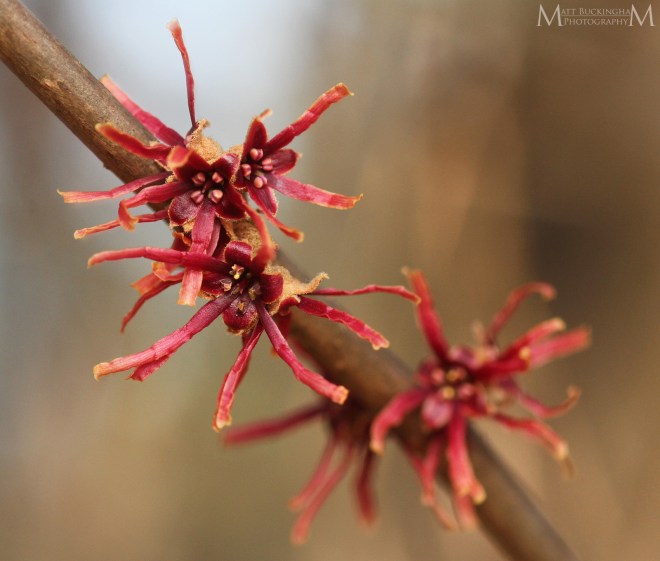
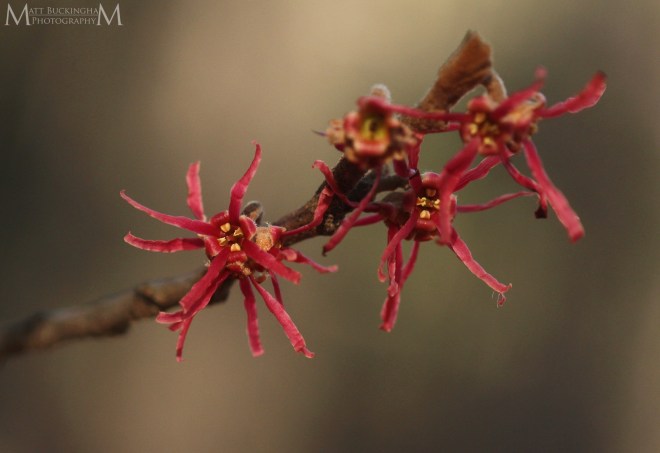
There are three species of Hamamelis a.k.a. Witch-hazel in the United States.  All three species occur in East Texas, and today I present two of them.  Witch-hazel was an important plant for native cultures and settlers, both for its wide range of uses and associated folklore.

Witch-hazels contain a variety of medicinal compounds.  Native Americans used witch-hazel extract to treat skin conditions, swelling, inflammation, burns, insect bites, poison ivy, stomach issues, colds, and more.  Early settlers adopted these uses, and with-hazel extract is still used today for a multitude of skin products including aftershave.

Witch-hazel twigs were also frequently used for “witching for water”.  Also known as “divining”, witching involves walking while lightly holding a forked twig at the points of each side of the split.  Legend has it when the twig passes over water, the opposite end will point toward the ground.

Once while visiting an East Texas old graveyard with long-time resident and expert on everything East Texas, Keith Stephens, he told me and the group we were with a legend I hadn’t heard.  This legend states that if one carries a small witch-hazel twig in each hand pointing straight in front of them, the twigs will turn to the right or left when passing over the grave of a woman.  Every member of the group proceeded to try, and it proved true for each of us.  Perhaps there is a little magic in this interesting genus.

Their blooms certainly seem to be magical, blooming at the height of winter when no other plant dares to.  I’ve seen them bloom from mid December to mid January.  It seems foolhardy for a plant to bloom at this time, but by doing so they receive little to no competition from other species for hungry pollinators.  Though few insects are active this time of year I have observed several hover flies visiting the same witch-hazel shrub on a cool January day.

The most common and wide-spread species of witch-hazel in the U.S. is the American Witch-hazel (Hamamelis virginiana).  In Texas it ranges over much of the southern Pineywoods with a disjunct population in the Edward’s Plateau.  It can be identified by its pure yellow flowers.

IMG_1696

American Witch-hazel

The Big-leaf Witch-hazel (Hamamelis ovalis) was only recently discovered in Texas.  This species was first described in 2006.  At the time it was thought to be restricted to just a single site in Mississippi. Shortly after it was discovered at a handful of other sites in Mississippi and Alabama.  A couple of years ago it was found in the rich forested slopes of extreme eastern Texas. Though it may yet be discovered in parts of Louisiana, it appears to exhibit an interesting disjunction noted in a number of other species in the coastal plain.

IMG_1737

Big-leaf Witch-hazel

The flowers of Hamamelis ovalis are generally maroon or wine-colored, however they can occasionally be orange or bi-colored, with orange centers and yellow petal-tips.

IMG_1534

Big-leaf Witch-hazel

Observing the witch-hazel in winter helps to satisfy the wildflower withdrawal that tends to come with winter.  Fortunately here in East Texas our winters are fairly short, and in just a few short weeks we should begin to see the blooms of our brilliant spring ephemerals!

Christmas in November

IMG_7662

Soapwort Gentian

Target Species: Soapwort Gentian (Gentiana saponaria)

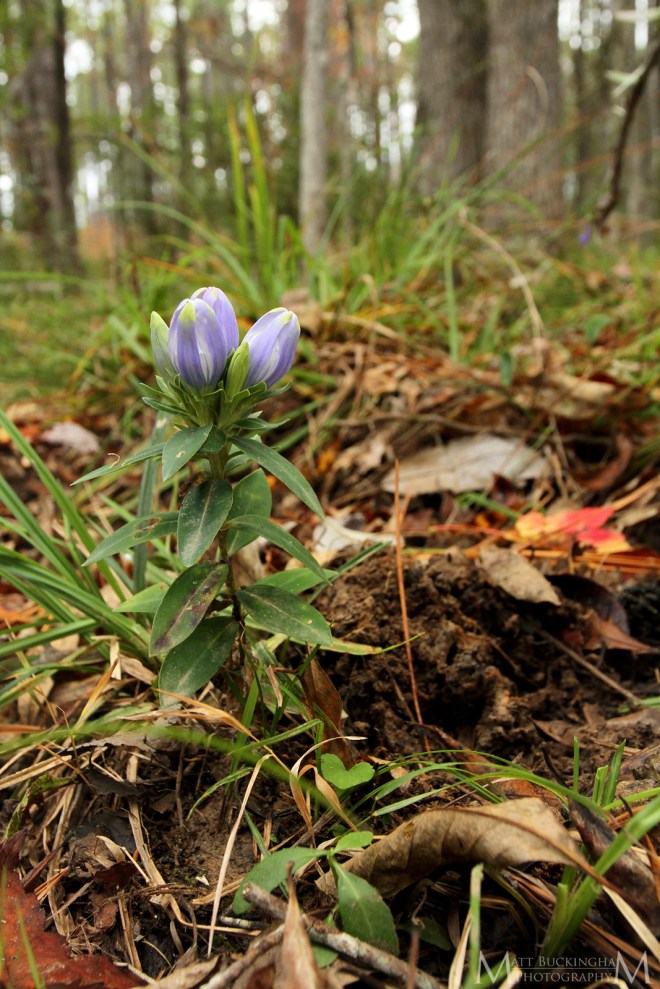
One of our country’s more enigmatic plant genera is Gentiana.  Spring may be more often associated with wildflower blooming, but many of the brightly colored species of this genus bloom in the fall, and in the case of Gentiana saponaria in Texas, into the winter.  The genus is also unusual in that many of its flowers do not open, remaining forever in a bud-like state, despite having fully developed sexual organs hidden within the closed petals.

IMG_7636

Soapwort Gentian

Gentiana saponaria is one of a suite of species that reach the southwestern extent of their range in extreme Eastern Texas.  In Texas it is very rare, probably occurring in five or less populations.  While elsewhere within its range it might occur in prairie remnants and moist woodlands, in East Texas they seem to be confined to a few mature forested seeps nestled within longleaf pine savannahs.  Associated species include Pinus palustrisMagnolia virginianaNyssa bifloraAcer rubrumPlatanthera ciliarisVeratrum virginicumEutrichium fistulosumOsmundastrum cinnamomeum, and more.

County-level distribution of Gentiana saponaria.  Yellow counties indicate that the species is present and rare.

Soapwort Gentian has been on my radar for several years now.  Very few pictures from Texas exist, and I suspect that reflects that very few people have seen this plant in Texas.  Being at the periphery of its range, suitable habitat in East Texas is likely at a premium.  Despite their preferred habitat appearing to be relatively common in Deep East Texas, this plant persists at only a handful of sites.  It is likely that there are other factors influencing its distribution that we don’t fully understand.

IMG_7619

Soapwort Gentian

The perpetually closed nature of this gentian’s blooms has always intrigued me.  It is likely pollinated primarily by bumble bees and large beetles, which are strong enough to push their way through the closed petal lobes.  It may also, however, be pollinated by tiny beetles that are small enough to work their way between the tiny gaps at the tip of the blooms.  Throughout its range the flowers of Gentiana saponaria vary from white to electric blue to purple.  In Texas, the buds are lime green as the develop, and as the flower matures it turns sky blue.  Then, as it fades, it gradually turns to deep purple and ultimately tan before it withers.  My friend and author of Wild Orchids of Texas, Joe Liggio likened the blooms to a cluster of Christmas lights, a fitting description if you ask me.

IMG_7614

Soapwort Gentian

The genus Gentiana has long history of utilization for its medicinal properties.  The root has a multitude of purported uses including as an remedy for snakebite, digestive issues, and a variety of other ailments.  Compounds from the roots have proven to be anti-inflammatory, antiseptic, and beneficial for the treatment of liver disease.

IMG_7602

Soapwort Gentian

To see this plant, I communicated with some contacts with the National Forests and Grasslands of Texas.  They pointed us in the right direction, and the first weekend of November Carolina, our friend Scott and I set out to look for them.  We found dozens of plants scattered along the upper reaches of a baygall within a fairly extensive rolling longleaf pine savannah.  The baygall is partially fed by a small springfed stream.  The plants were growing along the banks of the stream and in the drier portions of the baygall.

IMG_7646

Soapwort Gentian

After spending some time at this site, we explored some other baygalls in the area.  After striking in several areas, we found a handful of plants at what we suspect is a new location for this species in Texas.  I sent the information to the Forest Service, and they confirmed that it had not been previously documented in that area.

IMG_7595

Soapwort Gentian

An added bonus of searching for wildflowers in autumn is the fall foliage, set ablaze by the annual process where leaves break down chlorophyll to reveal their other brightly colored pigments.  Though it was still early in the season, that day we admired the changing colors of elms, maples and hickories.  Perhaps most striking were the fronds of Cinnamon Fern within the baygalls, that looked more like flickering flames than once lush Pteridophytes.  Though there are a few more species that may bloom into December, photographing Gentiana saponaria essentially brings a close to the East Texas wildflower season, and I can definitively say that I went out on a high note.

IMG_7670

Autumn in the Baygall

October Recap

IMG_7302

A rich mesic forest dominated by American Beech and other hardwoods

October was a productive month.  I was able to photograph another six species on my biodiversity list:

Rainbow Scarab (Phanaeus vindex)

Black-tailed Rattlesnake (Crotalus ornatus)

Button Cactus (Epithelantha micromeris)

Lacespine Nipple Cactus (Mammillaria lasiacantha)

Living Rock Cactus (Ariocarpus fissuratus)

Great Plains Ladies’ Tresses (Spiranthes magnicamporum)

2017GoalsOct

East Texas generally experiences its first significant cold fronts in October, providing our first real relief from the sweltering summers.  These cool days are the perfect time to wander around in the woods.  This year Carolina and I spent a few days in the rich mesic American beech slopes, where we searched for rare plants and early signs of fall color.

Though not particularly rare, the American Strawberry Bush (Euonymus americanus) displays its bizarre fruits in the fall.  Also known as “Hearts-a-burstin”, the fruits of this small shrub generally resemble strawberries when closed, but are hard and inedible.  In the early fall the break open to reveal the large red seeds within.

IMG_6280

Fruits of the American Strawberry bush

The Tall Rattlesnake Root, or Tall Wild Lettuce (Prenanthes altissima) is very rare in Texas, known only from a few sites in Jasper and Newton Counties.  Here it is at the southwestern extent of its range.  It occurs along small streams in rich mature hardwood dominated forests.

IMG_7277a

Tall Rattlesnake Root

Always found among the roots of its host plant, Beechdrops (Epifagus virginiana) is parasitic on the roots of American Beech.  This bizarre plant lacks chlorophyll and is entirely dependent on its host for energy.

IMG_7137

Beechdrops

After a long day of botanizing, I spotted the unmistakable form of a Canebrake Rattlesnake (Crotalus horridus) crossing the road. The sighting was remarkable, and special to me, in that it occurred on the 2nd busiest highway in my county. It had made it most of the way across two lanes of traffic, and was nearly across the shoulder when I spotted it. I quickly turned around, worried that some vehicle would come from behind and purposely put an end to this beautiful creature, an all too common occurrence here, perpetrated by the unsympathetic and uninformed. Fortunately it made it safely across the pavement, and I watched as it inched across the right-of-way toward the dense forest beyond.

This encounter also helped remind me that sometimes there are more important things than getting the shot. I’ll admit, I hoped very much to capture a spectacular image of this three and a half foot beauty. But as I tried to balance poor light, a multitude of onlookers passing by at 70 miles an hour, and issues with trespassing, I realized that not only was it futile, but completely unnecessary. Simply spending a few moments with this incredible creature was more than enough.

IMG_7368

Canebrake Rattlesnake

A Fall Rarity

Target Species: Barbed Rattlesnake Root (Prenanthes barbata)

IMG_6384

Barbed Rattlesnake Root

In late summer and early fall the nodding blooms of the Barbed Rattlesnake Root (Prenanthes barbata) unfurl.  It is a member Asteraceae, commonly referred to as the composite or sunflower family.  The genus Prenanthes earned the common name rattlesnake roots from their early use as a treatment for venomous snake bites.  This treatment involved consuming the plants’ milky white sap, a bitter substance produced by the plants to deter predators, and applying a poulstice of the plants’ leaves directly to the wound.  Rattlesnake root has served other medicinal purposes for native tribes and early settlers, including use a treatment for dysentery and diarrhea.  Perhaps most interestingly, some believed that smearing the juice of rattlesnake roots on one’s hands would make them invulnerable to venomous snakes.  I found this quote from William Byrd of early colonial Virginia about a closely related member of the genus Prenanthes:

…the rattlesnake has an utter antipathy to this plant, in-so-much that if you smear your hand with the juice of it, you may handle the viper safely. Thus much can I say of my own experience, that once in July, when these snakes are in their greatest vigor, I besmear’ed a dog’s nose with the powder of this root and made him trample on a large snake several times, which however, was so far from biting him that it perfectly sicken’d at the dog’s approach and turn’d its head from him with the utmost aversion.”

IMG_6346

Barbed Rattlesnake Root

In East Texas Barbed Rattlesnake Root occurs in rich mesic forested slopes and moist flatwoods.  Elsewhere in its range it may occur in dry mesic sandy uplands, prairie remnants, and the margins of barrens and glades.  In general it is found on calcareous soils (those which are rich in calcium carbonate).  It is rare throughout its range, and in Texas it seems to have declined dramatically in recent decades as a result of habitat loss and land use conversion.  In Texas it is often found with other rare and declining species like Bloodroot (Sanguinaria canadensis) and the Kentucky Lady’s Slipper (Cypripedium kentuckiense).

Nabalus barbatus

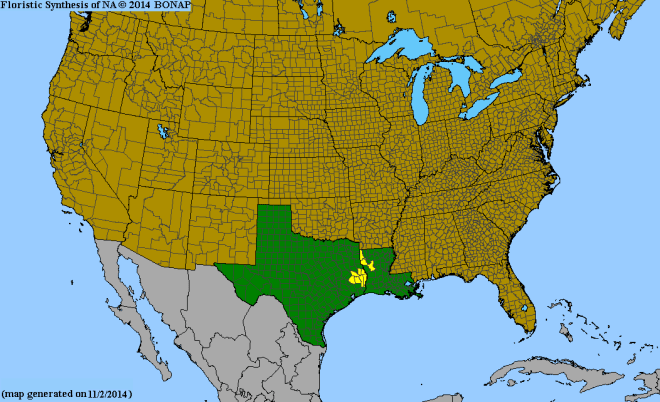
County level distribution of Prenanthes barbata.  Yellow counties indicate that the species is present and rare.

Prenanthes barbata is a striking plant.  It may reach heights of 5 to 6 feet and a single plant may contain dozens of flowers.  We found them at a few locations in East Texas growing on steep slopes grading into small to mid-sized streams.

IMG_6182

Barbed Rattlesnake Root

Prenanths barbata is one of East Texas’s many interesting fall-blooming plants.  Over the coming weeks I hope to document more of these species before winter all but halts flowering activities until spring comes again, to revive the botanical world.

Blaze of Glory

Target Species: Gulf Blazing Star (Liatris tenuis)

IMG_5296

One of the Gulf Coastal Plain’s major centers of endemism occurs in the Pineywoods of East Texas and western Louisiana, and to a lesser extent southeast Oklahoma and southwest Arkansas.  Many of these species are concentrated in the xeric sandhills and longleaf pine savannahs of the region.  The Gulf Blazing Star (Liatris tenuis) is one such species.  It primarily occurs in longleaf pine savannahs, sandhills, and sandstone barrens.

Members of the genus Liatris can be difficult to differentiate.  Two similar species, Liatris squarrosa and Liatris squarrulosa can occur in similar areas.  L. tenuis is best identified by its narrow leaves, few florets per head, and short involucre.

Liatris tenuis

One possible explanation for the high levels of endemism in the longleaf pine and xeric sandhill communities is a break in the range of longleaf pine and bands of geological formations with deep sand deposits created by the Mississippi River Delta.  This has created barriers to gene flow for species with very specific habitat requirements.  This isolation has led to the evolution of different lineages, resulting in speciation over time.

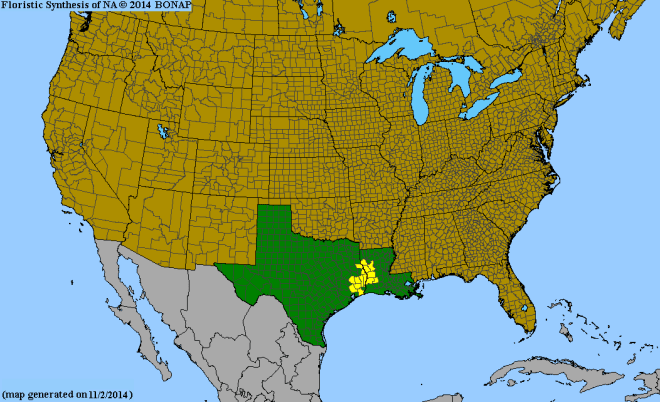
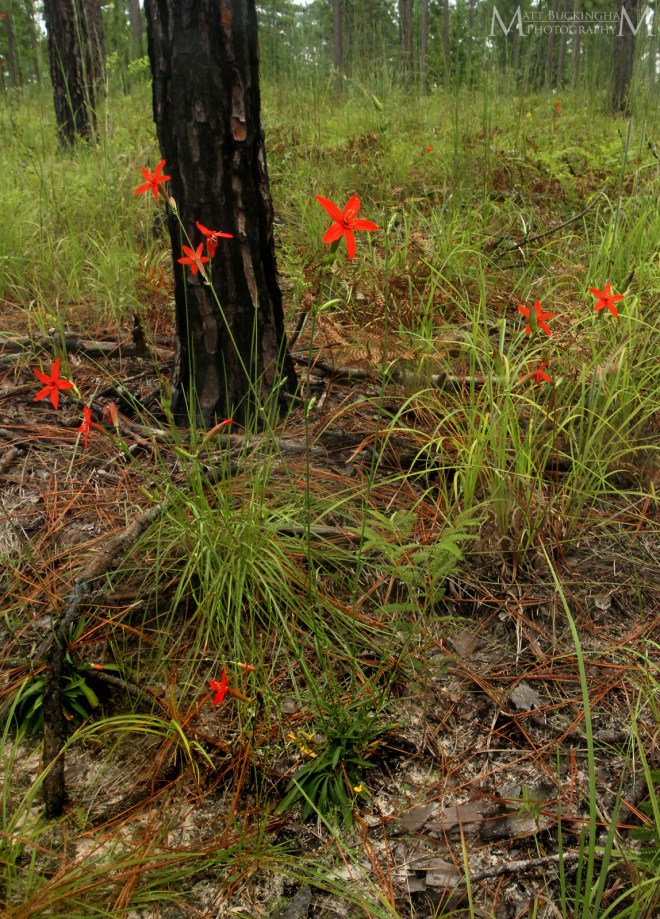
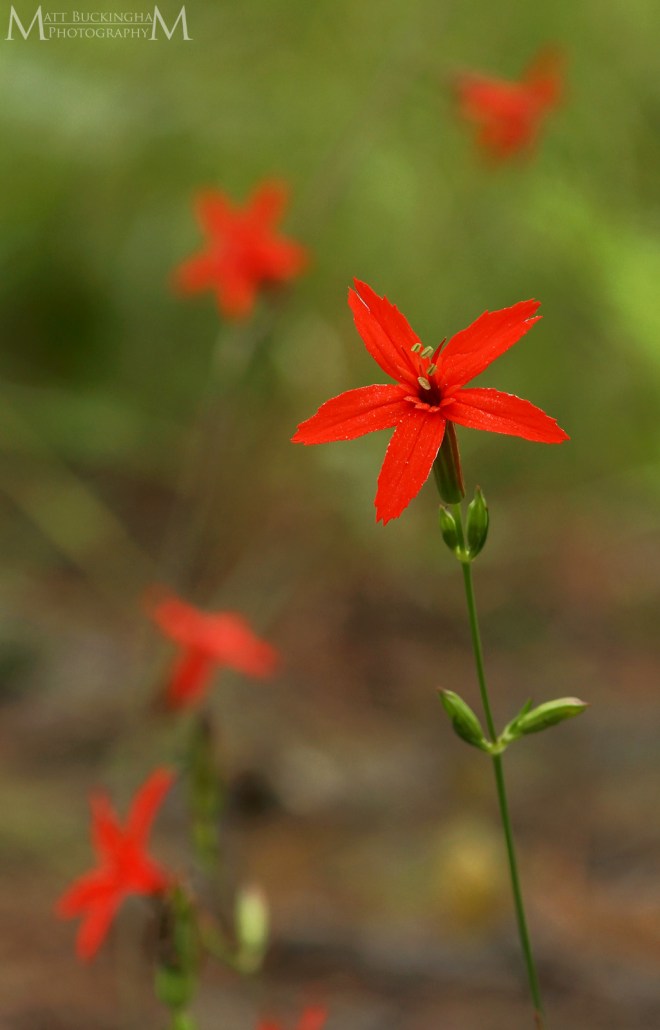
Another endemic of the West Gulf Coastal Plain that can often be found growing in close proximity to Liatris tenuis is the Scarlet Catchfly (Silene subciliata).  This aptly named catchfly blooms from mid summer through most of the fall.

IMG_5277

Note the similarity of range between Silene subciliata and Liatris tenuis.  As mentioned before, this same pattern is shared by many of the Pineywoods’ plant species.  Silene subciliata occurs on deep sands in longleaf pine savannahs and xeric sandhills.

Silene subciliata

Both L. tenuis and S. subciliata are species of conservation concern in both Texas and Louisiana, where they are formally listed on the state’s rare plant lists.  Like so many species of the longleaf pine savannahs, their numbers of been reduced dramatically by loss of habitat and land use conversion.  Today they remain in only a handful of scattered populations.  Fortunately some of these have been protected by entities like the U.S. Forest Service, Big Thicket National Preserve, and the Nature Conservancy of Texas.

IMG_5192

IMG_5227

July Recap

IMG_3479

Cow Killer

July has been my most productive month yet.  Due in large part to a trip to the Davis Mountains I was able to check 7 species off my list:

Spider Lily (Hymenocallis occidentalis)

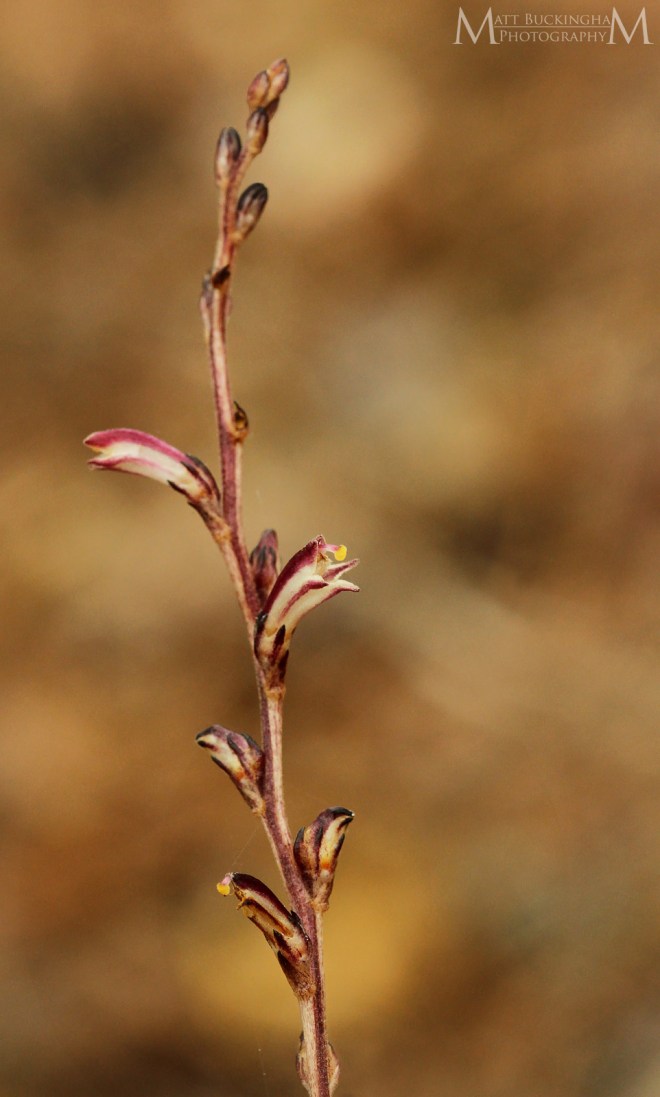
Texas Coralroot (Hexalectris warnockii)

Glass Mountain Coralroot (Hexalectris nitida)

Giant Coralroot (Hexalectris grandiflora)

Mexican Catchfly (Silene laciniata)

Glorious Scarab (Chrysina gloriosa)

Canyon Tree Frog (Hyla arenicolor)

2017GoalsJuly

One of the most interesting photographic experiences of July came toward the end of the month, when a female Red Velvet Ant a.k.a. Cow Killer (Dasymutilla occidentalis) came wandering through our yard.  These large wasps have always fascinated me, and I’ve long wanted to get a good photo of one. I’ve tried a few times in the past but found them nearly impossible to photograph. They are surprisingly fast and never stop moving.  The females are flightless, while the males are winged.

Despite their ominous name, which eludes to their supposedly highly painful sting, my wife offered to help. I captured it in a cup and then led it onto a 3-foot long stick. My wife held the stick, switching hands as it paced rapidly from one end to the other. Occasionally it would stop at the edge for the briefest of moments. I ended up taking over 100 shots. I got some that were very sharp, but she was in an awkward position, and others where she was in the perfect position, but the focus wasn’t right. This one ended up being my favorite. When we finished I let her continue on its way.

Cow killers are parasites of parasites, and when we encountered her I assume she was on the hunt for a suitable host for her offspring. They seek out the larvae of Cicada Killer wasps (Sphecius speciosus), and lay their own eggs into the larvae of the Cicada Killers, which have been laid on a live, paralyzed cicada. They will also parasitize a number of other ground nesting wasps and bumblebees.

In early July I went to visit a population of Crested Coralroot (Hexalectris spicata) in the Davy Crockett National Forest.  Despite significant damage from feral hogs to the dense leaf litter at the site, I found several blooming plants.  Though most were past their prime, i found a few fresh, interesting blooms.  It’s hard to imagine a flower having a personality, but the flowers of Hexalectris spicata certainly look like they could.

IMG_0876

Crested Coralroot

En route to the Crested Coralroot spot I stopped along a forest road to relieve myself.  As I was doing so I spotted several Little Ladies’ Tresses (Spiranthes tuberosa) blooming alongside the road.  These diminutive orchids bloom in the summer in open woodlands.

IMG_0924

Little Ladies’ Tresses

I photographed this Bog Coneflower (Rudbeckia scabrifolia) in a herbaceous seep on private land.

IMG_0935

Bog Coneflower

I have been wanting to photograph Climbing Milkweed (Matelea decipiens) for a while.  I found a plant with a single cluster of blooms along a springfed stream.

IMG_0992

Climbing Milkweed

The striking Blue Waterleaf (Hydrolea ovata) is common in herbaceous wetlands in the eastern third of the state.

IMG_1097

Blue Waterleaf

Hydrolea ovata can often be found growing with Looseflower Water-Willow (Justicia lanceolata).

IMG_1132

Looseflower Water-Willow

Toward the end of the month I visited a high quality longleaf pine savannah on private land with my friend James.  During our visit we were fortunate to catch the rare Scarlet Catchfly (Silene subciliata) in bloom.

IMG_3250

Scarlet Catchfly

I’ll end my July recap with a photo of a Slimleaf Milkweed (Asclepias stenophylla) that we saw on our way back from Dallas, where we photographed Hexalectris warnockii and H. nitida in early July.  This is one of the rarer milkweeds of Texas. It is primarily a species of the Great Plains, occurring on dry, sandy prairies that have not experienced significant soil disturbance. In Texas it occurs in scattered populations from the Rolling Plains to the Blackland Prairies, where it appears to be rare and declining.

IMG_1626

Slimleaf Milkweed