Beach Tigers

Target Species: Eastern Beach Tiger Beetle (Habroscelimorpha dorsalis)

IMG_1363

A Tiger’s World – Eastern Beach Tiger Beetle

Sunday, August 5

I didn’t know what to expect, as we set out toward the coast.  We woke up late this morning, and I had no plans save to relax after a weekend of chores.  Carolina, however, had other plans, and presented me with an interesting idea.  She wanted to head down to explore the coast where Texas and Louisiana meet.  Outside a couple spring birding trips to the area over a decade ago, I had spent little time in that area, so I jumped at the idea.  By 11 am we were off.

This stretch of beach is actually the closest to our home, yet we always opt for the more obvious choice of Galveston Island and the Bolivar Peninsula.  The skies were gray as we made our way south on the Big Thicket National Preserve Parkway.  Just south of Woodville it began to rain, hard.  We wondered if this spur the moment trip would turn into a bust.  It rained almost until Beaumont, but stopped shortly after.  The storm left in its wake a thin veil of wispy clouds that dulled the sun’s rays.

We first made our way into southwestern Louisiana, and as we crossed Sabine Lake, a vast swath of coastal marsh came into view.  It was a beautiful thing to see, as Tricolored Herons, Roseate Spoonbills, Black-necked Stilts, and a wary Clapper Rail patrolled the roadside ditches.  We passed an American Alligator resting haphazardly a few feet from the shoulder of the roadway.  Before long we found a secluded stretch of beach and decided to sink our toes into the sand.

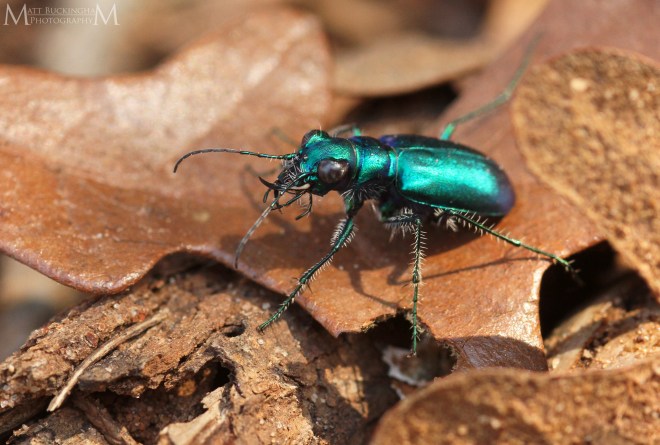
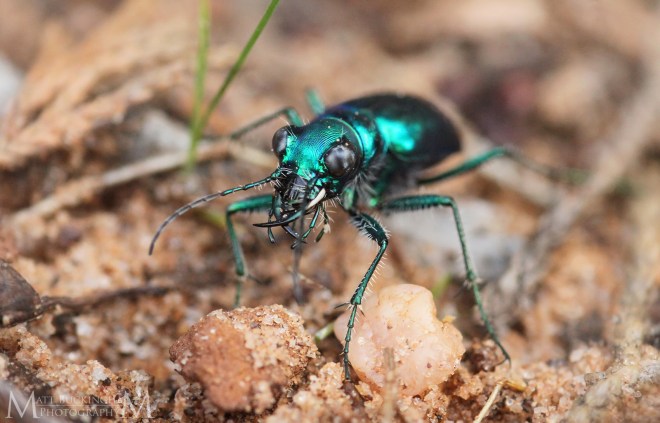
The coarse chatter of Royal Terns and Laughing Gulls filled the air as we scoured the beach.  I had no expectations for the day’s adventure, but that soon changed, when I saw a series of tiny blurs scatter before me.  There, where the gentle surf lapped at the sandy shore, I spied the Eastern Beach Tiger Beetle (Habroscelimorpha dorsalis).  This was a species on my list of biodiversity goals, and I came across it by the pure luck and happenstance of a spontaneous trip to the beach.

The first thing that struck me was the sheer number of them.  There were hundreds, the beach was literally crawling with them.  This is significant, I should note, as this species is rare and declining throughout its range.  They are dependent on pristine beaches and do not fare well in the face of human disturbance.  The northeastern subspecies (H. dorsalis dorsalis) has become so rare that it has been listed as a Federally Threatened species.

The reason it was so abundant here, I presumed, was that this particular stretch of beach was inaccessible to vehicles, and despite being undisturbed it was not particularly scenic, and therefore likely sees little human traffic.  In fact, we saw no evidence that anyone had been here for some time.

So I set out to photograph these little beach jewels.  Easier said than done.  The beetles were incredibly wary, and I couldn’t get close.  I did get one shot from above (the first image in this blog), which I think really communicates the natural history of this species.  It shows the beetle very small in the frame within a tiny patch of sand, likely no more than a few square feet.  Though seemingly minuscule to us, it is a vast landscape to the tiger.  They live out their entire lives on these tiny beaches, following the water’s edge with the ebb and flow of the tide, voraciously hunting down anything they can get their jaws around.  Even their larvae make their burrows in the sand just beyond the high tide line.

After several frustrating minutes I developed a strategy.  Ideally one would be armed with a 180 or 200mm macro lens and extension tubes to photograph such a tiny, elusive quarry.  Unfortunately I was only armed with a 100mm macro.  This meant I had to get close.  Very close – within a foot to capture the kind of image I was after. At first I tried belly crawling toward them, a strategy I have successfully used with other tigers.  They weren’t having it.  Any movement whatsoever sent them scattering.

They were so abundant here, that I thought to myself, what if I just lie in wait.  So I did.  Eventually they became somewhat accustomed to my presence.  If I could find a distant beetle moving in my direction and set it in my viewfinder, I could slowly change my focus as it moved closer and closer.  And so I had solved the problem of how to get close.  But before I could celebrate my victory, another problem presented itself.  On their endless pursuit of prey, they are constantly scurrying.  Tiger Beetles are, in fact, among the fastest organisms on the planet with respect to their body size.  I have read that they have to stop every second or so in order to reassess their surroundings, as they move so fast that they have trouble seeing the world around them when in motion.

But when they do stop, it is only for the briefest of milliseconds.  Not much time for me to adjust my focus.  And when shooting macro at this scale, focus is everything.  The beetles’ eyes and jaws need to be in focus to draw the viewer in.  So I ended up with dozens of shots that were just slightly blurred or had the focus just behind the eyes.  I was frustrated.  Then I saw a beetle that was moving much more slowly, stopping more frequently, and for longer.  And as luck would have it, it was coming my way.  Ecstatic, I fired away and captured a few shots in good focus.  It was only after I processed the image that I noticed it was missing the tarsus on one leg and had a large grain of sand on its mandibles.
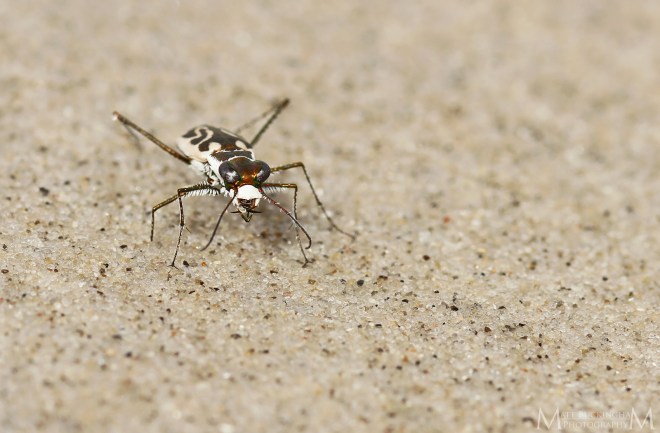
IMG_1477

Eastern Beach Tiger Beetle

Though this hardened veteran of the Louisiana shore was interesting, it was not the image I was hoping for.  It’s hard to complain, however, when spending a day surrounded by such rare natural wonders.  I was getting nowhere fast with my efforts to photograph these beetles, so we spent some time combing the beach and swimming in the Gulf (despite the numerous warnings about bacteria levels).

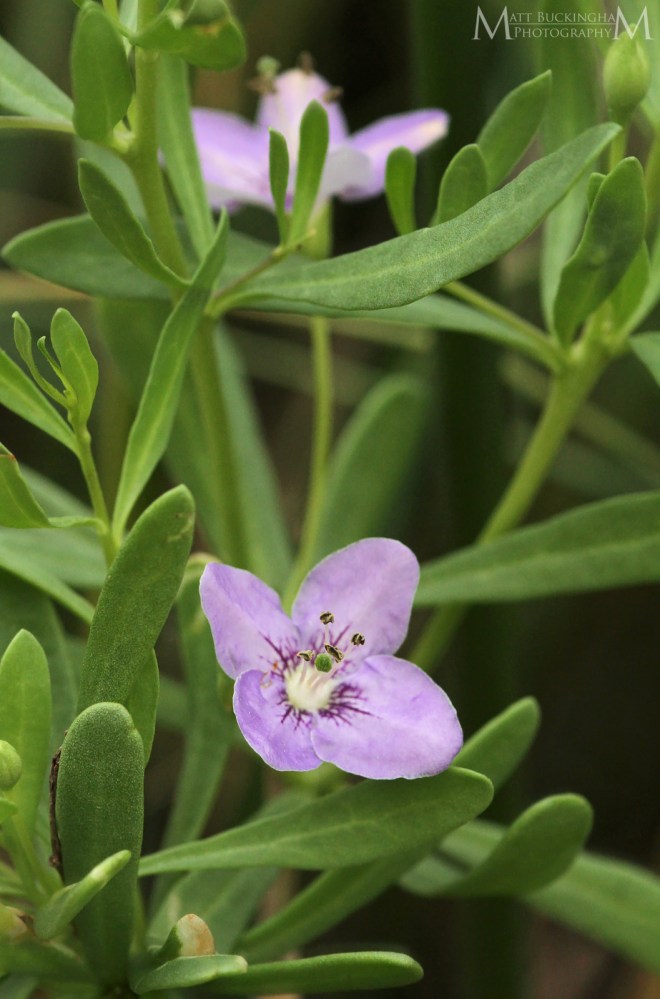
That evening we crossed back into Texas and made our way to Sea Rim State Park.  Before heading back to the beach, we explored some of the surrounding marshlands.  Here we found a few Carolina Wolfberry (Lycium carolinianum) plants in bloom.  This halophytic (salt-loving) species occurs primarily along the coast of the southeastern U.S., with some inland populations in parts of Texas and Mexico.
IMG_1613

Carolina Wolfberry

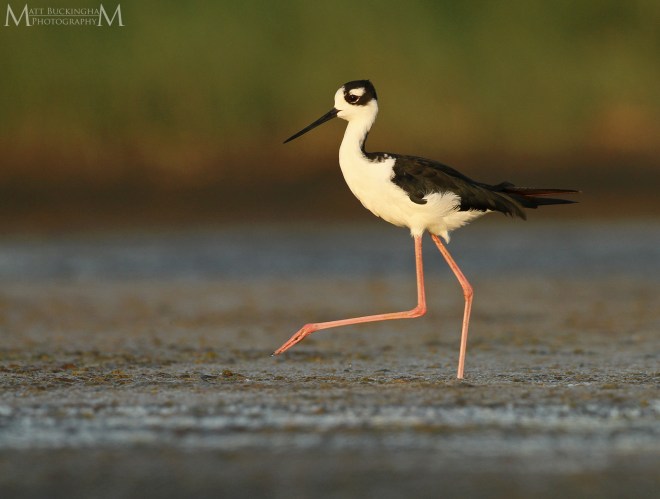
The scattered pools in the saltmarsh were flush with bird activity.  I set my sights on a group of Black-necked Stilts (Himantopus mexicanus) and laid on my side at the marsh’s edge.  The light was fading and the mosquitoes were relentless (seriously).  But I endured this discomfort to try to capture some images of these bizarre shorebirds.

IMG_1706a

Black-necked Stilts

As I was photographing a distant group, a very vocal stilt flew in and landed close, apparently oblivious to my presence.  I was able to capture a few images before it wandered off to join the others.

IMG_1750ab

Black-necked Stilt

IMG_1766a

Black-necked Stilt

After photographing the stilts we went back to the beach, and I reveled in my own insignificance as I looked out onto the swaying waters of the Gulf.  We took to the water and enjoyed the day’s transition into dusk.  We then drove home, guided by the yellow lights of oil refineries that dotted the horizon like distant cities.  A sign of the times, I thought.

Friday, August 10

I still had tiger beetles on the brain as we made our way to Houston on this morning.  We had a meeting in the city, and had decided that afterward we would spend the remainder of the weekend on the coast.  After the meeting we drove to Port Arthur, checked into our hotel, and made our way back into Louisiana.  It was late afternoon when we arrived, and I was excited to once again try my luck photographing the beach tigers.

I laid down to try my proven technique once more, and soon encountered another problem.  While it was cloudy on my first attempt, today was sunny, and my head cast a broad shadow directly in front of me.  So now I had a narrow band of light on either side of the shadow that wouldn’t be too harsh or directional for photography.  I could have alternately tried to set up a flash system, but I decided instead to see if I could capture some images in natural light.

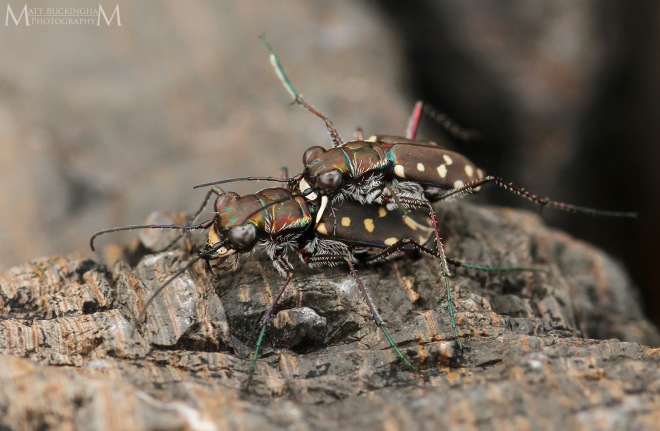
I had read that mating in the Eastern Beach Tiger Beetle typically occurred in the late afternoon and early evening.  It has been my experience that copulating beetles are much easier to approach, so I hoped I may be able to come across a mating pair.  After many failed attempts at single beetles I did find a coupled pair.  I managed to get a bit closer before the female finally shook the male off and they both scattered.

We spent the rest of the evening exploring the beach, the marsh, and a handful of scattered woodlots that no doubt hosted thousands of Neotropical migrant songbirds in the Spring.  On our drive back to the hotel the night sky was again interrupted with the distant lights of refineries, lighting up the night sky like dull orange stars.

IMG_2063

Copulating Eastern Beach Tiger Beetles

Saturday, August 11

Today we slept in a bit.  We spent the morning exploring the area around Port Arthur, and taking in the devastating toll that Harvey had on the residents of the region.  Such hurricanes, while undeniably tragic, are a normal occurrence which helped shape the natural communities of the coast. These systems evolved under the periodic disturbance of these strong storms.  This was evident as we drove through McFaddin National Wildlife Refuge, where the marsh looked as vibrant and healthy as ever.  I wondered how the tiger beetles weathered the storm, for their population certainly seemed as robust as ever.  Perhaps they too benefit from the storm’s aftermath in some way.

After exploring McFaddin and catching up with a friend from College who works the Chenier Plain Wildlife Refuge Complex, Caro and I made our way to Sea Rim.  Here driving is permitted on the beach, and I struggled to find beetles.  In fact, the only place where I found them abundant was in a small football field sized area closed off to vehicular traffic.  Here I found a few Habroscelamorpha dorsalis and several Coastal Tiger Beetles (Ellipsoptera hamata).  E. hamata is much larger and more approachable than H. dorsalis.  I found that my belly crawl technique worked well with them, and I managed to capture a few images.

IMG_2142a

Coastal Tiger Beetle

E. hamata occupies a broader range of habitats than H. dorsalis, occuring further into the dune and swale complex and salt flats adjacent to the beach.  The pattern of the maculations on their elytra are intricate and breath-taking when viewed close.  I watched them through my viewfinder, and smiled as the relentless Gulf breeze blew their antennae like errant strands of hair.

IMG_2149

Coastal Tiger Beetle

As the sun drew nearer to the horizon we set out to try our luck once more with the comically proportioned Black-necked Stilts.  Stilts have the longest legs relative to body size of any bird native to North America.  They can be found year-round on the Texas Coast.

IMG_2180a

Black-necked Stilt

IMG_2197

Black-necked Stilt

We returned to the beach when the sun was all but gone and the mosquitoes of the marsh had drank their fill.  We laid in the shallow water and watch as dusk painted the world.  The sand, the sky, the water, it all appeared the same hue of dull pink for a brief moment in time.  It was a fine end to a fine day.

Sunday, August 12

My original plan was to wake very early this morning and head out to the Marsh to capture some images as day broke.  The pillow had other plans for me, however, and we slept in until around 8:00.  I felt better as I looked out the window to gray skies.  The plan was to head back to southwest Louisiana for one last effort to photograph the Beach Tiger Beetle.  I still hadn’t captured “the one” – the image I was after.

It was still overcast when we arrived at the beach.  The Beach Morning Glory (Ipomoea imperati) was open.  These large, showy blooms open early and wither by mid day.   It is a plant adapted to the harsh conditions of the beach, and is primarily restricted to the sandy complex of dunes and swales adjacent to the shore.

IMG_2319

Beach Morning Glory

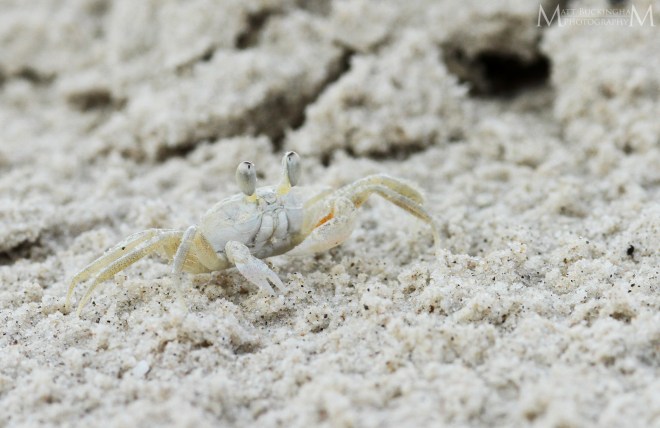
As I was made my way down the beach I caught site of the slightest hint of movement.  It was a juvenile Atlantic Ghost Crab (Ocypode quadrata)!  It scurried across the sand like a wispy cloud moving against a background of gray.  I had long wanted to photograph this ethereal beach dweller, but despite having seen many large adults, I could never quite get close enough for a good shot.  This juvenile, however, allowed me to approach close enough to capture it with my macro lens.

IMG_2342

Atlantic Ghost Crab

IMG_2360

Atlantic Ghost Crab

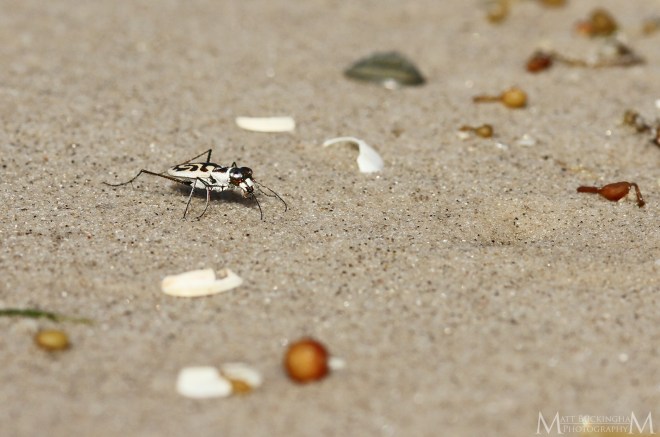
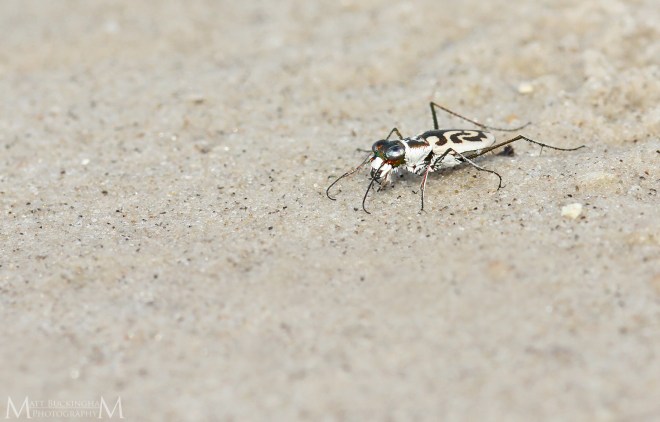
Satisfied with my Decapodean encounter, I moved to the water’s edge, where the Eastern Beach Tiger Beetles were hard at work, hunting and scavenging along the miniature wrack of shells and debris.  The light was good, and I settled in with my camera in hand.  Watching these remarkable insects through the viewfinder offered me a rare chance to capture a glimpse into their miniature world.  The subspecies in Louisiana and Texas is H. dorsalis venusta.  It is the smallest, and most boldly patterned of the H. dorsalis subspecies.
IMG_2391

Eastern Beach Tiger Beetle

It wasn’t long before they came scurrying in.  However, once again I found my 100mm macro to be a bit too short.  Capturing that perfect image was further complicated as I noticed that most beetles were thermoregulating in the relatively cool morning, keeping their bodies close to the ground wherever they stopped.  Not one to be dissuaded, I set out to make my best of the situation.  Unfortunately my camera had other things in mind, and as I was reviewing images I began to receive error messages from my card and camera.  Something was wrong, and several of the images had not recorded.
IMG_2416b

Eastern Beach Tiger Beetle

By this point my frustration had got the better of me, and I wondered if I just simply was not meant to photograph this beetle!  I went right away to download the images, and fortunately I was able to recover some of them.  In the end, the images I have included in this blog were the best I was able to get.  And while they may not be exactly what I had hoped for, I was happy with them.  I have since changed the card in my camera and it seems to be working fine.

With that, we left the beach and made our way north through western Louisiana.  The marsh in this part of the country is spectacular, and in some areas we could see a seemingly endless expanse of wetland grasses, sedges, and rushes.  I admired the subtle change in color and texture as broad stretches of Spartina grass were broken by pockets of Black Needlerush.  Eventually the marsh changed from saltmarsh to brackish to freshwater.  Before long we glimpsed our first oak trees, followed shortly by stunted pines.  And just like that, we were back in the Pineywoods, albeit the Louisiana side of things.

Tiger beetles are fascinating creatures, and photographing them can easily become an obsession.  Being so focused on getting the shot can sometime cause me to lose sight of the experience of being present in a place and moment of time.  Interestingly enough, however, by setting my lens on these bejeweled predators I was able to catch a unique glimpse into their captivating lives.  I watched as they stalked down and pounced on tiny flies, excavated burrows in search of some invertebrate prey, and tracked down mates.  Indeed, I can see myself returning at some point in the not too distant future to visit these voracious miniature tigers again.

Spring in the Pineywoods

IMG_3303a

Kentucky Lady’s Slippers – A Gift of Spring

As I sit here typing, we are in the height of August, which has the misfortune of traditionally being our most miserable month – at least climatically speaking.  So as the dried grass crunches beneath my feet and my skin bakes under triple digit temperatures, it’s easy to escape back to a day over four months ago.

It was the last day of March.  There was a definite chill in the air as I set out into the forest.  The gray of dawn was made darker by the the canopy of beech and oak towering one hundred feet above my head.  I worried for a moment that I may not see them – my elusive botanical quarry.  But despite the dim light of the understory, the yellow egg-sized blooms of the Kentucky Lady’s Slipper (Cypripedium kentuckiense) caught my eye like a beacon sent out to some wayfaring sailor, and drew me to them with a siren’s song of its enigmatic beauty.

A few days prior my friend Peter Loos had called and told me that the slippers were out early this year, a full two weeks early.  He also told me that one population, which typically has only a plant or two in flower, was displaying six perfect blooms this year.  If it weren’t for his call, I would have likely missed out on a very special experience.

The soil was cold and damp as I sat, saturated from a previous day’s rain.  It was still to early for photography, the forest too dark to properly render the color of the scene.  So I sat and waited in the company of the forest.  I admired the slippers and the ferns that grew around them.  I listen to the familiar songs of Red-eyed Vireos, Summer Tanagers and Hooded Warblers, and the distant trill of a Northern Parula.  After some time I could see hints of dappled sun in the highest leaves in the canopy.  The forest grew brighter, its colors warmed.  In this new light I could see distant azalea blooms lining the creek downslope.

I had to pay close attention to the light.  There would only be a brief moment for me to capture the image I was after.  That time when the ambient light early morning sun illuminated the forest, but before its rays penetrated the canopy, casting sun spots and uneven light on the forest floor.  Finally the moment was right, and I captured the image above.

Though the end of March may have been the height of the season, spring itself had begun nearly two months prior, when the first of the spring ephemerals pushed their way through the leaf litter.  Perhaps my favorite of these is the Bloodroot (Sanguinaria canadensis), so named for the red sap of its roots that has long been used for a wide range of medicinal purposes.  Bloodroot is now rare in Texas, where it hold on in a few remnant patches of mature hardwood forest.

IMG_5185

Bloodroot – An Ode to Spring

Like the Bloodroot, the White Trout Lily (Erythronium albidum) is one of our first harbingers of spring.  White Trout Lily can be found throughout the Pineywoods.  Though it is common nowhere, it is more frequently encountered in the northern and western portions of this forested ecoregion.  Elsewhere in the state it can be found in some Post Oak Savannah and Cross Timber woodlands.

IMG_5425

Trout Lily

It is not just the rich woods that experience a flush in early spring activity.  In mid February the wetland pine savannahs of East Texas appear bleak, their grasses turned brown by the short days and biting cold of winter.  But it is in that time that the Woolly Sunbonnet (Chaptalia tomentosa) emerges, opening its blooms in the midday sun.

IMG_4921

Woolly Sunbonnet

Though the forest floor may be coming to life, early spring still finds the trees leafless and dreary.  I captured the haunting scene below as a fog rolled in over the Angelina River on a cold day in mid February.

IMG_4637

The Angelina River looks to be a dismal place in early spring.

Even in early March the forest still seems gripped in winter.  At least from a distance…

IMG_6327

A rare waterfall in one of the last patches of old growth forest in East Texas.

IMG_6344

A small stream flows, fueled by spring rains

But closer examination shows that by early March the forest has come alive.  The scene below was captured at our friends Susan and Viron’s land.  Under their stewardship, a spectacular patch of rich mesic forest has persisted.  Here nearly all of the plants that have become exceedingly rare elsewhere in the states, still thrive.  Their forest contains colonies of Yellow Trout Lily (Erythronium rostratum) that cover acres!

IMG_6294

Yellow Trout Lilies – Ephemeral

IMG_6161

Yellow Trout Lilies

Their land is also home to one of only two known populations of False Rue Anemone (Enemion biternatum) in the state.

IMG_6229

False Rue Anemone

Spring Beauties (Claytonia virginica) flourish here as well.  They are one of our most common spring ephemeral, but that in no way diminishes their beauty.

IMG_6248

Spring Beauty

One of the more unexpected denizens of early spring is the Wrinkled Festive Tiger Beetle (Cicindela scutellaris rugata).  Unlike most tiger beetles, which are most active during the summer, the Wrinkled Festive Tiger Beetle is active in the early spring, and by late May are almost impossible to find.

IMG_6089

Wrinkled Festive Tiger Beetle

This jewel-like beetle is restricted to eastern Texas, western Louisiana, and extreme southwestern Arkansas and southeastern Louisiana. Here it occurs in areas with vast expanses of bare sand such as xeric sandhills and sand “blowouts” in the Pineywoods and Post Oak Savannah.

IMG_6099

Wrinkled Festive Tiger Beetle

By mid-March most of the woodlands in the southern Pineywoods had begun to leaf-out.  The scene below was captured in a vast floodplain adjacent Big Sandy Creek in the Big Thicket.

IMG_6062

Vernal

As the freshly emerging leaves hardwoods begin to turn the slopes and floodplains green, a different explosion of color is occurring in a precious few longleaf pine savannahs in the Big Thicket.  At the few sites where it still occurs, the Federally Endangered Texas Trailing Phlox (Phlox nivalis ssp. texensis) reaches peak bloom in mid-March.

IMG_2597

Texas Trailing Phlox

Around the same time, a very different phlox species blooms in the shade American Beech and other hardwoods of rich forested slopes.  Though common throughout much of its range in eastern North America, Wild Blue Phlox (Phlox divaricata) is rare in Texas.  The combination of pale blue blooms, feathery fern fronds and a gnarly old hornbeam created a scene that seemed like something more suited for a Tolkien novel than the Pineywoods.

IMG_2690

Mirkwood

While we’re on the topic of phlox, one can’t drive the backroads of the Big Thicket without admiring the recently described Texas endemic Big Thicket Phlox (Phlox pulcherrima), a member of the Phlox pilosa complex.

IMG_2734

Big Thicket Phlox

With March in full swing, color was coming to all of the vegetative communities of the Pineywoods.  Wright’s Lily (Schoenolirion wrightii), a rare species of glades and barrens came into bloom over deposits of Catahoula Sandstone.

IMG_2666

Wright’s Lily

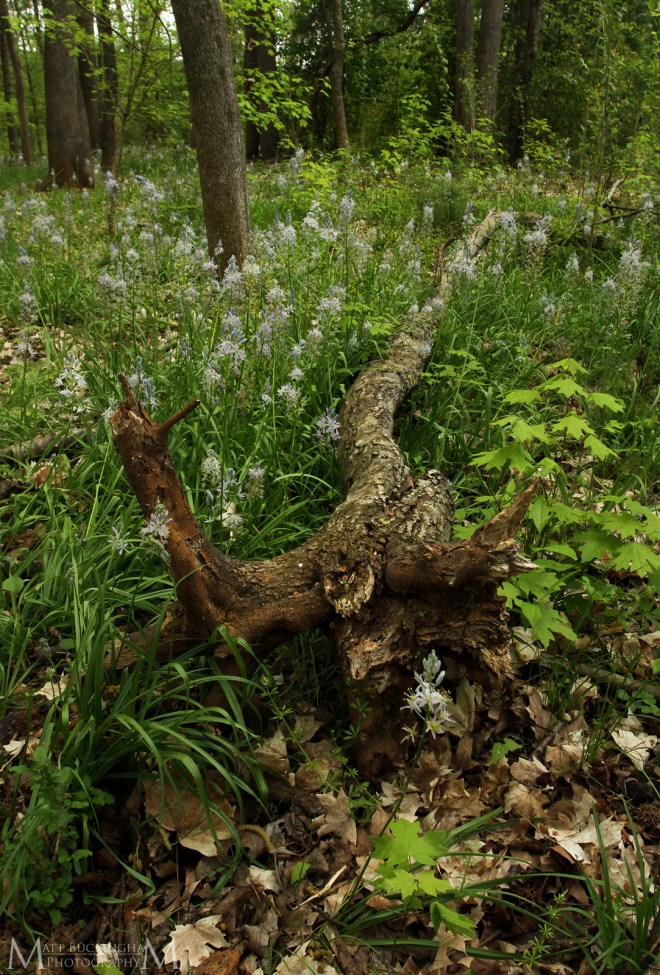
And expansive drifts of Wild Hyacinth (Camassia scilloides) turned the forest floor blue in this woodland in the northern Pineywoods.

IMG_2625

Rebirth

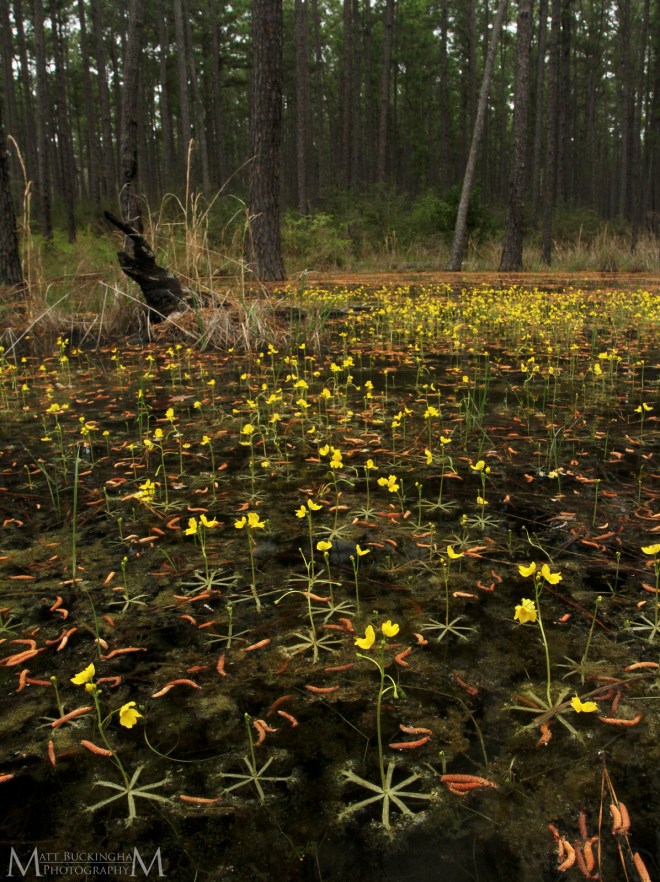
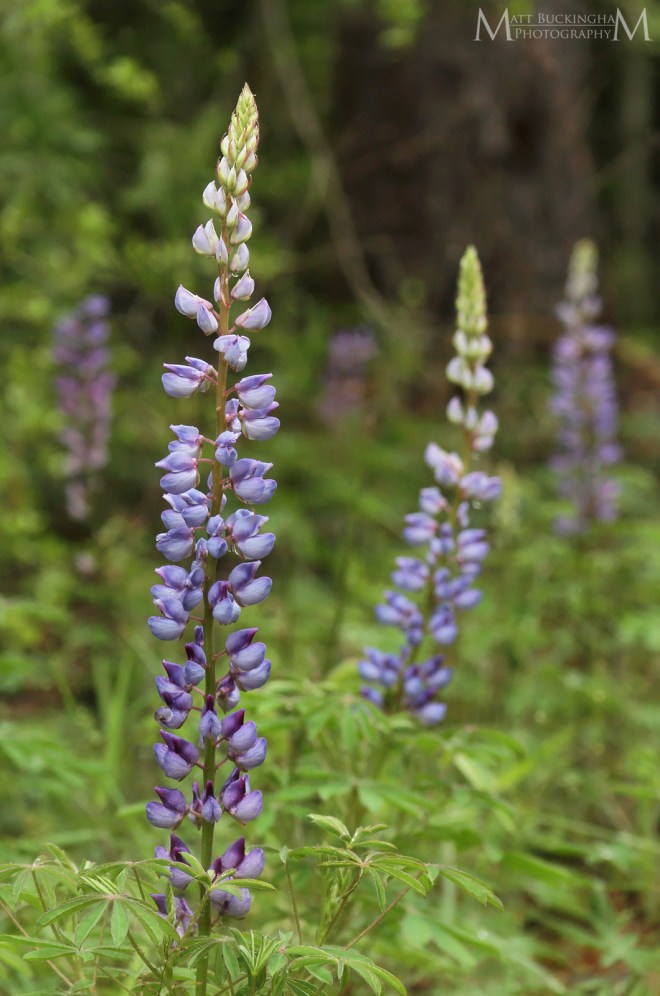
One afternoon, as we were exploring the longleaf pine savannahs of the Angelina National Forest, Carolina spotted a splash of yellow in the distance.  It turned out to be a small flatwoods pond decorated with the blooms of thousands of Floating Bladderworts (Utricularia radiata).  These plants are carnivorous, and I couldn’t help but think that below the surface was something akin to a minefield for the unfortunate aquatic invertebrates that dwell within.
IMG_2744

Floating Bladderworts – Minefield

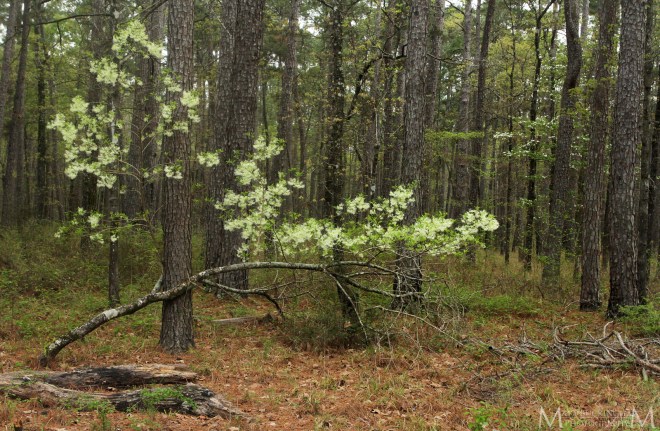
Not all of spring’s palate is painted on the forest floor however, and a multitude of trees and shrubs put on an impressive display as they come into flower.  In the picture below White Fringetree (Chionanthus virginicus) flowers in the foreground while Flowering Dogwood (Cornus florida) blooms in the distance.

IMG_2764

White Fringetree – Old Man of the Woods

By late March the Mayapples (Podophyllum peltatum) have taken over the forest floor.  One of my favorite spring ephemerals, Mayapple is still quite easy to find in certain parts of East Texas, unlike so many other species of rich woods that have become increasingly rare.

IMG_2801

Mayapple – Sea of Green

The large umbrella-shaped leaves of Mayapple are actually toxic.  Only the ripe fruit is edible.  The downy white blooms hang beneath the leaves.  Non-blooming plants always sport a single leaf, while those that bloom have two.

IMG_2817

Mayapples

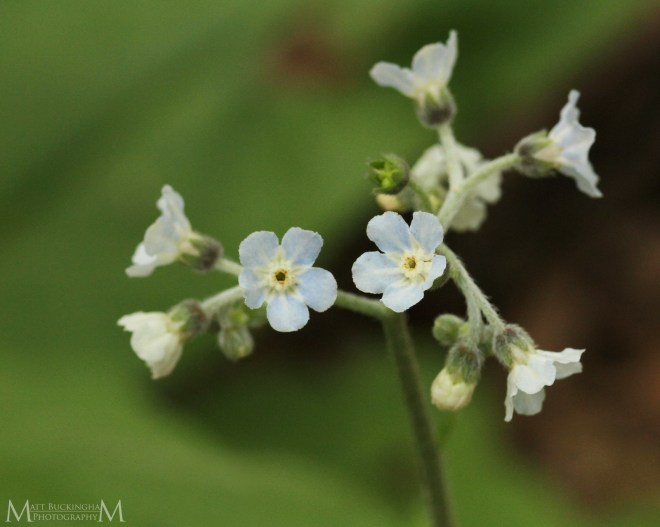
Along the bluffs lining the Angelina River, Carolina and I found a large colony of Wild Comfrey (Cynoglossum virginianum).  These wildflowers, with their downy basal leaves and tiny sky-blue blooms have become quite uncommon in Texas.  They often occur in the company of the Kentucky Lady’s Slipper, and I couldn’t help but wonder of the enigmatic orchid once called these hills home.

IMG_2872

Wild Comfrey Hills

IMG_2925

Wild Comfrey Blooms

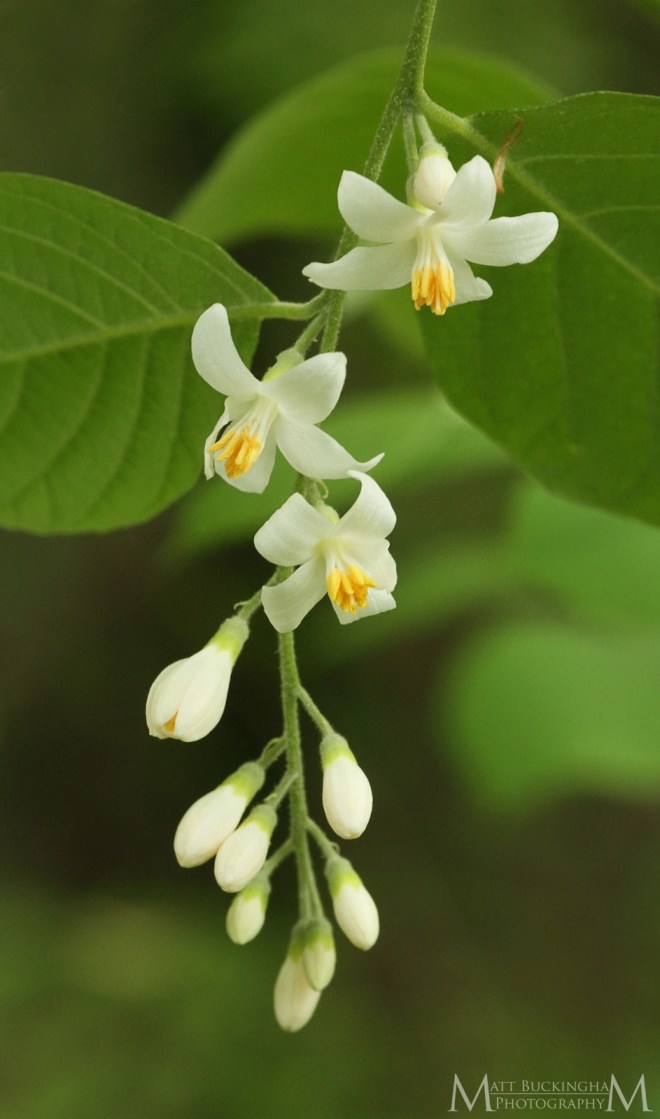
Another uncommon species often found in the presence of the lady’s slipper is the Bigleaf Snowbell (Styrax grandifolia).  It’s easy to see how this species gets its common name, as thousands of small white blooms may dangle from its branches in early April.

IMG_3006

Bigleaf Snowbell

In the vast floodplain of the Neches River I spotted a large colony of Eastern Bluestar (Amsonia tabernaemontana), and I stood in the flood waters to photograph its delicate blooms in the evening light.

IMG_3166

Eastern Bluestar

Every spring I look forward to the emergence of the trilliums.  This year I found this large colony of Sabine River Wakerobin (Trillium gracile) in a rich hardwood forest in Sabine County.

IMG_3598

Sabine River Wakerobin

By mid-April many of the spring ephemerals have already faded, and a new cast of floral characters appears on the scene.  Clasping Milkweed (Asclepias amplexicaulis) emerges from deep sands and displays its bizarre blooms for all the pollinating world to see.

IMG_5627

Clasping Milkweed

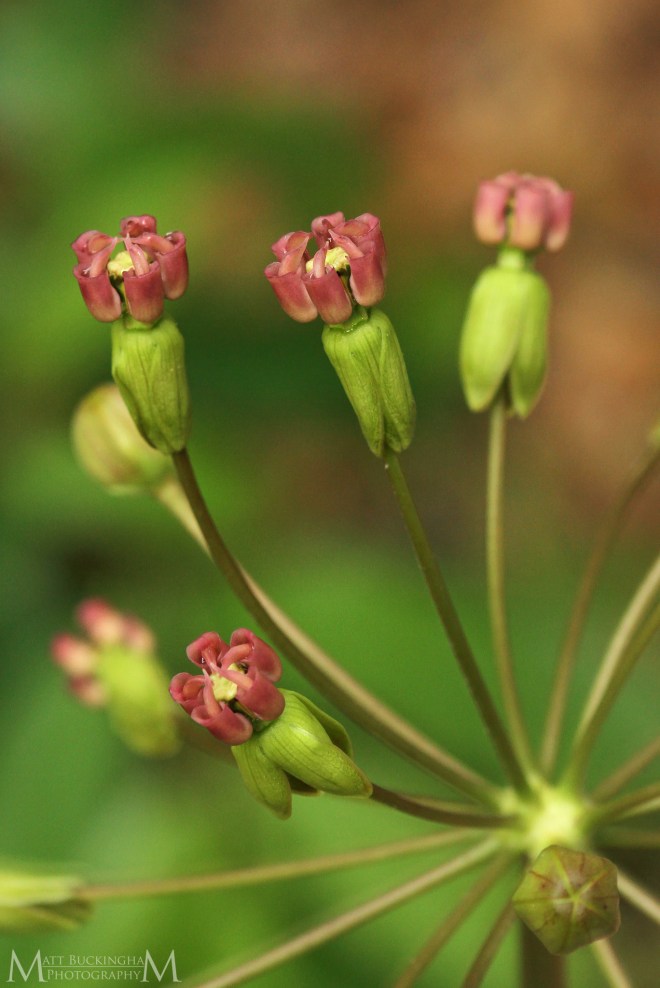
Deep in the forest a very different milkweed was blooming.  By mid April the White (A.K.A Redring) Milkweed was beginning to come into flower.

IMG_5374

White Milkweed

The Zigzag Iris (Iris brevicaulis) can be found on the margins of wetlands in the Pineywoods.

IMG_5309

Zigzag Iris

Flowering Dogwood is one of the most familiar small trees of East Texas.  Lesser known are the other species of dogwood that occur here.  This spring we found several Roughleaf Dogwoods (Cornus drummondii) in bloom along a small stream in Houston County.

IMG_5233

Roughleaf Dogwood

The Rose Pogonia (A.K.A. Snakemouth Orchid) (Pogonia ophioglossoides) is always a crowd-pleaser.  I found several blooming in late April with my friend James Childress in a remote seep on private land.

IMG_4995

Rose Pogonia

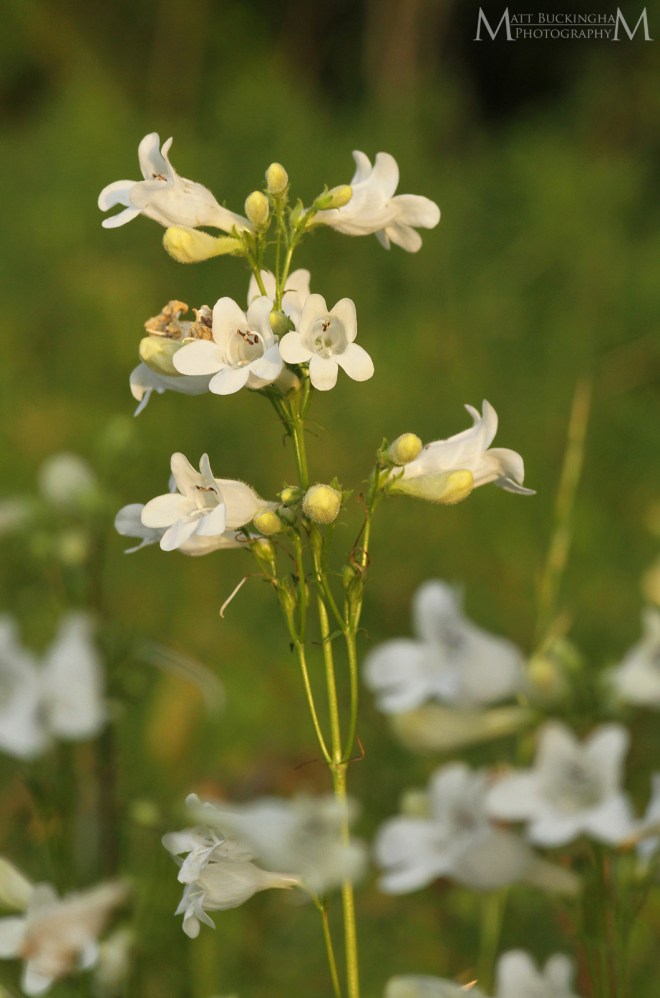
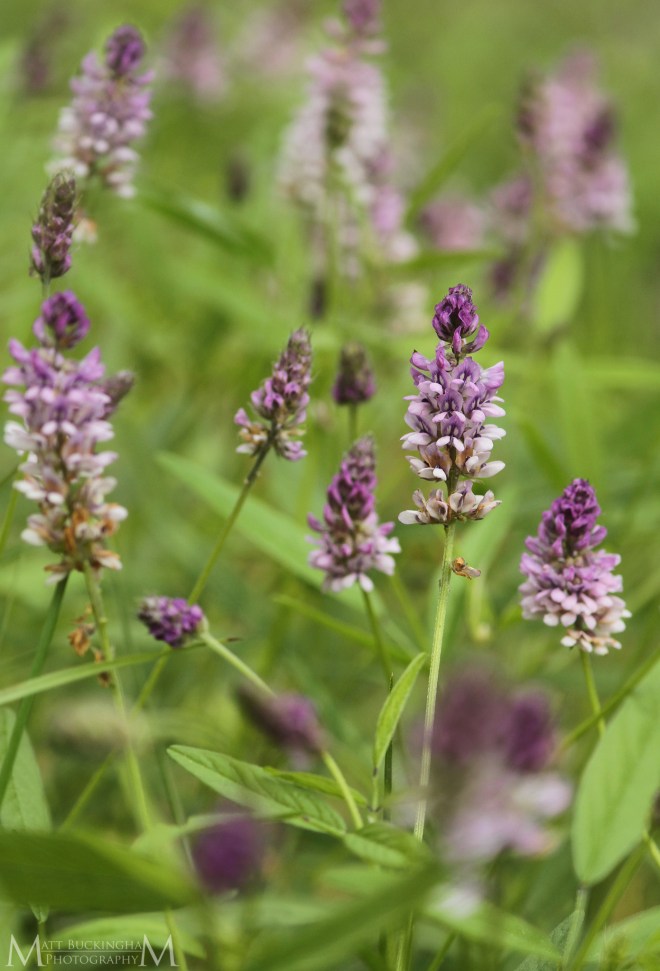
One evening in April I received a call from my friend, and author of The Wild Orchids of Texas, Joe Liggio.  He told me that while returning home from a long day of botanizing, he spotted an uncommon wildflower along a remote road in Liberty County.  It was the Foxglove Penstemon (Penstemon digitalis).  Shortly after photographing the plants at Joe’s site, I found it growing in similar remoteness in Sabine County.  This penstemon has a fairly broad distribution in the eastern third of the state, occurring in scattered populations in rich, open woodlands and their margins. There is some debate as to whether it is native outside northeast Texas, while others question whether or not its native to the state at all.  The plants that Joe and I discovered were, in my opinion, unlikely candidates for escapees from cultivation.  This leads me to believe that is in fact native to East Texas.
IMG_4905

Foxglove Penstemon

IMG_4833

Foxglove Penstemon

Also in April, my friend Scott Wahlberg and I visited a site in the Big Thicket where last year I was able to track down Wild Blue Lupine (Lupinus perennis).  I went into some detail on this species in a blog post last year, so I won’t say much here, save to mention it’s striking beauty.

IMG_4621

Wild Blue Lupine

IMG_4758

Wild Blue Lupine

Another species that I pursued last year was the Green Adder’s Mouth (Malaxis unifolia).  Carolina and I found them again this year, and I photographed them to the sound of the thunder of a rapidly approaching storm.

IMG_4331

En-route to photograph the adder’s mouth, we spotted a striking little purple legume flowering alongside the road.  It was a patch of Sampson’s Snakeroot (Orbexilum pedunculatum), a plant I only occasionally encounter in the Pineywoods.

IMG_4307

Sampson’s Snankeroot

Though it’s pushing the limits of late spring and flirting with early summer, late May still has a lot to offer, botanically speaking.  One warm evening in late May, Caro and I drove out to Walker County to photograph the Bush’s Purple Coneflower (Echinacea paradoxa var. neglecta).  This puzzling population was found growing in a calcareous prairie remnant by my friend Eric Keith.  Echinacea paradoxa is a species of coneflower found in the Ozark Plateau and isolated populations in southern Oklahoma and southeast Texas. While typically yellow, E. paradoxa var. neglecta range from pale purple to deep pink.  The population here in southeast Texas is disjunct from other known populations by hundreds of miles.

IMG_7617

So it was that the Spring of 2018 came to a close and gave way to summer.  It was hard to say goodbye to the cool, gray days of Spring, but as a naturalist I find some joy in each of our seasons.  Soon the sun would be blaring, the cicadas would be trilling, and a whole new cast of plants and animals would make themselves known.

One in the Hand, Two in Tobusch

IMG_5898

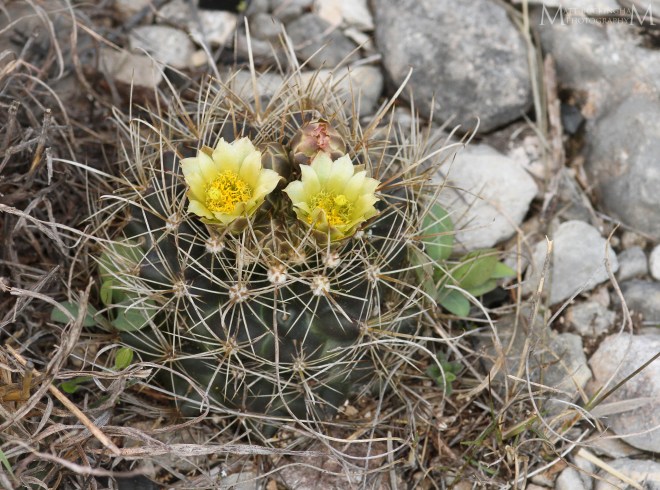
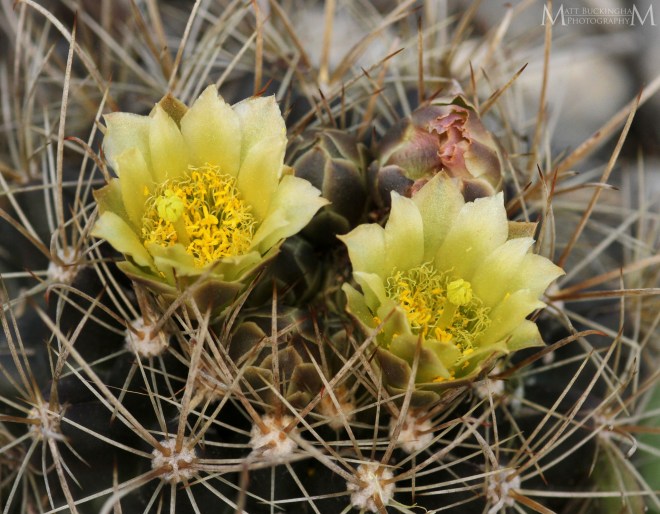
Tobusch Fishhook Cactus

This past weekend I spoke at the Native Plant Society of Texas Spring Symposium about photographing the biodiversity of Texas.  The symposium was in Austin, and happened to occur during the blooming period of the Federally Endangered Tobusch Fishhook Cactus (Sclerocactus brevihamatus ssp. tobuschii).  Though the cacti do not occur particularly close to Austin, it was the closest we would get for the foreseeable future, so Carolina and I decided we would stay an extra night in the Hill Country and try for the cactus the day after the symposium.

We arrive in Austin on Friday afternoon and took the day to explore the city.  While big cities are certainly not my thing, I really enjoyed visiting the Texas State Capitol building.  Plumes of Cedar Waxwings danced and buzzed among the many trees that decorated the capitol lawn and the redbuds were just coming into bloom.  Inside we marveled at the architecture and artwork, and took in the history of the place.

Saturday we rose early and made our way to the symposium.  We thoroughly enjoyed the event.  I saw some old friends and met a lot of friendly, interesting people.  The symposium was over by 3 or so, so Carolina and I took some time to explore the area.  Early spring wildflowers were just coming into bloom and Texas Spiny Lizards (Sceloporus olivaceus) were out basking on the limestone, though they did not take kindly to our approach.

In one of the many tributaries of the Colorado River we spotted a pair of Texas Map Turtles (Graptemys versa).  The Texas Map Turtle is one of a number of species of turtles endemic to central Texas.  This beautiful, fascinating species is restricted to the Colorado River basin.  The females are significantly larger than the males, and each sex has specialized head morphology to utilize different food sources.  Males feed primarily on aquatic insect larvae and other invertebrates, while adult females feed primarily on mollusks, shell and all.  We spotted the pair basking on some rocks, but the tiny male soon sank into the cool clear water.  The female allowed a slow approach as she took in the warmth of an early spring afternoon.

IMG_5564

Texas Map Turtle

That evening we made our way to San Antonio.  I wanted to show Carolina some of the old Spanish and German architecture of the city, and we would be closer to the cacti.  We spent some time exploring downtown, and grabbed a hotel on the outskirts of town.  The next morning we slept in.  Generally speaking, cacti flowers open midday in order to take advantage of the peak of pollinator activity.  Our destination was an hour and a half or so west of the Alamo City.  The path took us through the scenic country of the western Edwards Plateau, over oak and juniper hilltops, and down through rocky river valleys, where crystal clear water cut through limestone.

We finally arrived at a Tobusch Fishhook Cactus population that I had access to.  We began exploring.  It wasn’t long until I spotted the first cactus, and it was in bloom!  They were smaller than I had expecting, most being only a few inches across.  This cryptic species is extremely difficult to spot when not in bloom.  In late winter/early spring, however, they bloom, and their striking, albeit tiny, yellow flowers make them ever so slightly more conspicuous.

IMG_5665

Tobusch Fishhook Cactus

The story of the Tobusch Fishhook Cactus is an interesting one.  In the late 1970s there were only four known populations in two Texas counties.  In 1978 a flood hit and wiped out half of these populations in one fell swoop.  Fearing that S. brevihamatus ssp. tobuschii would soon be lost forever, the government afforded them protection under the Endangered Species Act in 1979, designated them a Federally Endangered Species.  At the time that it was listed it was believed to be restricted to limestone ledges and gravelly stream terraces adjacent to streams in just two Texas Counties.

IMG_5740

Tobusch Fishhok Cactus Flowers

Once it was listed, survey and conservation efforts were undertaken in earnest.  In the following decades several new populations were discovered, including many on protected land.  It also became evident that its habitat preferences were not as narrow as previously thought.  Today we know that it also occurs in shallow soils over slabs of limestone within clearings within a broader matrix of oak-juniper and oak-juniper-pinyon woodlands.  Many of these areas are well away from streams and their associated floodplains and terraces.

IMG_5753

Tobusch Fishhook Cactus

Armed with the knowledge that this diminutive cactus is doing better than previously thought, the US Fish and Wildlife Service proposed to downlist the Tobusch Fishhook Cactus from Endangered to Threatened in December 2016.  While this Texas endemic may be more common than initially thought, it still faces very real threats, and a number of historic populations have become extirpated, including the original populations at the time of listing.  Even in the face of these threats, today the future for this subspecies looks promising.

IMG_5900.jpg

Tobusch Fishhook Cactus

That day we would see many Tobusch Fishhooks, most of them in bloom.  In the sunny warmth of that spring afternoon the pollinators were out in force.  We watched as a variety of butterflies and bees bounced from flower to flower in search of the sweet nectar within.  Perhaps my favorite of these propagators were the metallic green sweat bees (Agopostemon sp.).  Their brilliant metallic sheen added the perfect compliment to the greenish yellow blooms of the cacti.

IMG_5874

Metallic Sweat Bee

The title of today’s blog comes from my good friend Toby Hibbitts.  Many of my friends enjoy a good pun as much as anyone should.  Last year after a friend posted a photo of the Tobusch Fishhook Cactus, Toby commented that he had always heard that “a bird in the hand is worth two in Tobusch”.  He was undoubtedly, and understandably pleased with himself.  I can only hope that this species persists for future generations of cactus lovers, naturalists, pollinators, weevils, and bad pun lovers to enjoy.

Fall into Winter: November and December Recap

IMG_8117

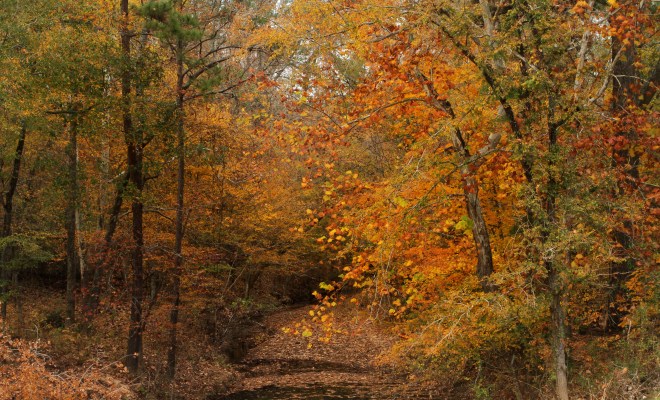
Fall color along a forest stream

We’re in the heat of winter here in the Pineywoods, and I’ve got a backlog of posts to catch up on.  Soapwort Gentian ended up being the last species checked off my list in 2017.  Though I would not see any more of my “target species”, my November and December were still filled with incredible biodiversity and natural beauty.

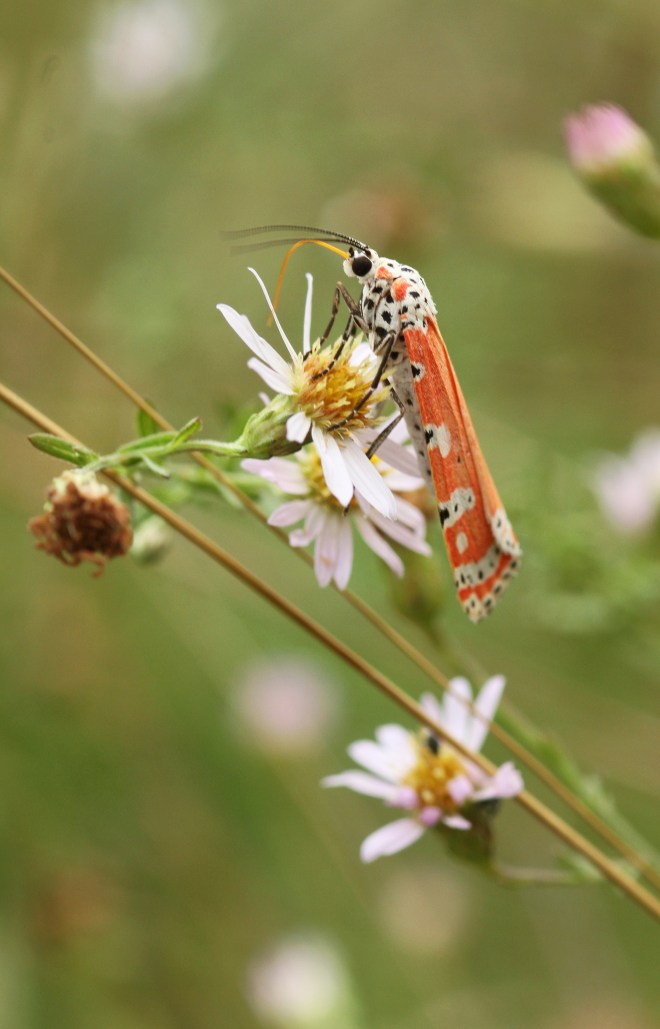
In mid November Carolina and I met up with our friend Skip Pudney in the Big Thicket.  We were hoping to photograph the rare orchid Spiranthes longilabris in bloom.  While we did find a single plant, the true show was put on by the invertebrates – pollinators taking advantage in a flush in late season flowers.  We noticed several Yellowjacket Hover Flies (Milesia virginiensis), Ornate Bell Moths (Utetheisa ornatrix), Common Buckeyes (Junonia coenia), Blister Beetles (Epicauta sp.) and more.

IMG_7751

Yellowjacket Hover Fly

IMG_7755

Ornate Bell Moth

IMG_7709

Common Buckeye

IMG_7687

Blister Beetle

By mid-November the leaves had begun to change.  This was a good year for fall color in East Texas.  The leaves of deciduous trees begun to change color in the falls when the days are sunny and the evenings are crisp.  These cues, along with the shortening photoperiod trigger a chemical reaction within the leaves.  Production of chlorophyll halts, and slowly this green pigment begins to break down and is rendered clear.  As the green fades, other colors such as carotenoids and anthocyanins, which have been active in the leaves all along, now become dominant, and the forest turns from green to brilliant hues of yellow, orange, and red.

In late November I spent a foggy morning photographing the maples, oaks, hickories, and elms of a rich hardwood stream bottom.

IMG_7847

Fall color in the fog

IMG_7917

Hickories and maples provide the yellows in this fall forest

I then went on to a steep bluff over the upper reaches of the Neches River, where the Red Maples lived up to their name.

IMG_7982

Fall color on a bluff over the Neches River

While I find broad views of a fall forest to be especially beautiful, the subtle beauty of fall can be observed up close, like in the leaves of poison ivy, as seen below…

IMG_8128

Fall color in poison ivy

…and in the layers of Florida Maple leaves on branches draped around the trunks of pine trees.

IMG_8140

Florida maples display their fall colors.

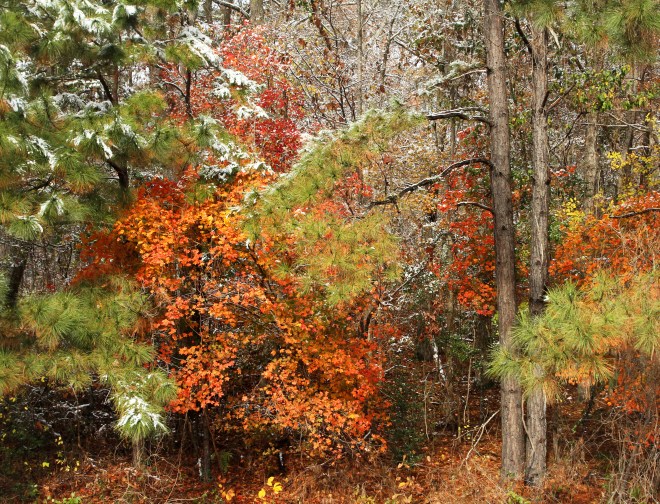
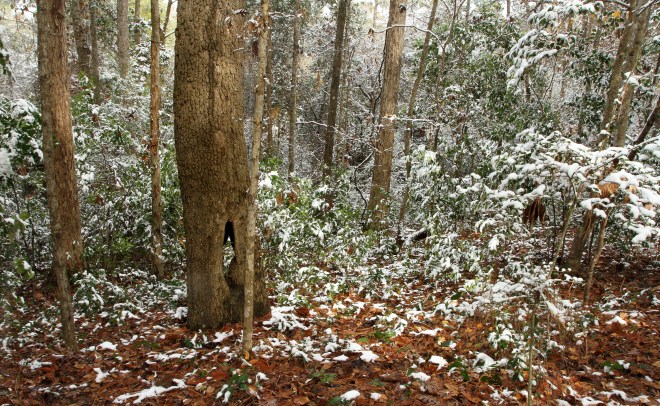
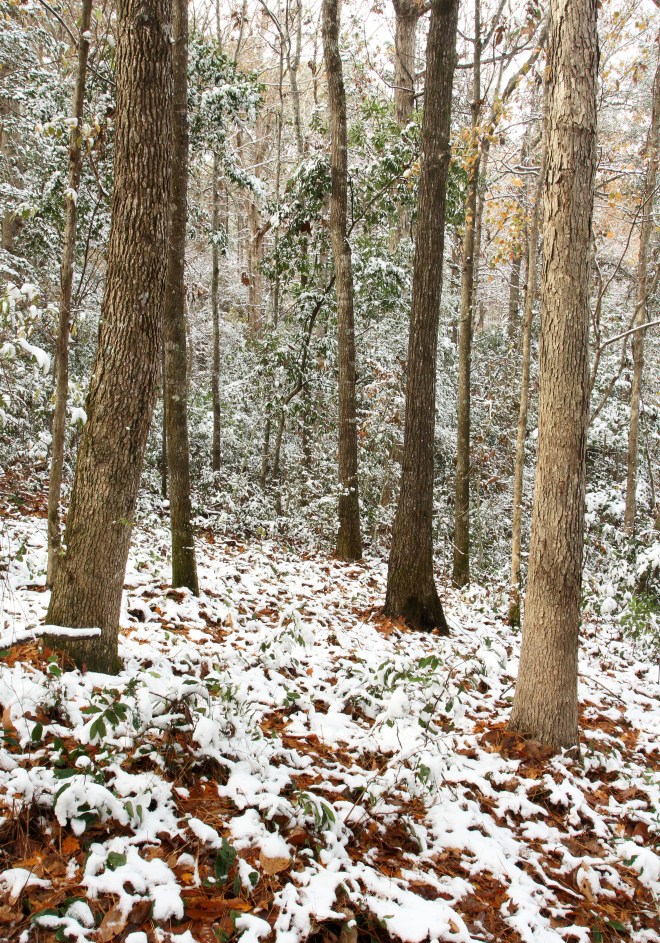
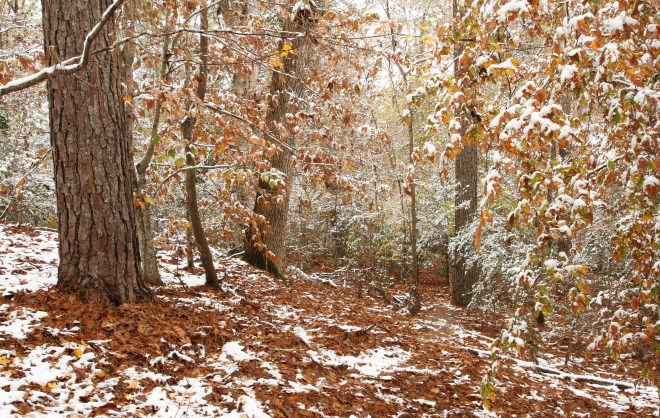
In early December much of East Texas was hit with an uncharacteristic snow storm.  In over 20 years in the region, I have only seen snow a handful of times, and of those only a fraction actually stuck.  This was one of the finest in recent memories.  In East Texas fall color lingers well into December, and the result was what looked to be a battle between fire and ice.

IMG_8153

Fire and Ice

Deeper in the forest, the landscape appeared a winter wonderland.

IMG_8207

Pineywoods Snowscape

IMG_8213

My Winter Wonderland

IMG_8227

Snow in the Beechwoods

IMG_8162

Dressed in White

Having grown up in Chicago, I experienced harsh, snow-filled winters in my childhood.  It was good to spend some time walking and playing in the snow again – like reuniting with an old friend.  I think that for Caro it was even more special, as she seldom saw snow in her native province of Entre Rios, Argentina.

IMG_8217

Carolina in the Snow

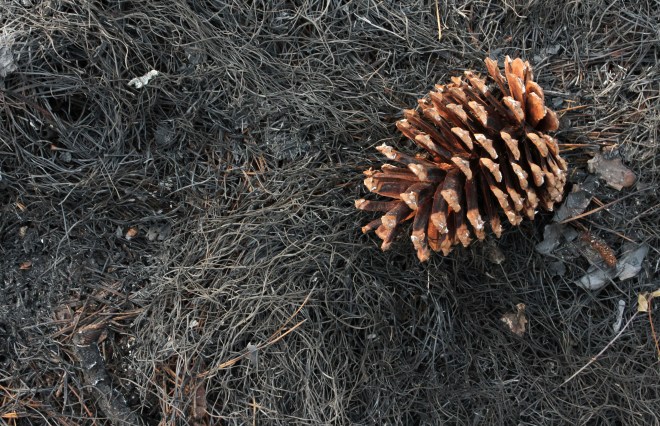
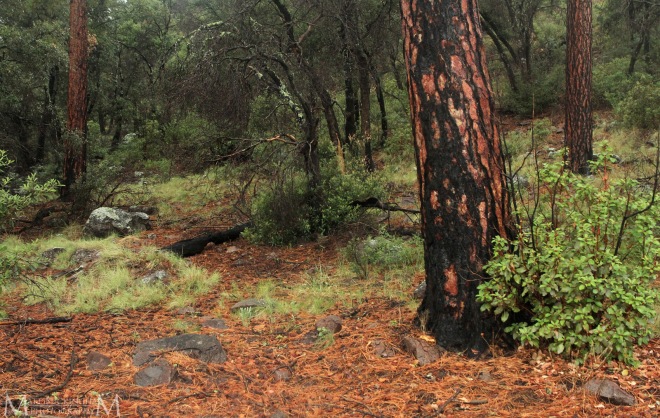
Later in December we visited a longleaf pine savannah shortly after a prescribed fire.  Here we saw fresh cones on the torched leaf litter…

IMG_8506

Borne of Ashes

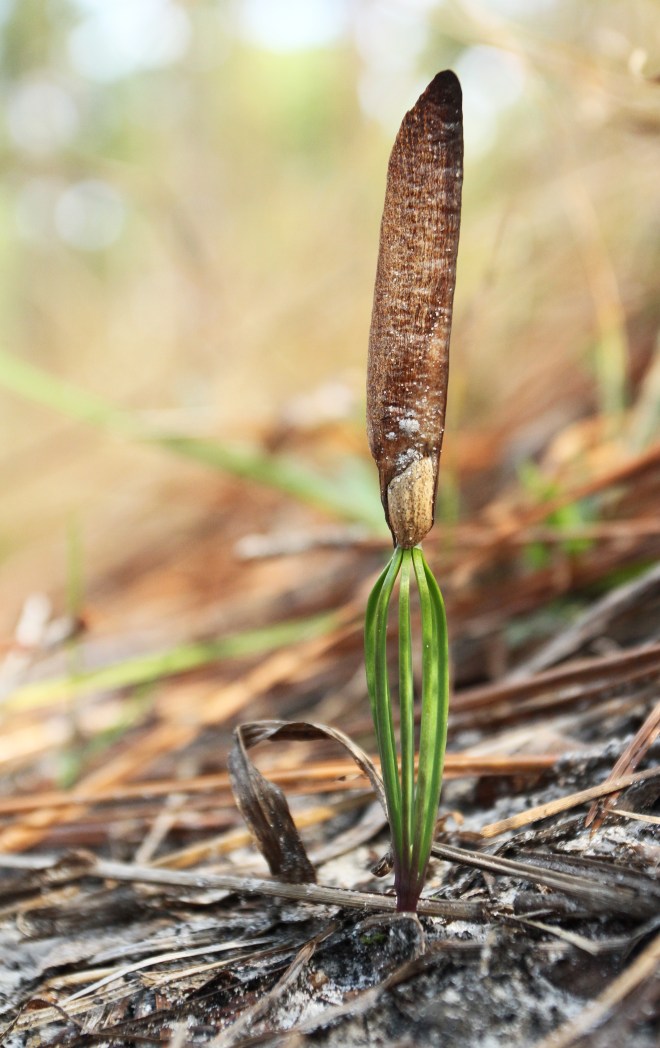
…and a freshly germinated seedling rising from the ashes. With luck, this tiny seedling will grow into a stately tree in this longleaf pine savannah. Perhaps it will one day harbor the cavity of a Red-cockaded Woodpecker, and Bachman’s Sparrows and Brown-headed Nuthatches will sing from its boughs while Louisiana Pine Snakes and Wild Turkey patrol among its roots.

IMG_8372

New Beginnings

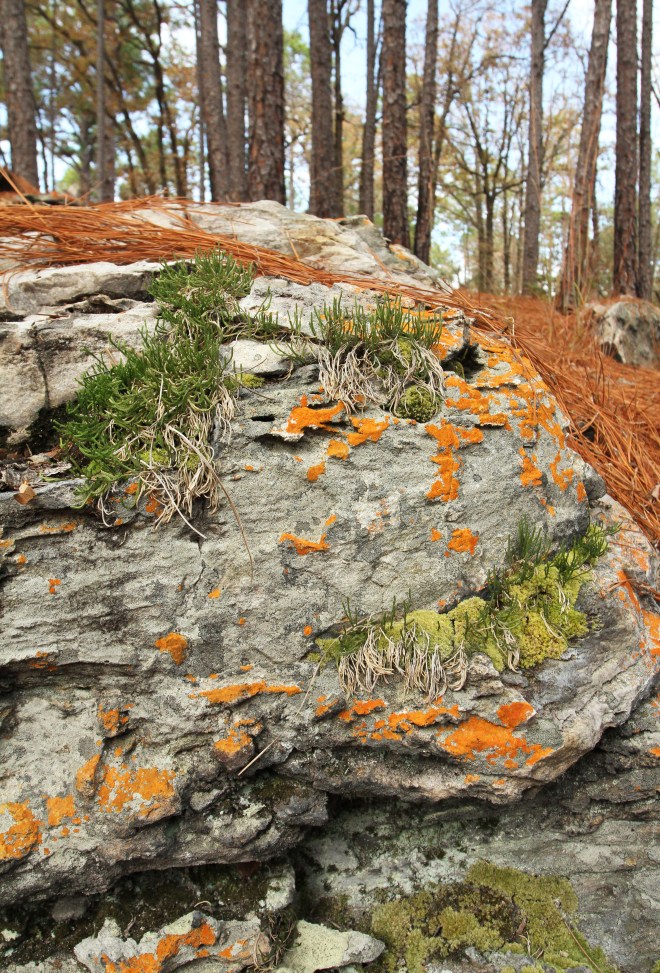
Within the longleaf pine savannah we found Riddell’s Spike-Moss (Selaginella corallina) growing in the crevices of exposed boulders of the Catahoula Formation.  S. corallina is a primitive vascular plant that is typically included with the “fern-allies”, and despite its name is more closely related to ferns than mosses. It has an interesting disjunct range, with one population in central and east Texas, northwestern Louisiana, western Arkansas and Eastern Oklahoma, and another in Alabama and Georgia. I seldom encounter them in East Texas. When I do, it is generally growing off the faces of sandstone outcrops or in areas of deep sand.

IMG_8416

Riddell’s Spike Moss

IMG_8401

Ridell’s Spike Moss

After exploring the savannah we ventured to the bluffs along the Neches River.  Here we found patches of fall color lingering in the American Beech trees on the bluffs’ slopes.  American Beech is one of the last trees to turn in the fall, and they brighten the otherwise gray December forest.  In the photo below the Neches River is visible in the distance.

IMG_8520

The Bluff’s Edge

In late December our friend Scott Wahlberg, Carolina, and I spent the day scouting salamander locations for the spring.  Though the conditions for finding a salamander weren’t ideal, we did turn up a single, apparently gravid, female Spotted Salamander (Ambystoma maculatum).

IMG_8626

Spotted Salamander

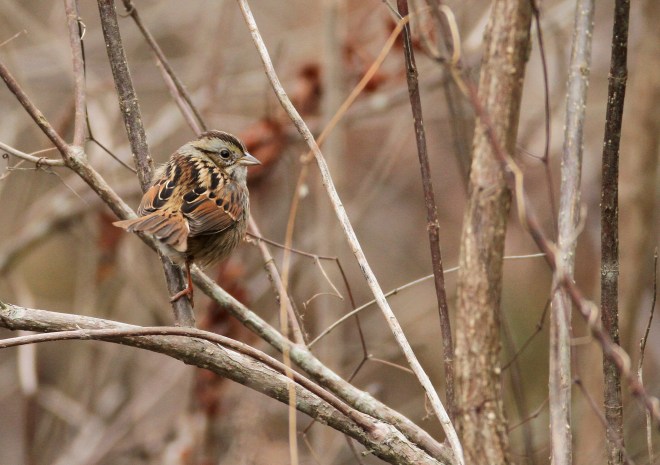
Toward the end of December James and I spent some time looking for birds in a local park.  There I was able to capture an image of a Swamp Sparrow (Melospiza georgiana) in the dense underbrush along the margins of a pond using James’s new 600mm lens (more on that in the future).  These striking sparrows are “skulkers” – small birds that prefer dense cover.  I was lucky to get a shot of one as it momentarily paused in its dense domain of tangles.

IMG_8690

Swamp Sparrow

I was also able to photograph a Yellow-rumped Warbler (Setophaga coronata) there.  The birds that winter in East Texas are members of the “myrtle” race, so named because they are one of the few birds that will regularly eat wax-myrtle berries.

IMG_8663

Yellow-rumped Warbler

On December 30, Carolina and I found a Broad-banded Water Snake (Nerodia fasciata confluens) while exploring the bottomlands off the Neches River.  The temperatures hovered just above freezing, and the snake could barely move, yet it was alive and well.  After taking a few photos we left it to weather the cold, as it and its kind have done for countless generations.

IMG_8812

Living Rocks, Golf Balls, and Other Strangely Named Cacti of the Trans-Pecos.

IMG_6987a

Living Rock Cactus

Target Species:

Black-tailed Rattlesnake (Crotalus ornatus)

Button Cactus (Epithelantha micromeris)

Lacespine Nipple Cactus (Mammillaria lasiacantha)

Living Rock Cactus (Ariocarpus fissuratus)

The landscape of Big Bend is striking for its vastness; famous for its sweeping views that stretch from horizon to horizon, and seemingly beyond.  Stepping into this rugged wilderness, one is immediately hit with the harshness of this land.  Brutal conditions created by lack of rainfall and extreme temperatures.  It is easy to think that this seemingly inhospitable land  would be devoid of life, but despite its harshness it is incredibly diverse, harboring a rich flora and fauna unlike anywhere else on the planet.  And as remarkable as this vastness is, equally astounding is the beauty and variety that can be found in just one small patch of the desert floor.

Big Bend, that large peninsula of Texas that dips down into Mexico as it follow a bend in the Rio Grande, has the greatest cactus diversity in the country.  It was that diversity that brought Carolina and I to the region this October.  Specifically we were hoping to find the Living Rock Cactus (Ariocarpus fissuratus) in bloom.

Big Bend is part of the Chihuahuan Desert.  It is the highest, wettest desert in North America, and the most biodiverse in the world.  The Big Bend Region includes a multitude of natural and cultural attractions, including Big Bend National Park, Big Bend Ranch State Park, and Terlingua.  We planned to explore these areas in pursuit of our succulent quarries, and hoped that our pursuit would bring with it other natural wonders.

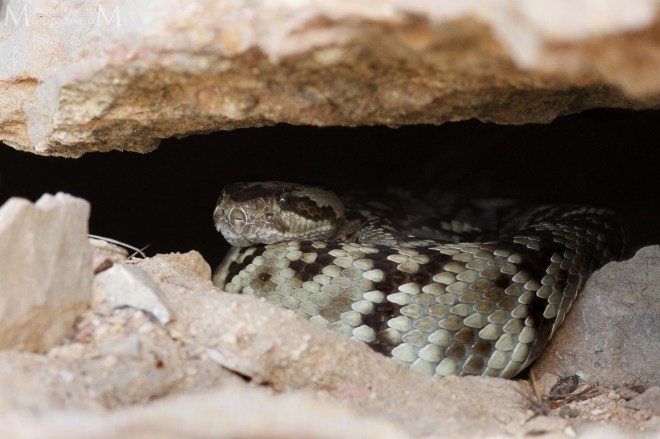
Cactus hunting is not without its hazards.  Aside from the obvious risk of an errant spine in the skin, there are other denizens of cactus country that pack a punch.  One such inhabitant is the Black-tailed Rattlesnake (Crotalus ornatus).  Yet despite this creatures fearsome reputation as a venomous marauder, it is one of the most docile snake species I have had the good fortune to encounter.

As I scoured a rock cut in search of spiny succulents, my eyes caught a familiar outline – a striking (as in attractive) Crotalus ornatus coiled at the mouth of a deep crevice in the limestone.  It was sitting, I presumed, waiting for some unsuspecting rodent to wander within its grasp.  Generally speaking, I think that the threat of rattlesnakes to your average desert-goer is greatly exaggerated, however seeing this beauty hidden away in the perfect hand or foot hold certainly reinforced the old adage “look before you step”.  The photo below depicts the animal as I found it.

IMG_6762

Black-tailed Rattlesnake

After spending a few moments with the black-tail I continued my search for cacti.  After a moment I heard Carolina call out that she had found something.  How she spotted them, I’ll never know, but she had found a population of the diminutive Button Cactus (Epithelantha micromeris).  This diminutive cactus seldom protrudes more than 2 inches above the rocky substrate it calls home.  It occurs primarily in Mexico, but also throughout much of West Texas, southern New Mexico, and extreme southeastern Arizona.

Though they were not in flower, I found these small, rock-like cacti to be quite photogenic.  They flower primarily in late winter and early spring.  Later in the year an elongated red fruit appears.  Caro likened the fruit to a particular part of an excited dog’s anatomy.

IMG_6711abc

Button Cactus

IMG_6719ab

Button Cactus

Nestled in a few populations along the Pecos/Brewster County line, one may find a particularly formidable looking cactus.  The Icicle Cholla (Cylindropuntia tunicata) is a wide ranging species, occurring in deserts throughout much of Latin America.  In the United States, however, it is known only from these few places in the Trans-Pecos of Texas.  Admiring the afternoon light filtering through its intimidating spines, it was easy to see how it earned its common name.

IMG_6772

Icicle Cactus

After a long day of travelling and exploring we finally made it to Marathon, but not before stopping at an extensive Black-tailed Prairie Dog town, where we admired their antics as the day began to fade.  We made our camp in Marathon, and I found myself deep in thought as we laid in our sleeping bags looking up at the twinkling wonder of space.  Along with the prerequisite existential questions inspired by such a vista, I pondered on the days to come, and the natural wonders that awaited us.

The next morning I spotted a remarkable creature on the stucco outside the campground’s bathrooms.  It was a male Chihuahuan Agapema (Agapema dyari).  A lovely member of the giant silkmoth family (Saturniidae).  I gently moved it to a nearby tree trunk, where I hoped it would be less obvious to the hoard of House Sparrows that were scouring the area.

IMG_6787

Chihuahuan Agapema

As the sun warmed the desert we broke our condensation-laden camp and set out for Big Bend National Park.  As we crossed into the park we immediately took notice of the diverse cactus community.  The most obvious were the abundant clumps of Strawberry Cactus (Echinocereus stramineus), the heavily armed Eagle’s Claw Cactus (Echinocactus horizonthalonius), and the ubiquitous prickly pears (Opuntia spp.).

Finding the smaller, more cryptic species, took a bit more work.  We found the Lacespine Nipple Cactus (Mammillaria lasiacantha) to be quite common.  Also known as the Golf Ball Cactus, this tiny succulent is quite similar to the Button Cactus.  Cacti of Texas, A Field Guide by Powell, et. al discusses some of the differences.

IMG_6913

Lacespine Nipple Cactus

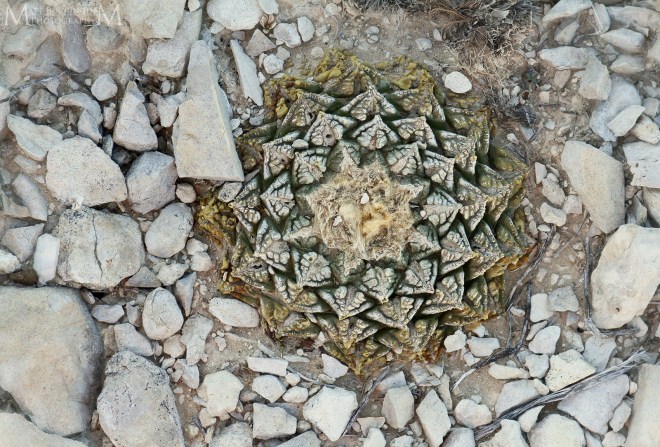
The real reason for our trip, however, was to try to catch the Living Rock Cactus (Ariocarpus fissuratus) in bloom.  This bizarre cactus is, in my opinion, one of the most spectacular plants in the country.  Hardly recognizable as a cactus, it is spineless, and consists of rough tubercles arranged in concentric rings around a center of soft fuzz.

For most of the year the dull green to gray Living Rock blends perfectly with the scattered stones that litter its limestone home, relying on camouflage rather than piercing spines for defense.  For a few short weeks in the fall, however, the limestone hills of the Trans-Pecos explode with color as thousands upon thousands of Living Rocks open their bright pink blooms to the world.

It was just such a scene that I was hoping Carolina and I would encounter in Big Bend.  We were soon to find, however, that finding these jewels of the Chihuahuan Desert in bloom would be far more difficult than we anticipated.  We spent all day scouring limestone ridges, bluffs along the Rio Grande, and flats in the low desert.  We jumped for joy when we found our first plant.  We knew we were were in the right area.  Even without their blooms, the Living Rock is a beautiful, bizarre plant and photographic subject.

IMG_6857

Living Rock Cactus

The desert sun is relentless, even in mid October.  Our spirits refreshed by finding our first Living Rock, we pushed on, scouring the bleached white limestone hills as the temperatures flirted with 100 degrees.  It was truly brutal, but we knew that the payoff of seeing the blooms would be well worth our suffering.  After several hours, and several hundred more Living Rocks sighted, however, the blooms did not come.  We were dismayed.  We had become proficient at spotting the near invisible cacti on the desert floor, but despite finding so many individuals in several different areas, we did not find a single bloom.  I began to think that this would not be the trip that we would see the exquisite flowers of Ariocarpus fissuratus.

IMG_7024a

Living Rock Cactus

That night we hoped to camp in the park, but alas, all of the campgrounds were full.  We debated between staying at a primitive campsite along a backcountry road, or driving to the campground in Study Butte.  In the end we opted for the latter, and made the drive from the Rio Grande to Study Butte in the darkness, with nothing but the Common Poorwhills, Black-tailed Jackrabbits, and Western Diamondbacks to keep us company.

When we arrived at the campground, the attendant informed us that there was a party going on that would last well into the night, and recommended that we select a site on the other  side of the property.  We happily agreed.  We made camp, ate dinner, and settled in for the evening.  The “party” turned out to be a music festival that blared across the desert until after 1 am, after which the multitude of bikers attending continued to keep us awake for at least another hour.  Finally, at some point in the wee hours before dawn we drifted off.

We were awoken around 6 am to gale force wind violently shaking our tent.  The temperature had dropped by tens of degrees, and as we stepped out from behind the nylon the air met us with a chill.  I must admit, as I broke camp with powerful wind gusts and stinging dust beating down on me, I was hating life.  “Not every trip can be a success,” I reminded myself, and I tried to take solace in the incredible organisms we had thusfar encountered, and the memories we had created.  In that moment, however, it was hard to do.

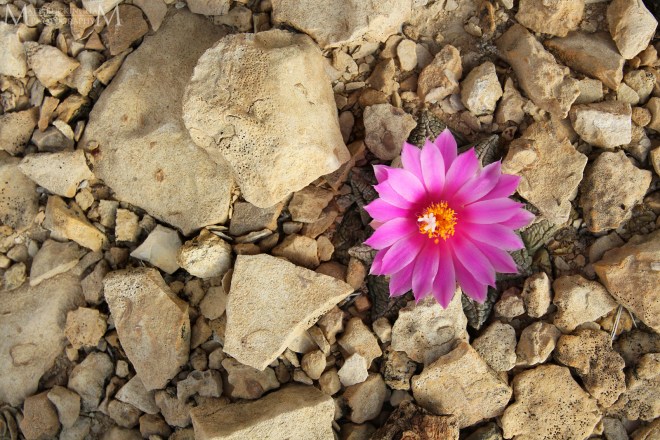
We decided to spend the morning and early afternoon exploring the area, before beginning our long journey back to the Pineywoods.  The habitat at our first stop looked promising, but after a lack of blooms the previous day, I took care not to get my hopes up.  We soon saw our first Living Rock, like a star etched into the talus.  I found myself once again admiring their bizarre firm when I heard Carolina shout out in glee.  I knew.  The memory of the brutal previous night faded as I made my way to her, and saw the bright pink bloom seemingly emerging from nothing.  We did it.  It was not long before we found another, and another.

IMG_6946

Living Rock Cactus

The Living Rock is one of three spineless cacti in Texas.  Their lack of spines means that they must rely on camouflage to avoid predation.  They also contain foul-tasting alkaloids which likely deter would be predators.  These alkaloids, however, have made this plant popular with the Tarahumara and other early tribes and settlers.  Though they do not contain mescaline like the similarly spineless Peyote, they contain other mildly hallucinogenic compounds like hordenine, and were reportedly used as a substitute when preferable psychoactive cacti weren’t available.  Hordenine also made the Living Rock useful for a number of medicinal purposes, including a disinfectant for wounds and burns.

IMG_6948

Living Rock Cactus

Ariocarpus fissuratus is  endemic to the Chihuahuan Desert.  They barely enter the U.S. in West Texas.  They are incredibly tough, even for a cactus.  We found that they would grow in the harshest parts of the landscape, often where even other succulents could not survive.  They owe their success to their uncanny capacity to store water, and their ability to shrivel away to virtually nothing in times of extreme drought.  Indeed, they often times seem to be more stone than plant.  Carolina and I admired them for some time, and reluctantly bid them farewell, content with the short moment in time we were fortunate enough to spend among their fleeting blooms.

IMG_6965

Living Rock Cactus

There are some songs that serve to inspire us and remind of of those things in this world that are most important to us.  For me, one such song is Stubborn Love by the Lumineers, and it came up on the playlist just as the Chisos Mountains began to fade in our rearview.  I looked about the desert that stretched beyond the horizons around us, and I was filled with a sense of contentment.  It’s easy to feel sad at the end of a great trip, but I take comfort in the fact that no matter where I am, if nature is near there is some great wonder waiting to be discovered.

Keep Rolling

Target Species: Rainbow Scarab (Phanaeus vindex)

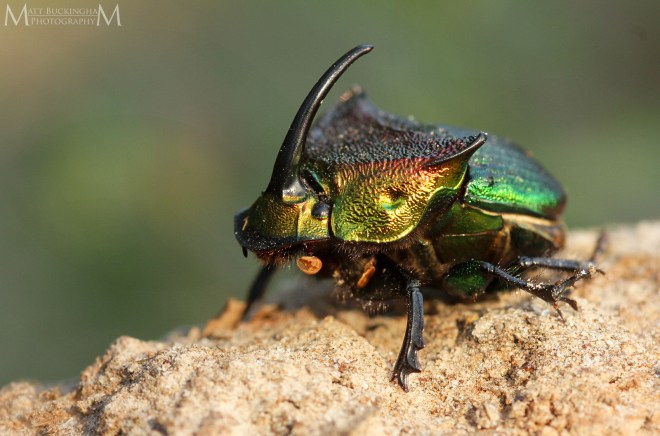
IMG_6560

Male Rainbow Scarab

Since I was a child I have had a fascination with beetles.  They are the most diverse group of animals on the planet, and come in an extraordinary array of shapes, sizes, and colors.  Some have iridescent, metallic carapaces, some have impressive weaponry like horns and toothed mandibles.  And some, like the Rainbow Scarab, have both.

The Rainbow Scarab is a dung beetle.  They feed on the refuse of mammals, and in doing so help to prevent an unsafe build up of animal feces.  Feces can be a vector for diseases, and by removing it from the earth’s surface, the Rainbow Scarab and other dung feeding beetles help to prevent the spread of feces-borne illnesses, some of which can be fatal.

IMG_6650

Male Rainbow Scarab

The benefits of dung beetles do not end there.  Rainbow Scarabs dig burrows below dung piles.  They then roll bits of the dung into balls and drag it below the surface.  The female then lays her eggs on the fecal matter, which will serve as nourishment for the developing larvae.  By spreading and depositing feces within the soil, the Rainbow Scarab is in effect fertilizing the landscape.

Rainbow Scarabs are broadly distributed east of the Rocky Mountains.  In East Texas they seem to prefer sandy soils, however elsewhere they have been documented in a variety of soil types.  The individuals pictured are from a longleaf pine savannah.

The strikingly beautiful Phanaeus vindex has been a favorite of mine since childhood.  I have observed and had the opportunity to photograph them on numerous occasions, however I have never been happy with the resulting images.  This year i hoped to capture some images that really showed off their brilliant iridescence.  Try as I might, I found that the age-old adage that “pictures can’t do them justice” really does apply with the Rainbow Scarab.  Their color seems to change depending on the angle of the light, and I found it impossible to capture their true brilliance, though I sure had fun trying.

For more on these fascinating creatures and the benefits they provide I strongly recommend this link:

http://entnemdept.ufl.edu/creatures/BENEFICIAL/BEETLES/Phanaeus_vindex.htm

August and September Recap

IMG_5016

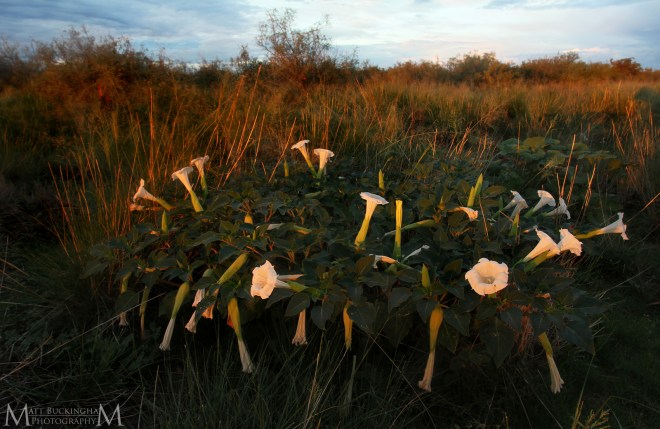
Sacred Datura

Between August 1 and September 30 I was able to cross 5 more species off my list, 3 of which came from another trip to the Davis Mountains:

Mountain Adder’s Mouth (Malaxis macrostachya)

Wood’s Jewel Scarab (Chrysina woodii)

Mountain Short-horned Lizard (Phrynosoma hernandesi)

Gulf Blazing Star (Liatris tenuis)

Barbed Rattlesnake Root (Prenanthes barbata)

2017GoalsSepAug

Although we spent most of our time during our August trip to West Texas in the Davis Mountains, we camped the last night on the shore of Lake Balmorhea.  I found the Sacred Datura (Datura wrightii) pictured above right at daybreak as I explored the area around our tent.  The flowers of the Sacred Datura are primarily pollinated by large sphinx moths.  As a result they open in the late evening and close in the early morning.  Sacred Datura has a long history of significance for the people of the southwestern U.S. and Mexico. It is well known for its potentially lethal toxicity. However it has also been used extensively for medicinal purposes. The plant was also used by many native tribes in religious ceremonies, often to induce visions.due to its hallucinogenic properties. Unfortunately, the potency of its toxins resulted in the death of many of its users.

On the drive home we stopped at a few rock outcrops to help break up the drive and stretch our legs.  It was at one of these outcrops that we spotted the Cory’s Dutchman Pipe (Aristolochia coryi).  In the U.S., this bizarre plant can only be found in central and western Texas.

IMG_5024

Cory’s Dutchman Pipe

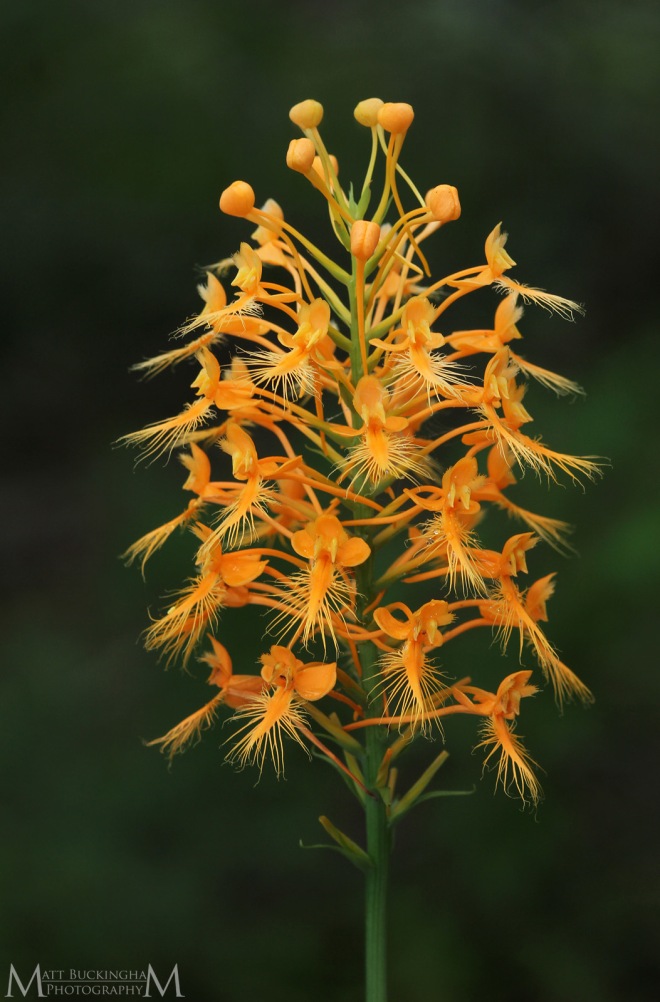
Back in East Texas, my friend James Childress and I went looking for some late summer wildflowers.  Two of my favorites are the Yellow Fringed Orchid (Platanthera ciliaris) and the Carolina Lily (Lilium michauxii).  Both species are uncommon in East Texas.  P. ciliaris occurs in herbaceous seeps, baygall margins, and occasionally wet ditches and prairie remnants.  L. michauxii primarily occurs on the upper slopes of rich mesic ravines, often near the transition zone between slope and upland.

IMG_5088

Yellow Fringed Orchid

IMG_5369.jpg

Carolina Lily

While hunting for wildflowers James spotted a most interesting creature.  The Giant Ichneumon (Megarhyssa macrurus) is a large parasitic wasp with extremely long ovipositors.  They use these ovipositors to probe tunnels created by the larvae of horntail wasps.  Horntails bore into the wood of dead and dying trees.  The female ichneumon seeks out these larvae and with her ovipositor and lays her eggs on or in them.  Her own larvae then parasitize the horntail larvae.  The young ichmeumons will feed only on the horntails, killing them in the process.  They will then pupate and emerge as adults from the tunnel that their host created for them.

IMG_5426

Giant Ichneumon

In late August Hurricane Harvey passed through East Texas and dumped unprecedented amounts of rain on the region.  Following the storm, James and I went looking for reptiles and amphibians, hoping that they would be active following the prolonged period of moisture.

We found a number of Southern Copperheads (Agkistrodon contortrix), the most attractive of which is pictured below.

IMG_5564a

Southern Copperhead

Among the amphibians observed was this enormous Gulf Coast Toad (Incilius nebulifer).

IMG_5589

Gulf Coast Toad

The prolonged rainfall brought out scores of Hurter’s Spadefoots (Scaphiopus hurteri).  These interesting frogs can be extremely abundant in certain areas, but require specific habitat conditions.  These conditions typically consist of areas with deep, undisturbed sand where they can burrow and aestivate during the hottest and driest part of the summer.  This species emerges only after heavy rains, where they may breed by the thousands in small ephemeral wetlands that may be little more than a puddle.  The tadpole stage for these spadefoots is among the shortest of any frog, requiring as little as two weeks to go from an egg to a froglet capable of leaving the water.  This short larval stage is an adaptation to allow them to breed in areas were the presence of water is a limiting factor, and allows them to breed in areas that other species are not capable of utilizing, effectively eliminating the competition.

IMG_5638

Hurter’s Spadefoot

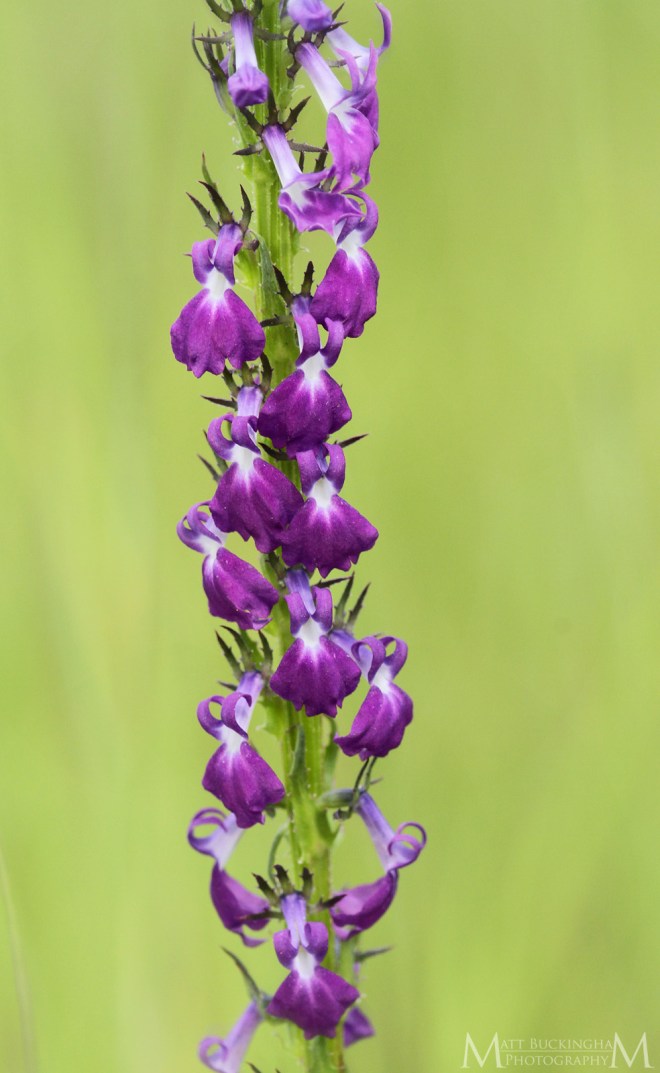
September is perhaps the best time to visit Catahoula Barrens.  Wildflowers such as Texas Blazing Star (Liatris mucronata) and Nuttall’s Rayless Goldenrod (Bigelowia nuttallii) bloom in mass.  Downy Lobelia (Lobelia puberula) is fairly common in wetter areas along the margins of the barrens.

IMG_5750

Downy Lobelia

Small-flowered Fameflower (Phemeranthus parviflorus) occurs sporadically in Catahoula Barrens.  The flowers of this interesting succulent open in late afternoon.

IMG_5790

Small-flowered Fameflower

I leave you with this final shot of a Catahoula Barren.  I captured this shot at dusk and tried to highlight the rich diversity of colors that can be found in these incredible landscapes.

IMG_6024

Catahoula Barren

Return to Sky Island

IMG_4424

Mountain Short-horned Lizard

Target Species:

Mountain Adder’s Mouth (Malaxis macrostachya)

Wood’s Jewel Scarab (Chrysina woodii)

Mountain Short-horned Lizard (Phrynosoma hernandesi)

The sky islands of West Texas have been woven into the fabric of my being.  Each trip to these high elevation oases of the desert brings with it a sense of wonder and euphoria, and a longing to return.  Since returning from our trip in July, not even a month ago, I have been desperate to get back to the high elevation grasslands, shaded canyons, and montane forests.  There is so much to see.  Such plant and animal diversity, such natural beauty.  Here among the cool mountain peaks I feel at home.

When I approached Carolina with the idea of returning to the Nature Conservancy’s Davis Mountains Preserve for another open weekend in August, it didn’t take much convincing.  We decided we would return, and this time we would be bringing our good friends James and Erin Childress with us.  So we set out in the blackness of early morning on a great pilgrimage to the Trans-Pecos.

By the time the sun rose, the towering Loblolly Pines and stately hardwoods had mostly vanished in the rearview.  As dawn broke they gave way to gnarled post oaks sprawled over verdant grasslands.  Gradually the post oak gave way to mesquite, and the grass became more and more sparse, until bare rock seemed more abundant than plantlife.  We passed over the Ozona Arch into the desert scrub of the Permian Basin, and finally after what seemed like an eternity, the foothills of the Davis Mountains came into view.

We took our time on the scenic loop, admiring the scenery in every direction, and watching for plants and wildlife along the road.  When we finally arrived at the preserve, we stepped out into the cool mountain airs and paused a moment to take it all in.  We could see Madera Canyon in the distance, as it worked its way toward the slopes of Mount Livermore, the highest peak in the Davis Mountains, and the fifth highest in Texas.

We visited a moment with our friend and local landowner Gary before venturing into the preserve.  We made camp in a flat basin among scattered Alligator Juniper and Pinyon Pine growing above a rich layer of forbs and grasses.  Among this herbaceous layer I spotted the purple flowering spikes of Lobelia fenestralis, the Fringeleaf Lobelia.  This striking sky island specialist barely enters the U.S. in extreme West Texas and one county in western New Mexico.

IMG_3500

Fringeleaf Lobelia

After setting up camp we journeyed into Madera Canyon.  We admired the birds as we went, watching as a Common Black Hawk flew from the crown of an Alligator Juniper, and a Montezuma Quail burst from the grasses and across the road before us.  We were serenaded by Western Kingbirds, Blue Grosbeaks, and Say’s Phoebes while the occasional hummingbird shot past like a bullet, offering little opportunity to identify it to species.

As we scoured the slopes along Madera Creek in hopes of glimpsing one of the many interesting things that dwell there, I heard Carolina call out that she had found one of my targets.  Sure enough, between the large rocks at the base of a Ponderosa Pine was a single green leaf.  My search was now narrowed and intensified, as I made my way along the steep, rocky slopes hoping to catch one of these bizarre plants in bloom.  I looked and looked, until I saw what I was searching for: the single leaf and ten-inch flowering spike of the Mountain Adder’s Mouth Orchid (Malaxis macrostachya).

IMG_3598

Mountain Adder’s Mouth

The Mountain’s Adder Mouth is an orchid of the montane forests of the southwestern U.S. and Mexico.  In Texas it is known only from the high elevation slopes of the Davis Mountains.  Though the plant itself may reach a foot in height, the flowers themselves are tiny, and a hundred or more may decorate the raceme.  This long, narrow raceme has earned this orchid the colloquial name “Rat-tail Malaxis”.  We searched the area for more orchids to no avail, and I counted myself lucky to have found such a fine specimen.

IMG_3621

Mountain Adder’s Mouth

As the sun vanished behind the distant peaks we slowly began making our way back to camp.  In the fading light of dusk we spotted a brown blur moving across the road ahead.  Drawing nearer we made out the shape of a large bobcat vanishing into the grass.  We paused a moment and watched, hoping that we might catch another glimpse of this elusive feline.  Our efforts were rewarded, as it occasionally appeared between breaks in the vegetation as it silently and meticulously made its way through the dark forest of pinyon and juniper.

We arrived back at camp with little light to spare.  James and I strung a large white sheet between the branches of two trees a short distance from our site.  We then propped a small florescent bulb on my tripod and aimed it at the sheet.  Our trap had been set.

As the sheet collected our six-legged quandary we prepared a meal of dehydrated broccoli cheese soup, and settled in to watch the skies.  The heavens seemed locked in some violent battle, as tailed balls of light danced across the sky,  flying from horizon to horizon.  In truth we weren’t witnessing some celestial war, but rather the peak of a perseid meteor shower, when the constellation Perseus scatters massive particles throughout space.  When our eyes and necks could no longer take in the wonder of the skies we shut off our light trap and retired for the evening.

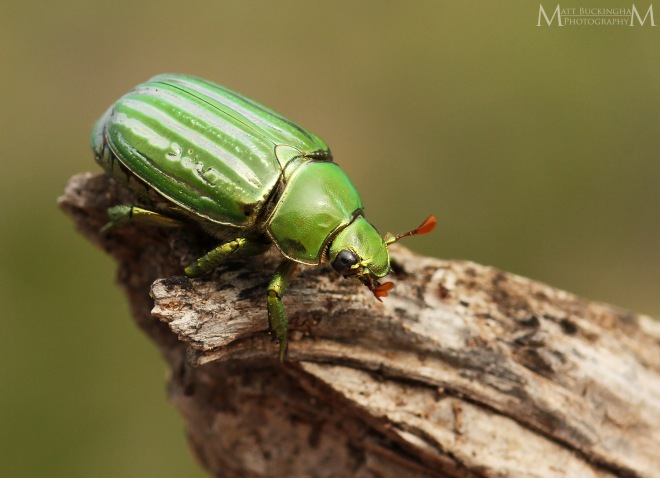
We rose early the next morning.  The first order of business was photographing a most spectacular creature that we had found the day before.  I was lucky enough to catch a fresh Wood’s Jewel Scarab (Chrysina woodii).  Carolina spotted the brilliant beetle as it flew about a pecan tree that had been planted at a picnic area in the foothill’s of the Davis Mountains.  As this species evolved to specialize on walnut leaves, it is not so surprising that it would also make use of Pecan, a close relative.  Anxious to arrive at the preserve, we held onto the beetle to photograph later.

IMG_3776

Wood’s Jewel Scarab

Now, in the beautiful early morning light we set it in our viewfinders.  I have always dreamed of finding a live Chrysina woodii.  A desire that has only been fueled after finding numerous crushed bits and pieces over the years.  C. woodii is endemic to the sky islands of West Texas, eastern New Mexico, and northern Mexico.  In Texas it has been documented in the Davis and Guadalupe Mountains.  The beetles actively feed during the day and are regularly attracted to lights by night.

IMG_4473

Wood’s Jewel Scarab

Chrysina woodii is also known as the Blue-legged Jewel Scarab.  It’s easy to see why, when admiring its brilliant metallic blue tarsi.  C. woodii is named for Dr. Horatio C. Wood, a pharmacologist who also published numerous papers on botany and entomology.  Wood collected a number of brilliant metallic green beetles in West Texas and gave them to his friend, George Henry Horn.  Horn was a pioneering coleopterist (entomologist specializing in beetles) active in the southwest during the late 1800s.  Horn presented the specimens at an entomological congress in 1883, and formally described Chrysina woodii in 1885.

IMG_3737

Wood’s Jewel Scarab

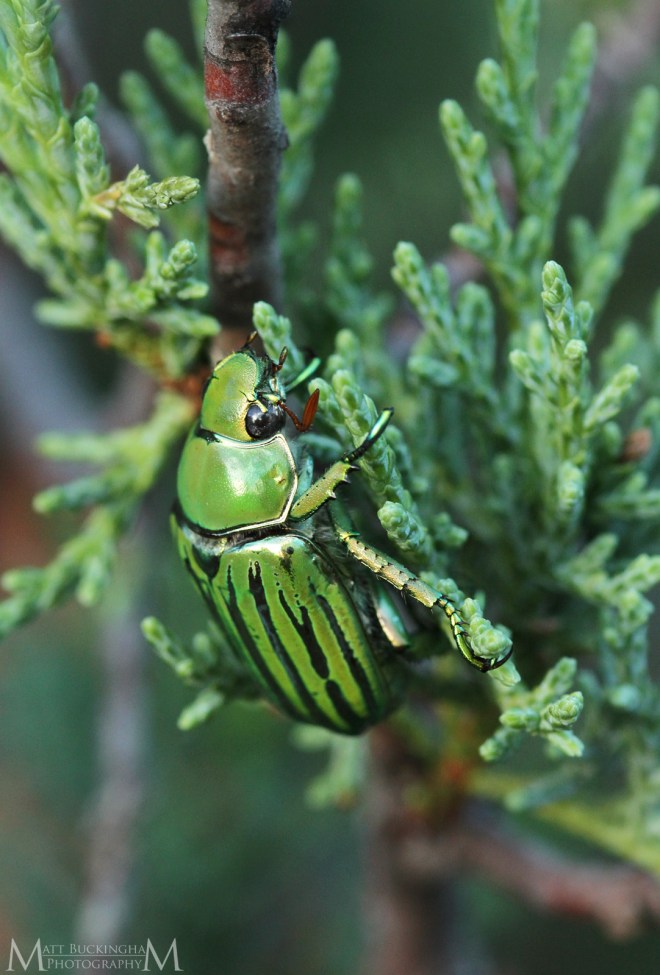
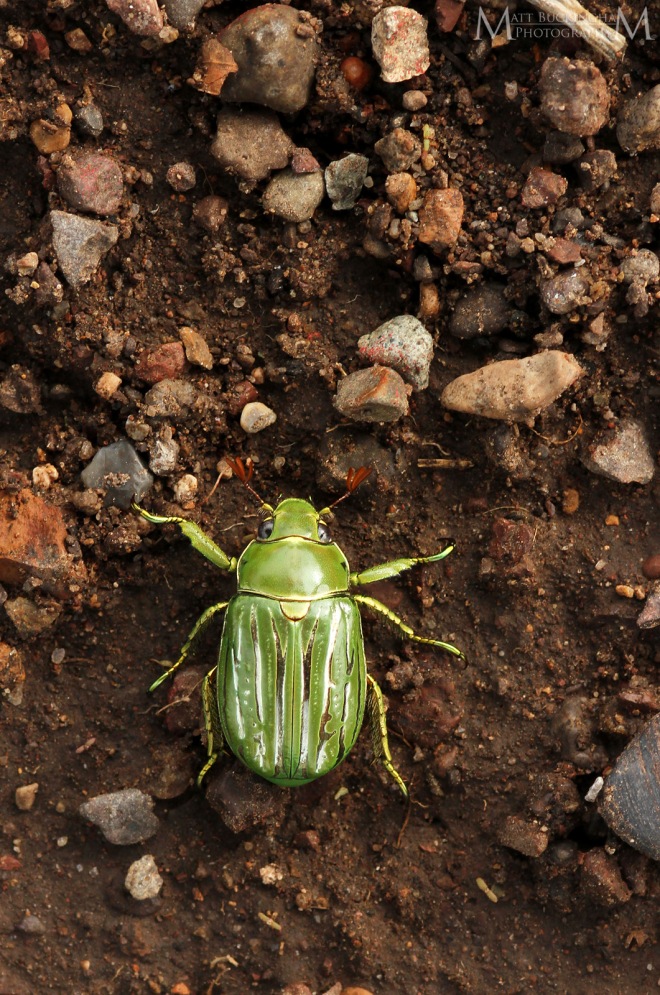
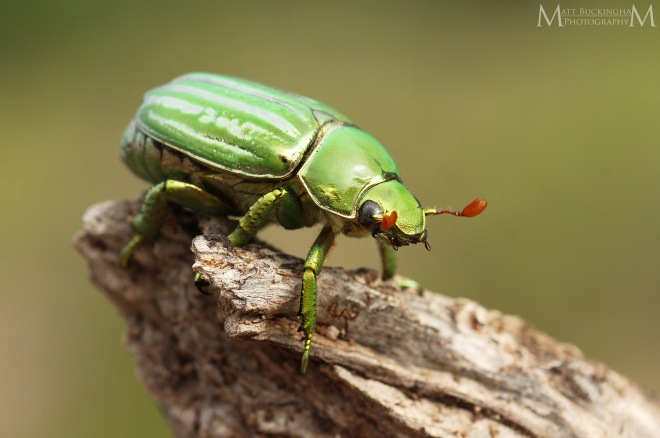
The light trap that we set the previous night was a success.  Among the flurry of moths that I was woefully under-prepared to identify, Erin spotted a creature of metallic green decorated with bright silver streaks: a Glorious Scarab (Chrysina gloriosa).  We held onto it until morning, when we opted to photograph it on the leaves of an Alligator Juniper, one of the primary food sources of the adults.  Despite the beetle’s gaudy appearance, it is incredible just how cryptic it was among the blue-green juniper leaves.

IMG_3718

Glorious Scarab

After breakfast and our coleopteran photo session we set back out into Madera Canyon.  Once again we paused to admire the incredible array of birds that flit about the trees, filling the mountain air with their sweet songs.  In the early morning hours the showy blooms of the Torrey’s Crag Lily (Echeandia flavescens) had opened.  By midday they will have closed, and the plants will become invisible among the sea of grass that surrounds them.

IMG_3806

Torrey’s Crag Lily

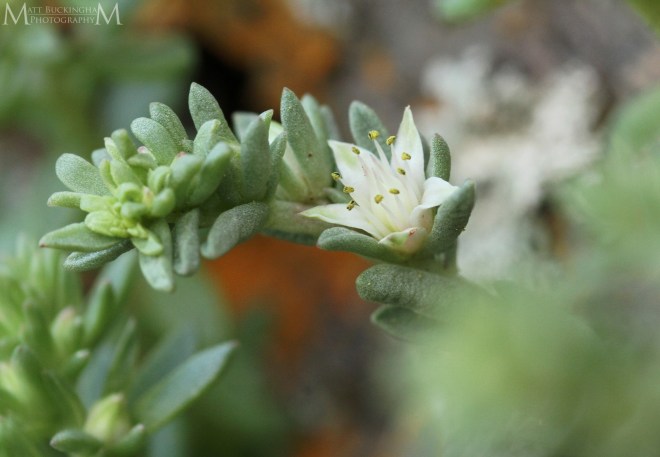
Along the bases of the large rocks lining Madera Creek I spotted the succulent Havard’s Stonecrop (Sedum havardii).  This species is known in the U.S. only from the Davis and Chisos Mountains of West Texas.

IMG_3853

Havard’s Stonecrop

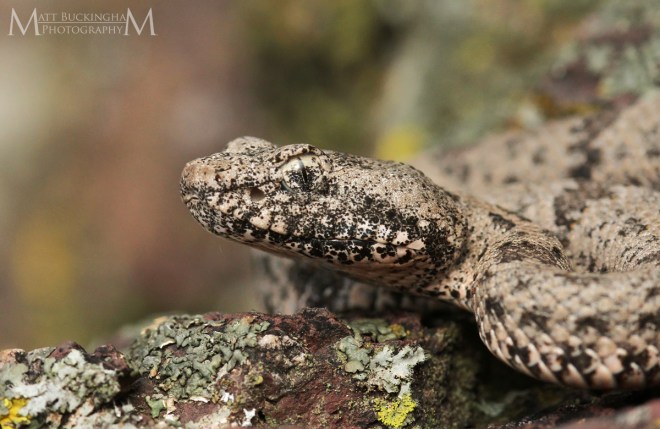
Deep in Madera Canyon we turned into one of the many side canyons formed by ephemeral streams feeding Madera Creek.  We were spread out along the gradual slope when we heard Carolina call out “snake”.  I’ll admit that it took me a moment when she struggled to draw our attention to the serpent before her.  But sure enough, there, among a downed alligator juniper sat a Mottled Rock Rattlesnake (Crotalus lepidus lepidus).  The cryptic viper was nearly invisible due to its remarkable camouflage.  We all delighted in observing and photographing the beautiful reptile.  Despite its potent venom, it remained docile throughout our encounter, and would not display even the slightest bit of aggression toward us.

IMG_3973

Mottled Rock Rattlesnake

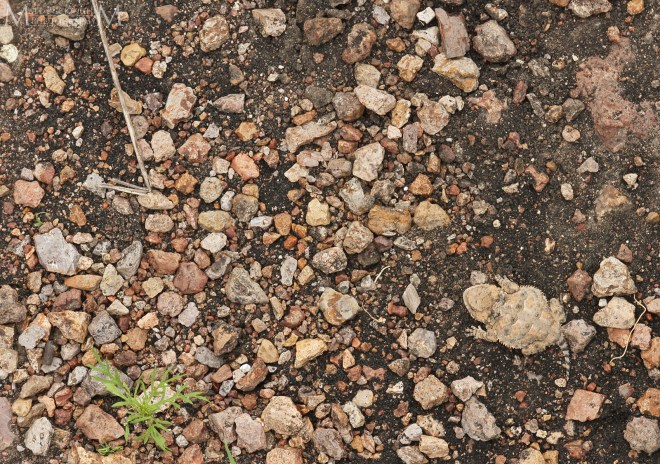
We bid the rattlesnake farewell, and ventured deeper into the canyon, until it flattened out into a broad high elevation basin.  The ground here was littered with small rocks.  Soon we came to realize that here some of the rocks move.  James was the first to catch movement among the pebbles, as one stone seemingly jumped out of his way.  Baffled, we looked closer, only to reveal that what looked like nothing more than one of the basin floor’s countless stones was actually a neonate Mountain Short-horned Lizard (Phrynosoma hernandesi).

IMG_4070

Mountain Short-horned Lizard

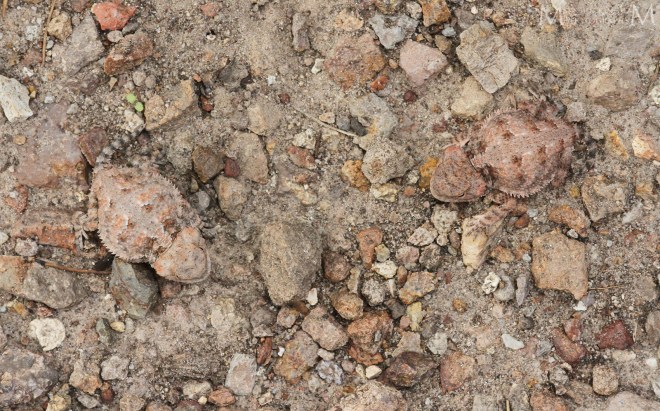
It soon became clear that these tiny lizards were all around us, and within the span of an hour we saw more than a dozen.  Their abundance that day is likely a product of their reproductive biology.  The females give live birth to as many as 40 or more of these living stones in July and August.  The neonates are then left to fend for themselves as they scatter about the surrounding area.  It is truly remarkable just how well-camouflaged these tiny dragons are.

IMG_4148

Mountain Short-horned Lizard

IMG_4196

Mountain Short-horned Lizards

Spotting the baby lizards became something of a contest.  And while I was genuinely thrilled to have seen them, I couldn’t help but hope that we might encounter an adult.  Deeper into the basin we pushed until a distant rumble drew my attention to the peaks behind us.  Behind the mountains a massive storm was building, sending broad black clouds towering to the sky.  It was fast approaching.  Deciding that we would prefer not to wait out a storm at the base of some pine or juniper we decided to retrace our steps.

The storm drew nearer and nearer still as we retreated toward the safety of my truck.  Between the cracking thunder that echoed from the canyon walls, Erin called out “a big one! A big one!”  My eyes followed her finger to the rocky earth, where it took them a moment to spot the large Mountain Horned Lizard sitting still among the stones.

IMG_4262

Mountain Short-horned Lizard

Despite the impending deluge, we settled in to admire this incredible creature.  Thunder rang and the sky darkened as our shutters closed in rapid succession, forever freezing a moment of the lizard’s life in time.  I couldn’t help but imagine what a bizarre, frightening experience this must have been for it.  Fortunately, for a lizard photographer, at least, most horned lizards rely on their camouflage as a defense mechanism, and are prone to hunker down in an attempt to avoid being seen.

As a group, the horned lizards of the genus Phrynosoma are often referred to as “horny toads”.  A misnomer, of course, as toads are amphibians and these are very much reptilian.  Phrynosoma hernandesi is among the most widespread of the horned lizards, occurring across much of the western U.S. and Mexico and into southern Canada.  They generally occur in high elevation woodlands, prairies, and savannahs in the southern portion of their range, and grasslands and forested foothills to the north.  In Texas they are primarily restricted to the Davis and Guadalupe Mountains, with a few scattered populations in other ranges around El Paso.

IMG_4410

Mountain Short-horned Lizard

The Mountain Short-horned Lizard is one of a number of the Phrynosoma that is able to shoot blood from the corner of its eye.  This tactic appears to primarily be utilized against canine predators.  Fortunately it did not deem us a sufficient enough threat to warrant such an attack.

IMG_4339

Mountain Short-horned Lizard

We spent some time in the lizard’s company, and hastily returned to the truck.  On four wheels we were able to get ahead of the storm, and after a lunch of tuna sandwiches we set out to explore the scenic loop that winds around the Davis Mountains.  We stopped a moment at the McDonald Observatory, and continued on to Fort Davis.  As we neared the small grocery store in town, the rain finally caught up with us.  It is a magical experience, rain in the desert.  The dusty earth dampens and releases its sweet, distinctive aroma to the air.  We soaked in the rain, both literally and figuratively, as we restocked some supplies and prepared to continue on the loop along the southern and western edge of the Davis Mountains.

The rain was letting up as we spotted a large Pronghorn buck and his harem of six does not far outside of Fort Davis.  We watched them as lightning descended distant clouds on the horizon.  After spending a few moments with North America’s fastest land mammal, we continued down the road where we saw a large Mule Deer Buck browsing among the cholla and desert grasses.

Scaled Quail and Roadrunners darted across the road before us as we made our way further down the scenic loop.  We stopped at the Point of Rocks Roadside Park, where James chased after a Canyon Towhee with his camera, Carolina and Erin explored the massive rock outcrop, and I prepared a dinner of macaroni and tuna.  The sun had begun to peak through the clouds, casting its rays to distant rain showers that transformed its light to a myriad of brilliant colors arching across the sky.  After dinner we returned to the loop where we found a number of Western Diamondback Rattlesnakes before returning to our campsite around 11 pm.

The next morning we broke camp and said farewell to the Davis Mountains Preserve.  Our time in this remarkable sky island, however, was not yet over.  We were off to visit Gary at his property on the other side of the range.  He lives in a remote corner of Limpia Canyon far from paved roads.  The creek that helped form the canyon was running.  Its crystal clear waters pouring over boulders among the towering Ponderosa Pines looked more a scene from Colorado than West Texas.  We would later learn from Gary that it might run only a month or two out of the year.

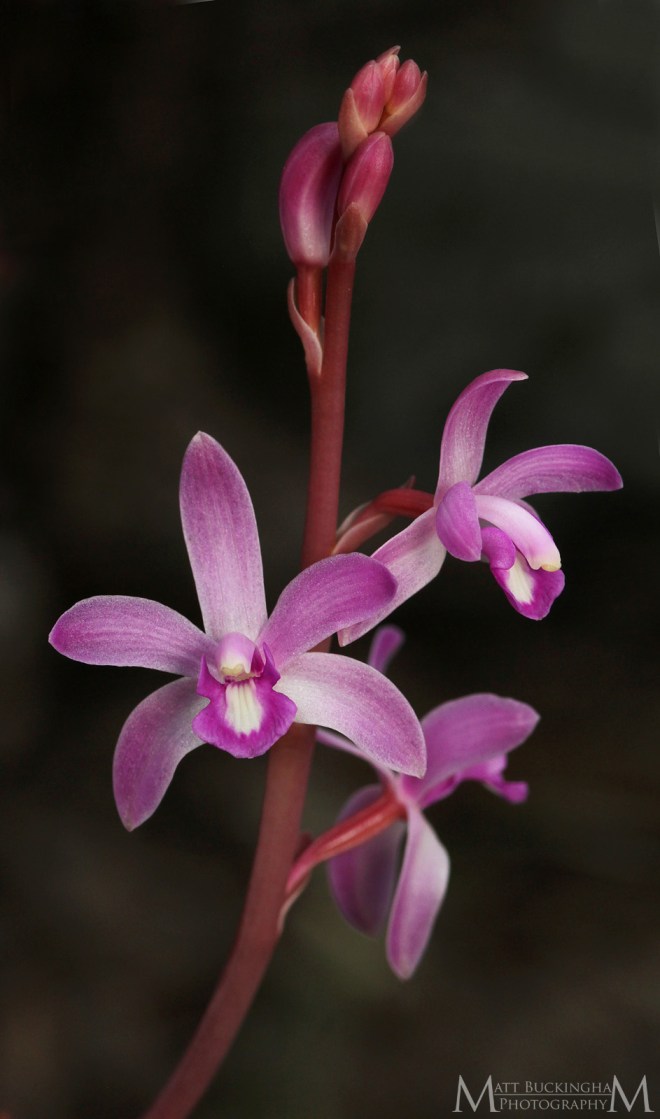
I had visited the forested canyon on Gary’s property last year and I couldn’t wait to show James and Erin this hidden paradise.  I hoped that we might spot some Giant Coralroot Orchids (Hexalectris grandiflora).  We had looked for them on the preserve, but only succeeded in finding spent, wilted flowering stalks.  As we followed Gary up the canyon he regaled us with stories of the “Republic of Texas“, a militia group that believed that Texas should never have become part of the United States, and took it upon themselves to secede.  There were still signs and artifacts of their presence on his land.

It wasn’t long before we spotted the first group of coralroots.  It was a cluster of fresh plants, but unfortunately the flowers were all closed and drooping, a phenomenon that is fairly common among the genus Hexalectris.  We took their presence to be a good sign and continued on.  We (more accurately Carolina) spotted several Mountain Adder’s Mouth Orchids.  They seemed to be more numerous here than in Madera Canyon.

Just as we were debating turning around, James pointed out a splash of color in the deep shade of some low hanging branches of an Emory Oak.  It was a pair of Giant Coralroots in perfect bloom.  I had grown accustomed to seeing only one or two open flowers on any given individual at a time.  One of these, however, had three that were clustered closely together.  After a long, uncomfortable photo session we bid the orchids farewell and returned down the trail as an afternoon thunderstorm, typical of the monsoon season, began to build behind the peaks surrounding the canyon.

IMG_4795

Giant Coralroot

Gary invited us in for snacks and alcoholic cider, an offer that was hard to turn down.  We enjoyed his company and knowledge of the area’s natural and cultural history.  After visiting a while James and I set out to photograph the wealth of scenery around Gary’s home when James spotted a peculiar pattern on a nearby boulder.  “Do you see what I see?” he asked pointing at the rock.  It took a moment, but finally I saw it – a young Mottled Rock Rattlesnake resting still and silent.  In that moment our photographic priorities changed and we set about capturing the beautiful snake.  Just as we were finishing the building clouds reached their critical mass and began releasing their moisture in the form of an afternoon downpour.

IMG_4915

Mottled Rock Rattlesnake

We bid our reluctant “good bye’s” to Gary and the mountains he calls home.  That night we would descend from the sky islands and make our camp in the desert scrub around Lake Balmorhea.  Here we watched a large group of Clark’s Grebes on the water, while we listened to a Pyrrhuloxia call from among the impenetrable thorn fortress of the surrounding desert.  Carolina spent the evening rock hounding in search of the elusive Marfa Agate while James and I looked for signs of life and Erin enjoyed one of her favorite books in the spectacular setting of the Chihuahuan Desert.  Carolina was lucky enough to find a few choice pieces of agate while James and I spotted a number of large Tarantula Hawks and Western Green June Beetles.  All of our attention, however, soon turned to the horizon, where the setting sun painted a rainbow on the black clouds of a distant thunderstorm.  It was a fine final chapter to an incredible Trans-Pecos adventure.

36637933825_3fc24bb99d_o

A distant thunderstorm rages over the desert scrub near Balmorhea.

July Recap

IMG_3479

Cow Killer

July has been my most productive month yet.  Due in large part to a trip to the Davis Mountains I was able to check 7 species off my list:

Spider Lily (Hymenocallis occidentalis)

Texas Coralroot (Hexalectris warnockii)

Glass Mountain Coralroot (Hexalectris nitida)

Giant Coralroot (Hexalectris grandiflora)

Mexican Catchfly (Silene laciniata)

Glorious Scarab (Chrysina gloriosa)

Canyon Tree Frog (Hyla arenicolor)

2017GoalsJuly

One of the most interesting photographic experiences of July came toward the end of the month, when a female Red Velvet Ant a.k.a. Cow Killer (Dasymutilla occidentalis) came wandering through our yard.  These large wasps have always fascinated me, and I’ve long wanted to get a good photo of one. I’ve tried a few times in the past but found them nearly impossible to photograph. They are surprisingly fast and never stop moving.  The females are flightless, while the males are winged.

Despite their ominous name, which eludes to their supposedly highly painful sting, my wife offered to help. I captured it in a cup and then led it onto a 3-foot long stick. My wife held the stick, switching hands as it paced rapidly from one end to the other. Occasionally it would stop at the edge for the briefest of moments. I ended up taking over 100 shots. I got some that were very sharp, but she was in an awkward position, and others where she was in the perfect position, but the focus wasn’t right. This one ended up being my favorite. When we finished I let her continue on its way.

Cow killers are parasites of parasites, and when we encountered her I assume she was on the hunt for a suitable host for her offspring. They seek out the larvae of Cicada Killer wasps (Sphecius speciosus), and lay their own eggs into the larvae of the Cicada Killers, which have been laid on a live, paralyzed cicada. They will also parasitize a number of other ground nesting wasps and bumblebees.

In early July I went to visit a population of Crested Coralroot (Hexalectris spicata) in the Davy Crockett National Forest.  Despite significant damage from feral hogs to the dense leaf litter at the site, I found several blooming plants.  Though most were past their prime, i found a few fresh, interesting blooms.  It’s hard to imagine a flower having a personality, but the flowers of Hexalectris spicata certainly look like they could.

IMG_0876

Crested Coralroot

En route to the Crested Coralroot spot I stopped along a forest road to relieve myself.  As I was doing so I spotted several Little Ladies’ Tresses (Spiranthes tuberosa) blooming alongside the road.  These diminutive orchids bloom in the summer in open woodlands.

IMG_0924

Little Ladies’ Tresses

I photographed this Bog Coneflower (Rudbeckia scabrifolia) in a herbaceous seep on private land.

IMG_0935

Bog Coneflower

I have been wanting to photograph Climbing Milkweed (Matelea decipiens) for a while.  I found a plant with a single cluster of blooms along a springfed stream.

IMG_0992

Climbing Milkweed

The striking Blue Waterleaf (Hydrolea ovata) is common in herbaceous wetlands in the eastern third of the state.

IMG_1097

Blue Waterleaf

Hydrolea ovata can often be found growing with Looseflower Water-Willow (Justicia lanceolata).

IMG_1132

Looseflower Water-Willow

Toward the end of the month I visited a high quality longleaf pine savannah on private land with my friend James.  During our visit we were fortunate to catch the rare Scarlet Catchfly (Silene subciliata) in bloom.

IMG_3250

Scarlet Catchfly

I’ll end my July recap with a photo of a Slimleaf Milkweed (Asclepias stenophylla) that we saw on our way back from Dallas, where we photographed Hexalectris warnockii and H. nitida in early July.  This is one of the rarer milkweeds of Texas. It is primarily a species of the Great Plains, occurring on dry, sandy prairies that have not experienced significant soil disturbance. In Texas it occurs in scattered populations from the Rolling Plains to the Blackland Prairies, where it appears to be rare and declining.

IMG_1626

Slimleaf Milkweed

Sky Island

Target Species:

Giant Coralroot (Hexalectris grandiflora)

Mexican Catchfly (Silene laciniata)

Canyon Tree Frog (Hyla arenicolor)

Glorious Scarab (Chrysina gloriosa)

IMG_2995

Glorious Scarab

There are those profound moments in life that help shape who we are.  Experiences that put things into perspective, and fill us with a sense of purpose and being.  Moments that bring clarity to an otherwise murky sea of questions, concerns, and uncertainty.  For me most of these moments occur when I’m in the natural world – in places where the advance of civilization and the concrete world is less evident.  These wild places are my “church”, for it is here that I seek the direction and advice that guides me, and puts me on my path.  Make no mistake, I do not hold any misconceptions that Mother Nature reciprocates my feelings toward her, but rather I take comfort in my insignificance in the grand scheme of the natural cycle.  In these moments I know that my life will be fulfilled, for I could never hope to run out of new natural wonders to discover.

One such moment occurred recently in the Davis Mountains of West Texas, when Carolina and I stood high in a narrow canyon overlooking the rain-drenched valley below.  We were soaked from head to toe, yet our spirits were not dampened as we pondered the denizens of the forests and meadows that lay below us.  On the walk up we had passed groves of massive Ponderosa Pines (Pinus ponderosa), one of the many Rocky Mountain relicts that persist in these sky islands.  Among these pines was the largest individual recorded in the state of Texas.

IMG_2483

High Elevation Valley with Ponderosa Pine, Texas Madrone, and a variety of oaks

Rain in West Texas is a beautiful thing.  You can literally see the world come to life as it rains.  You can smell it, hear it, feel it.  It’s a difficult sensation to describe.  Though in these sky islands, rain is not as scarce as one might think.  Sky islands are unique habitats that occur in isolated mountain ranges in the desert southwest.  Here warm air cools as it rises up the slopes and moisture accumulates.  This combines with annual monsoons that typically begin in July and last into September, soaking the mountains with nearly daily afternoon thunderstorms.  The result is annual levels of rainfall that may be 4 times greater or more than the surrounding desert.  Temperatures are significantly cooler as well.  These conditions result in the presence of several species typical of the Rocky Mountains as well as species of the desert southwest.  Couple this with the fact that West Texas and northern Mexico is a a significant center of endemism, and the importance of the Davis Mountains for biodiversity becomes clear.

We were exploring the Davis Mountains Preserve, owned and managed by the Nature Conservancy in Texas.  This 33,000 acre preserve protects the highest and most spectacular portion of the Davis Mountains.  It joins approximately 70,000 acres of additional land protected through acquisition and private landowner conservation partnerships.  The result is the protection of over 100,000 acres of sky island habitat that is critical for a number of rare and declining species and natural communities.  Here we observed an array of fascinating plant and animal species typical of these sky islands.

IMG_2252

A rain-drenched montane woodland with an overstory of large Ponderosa Pines and an understory of oaks and Texas Madrone

Topping out at over 8,000 feet, the Davis Mountains are the tallest, and largest mountain range confined entirely to the Lonestar State.  Though the Guadalupe Mountains are indeed taller and more extensive, we share them with New Mexico.  The Davis Mountains were the last refuge for Mexican Gray Wolves and Grizzly Bears in Texas.  Those these apex predators are gone, the Mountain Lion still roams here, and Black Bears are making a comeback.  Today, the Davis Mountains remain one of the final strongholds in Texas for a variety of plant and animal species.  Perhaps the most spectacular of which is the Giant Coralroot (Hexalectris grandiflora).

The rain was just beginning to let up when Carolina spotted them.  A clump of pink beacons shining against the wet rocks and grasses.  She had found the Giant Coralroot.  It is hard for me to describe the sense of wonder and excitement that overcomes me while I observe such an elusive treasure.  The clump of orchids had at least 10 stems with dozens of flowers in various stages of development, from bud to senescent blooms.  Over the next two days we would end up observing four clumps and a total of approximately 15 plants.

IMG_2513

Giant Coralroot

Previously the Giant Coralroot was thought to occur in the United States only in the moist pine-oak-juniper canyons of the Davis Mountains.  Though it remains restricted to Texas, it has since been discovered in the Chisos Mountains within Big Bend National Park, the White Rock Escarpment of north-central Texas, and oak-juniper woodlands of the Edward’s Plateau.  They seem to be exceedingly rare in these areas, however, and their real stronghold in the U.S. remains the Davis Mountains, where they are relatively common in high elevation forests dominated by Alligator Juniper, Pinyon and Ponderosa Pines, Texas Madrone and a variety of oaks.

IMG_2275

Giant Coralroot

Giant Coralroots are myco-heterotrophs, obtaining energy and nutrients from the mycorrhizal fungi of tree roots.  Unlike most plants they do not photosynthesize, and therefore do not require chlorophyll-containing leaves.  They spend most of their lives as nothing more than an underground rhizome and roots, but following the onset of the summer rains, they begin to send up stalks that may bare a dozen or more bright pink blooms.  They seem to bloom sporadically from late June to mid September, likely peaking in mid to late July in most years.

IMG_2183

Giant Coralroot

These spectacular orchids are easiest to find growing beneath trees and at the base of rocks where moisture and organic material accumulate, providing ideal conditions for both the plants and the fungi they depend on.  Though there is a lot of respectable competition, the combination of their beautiful blooms, interesting life history, and the spectacular places that they inhabit make this my favorite species of orchid.

IMG_2581

Giant Coralroot

IMG_1788

Giant Coralroot

Growing near the orchids was Mexican Catchfly (Silene laciniata).  This striking wildflower occurs in the mountains of the southwestern United States and northern Mexico, barely entering Texas in the mountains of the Trans-Pecos.  It’s name comes from its sticky stem, which can trap insects in order to protect the plant from predation.

IMG_1708

Mexican Catchfly

A number of milkweed species occur in the West Texas sky islands.  We observed Asclepias latifolia and Asclepias brachystephana in the lower elevation grasslands.  Higher up we came across Asclepias texanaAsclepias subverticillata, and Asclepias engelmanniana in bud.  The true star of the high elevation milkweeds was the Nodding Milkweed (Asclepias glaucescens).  We found one robust flowering plant growing alongside a rocky stream in a canyon shaded by Alligator Juniper and Pinyon Pine.

This large, showy milkweed is primarily a species of the mountains of Mexico.  It barely enters the United States in the sky islands of West Texas, and southern Arizona and New Mexico.  In Texas they are restricted to the Davis, Chisos, and Guadalupe Mountains.

IMG_1789

Nodding Milkweed

Like Asclepias glaucescens, the U.S. distribution of Threadleaf Phlox (Phlox mesoleuca) is largely restricted to the sky islands of the southwest.

IMG_1868

Threadleaf Phlox

In addition to species that are primarily Mexican in their distribution, the Davis Mountains provides refuge for a variety of Rocky Mountain relicts.  Purple Geranium (Geranium caespitosum), for example, occurs primarily in Ponderosa Pine savannahs and other coniferous woodlands of the Rockies from Wyoming to northern Mexico.

IMG_1995

Purple Geranium

IMG_2005

Purple Geranium

The Harebell (Campanula rotundifolia) has an even broader distribution, occuring in the formerly glaciated northern United States and Canada down through the Rocky Mountains, and into the sky islands of the southwestern United States and Canada.  It is common in the high elevations of the Davis Mountains and puts on a spectacular show during the summer monsoon.

IMG_2020

Harebell

One of the Davis Mountains most spectacular botanical residents is the Desert Savior (Echeveria strictiflora).  This succulent member of the stonecrop family (Crassulaceae) is primarily found on rocky canyon walls and slopes of central and northern Mexico.  In the United States it is known only from Jeff Davis, Brewster, and Presidio Counties in far West Texas.

IMG_2058

Desert Savior

We found several growing from rock crevices and the bases of boulders at elevations above 6000 feet.  Here they were able to take advantage of minute amounts of soil and moisture that collect over time.  In the Davis Mountains they seem to be found primarily in exposed rock outcrops and canyon walls adjacent to rocky streams.

IMG_2125

Desert Savior

The Desert Savior is a truly spectacular plant.  It’s stalk of waxy, fiery flowers reaches up to a foot and a half over it’s thick, grayish green succulent leaves.  Each curled stalk may bare 2 dozen or more flowers that gradually open, unfurling the stalk as they develop and fade.  Hummingbirds are likely an important pollinator of these succulents, as evidenced by their bright red coloration, somewhat tubular flowers, and the fact that their peak blooming seems to coincide with the start of hummingbird migration of late summer.

IMG_2227

Desert Savior

IMG_2721

Desert Savior

The mountains of Trans-Pecos Texas boast more species of Hexalectris orchids than anywhere else in the country.  For some time I had communicated with North Texas botanist Matt White on our shared interests.  As luck would have it, while returning to the Davis Mountains Preserve visitor center, our friend, The Nature Conservancy volunteer, and local landowner Gary was talking to a man that he introduced as Matt White.  This chance encounter led to Matt guiding us to a population of Texas Coralroots (Hexalectris warnockii) that he had stumbled across on a remote rocky ridge a few hundred meters from the preserve’s main road.  He made a comment that caught my attention – that these plants and their ancestors have likely been at this spot for hundreds of years.  And in all likelihood we were the first humans to ever see them, and the last that ever will.  I smiled at the prospect, and hoped it to be true.

IMG_2333

Texas Coralroot

Following a long day of exploring the Davis Mountains Preserve, we decided to spend the evening resting our legs by taking a leisurely drive along the scenic loop that surrounds the range.  I use the term resting loosely, for it seemed like every few hundred feet we were stopping to explore some new biological or geological wonder.  After a while we passed below Sawtooth Mountain.  The mountain is a prominent landmark in the area, its peak reaching nearly 7,700 feet above sea level, and rising nearly 1500 feet above the surrounding slopes.
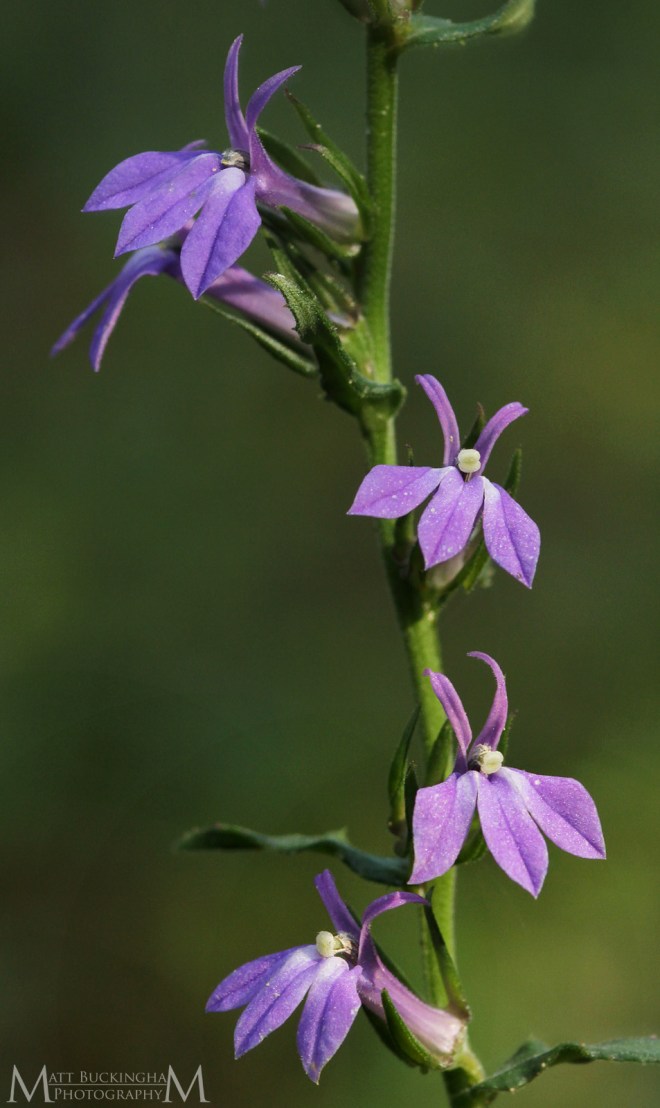
Like the Davis Mountains Preserve, Sawtooth Mountain and its surrounding habitat is protected by the Nature Conservancy.  However the mechanisms that protect the two are quite different.  While the Davis Mountains Preserve is owned outright by the conservancy, Sawtooth Mountain remains private, and instead is protected through a conservation easement.  Conservation Easements are legally binding documents that place restrictions on land use in order to achieve certain conservation objectives.  Sawtooth is another piece of the puzzle that has led to the protection of over 100,000 acres of these sky islands.

IMG_2396

Grassland grades into pinyon-juniper-oak woodlands on the slopes of Sawtooth Mountain

IMG_2407

Sawtooth Mountain looms over an interest rock outcrop

In addition to their unique flora, the Davis Mountains supports an equally interesting faunal community, melding species of the mountainous west, the desert southwest, and those primarily Mexican in their distribution.  In a single day one can hear the call of the Stellar’s Jay alongside that of the Cactus Wren and Painted Redstart.  Rare vagrant bird species turn up here, and reptiles like the Greater Short-horned Lizard thrive in one of the few areas of suitable habitat in the state.

The monsoon rains bring with them an increase in amphibian activity.  We observed many Red-spotted Toads (Anaxyrus punctatus) during our visit.  These large, handsome amphibians occur in a variety of habitats throughout most of the southwest, down into central Mexico.

IMG_2450

Red-spotted Toad

One of the most memorable experiences of any trip to the Davis Mountains is hunting for Canyon Tree Frogs (Hyla arenicolor) as they sit perfectly camouflaged among boulders adjacent to pools in high elevation canyon drainages.  In Texas the Canyon Tree Frog is restricted to a handful of mountain ranges of the Trans-Pecos.  Though most are brown to gray with dark brown blotches, occasionally a striking green or green-spotted individual turns up.  Carolina spotted one such animal camouflaged among the lichen on a large boulder.

IMG_2697

Canyon Tree Frog

As a child, I remember being captivated with the insect community in West Texas.  My parents indulged me as I ran about the desert with a net in hand, eagerly trying to capture and identify the staggering array of flying and crawling six-legged wonders that call the Trans-Pecos home.  There are few places in the country that provide as wonderful an entomological playground as West Texas.

One of the most conspicuous members of the insect community is the Arizona Sister (Adelpha eulalia), a member of the brush-footed butterfly family (Nymphalidae).  On warm, sunny days that can be seen dancing about the canyon floor and rocky outcrops seeking moisture and areas of mineral deposits.  At some such deposits its not uncommon to see dozens of different species sharing the same space in search of essential nutrients that their nectarivorous diet does not provide.

IMG_2768

Arizona Sister

The Orthopterans (grasshoppers, katydids, and crickets) of the Trans-Pecos range from species of muted camouflage to those with fitting, gaudy names like the Rainbow Grasshopper.  Carolina spotted this blue-winged grasshopper (Trimerotropis sp.) resting among the pebbles in a mountain wash.  Though they initially appear to be adorned in dull, muted tones, when they jump they reveal their translucent blue hind wings and cobalt blue markings on the inside of their hindlegs.

IMG_2892

Blue-winged Grasshopper

It’s always a treat observing tiger beetles.  Ruthless predators, tiger beetles are lightning fast and armed with deadly mandibles.  We observed these Western Red-bellied Tiger Beetles (Cicindelidia sedecimpunctata) scurrying about rocks adjacent to a mountain stream.  This species, like so many others in the area, barely enters the U.S. in extreme western Texas and southern New Mexico and Arizona.

IMG_1746

Western Red-bellied Tiger Beetle

The Western Rhinoceros Beetle (Xyloryctes thestalus) is one of the largest, most abundant beetles of the Davis Mountains.  Following the onset of the monsoon they emerge in droves and seek out ash trees (Fraxinus spp.), their primary food source.

IMG_3157

Western Rhinoceros Beetle

The real gems of the sky islands, however, are the beetles of the genus Chrysina.  There are five species in the United States, two of which occur in Texas.  In what I suspect is a common occurrence among lifelong naturalists, I have certain species that I always admired and dreamed of one day seeing while pouring endlessly through field guides and other nature books as a kid.  One of these species was the Glorious Scarab (Chrysina gloriosa).  It is a species that looks more at home in the tropics, in places well out of reach.

I had looked for this species on many previous trips to the Davis and Chisos Mountains, and had always left having only caught glimpses of elytra discarded by some predator, or some smashed semblance of what once was a Glorious Scarab on busy roads and trails.  But on this trip, much to my delight, a lifelong dream was realized when I saw a live Chrysina gloriosa crawling on the ground on our final evening in the mountains.  I must have made some strange gleeful sound as I reached down to pick it up.  I examined it closely, taking delight in this serendipitous encounter.

IMG_3089

Glorious Scarab

Chrysina gloriosa is highly sought after by collectors, and it is easy to see why.  Fortunately they remain common in sky islands from Arizona to West Texas.  The beetle’s brilliant greens were impossible to capture on “film”, but that didn’t stop me from trying.  The elytra (hardened outer wings) of Chrysina gloriosa are decorated with metallic silver streaks that brilliant reflect the light.  It is believed that the bright coloration and streaked pattern help break out the outline of the Glorious Scarab when it feeds on the juniper leaves that it depends on, helping to camouflage it from would-be predators.  In all we would find five individuals that night and the following morning.  It truly was the perfect ending to a spectacular trip that was rich in biodiversity.

IMG_2982

Glorious Scarab

The Davis Mountains truly are one of Texas’s natural treasures.  We can take comfort knowing that the biodiversity, scenery, and cultural history will be protected for generations to come thanks to the conservation efforts of the Nature Conservancy, Texas Parks and Wildlife, and landowners with a passion for the area.  I hope to return many times in the future, in an endless attempt to document but a mere fraction of the beautiful and interesting plants and animals that call this sky island home.