
*Note – on some monitors images may initially appear “washed out”. Please scroll over each image to see its intended presentation.
Before diving into our next set of pollinators, I thought I’d take a few moments to talk a little bit about photographing these tiny creatures. It has been challenging but rewarding. Many stunning macro images are made with techniques that include lighting via external flash, manual focus, and capturing multiple images that are stitched together in a process called “focus stacking” to maximize depth of field. In most cased I don’t employ any of these. I prefer to use natural light, however this means that I’m limited to shooting during overcast days or when the subject is in the shade. Sometimes shading the insects works, however bees and wasps often tend to flee when a sudden shadow overcomes them. This also means that I tend to shoot at higher ISO, though given today’s cameras and post processing software this isn’t a significant issue. I do sometimes use fill flash, particularly when I have relatively still subjects. In this case, natural light still does most of the work while the fill flash helps bring out the detail in shaded areas.
Most macro photographers utilize small apertures (f/8, f/11, or higher), and/or focus stack so that most of the insect appears in sharp focus. I tend to utilize larger apertures such as f/5. I like this look, and find it allows for some creative freedom with selective focus. It is also typically enough to get much of the insect in focus in profile poses. These large apertures also allow in more light, facilitating higher shutter speeds that help to freeze action, and they result in excellent background blur, even when there are other objects relatively close. Every so often a bee or other insect sits still long enough to allow a few frames that I can then manually focus stack in post processing.
Below is an image of a Megachilid (right) and a female Halictus ligatus sharing a bloom. I was lucky that both of their heads entered the same plane of focus for long enough to capture an image rendering the eyes of both species sharp.

Conventional macro photography also heavily utilizes manual focus. This is because the subjects are often so small and focus needs to be so precise. I agree this is best with still subjects, but I find it nearly impossible to manually focus on rapidly moving pollinators. My hit rate is much higher when I use autofocus in these situations. I’m still rolling with a DSLR, which doesn’t have animal eye tracking. With my setup, I find that single point focusing usually works best. When photographing certain subjects I like to move that point around to compose the shot in camera, but in these cases where the subjects are changing directions and moving back and forth, I tend to keep the point in the center and compose the image in post processing.
And now, back to the bugs!
Stinging Wasps
Recent studies suggest that bees are essentially specialized wasps. While bees have evolved to feed pollen to their developing larvae (or parasitize the pollen stores of other species), other wasps feed their larvae animal prey – typically other arthropods. Bees tend to have hairy legs and or abdomens, while other wasps often have spiny legs and smooth (or nearly smooth) abdomens.
The common name “wasp” is used to describe several clades in the order Hymenoptera, but more often than not it is used to describe “stinging” wasps. Below are representatives of a number of families currently included in this clade.
Family Crabronidae
Crabronidae (along with Sphecidae) are considered “Apoid” wasps. They are closely related to bees, which diverged from this family some 125 million years ago or so. There have been various recent works that have challenged the phylogeny of Apoidea and suggest that Crabronidae is a paraphyletic group. I won’t get too into the weeds on this here, and generally follow the taxonomy established on BugGuide.net.
Tribe Bembicini
Commonly known as “sand wasps”, there are some 200 species in this tribe in the United State and Canada. Prey sources for Bembicini are varied. Most species parasitize flies (order Diptera), though some prey on dragonflies and damselflies (order Odonata), butterflies and moths (order Lepidoptera), “true bugs” (order Hemiptera), and even other Hymenoptera.
Bicyrtes quadrifasciatus
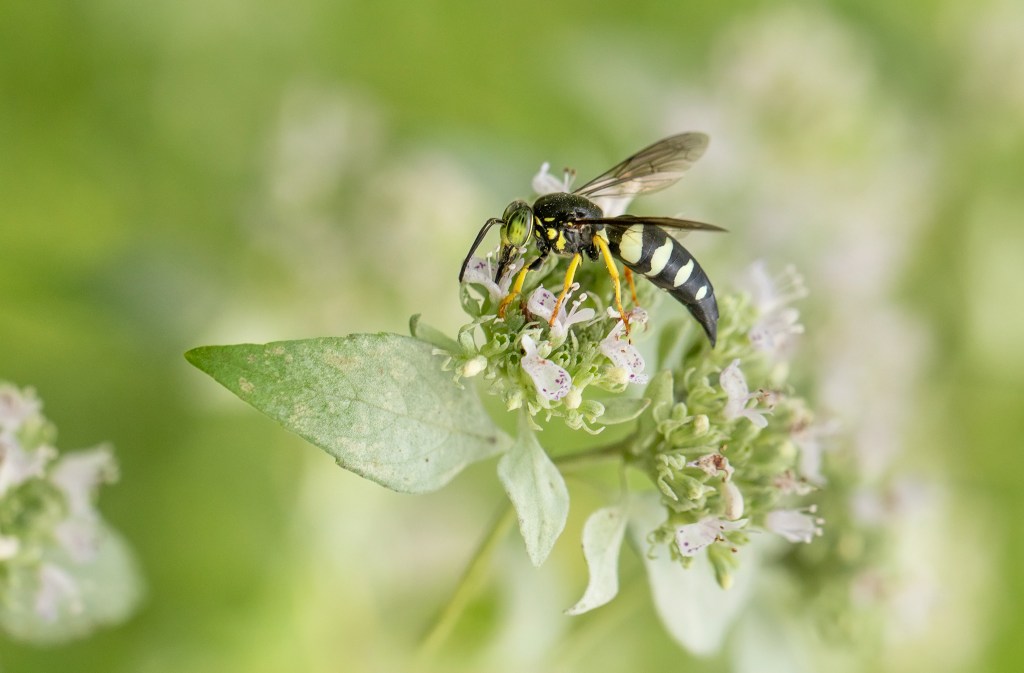
Commonly known as a “stink bug” wasp, females of this fairly large wasp species capture and paralyze true bugs (order Hemiptera, suborder Heteroptera). They then drag them to nests dug in the sand where they will provide food for their developing larvae. Adults feed on nectar like that of the Pycnanthemum albescens I photographed this one on.
Sphecius speciosus
The eastern cicada killer is one of the largest wasps in the country. Large females may approach two inches in length. They are thoroughly intimidating to look at, but though the female is capable of delivering a painful sting, they are not aggressive and only sting if being roughly handled. That said, I was still a bit nervous as I laid prostrate inches from these gentle giant as they buzzed all around me. There is a sandy patch of ground behind my office that has become home to several cicada killer burrows, and the males vigorously defend the entrances. At times they would lock up in aerial battle and land directly on top of me. To top it off, the area was thick with “cow killer” velvet ants (Dasymutilla occidentalis), a known parasite of the cicada killer! Imagine that, a flightless wasp that parasitizes one of our largest wasp species that parasitizes one of our largest insects, cicadas. I was very careful as to where I positioned myself on the earth, since velvet ants, while also non-aggressive, are capable of inflicting a sting that is purportedly even more painful than that of the cicada killer.

When we try and place the life cycle of most wasps in human terms, they’re really pretty brutal creatures. Imagine if there was some predator out there capable of overpowering us, delivering a paralyzing sting that immobilizes us, but keeps us alive so that our flesh stays fresh. They then drag us to a nest and either lay eggs near, on, or even inside of us. Those eggs then hatch into larvae which slowly eat us alive. Its gruesome, but also fascinating, and I dare say humans are capable of much worse.

Tribe Crabronini
Crabronini includes “square-headed wasps” and includes the genera Anacabro, Entomognathus, Crabro, and Ectemnius, among others. Many wasps are difficult to identify to species, but several in this tribe are difficult to narrow down to genus. Members of this tribe nest in the ground or rotting wood, and most provision their nests with flies (order Diptera).
Ectemnius decemmaculatus
Bugguide.net provides the following distinguishing features that separate Ectemnius from similar genera: recurrent vein ending in distal third of submarginal cell, ocelli forming a “low triangle”, lacking orbital foveae, and upper fronts evenly punctate. Hopefully this gives you an idea as to just how difficult insect identification can be.
That said, I believe that the species pictured below on Ampelopsis (Nekemias) arborea is a member of the genus, and that it is most likely E. decemmaculatus. This tentative ID is based of reddish femora on the handles and a silvery patch above the antennae. I think that these are some of our coolest looking wasps. Their squarish heads and huge bulging eyes make them look like tiny aliens.

Tribe Larrini
Tachytes sp.
The genus name Tachytes is derived from a Greek word meaning “swift”. These medium sized wasps are fast fliers, and hunt down grasshoppers and katydids (order Orthoptera) to provision their nests which are dug in sandy soils. There are a couple of similar species in our area. I played around with a key for a bit but it got to be a bit too dense for my casual curiosity. I photographed this individual on Mikania scandens at a local park.

Tribe Philanthini
Philanthus sp.
Members of this family are commonly referred to as beewolves due to their choice in prey. Adults feed on nectar of a variety of flowering plants like the Solidago ulmifolia below. The larvae, however, feed on small bees which the adults pursue and hunt down. They may intercept them on the wing, capture them at flowers, or even enter bee nests. Once a bee has been captured, the beewolf paralyzes it with a well placed sting and carries it to a subterranean nest. I have read that the females cultivate a beneficial bacteria in their antennae that they apply to their nests in order to combat potentially harmful bacteria.

I believe this is Philanthus gibossus based on the abdominal marking. This wide-ranging species preys on a variety of bees including Colletes and Sphecodes. They have also been documented capturing small wasps of the family Crossocerus.

Family Sphecidae
This is another family in the “Apoid” wasp group and includes the “thread-waisted wasps”, which are comprised of many distinctive species. These species are among our most familiar wasps, and many are familiar sights around homes. They provision their nests with a variety of invertebrate prey from katydids to spiders.
Ammophila procera
This thread-waisted wasps and others of its genus have very long, narrow abdomens (“waists”). This is one of the most widespread and frequently encountered Ammophila species in eastern North America. It does share its range with some similar congeners which typically require microscopic comparison of various morphological characteristics to differentiate. Adults feed on nectar and are frequently seen on flowers in the summer and fall. They provision their nests with paralyzed caterpillars (order Lepidoptera) and sawfly (order Hymenoptera) larvae.

Eremnophila aureonotata
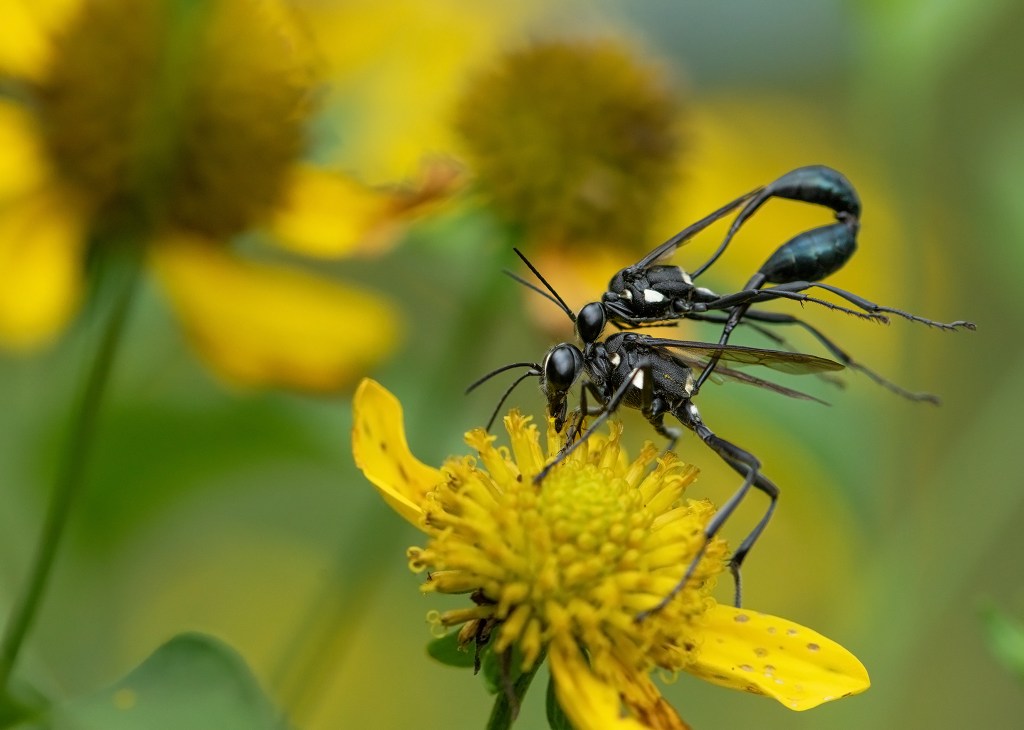
E. aureonotata is similar to several species of Ammophila, but can be identified by its distinctive silvery patches on the side of the thorax, and lack of an orange band on the abdomen. They are similar in size and specialize on the caterpillars of a few butterfly and moth families such as skippers (Hesperiidae) and sphinx moths (Sphingidae), though they apparently have a special preference for prominent moths (Notodontidae). Females dig burrows in friable soil and provision them with a single paralyzed caterpillar, which will feed her developing larvae.

Apparently it is common to observe this species mating on flowers (even Bugguide.net mentions this). I did observe this several times in our garden, particularly in mid to late July. Coupled pairs would fly around together and the female would frequently land on flowers and feed during copulation.
Tribe Sceliphrini
This tribe includes species that are commonly referred to as mud or dirt daubers. These are large, charismatic wasps, and are frequently encountered around human habitations. I remember spending time admiring these wasps and their distinctive nests around my house growing up. Though they are harmless to people they can be quite intimidating due to their size and often bold nature. They feed their larvae paralyzed spiders which are stored in nests constructed of mud.
Chalybion californicum
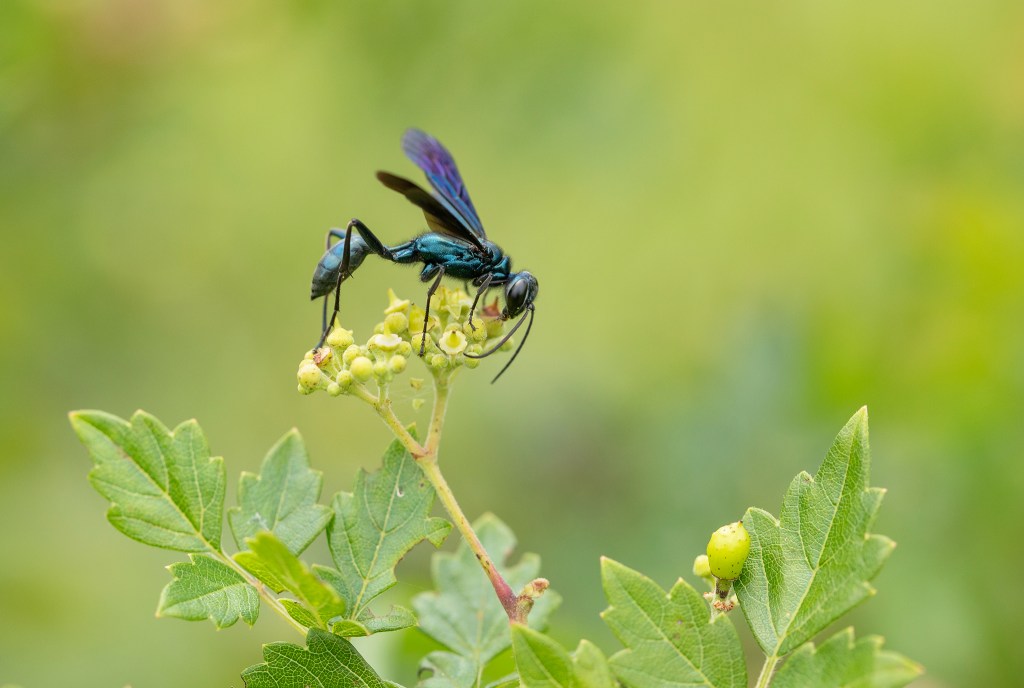
Commonly known as the common blue mud-dauber wasps, this is a large, fast moving species with a brilliant iridescent midnight blue exoskeleton. They occur throughout North America. Females seek out protected areas to nests with mud which dry and contain various tunnels and chambers. These chambers are provisioned with multiple paralyzed spiders.
Sceliphron caementarium
This is probably one of our most familiar wasps, and is commonly referred to as the yellow-legged or black-and-yellow mud dauber. I love the specific epithet “caementarium“. It translates to mason or “builder of walls”, but sounds like a gothic cement prison, which is fitting for the mud nest where paralyzed spiders are imprisoned.

The yellow-legged mud dauber is an example of a species native to North America that has been introduced throughout much of the world, mostly accidentally. I find these wasps to be especially striking, with their sleek form and black and yellow markings.
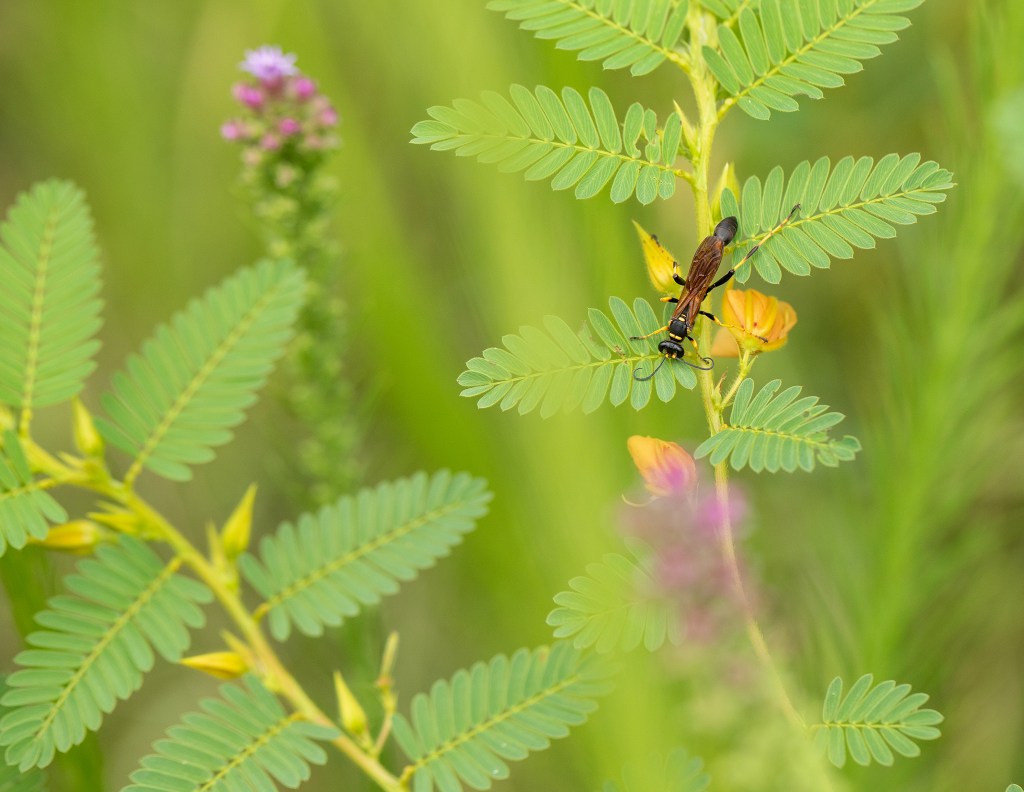
Tribe Sphecini
This tribe contains two genera: Sphex and Isodontia. They specialize on crickets, katydids, and other members of the order Orthoptera.
Sphex ichneumoneus
This large wasp is commonly known as the great golden digger wasp, and I think it’s a fitting name. I had my first encounter with this wasp back in the 7th grade, when I was working on an insect collection for my life sciences class. I captured one near my childhood home in the northern suburbs of Chicago and was instantly taken with it. I generally encounter a few every year, and each time I do I’m taken back to the excitement I felt all those years ago.

S. ichneumoneus digs burrows in sandy soil. Their burrows have a central vertical tunnel with several branches containing chamber like “cells”. Female wasps provision each of these cells with a paralyzed katydid and lay a single egg upon it. The leg will hatch into a larva with a free buffet of Orthopteran meat.
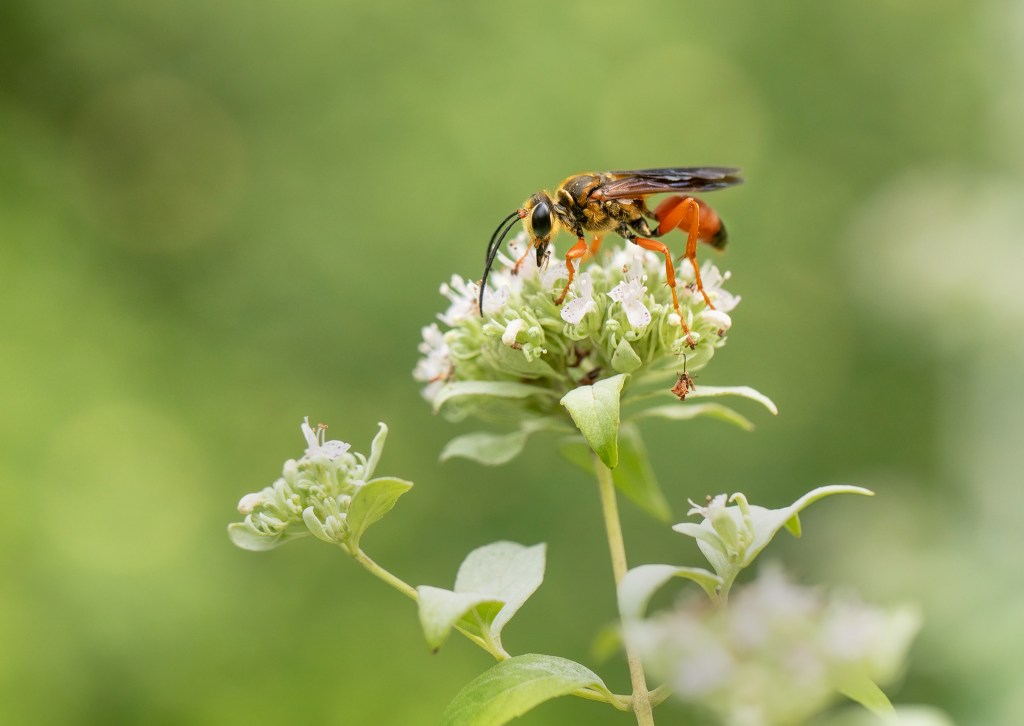
Sphex pensylvanicus
Large and intimidating looking, this species is commonly referred to as the great black digger wasp or just simply the great black wasp. They provision subterranean nests with large katydids. Like most other wasps, adults feed on nectars and the individual below was photographed on Eupatorium.

Isodontia auripes
Members of the genus Isodontia are collectively known as “grass carrying wasps”. They build nests in tree cavities or hollow stems and line the nest with blades of grass. They provision these nests with crickets and katydids.

Family Pompilidae
These are the spider wasps, so named for their behavior of paralyzing spiders to feed their larvae. Some species build nests where they drag paralyzed spiders to feed their larvae, while others enter the spiders nest, paralyze it, and leave it in its own home.
Tribe Pepsini
This tribe includes the tarantula hawks and their allies, which are some of the largest wasps in the country, though some species like those of the genus Epipompilus can be quite small.
Entypus unifasciatus
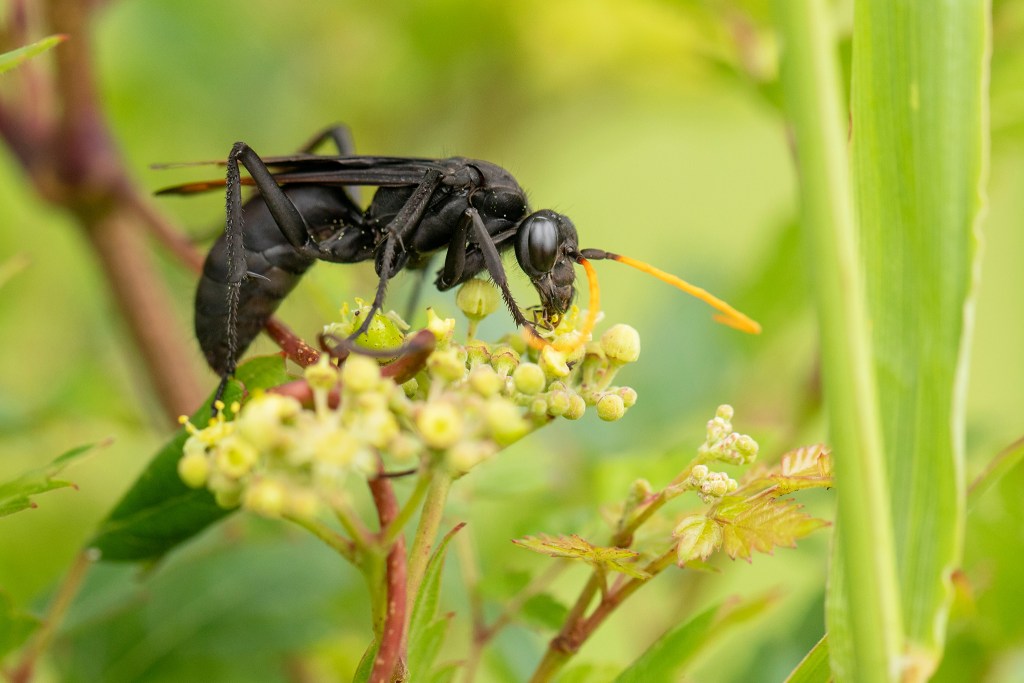
This is one of the largest wasp species in our area. They are distinctive with their bright orange antennae and wing tips. E. unifasciatus occurs across most of the United States and southern Canada. They parasitize wolf spiders and other large spider species, and though the adults primarily feed on flowers there have been observations of females taking liquids from spider extremities.

There are multiple subspecies of E. unifasciatus. East Texas is home to the nominate subspecies, E. u. unifasciatus which occurs in eastern North America. It is the only subspecies with bicolored wings – which are entirely orange in the others.

Tribe Pompilini
Poecilopompilus interruptus
At first glance, this species may look like a paper wasp (Polistes sp.), but it is in fact a solitary spider hunting wasp. They dig burrows in sandy soils where they prepare nests that are provisioned with orb-weaver spiders (families Areneidae and Nephilidae). This is somewhat unique among spider wasps, as most hunt spiders that do not form extensive webs (like tarantulas, wolf spiders, crab spiders, jumpingg spiders, etc.). I’ve read that tarantula hawks may use their legs to lightly disturb strands of webs outside of tarantula burrows to elicit a response. While I haven’t been able to find any resources describing Poecilopompilus hunting behaviors in detail, I wonder if they do something similar to orb weaver webs in order to draw them in closer.

Tachypompilus ferrugineus
Commonly known as the rusty spider wasp, I find this species to be particularly attractive. They’re fairly large with a mostly reddish orange exoskeleton and black to bluish wings. Females hunt large spiders including wolf and fishing spiders, paralyze them, and drag them to their nests. Once there, the female flips the spider over, affixes an egg to it, and covers it with soil.

To be continued…
 A Naturalist's Journey