

I’ve never wanted to be one with the animals – not really. In fact, it’s our differences that have always drawn me to them. Many children have dreams of being able to speak with animals, to understand their language. I had these dreams as well, but for me they were more like nightmares. Even at an early age I felt that having that ability would remove the sense of wonder I feel while observing, learning, and experiencing biodiversity. Each species is unique and should be, at least in my opinion, revered on its own merits, not those that we can liken to ourselves. That’s not to say I don’t feel empathy. Quite the opposite actually – I feel empathy to all creatures, great and small – revered and reviled. And though it’s clear that different species experience the world in different ways, I still try to imagine what life might be like were I born another creature.
I think that’s part of what fascinates me about insects. Their morphologies and life histories are so very different than ours. Imagine, for example, you were no less than a half inch long and weighed a fraction of a gram. Despite this, you still had to navigate the world – a world much much larger and more dangerous than the one we know.
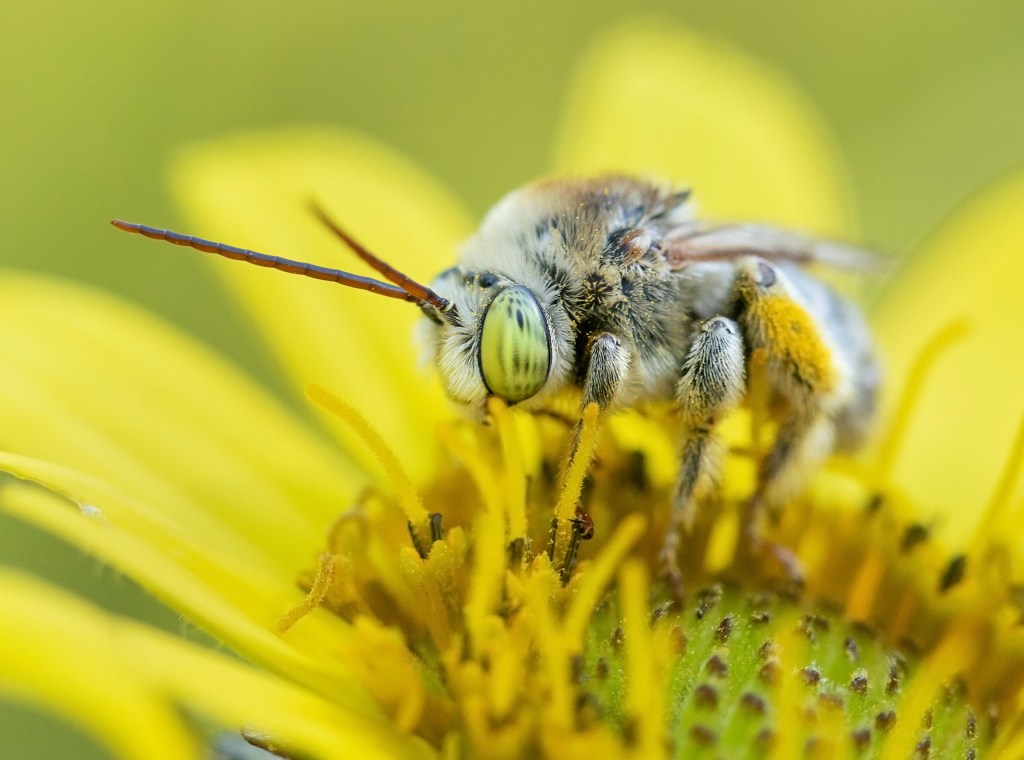
I was plunged into this state of contemplation today during my lunch break. Fortunately my office is a couple of blocks away from the Pineywoods Native Plant Center in Nacogdoches, Texas. I frequently wander the grounds during lunch and enjoy the abundant blooms, birds, and bugs. Today while admiring some late summer/fall blooming plants I spotted a male longhorn bee sleeping on a sunflower (Helianthus sp.). I’m still not sure which species, but have been trying to compare phyllaries to possible suspects and will update once I figure it out. ***Edit – after looking into it further, I now believe the flower belongs to Silphium asteriscus***. I was planning to continue my treatment of Hymenoptera today by moving onto the wasps, but today’s experience inspired me to focus on a single species – a single individual no less worthy of our admiration.

When I first spotted him and realized he wasn’t moving, it was instantly clear that he was sleeping. This isn’t unusual, and bees frequently take catnaps on flowers during the day. This was different though, and this little long-horned bee seemed to find the perfect little bed.

Admittedly I haven’t tried very hard to identify him to species yet. I believe he is a member of the genus Sastra. I have seen both S. petulca and S. obliqua at this site. I suspect this due to his antennae that, while long, seem shorter to me than those of other similar genera of Eucerini (refer back to my first installment of this summer pollinator series for more information on long-horned bee taxonomy). This individual looked a bit different, however. Particularly his coloration. He was very light, with light gray hairs that seemed to have an ever so slight bluish hue on the abdomen.

I watched him for around half an hour and he never left this flower. Occasionally he would stir from his slumber and walk circles around the disk flowers forming the bloom’s center, lapping up nectar with his glossa (tongue-like mouthpart). Then he would stop again, catch a few more minutes of z’s, and get back to eating. He even took a moment to play a game of peek-a-boo with me (or more likely just to use the hairs of his foreleg to clean bits of pollen and other debris from his compound eyes).

I really enjoyed this experience, and it brought me more joy than one might expect half an hour of staring at a lazy bee might (forgive my anthropomorphism of an animal that is anything but lazy). The natural world never ceases to amaze me, and there really is endless wonder to be found in observing our planet’s incredible biodiversity. From the drama of the elk rut, where massive warriors weighing hundreds of pounds and adorned with lethal weaponry clash and may meet their deaths, to the beauty and tranquility of a tiny bee clad in an adorably fuzzy exoskeleton allowing me a glimpse into his life from mere centimeters away, countless experiences await those willing to seek them out. It brings me great joy and comfort that in my forty years, which have been filled with more time in nature than most, I haven’t even scratched the surface of the fascinating life forms that call this planet home.
 A Naturalist's Journey