What Lies Beneath

Target Species: Alligator Snapping Turtle (Macrochelys temminckii)

4N1A5339

I’m a little embarrassed that it has taken me all the way into May to check off the first species of 2020 from my list of biodiversity goals, but it was a good one – an ancient leviathan dwelling in the depths of a murky stream meandering through a mature hardwood forest – the old loggerhead – the alligator snapping Turtle (Macrochelys temminckii)

This story begins in January, with a meeting at my Alma Mater – Stephen F. Austin State University (SFA) in Nacogdoches, Texas.  I met with Dr. Chris Schalk, a herpetologist and ecologist with the Arthur Temple School of Forestry, the department where I obtained my undergrad.  We discussed ways that we may collaborate on topics like road ecology and reducing impacts to wildlife from transportation projects.  I immediately liked Chris, and found him a like-minded individual in many respects.

In the following months we touched base from time to time, and in one of our conversations he mentioned the research being carried out by one of his graduate students, David Rosenbaum.  Chris recounted the start of their field season, during which they captured numerous large alligator snapping turtles.  And much to my delight, he invited me to join them on a future outing.

It may not be surprising to the followers of my blog, but this sort of thing is right up my alley.  One of my most memorable jobs was when I worked a summer as a field tech on an American alligator research project.  Capturing these ancient reptiles was equal parts thrilling, interesting, and rewarding.  The idea to relive that in some small part was an opportunity too good to pass up.

So in late May I met up with David, and field techs Laura and John Michael.  Also along for the day was my good friend and frequent adventure companion, James Childress.  After some brief (socially distant) introductions, we were on our way to the first study site, a tributary to the Angelina River deep in a remote hardwood bottom.

4N1A7780

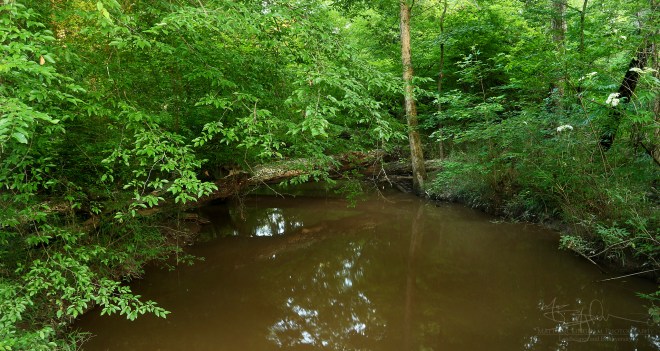
A creek containing several study sites for David’s research.

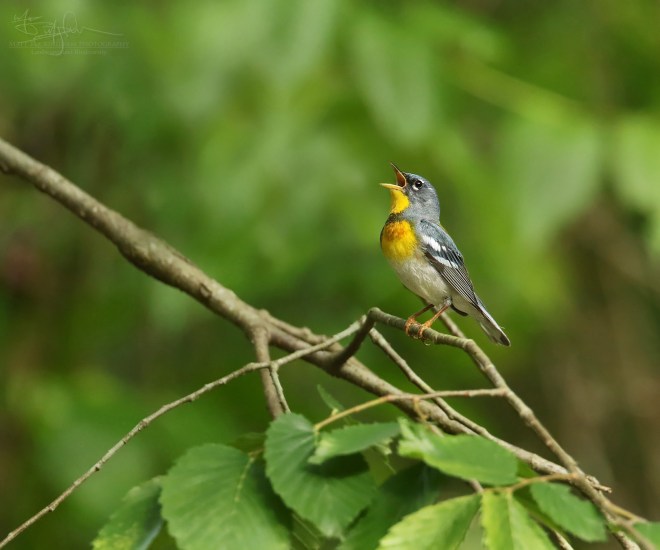
Blooming American elderberry lined the banks here, and  the boughs of ancient River Birches and American elms reached out over the water.  From high in the canopy the buzzy trill of a Northern Parula rang out.  A suite of other songbirds also made their presence known, including a Prothonotary Warbler, Hooded Warbler, Swainson’s Warbler, Yellow-throated Warbler, Red-eyed Vireo, Summer Tanager, and Acadian Flycatcher.  In the distance we could hear the cackle of a Pileated Woodpecker and the croak of a Yellow-billed Cuckoo.  It was immediately clear that this site was rich in biodiversity on land and air.  We would soon realized it was equally diverse beneath the water’s surface.

4N1A7187

A Northern Parula sings from a branch overhanging the creek.

For the first year of their study, David and Chris are replicating a survey performed twenty years ago.  When I added the alligator snapping turtle to my list of biodiversity targets, I knew that I would have to think outside the box if I had any hope of photographing one.  This is not a species that one can expect to find by conventional means.  They spend virtually their entire lives at the bottom of streams, rivers, lakes, and deep swamps.  They can stay submerged for nearly an hour, and the only time they can be expected to seen on land are when the females leave the water to lay their eggs, and the rare occasion when an individual disperses to a new water body.  In short, I knew if I wanted to see one, it would have to be trapped.

Fortunately, that was exactly what David, Laura, and John Michael were doing.  They use special partially submerged traps that allow for the turtles to be captured alive and unharmed, and check the traps daily once they’ve been deployed.  I was joining them for the third day of trapping effort at this particular site, which had several traps spaced out along this meandering forest stream.  The first day trapping here they caught six individuals, however the previous day they had caught none, so no one really knew what to expect.

The first trap we checked was empty, save a decent diversity of riverine fishes.  The second did have a turtle.  It was an interesting species, but not the one we were looking for.  Razorback musk turtles occupy similar habitats to alligator snapping turtles, and have been the subject of previous studies by SFA.  I didn’t photograph our first turtle of the day, but was certainly happy to see it.

Soon after the three researchers sank into the chest deep water at the third site, I heard David call out, “We’ve got something big in this one!”  It was a special thing, seeing him reach into the depths and pull out this massive, prehistoric-looking beast.  In that moment I thought of the fascinating ecology of these streams.  Beneath the water exists a diverse world that is unknown and unseen by most.

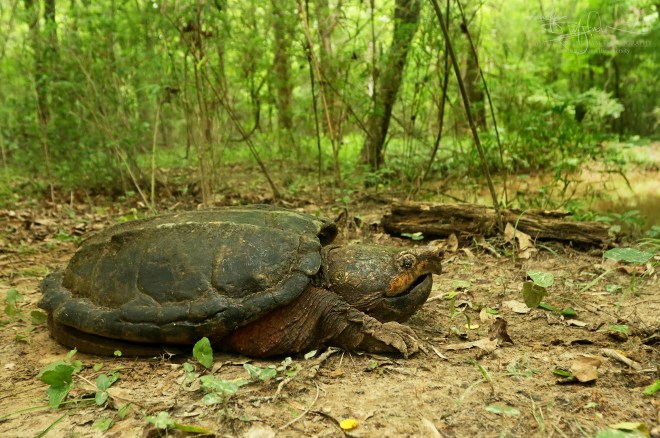
They pulled the massive turtle to the shore so that they may collect a variety of data, including morphological measurements, images, and blood and tissue samples.  It was determined to be an old female weighing in at nearly forty pounds.  We knew she was old, based on her smooth carapace.  When young, they have three raised ridges with scutes that form triangular peaks.  After years and years of wandering under woody debris lodged in the stream bottom, the shell gradually wears down until, in very old individuals it becomes essentially smooth.

4N1A5352

We knew she was old, but we had no idea how old.  Large turtles can live a very long time.  When collecting those previously mentioned data, David and his team noted that the turtle had a distinctive notch in her shell.  It turned out that she had been captured during the original survey, 20 years ago.  We aren’t sure how large she was at that time, but that information should be available, and I’m very interested to find out!

David’s study will be looking at a variety of aspects related to the ecology of alligator snapping turtles in eastern Texas.  One aspect of his research is very similar to my own master’s thesis – using presence/absence data to determine important variables that can predict for the species’ occurrence.  I really enjoyed chatting with David about his project, and it brought me back to a time when this sort of thing played a much larger role in my life.

4N1A5294

The research being carried out by David and Chris is important.  Alligator snapping turtles populations have declined dramatically, and they are now uncommon or rare throughout much of their range.  Factors influencing this decline include a loss of high quality habitat and over-harvest for its meat, which has long been considered a delicacy.  As a result, they are now protected in many states where they occur, including Texas.  This protected status has not stopped illegal poaching, however, and many animals are still taken this way, or caught on trotlines set callously in their habitat.  Once hooked on these lines, the turtles suffer a slow, agonizing death.

4N1A5399

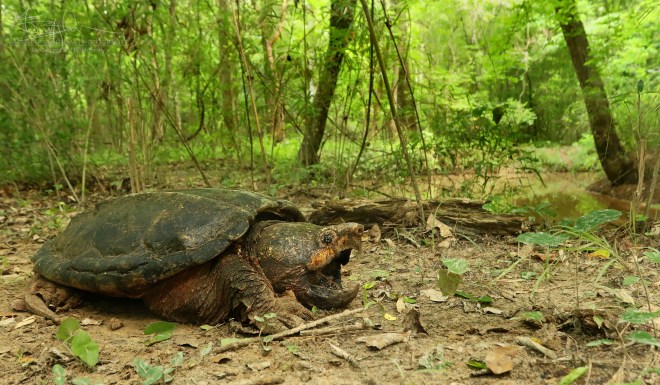
When initially captured or threatened, the loggerhead generally opens its mouth wide, and will snap at anything that approaches too close to its head.  Believe me when I say, this is a very effective intimidation tactic.  Those jaws slammed shut with bone-crushing force.  Those powerful jaws play a very important role in capturing prey in their murky aquatic habitats.  Alligator snapping turtles have lingual lures – specially adapted tongues shaped like worms that the turtles wriggle about while waiting motionless with their jaws wide open.  When some unsuspecting fish moves into to capture this false worm, the snapper’s mouth slams shut with blinding speed and crushing force.

As impressive as this gaping threat display was, I was really happy to capture images of the gator turtle with her mouth closed, in a more natural looking pose.  We spent a few minutes photographing and admiring this incredible animal.  We then set her near the stream’s edge, and walked as she slowly made her way back into the water and disappeared into the deep.

4N1A5409a

Spending time with this modern-day dinosaur was an incredible experience, and I was very grateful for the opportunity to get to know David, Laura, and John Michael and learn more about the important work they’re doing.  It made me nostalgic for my days as a field biologist, but fortunately my current position does provide opportunities to be involved in research, specifically aimed at conservation of wildlife and plant communities related to transportation activities.  I hope to join David and crew again in the field at some point, and very much look forward to what they learn about the ecology and natural history of this keystone species.

Beautiful Birds in Disturbed Places

4N1A7523ab

Indigo Bunting

Generally speaking, when I set out to explore nature I’m seeking the most pristine places I can find.  These places are ancient – old growth forests with towering trees or virgin prairie on a bed of soil that has never been plowed.  I like to see things the way they may have looked prior to European settlement, and transport myself to a distant, wilder time.

But if I chose to ignore those more disturbed habitats, I would be robbing myself of a wealth of beauty and diversity.  In fact, there are many species that have evolved to take advantage of early successional communities created in the wake of some disturbance.  Historically, these habitats may have formed by a variety of means.  For example, when a massive tree falls in an old growth forest.  Imagine ten tons of timber crashing to the earth.  A tree like this could take out a swath of forest totaling a third of an acre or more, especially if it brings adjacent trees down with it.  This new gap in the canopy would undergo the process of succession, responding much the way a fallow field does when it slowly reverts back to woodland.

The patch of disturbed land could increase significantly in the face of some natural disaster.  A tornado could take out a swath of forest hundreds of feet wide and miles long.  A severe hurricane could level acres of forest near the coast, and a wildfire could remove forest cover on the scale of thousands of acres.

Events like this are particularly important in the eastern United States, where much of the landscape was historically forested.  There existed, however, a multitude of non-forested communities interspersed among the old growth timber.  These included prairie inclusions, barrens, and similar habitats that were kept open by a variety of factors including soil conditions, grazing by American bison, and regular wildfire.  If one of these communities went too long without the introduction of some natural disturbance, it would begin to revert back to forest through the process of succession.

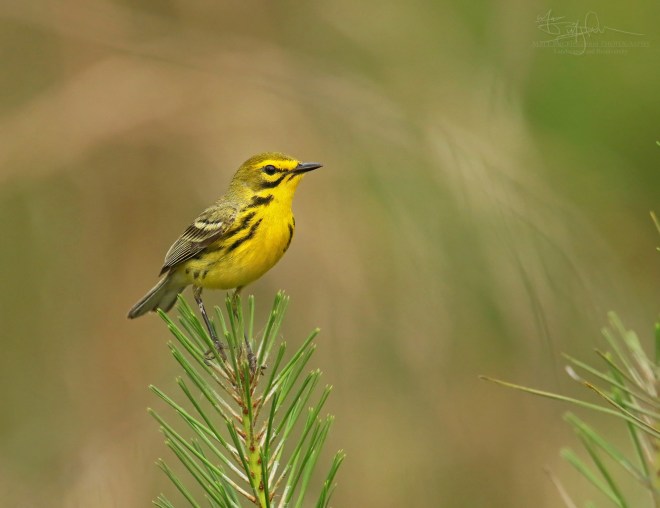
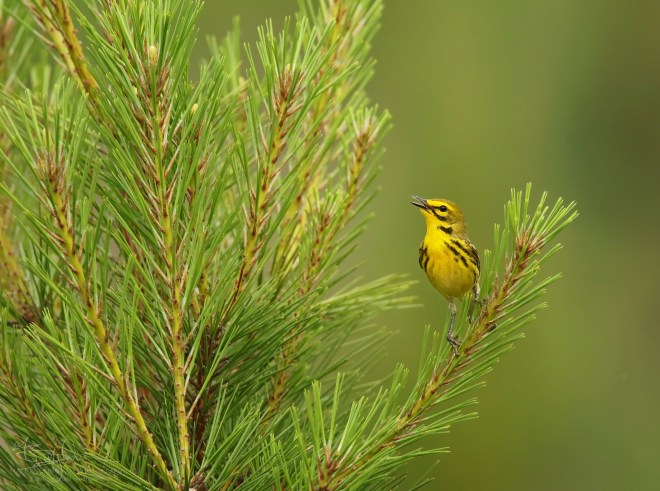
Today, however, the U.S. is far removed from the natural eden it was just a few hundred years ago.  That is not to say, however, that suitable habitat for these disturbance dependent species no longer exists.  Take the Prairie Warbler (Setophaga discolor), for example.  The “Prairie” in its name is misleading, as this is not a species of prairie or grassland habitats, but rather one of those early successional habitats described above.  They breed throughout much of the eastern U.S., from Maine to east Texas.  Here I most frequently observe them in regenerating pine stands 5 to 10 years after harvest.

4N1A0443

A male Prairie Warbler sings in defense of his territory.

These sites undergo succession much in the way a forest would following some natural clearing event.  First a variety of grasses and forbs will invade.  Soon after the pines will sprout.  Before long, however, the trees will grow to tall, the canopy will close, and the habitat will no longer be suitable for the Prairie Warbler.

4N1A9174

Prairie Warbler

The ephemeral nature of these ever changing habitats means that species like the Prairie Warbler do not have a reliable territory to return to each year, and must seek out new breeding sites once their old territories are no longer suitable.  I speculate that, given a certain element of unpredictability with their preferred habitat, Prairie Warblers, and other disturbance-dependent bird species likely experience local cycles of “boom and bust”, potentially increasing in numbers following large disturbance events, and decreasing as the disturbed areas reach later successional stages.

4N1A9136

A Prairie Warbler forages for invertebrates on a pine sapling.

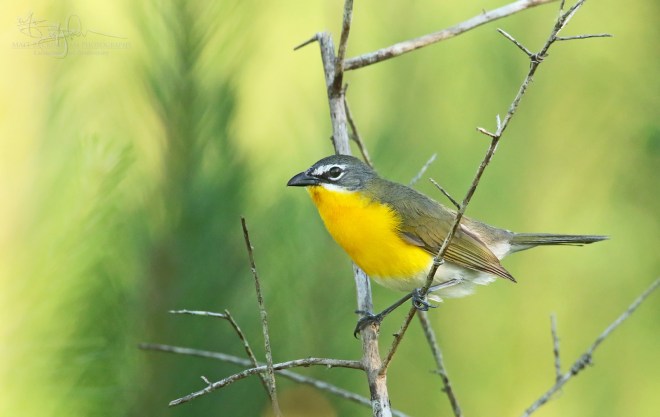
Another species found in these disturbed habitats is the Yellow-breasted Chat (Icteria virens).  The chat was once considered our largest warbler species, but recent research indicates that is more closely related to blackbirds, and it has been placed in its own family (Icteriidae).  Chats are well known for their loud, varied songs which consist of a variety of raucous warbles, whistles, rattles, and more.  The males perform elaborate courtship displays on the wing, slowly descending in choreographed fashion.

Yellow-breasted Chats can be found throughout much of the contiguous U.S and portions of Mexico and southern Canada.  They are less specific in their habitat preference than prairie warblers, and can be found in a variety of disturbed habitats.  They are easy to hear, but difficult to see, often skulking low in dense vegetation.

4N1A9444

A rare glimpse of a Yellow-breasted Chat in the open.

Unlike the chat, the Painted Buntings (Passerina ciris) maintain a visible presence in their territory, frequently singing from the highest perches available.  These sparrow-sized songbirds are considered by many to be among the most beautiful birds in the country, and they certainly leave a lasting impression on those fortunate enough to encounter them.  I’ll always remember the first one I saw birding with my mom.

4N1A0542

Male Painted Bunting

The Painted Bunting breeds in the south-central states, along the Atlantic coast in the southeast, and portions of northern Mexico.  They can be found in a variety of disturbed habitats, as long as there is some shrub or small tree component.

4N1A7779a

A male Painted Bunting sings in defense of its habitat.

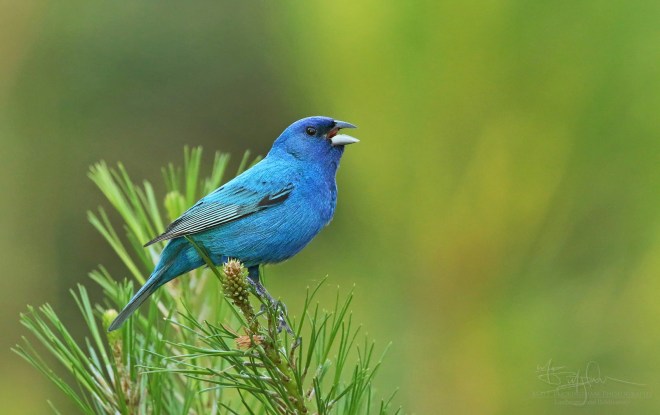
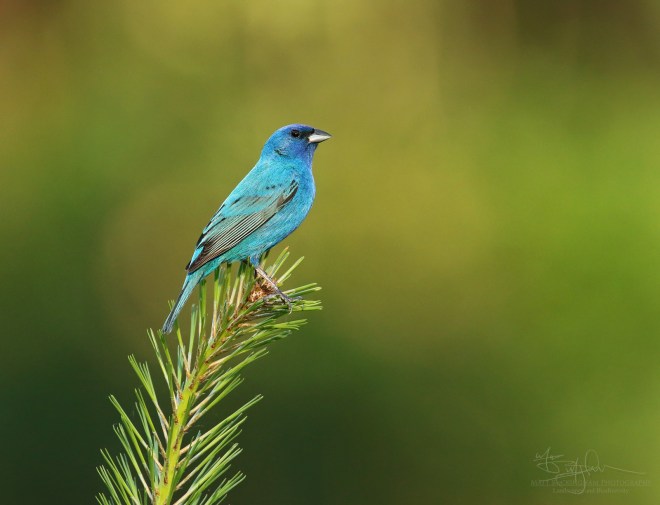
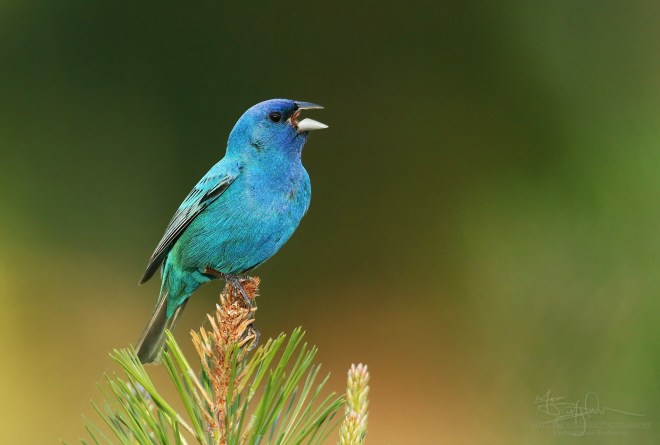
Though it lacks the varied color scheme of its cousin the Painted Bunting, the Indigo Bunting (Passerina cyanea) is no less striking.  With its metallic cyan plumage, this is one of my favorite birds to observe in the spring and summer here in the Pineywoods.

4N1A7402

Indigo Bunting Male

Indigo Buntings breed throughout much of the eastern U.S. with a few isolated populations in the southeast.  Though I most often associate this species with disturbed areas, I also frequently observe them in high quality habitats such as mature longleaf pine savannas.  This is not entirely surprising, however, as these once vast longleaf pine forests depend on regular disturbance to maintain an open understory and rich herbaceous layer.

4N1A7497

A male Indigo Bunting sings in the understory of a mature pine savanna.

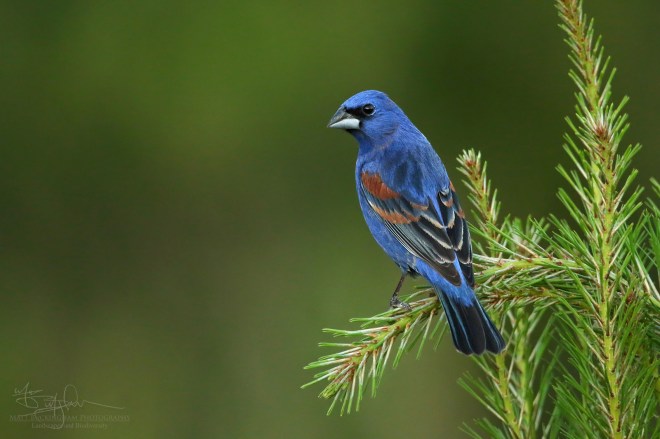
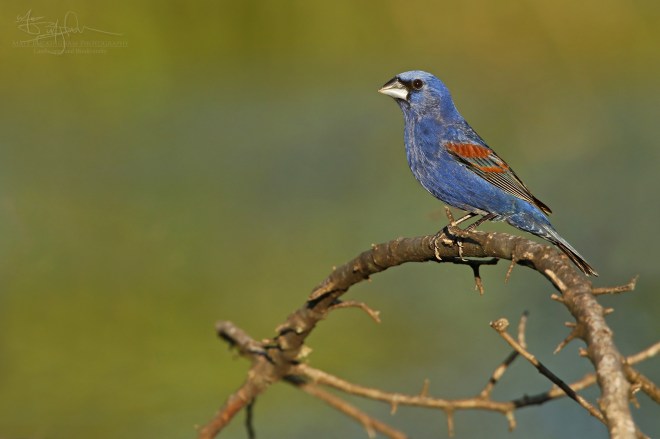
Another disturbance loving blue beauty is the Blue Grosbeak (Passerina caerulea).  They are quite similar to the Indigos, but can be differentiated by their heavier bill and chestnut wing bars.  To me, the blue of the grosbeak is more cobalt, and the bunting more cyan.

4N1A5314a

Male Blue Grosbeak

One might encounter Blue Grosbeaks across the southern and central United States and northern Mexico.  They can be found in a variety of shrubby habitats.  In the eastern U.S. this usually means areas that have undergone some recent or continuing disturbance, however further west this can include mature desert scrub and woodlands.

4N1A6796

When hit with direct sunlight, the Blue Grosbeak’s plumage takes on a metallic sheen.

The image below is of a regenerating pine plantation where I observed Prairie Warblers, Yellow-breasted Chats, Painted Buntings, Indigo Buntings, and Blue Grosbeaks.  Also present in the area were White-eyed Vireos, Northern Cardinals, and Northern Mockingbirds.  In East Texas, Northern Bobwhites may also utilize habitats like this, though they have all but disappeared from the Pineywoods.

IMG_3897

Regenerating Pine Plantation

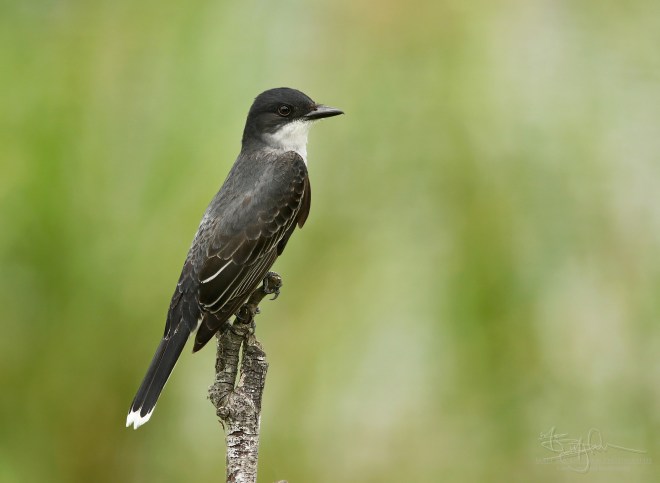
When a disturbed habitat occurs in close proximity to water, additional bird species may be encountered.  The Eastern Kingbird (Tyrannus tyrannus), for example, inhabits disturbed areas such as marshes, shrublands, forest edge, and riparian areas, and are generally closely associated with water.  Kingbirds are so-named for the voracity with which they defend their territories against intruders of all shapes and sizes.

4N1A4030

Eastern Kingbird

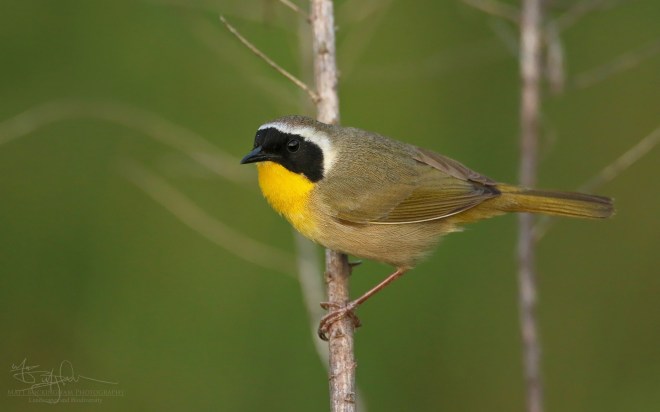
Perhaps our most familiar denizen of wet, disturbed habitats is the Common Yellowthroat – the little masked crusader that announces its presence to the world with its trademark wichity-wichity-wichity song.  Though they can be found away from water, yellowthroats are most commonly associated with weedy or scrubby habitats on the margins of marshes, ponds, and streams.

4N1A1149

A male Common Yellowthroat announcing his presence to would-be competitors. 

The Common Yellowthroat is a member of the Warbler family (Parulidae).  They are widespread in the U.S., Canada, and portions of Mexico.  We are lucky enough to have a few birds present year round in the southern half of the Pineywoods and on the Upper Texas Coast.

4N1A1297

Male Common Yellowthroat

In modern times, areas of significant disturbance have increased dramatically as old growth forest has been cleared to make way for pasture, agriculture, development, and managed timber.  It is clear that having some early and mid successional areas on the landscape is beneficial to biodiversity on a macro scale, however it becomes a concern when this occurs over a large scale, which is too often the case.  They key, like in so many things in life, is moderation.  Fortunately, modern forestry practices have improved dramatically, and programs like the Sustainable Forestry Initiative promote managing the landscape as a patchwork of successional stages.

Despite an increased abundance of disturbed areas across the U.S., many of these bird species remain uncommon and some are declining.  The problem is, disturbance in and of itself is not enough.  The nature, and method of the disturbance is important.  Areas that undergo intensive herbicide or pesticide use, for example, are not suitable breeding sites for birds.  Additionally, areas that are too heavily managed, where woody vegetation is not allowed to reach appropriate heights are similarly unproductive for all but the most generalist of species.

As lovers of biodiversity, it is important that we support and promote best management practices in land disturbing activities, so that we can simultaneously provide a sustainable resource and enhance local biodiversity.


The Prairies Forever Changed

4N1A4946

Prairie Hyacinth and Prairie Paintbrush bloom in a Fort Worth Prairie remnant 

Imagine, for a moment, that you are standing with your feet firmly planted in the dark soil atop a gentle knoll, surveying an undulating sea of grass that stretches as far as the eye can see.  You are somewhere north of Fort Worth, in a time before the land was forever scarred by asphalt, steel, and an insatiable need to bend the land to meet the will of man.  At a high point, you may be standing only a few feet higher than your surroundings, yet your view is unobstructed.  A lone, gnarled oak or mesquite may stand here or there in defiance of the forces that break any woody invader that tries to set roots in the prairie, and far in the distance a dark line of trees lines a gully that drains the plain.

The sky is darkening and rising columns of clouds in the distance give you pause.  Yet you wonder, for a moment if the faint roar that you hear is the advancing thunder, or the furious poundings of thousands of hooves as a herd of bison takes flight.  The wind hits, borne by the impending storm, and sends the countless wildflowers into motion, creating a kaleidoscopic blur of color.  If you could transport yourself to this place and time, you would be standing in the once vast tallgrass prairie of north-central Texas that served as a southern extension of the Great Plains that fueled and shaped our developing nation.

The truth is, we will never be able to know what these prairies were like prior to European settlement.  We can piece it together to some degree based on the journals of early explorers and settlers, however there were no doubt aspects of the landscape, flora, and fauna that were not captured in what they scribed.  When Anglo cultures first arrived, the landscape had been shaped by centuries of inhabitancy by Caddo, Wichita, Kichai, Osage, and other indigenous tribes.  Though their impact on the land was more harmonious than the people that succeeded them, they helped maintain the open nature of the prairie by setting fire to control vegetation and direct game movements, supplementing the naturally occurring lightning-ignited conflagrations that were common in the region.  Many of the tribes of the region also practiced small-scale agriculture, which would have no doubt altered the nature of the plains.

It has always been a fantasy of mine to experience Texas in these pre-settlement times.  If I could, I would start in Galveston, and make my way north, through the extensive coastal prairies, where the only variation in elevation were minuscule wind-sculpted mima mounds, and a matter of inches resulted in an entirely different cast of plants, and meant the difference between dry and wet feet.  Continuing north, I expect I would watch the timber hugging the larger streams become broader and broader, piercing the prairie until I was immersed in a wet savanna surrounded by towering longleaf pines.  As I hit the Kisatchie Wold, the terrain would change to become rolling, with steep ravines and exposed geologic outcrops.  Here the forests would become diverse, and stratified based on slope position.  I may still encounter a prairie here or there, particularly in the form of a sandstone barren over the Catahoula Formation, or a Blackland inclusion on the Fleming Formation.

As I reach the northeastern corner of the state, the trees would begin to thin again as I transition into the Post Oak Savanna.  In Bowie, Red River, and Lamar Counties I might be lucky enough to break into a silveus dropseed prairie.  It would be interesting to know if certain species that are now exceedingly rare in the state, like Castilleja coccinea, Parthenium integrifolium, and Platanthera lacera were more common then.  Eventually the sandy soils of the post oak would give way to the fertile black clays of the legendary Blackland Prairies.  This narrow band of tallgrass prairie is perhaps the most altered of all of Texas’s ecoregions, forever changed by development, agriculture, and the removal of bison and fire.

It wouldn’t be long before the black clays began to lighten and the influence of chalky limestone became evident.  Scattered trees would begin to return as I entered the eastern Cross Timbers.  My journey through this mingling of prairie and stunted woods would be short-lived as well, and soon I would come to my little knoll in the Fort Worth Prairie, the northern expression of the expansive Grand Prairie, which also contains the Lampasas Cut Plain to the south.

The adventure of this blog begins in the Blackland Prairie of Collin County, above virgin soil in what my friend David Bezanson of the Nature Conservancy calls “the best Blackland Prairie left in Texas.”  These blacklands once stretched 300 miles across the Lonestar State, and occupied over 10 million acres of her surface. They sustained massive herds of bison, prairie chickens, Texas Horned Lizards and numerous other species that have vanished from the region in the face of westward expansion. The black clays that lent the region its name formed as underlying cretaceous marine sediments were broken down through weathering and erosion over millions of years. This resulted in the formation of some of the most fertile lands in the state – lands that were quickly exploited for their richness and within a matter of generations, all but a fortunate handful of sites were forever changed. By most estimates, less than one percent of the historic Blackland Prairie contains soil that has never been broken by the plow. Of those precious remaining places, few are protected and even fewer receive the regular disturbance that they need to thrive.  This was one of those precious few remaining places where one can imagine the way things once were.

On a gray day in mid April, the towering blooms of Blue Wild Indigo (Baptisia australis) reached skyward and brightened the gloom.  Native cultures utilized this striking member of the pea family for a variety of purposes.  Some portions of the plant are toxic, however the roots were used to treat a variety of ailments, including nausea, toothaches, and inflammation.  The milky sap from the roots was also used to make a bluish dye.

4N1A3039a

Blackland Prairie with Blue Wild Indigo

4N1A3010

Blue Wild Indigo

4N1A3164

Blue Wild Indigo

The Prairie Penstemons (Penstemon cobaea) were just coming into bloom.  Their showy flowers may reach over 2 inches long and can be various shades of white, pink, and purple.
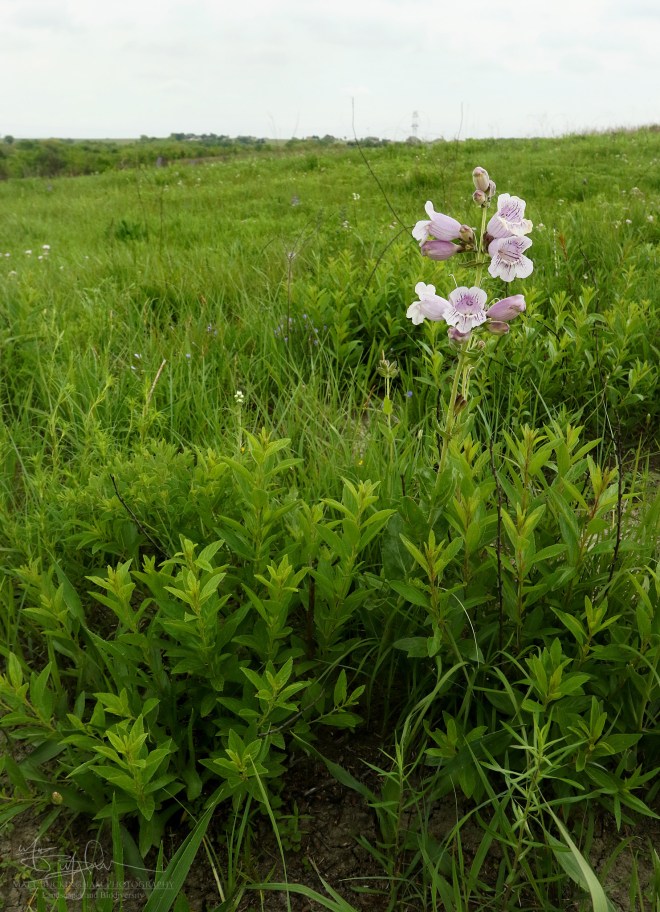
4N1A3058

Prairie Penstemon

Engelmann’s Daisies (Engelmannia peristenia) were also beginning to unveil this season’s flowers to the pollinating world.  This member of the sunflower family is a classic open country plant of the southern plains, and is still common in prairie remnants and areas that are not too aggressively managed with plows and herbicide.

4N1A3212

Engelmann’s Daisy

Each azure bloom of the Prairie Celestial (Nemastylis geminiflora) lasts only a few hours, opening in late morning and closing by late afternoon.  This member of the iris family is a true prairie gem that must have left an impression on early naturalists visiting the region.

4N1A3257

Prairie Celestial

Just west of the Blackland Prairies lies the Eastern Cross Timbers, where a band of sandy soils supports Eastern Redcedar and a variety of oak species.  Accounts from early settlers to the region indicate that this was not a homogeneous region of timber, but rather a varied landscape with numerous prairie inclusions, savannas, and areas of nearly impenetrable woodland.  Pre-settlement, this woody intrusion into the prairie was short-lived, and west bound travelers would soon reach the Grand Prairie.

The plant and animal species that occurred in the Grand Prairie are similar to those of the blacklands, though certain species are more common in one or the other.  The geology, however, is markedly different.  Chalky limestone substrates are more prevalent in the Grand Prairie, and deep clays are infrequently encountered.

4N1A3299

The Texas Yellowstar (Lindheimera texana) is a species commonly encountered in both the Blackland and Grand Prairies.

Like the Blackland Prairies, the Grand Prairie has been altered almost beyond recognition.  In many areas the prairie here would have stretched from horizon to horizon, and beyond.  Massive herds of bison occurred here, as evidenced by this excerpt from Narrative of an Expedition Across the Great Southwestern Prairies: From Texas to Santa Fé, a work by George Wilkins Kendall with many references to the prairies of north-central Texas:

“I have stood upon a high roll of the prairie, with neither tree nor bush to obstruct the vision in any direction, and seen these animals grazing upon the plain and darkening it at every point. . . . In the distance, as far as the eye could reach, they were seen quietly feeding upon the short prairie grass. .”

The Grand Prairie also marked the western extent of the Pronghorn, a prairie icon now long gone from the region.  Other species, like the Texas Horned Lizard have much more recently disappeared, and some species that are still common, like the Woodhouse’s Toad, show signs that they may be soon to disappear.
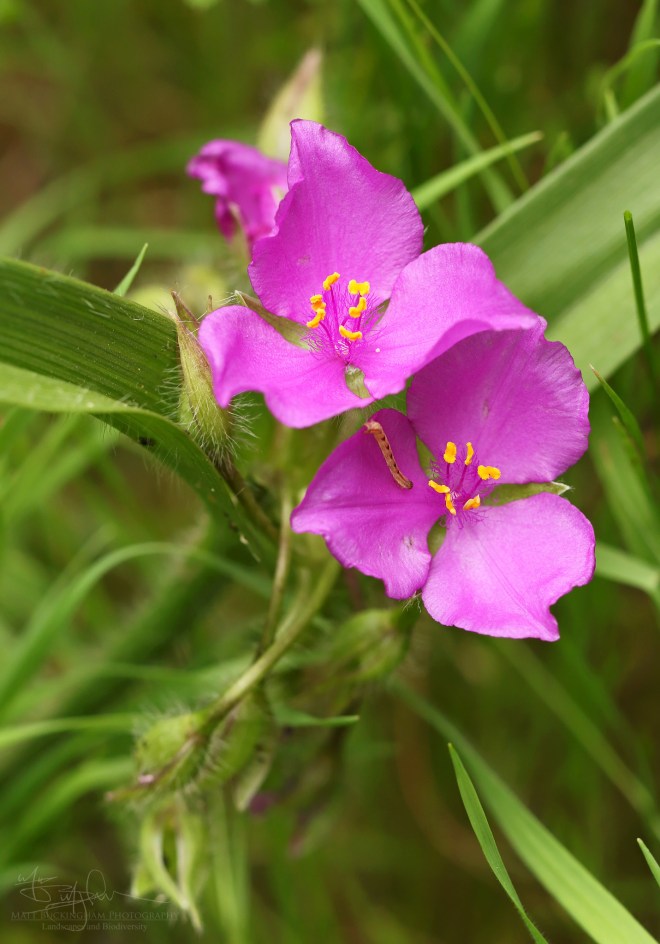
4N1A3443

Tharp’s Spiderwort (Tradescantia tharpii) occurs in a small area of the south-central U.S., where it can be found in calcareous prairies.
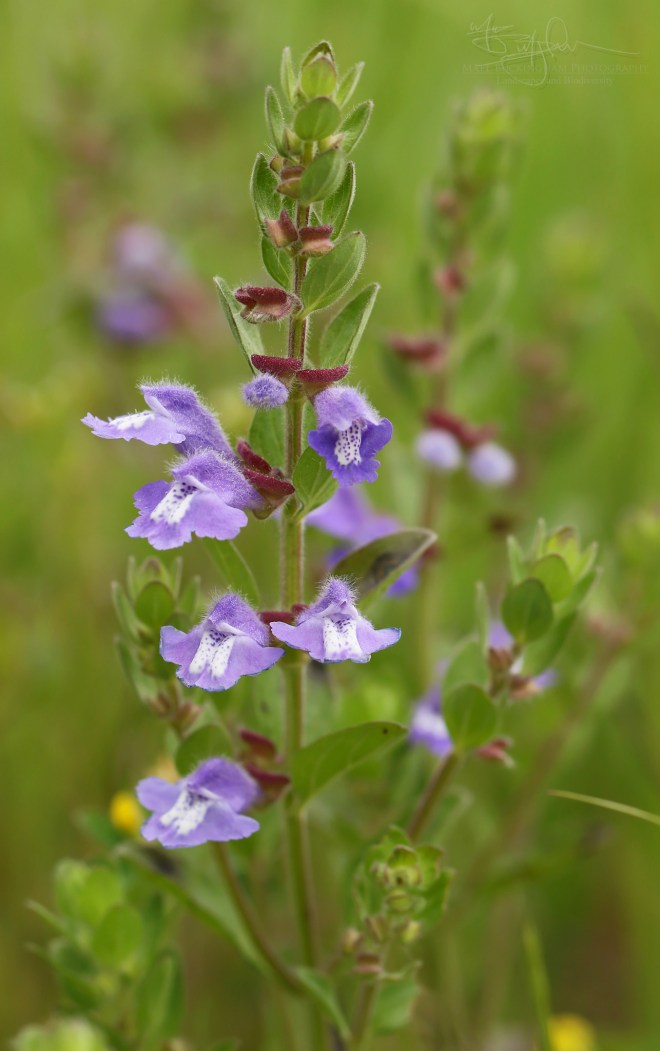
4N1A3419

Drummond’s Skullcap in a prairie inclusion within the Eastern Cross Timbers.
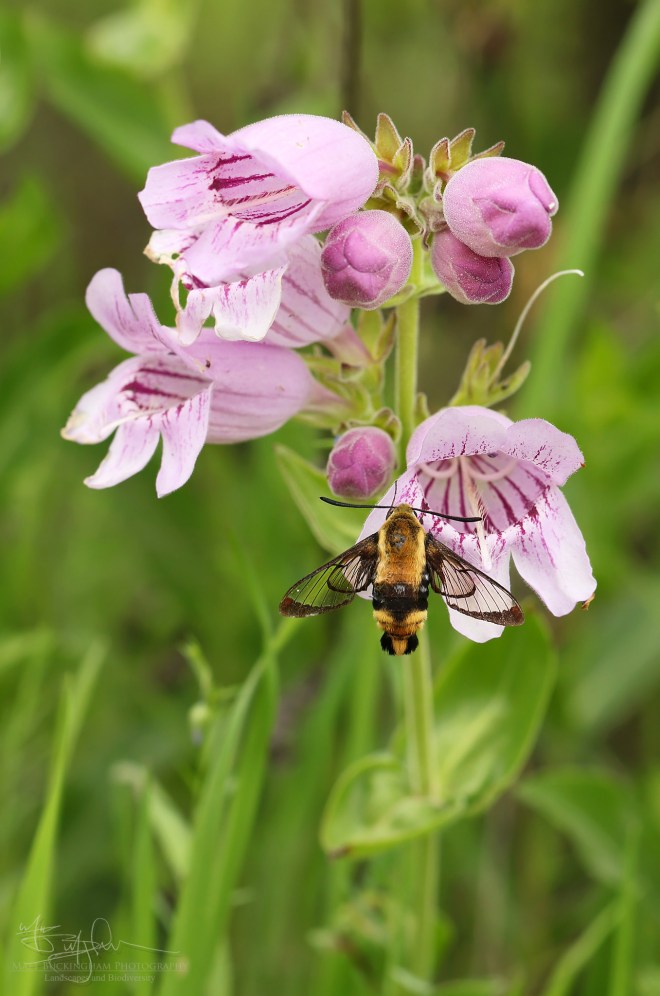
4N1A3536

A Clearwing Moth (Hemaris sp.) rests on a Prairie Penstemon in a Grand Prairie remnant.

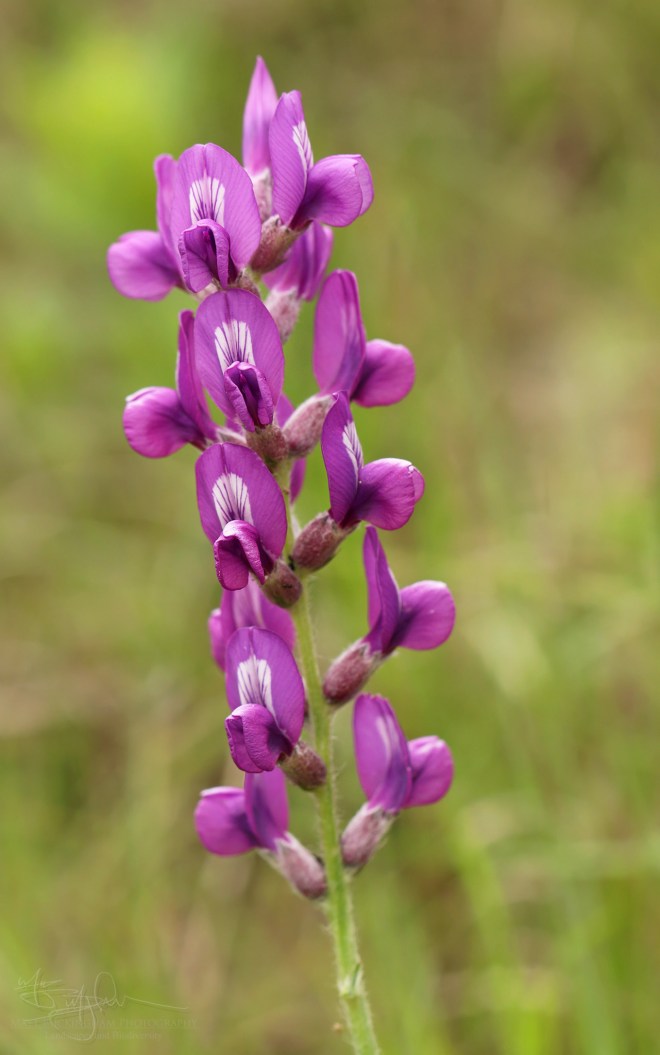
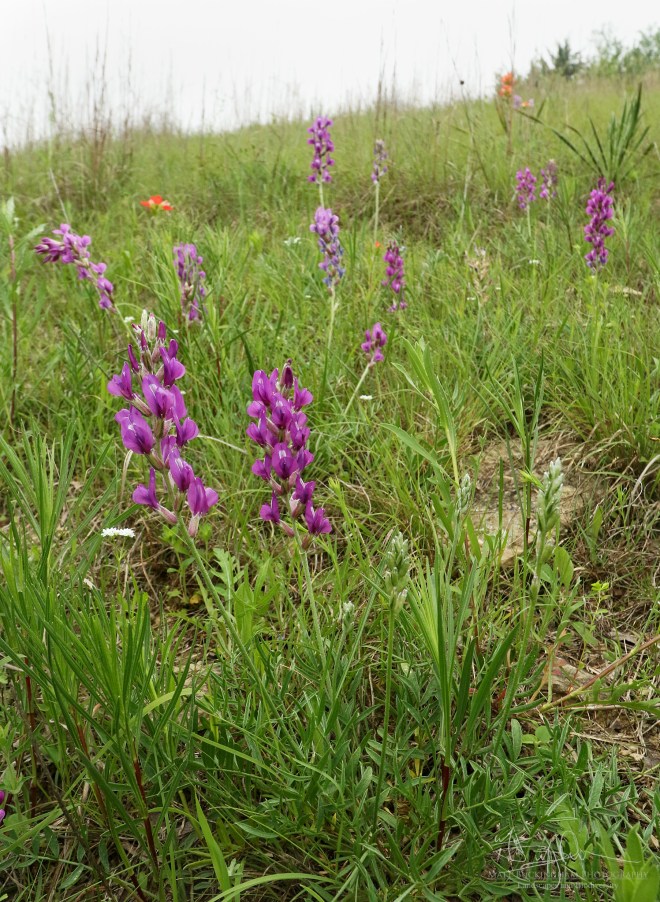
Being from the Pineywoods, I’m used to photographing species that are at the western edge of their range – species typical of the vast deciduous forests of the eastern U.S. In the Grand Prairie, however, a number of species reach the southeastern extent of their range.  One such species is the Purple Locoweed (Oxytropis lambertii) which occurs in the Great Plains and portions of the Rockies.  I first photographed this species over a decade ago in a Moraine Prairie in Rocky Mountain National Park, and I must say it was even more exciting finding them in perfect bloom in the Grand Prairie just three hours from home.

4N1A3344

Purple Locoweed

4N1A3363

Purple Locoweed

4N1A3387

Purple Locoweed in the Grand Prairie

The northern expression of the Grand Prairie is often referred to as the “Fort Worth” prairie and occurs in a relatively narrow band between the Red River to the north and the Brazos River to the south.  These once vast expanses of grass and wildflowers were said to be virtually devoid of woody vegetation, and likely bore a striking resemblance to the stark setting of the Great Plains familiar to most of us.  The “big three” prairie grasses – Little Bluestem (Schizachyrium scoparium), Big Bluestem (Andropogon gerardii), and Indian Grass (Sorghastrum nutans) were prevalent here.  And occurred alongside a diverse host of forbs and other grasses.

In mid-April, vast drifts of Eastern Shooting Star (Dodecatheon meadia) appeared, like thousands of meteors bearing down on earth spurning pink flames as they clash with the atmosphere.  The prairie-dwelling shooting stars of Texas are bright pink, in contrast to the white they display throughout the majority of their range.  Dodecatheon meadia occurs across much of the eastern U.S., occurring in a variety of habitats over calcium-rich substrates.  They reach the western extent of their range in the prairies of central Texas.

4N1A3651

Eastern Shooting Stars in the Fort Worth Prairie

It is hard to imagine a more photogenic wildflower than an Eastern Shooting Star in prime condition.  But like the meteors that dissipate before they can reach the earth’s surface, their appearance each spring is far too fleeting.  Though uncountable populations have undoubtedly been lost, there are still a few places where one can glimpse the splendor of a meadow with thousands of tiny pink meteors descending into the prairie.

4N1A3669

Eastern Shooting Star

4N1A3735

Eastern Sh

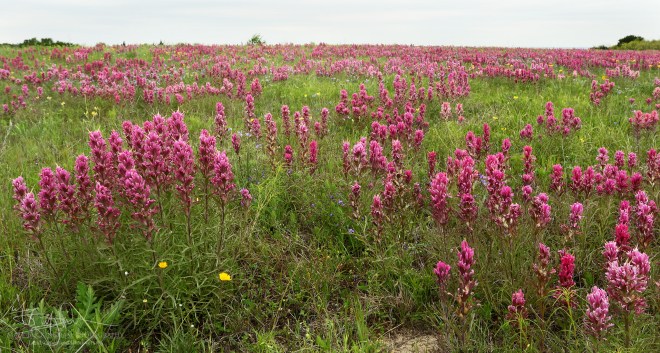
Among the shooting stars were the blooms of a complicated little plant, the Prairie Paintbrush (Castilleja citrina).  This hemiparasitic plant derives some portion of its energy and nutrients from the roots of other plants.  C. citrina is part of a complex of paintbrush species that includes the closely related Purple Paintbrush (Castilleja purpurea) and Lindheimer’s Paintbrush (Castilleja lindheimeri).  In fact, C. citrina and C. lindheimeri were previously considered varieties of C. purpurea, however subtle differences in flower color, plant morphology, and habitat preference has resulted in the designation of distinct species.
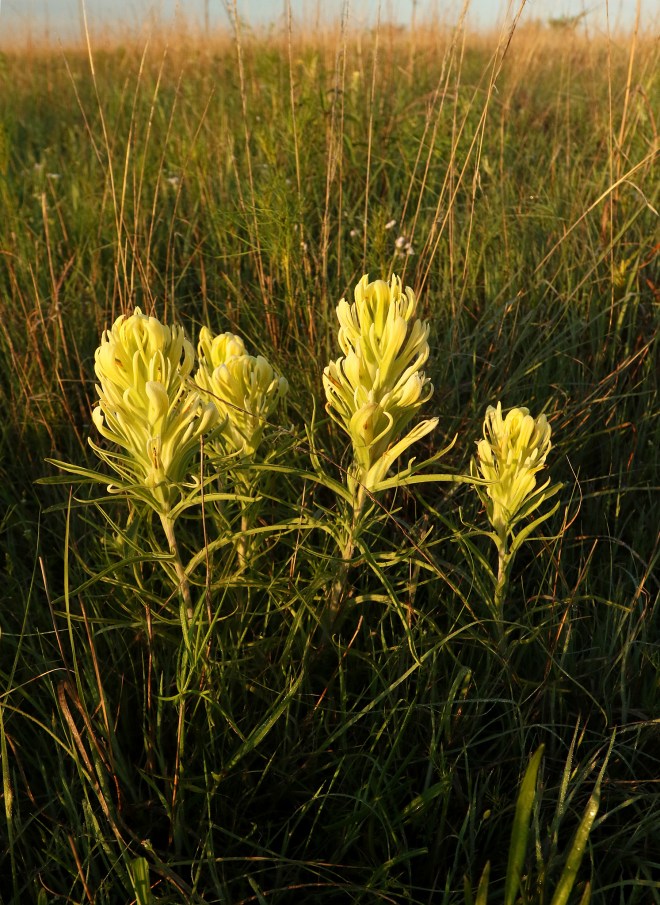
4N1A3658

Prairie Paintbrush

There are certain areas, however, where these species occur in close proximity.  In the Fort Worth Prairie, the area separating C. citrina and C. purpurea occurs right along the Wise/Montague County line.  North of this line, nearly all individuals observed are C. citrina, and to the south C. purpurea abounds.  There is a narrow band of hybridization, as evidenced by the variety of colors and shapes in the image below.

4N1A4253b

Hybrid Paintbrushes

Just south of this line, however, the Purple Paintbrush paints the prairie.  Seeing the beauty above, it is easy to forget the tumultuous battle occurring below the soil as the roots of the paintbrush wage war on other prairie plants.
4N1A4582

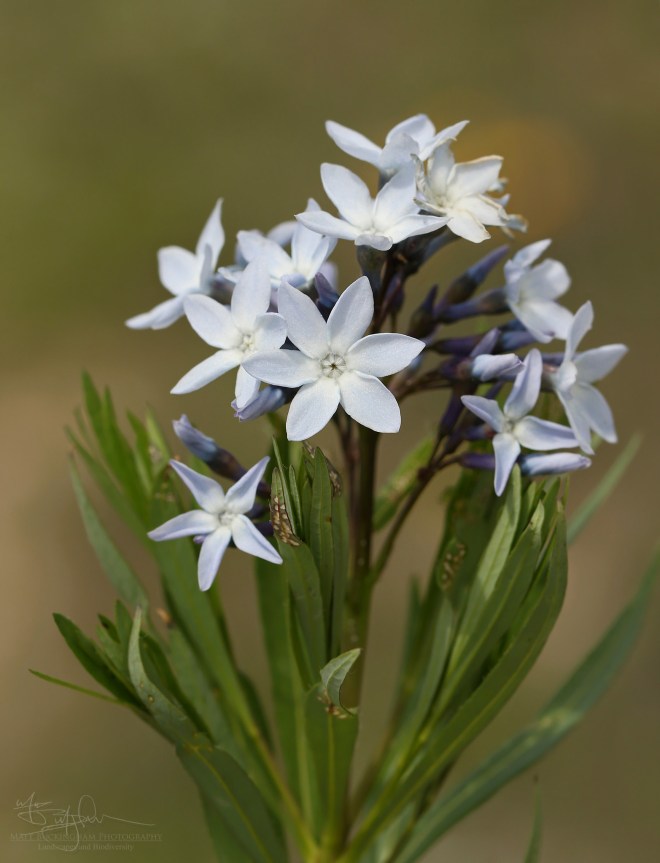
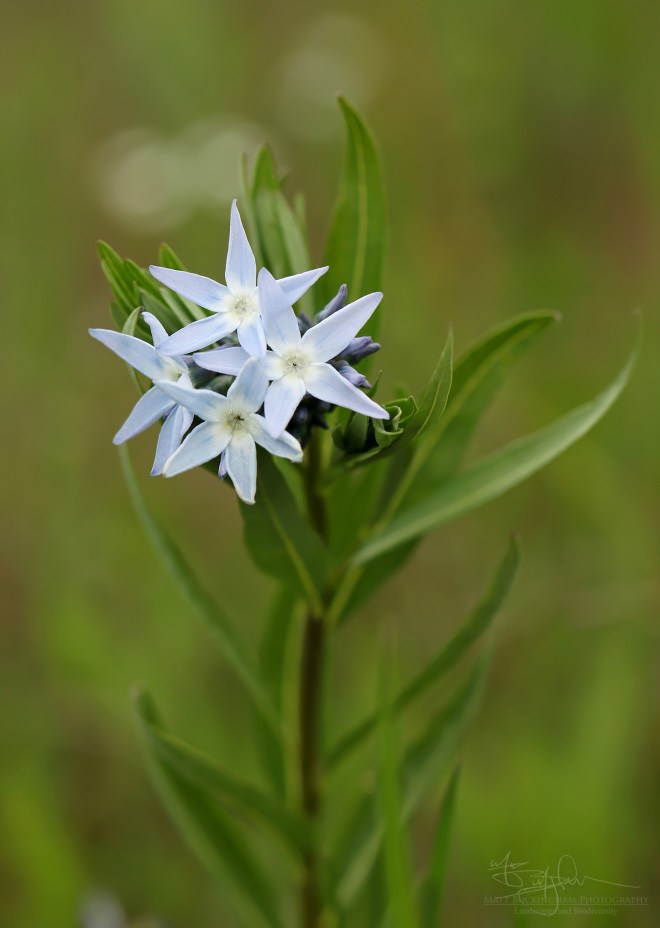
Another charming prairie plant is the Fringed Bluestar (Amsonia ciliata), its blue blooms echoing the sky.  The bluestars’ tubular flowers are pollinated by a variety of moths and butterflies, and migrating hummingbirds.

4N1A4443

Fringed Bluestar

4N1A4402

Fringed Bluestar

4N1A4649

Fringed Bluestar

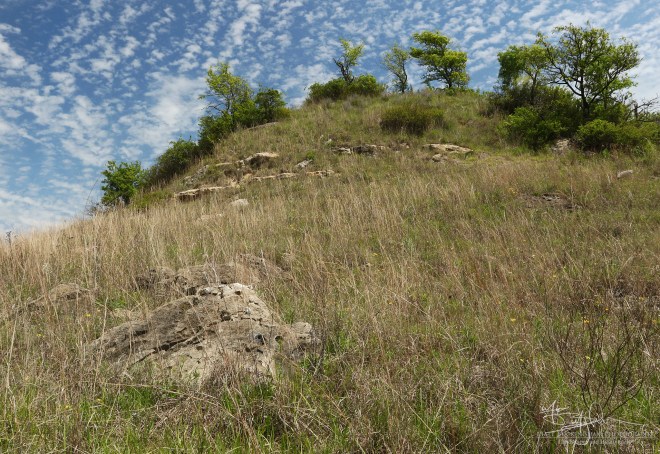
Though the Fort Worth Prairie is generally flat, topographic relief does occur in the form of cuestas – small hills that rise gradually to one side, and drop off abruptly to the other.  Cuestas are formed as more erodible geologic layers have weathered away, revealing the ends of more durable adjacent layers.  The vegetation varies from the top of the cuesta, down the slope to the bottom due to a variety of factors including soil conditions, moisture levels, and natural fire patterns.
4N1A4436

Looking up at a cuesta in the Fort Worth Prairie.  Historically shielded from fire to a degree, the tops of cuestas were one of the few places in the prairie where woody vegetation could be found.

4N1A4440

It was easy to imagine a massive heard of bison sprawling over distant cuestas
4N1A4520

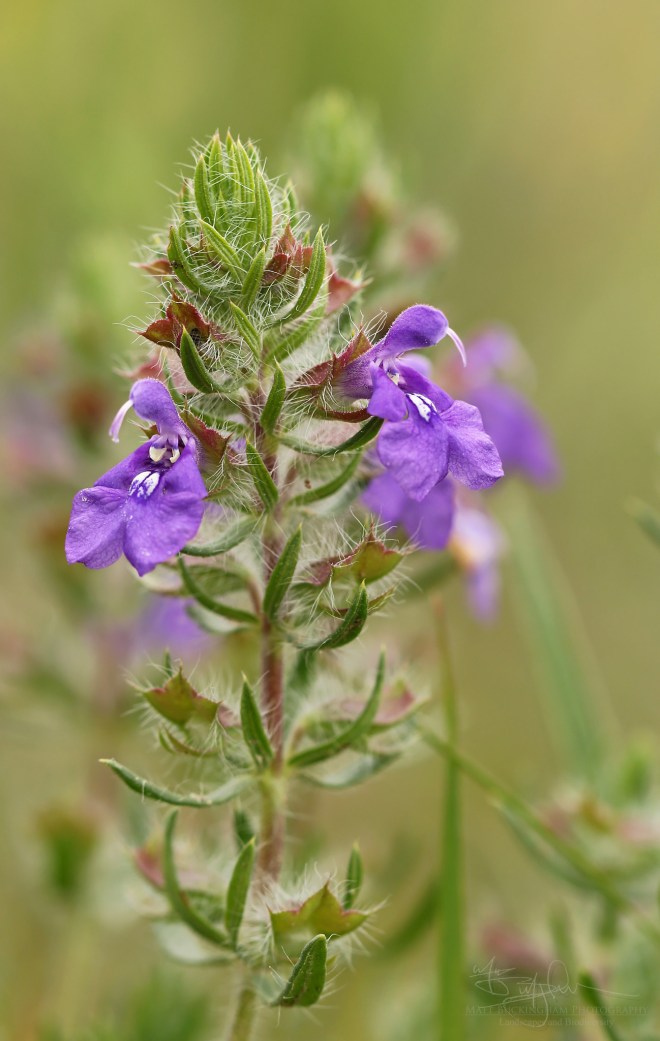
The rocky prairie at the cuesta’s edge is the perfect place for the Texas Sage (Salvia texana).

4N1A4571

Texas Sage

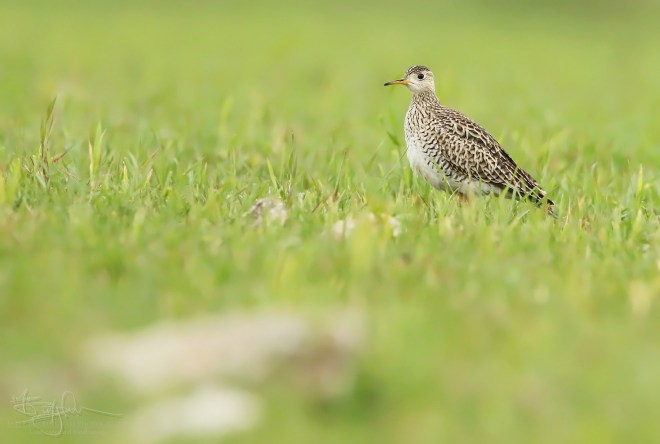
The rich prairies near the Red River once served as breeding grounds for the Upland Sandpiper.  This once abundant prairie shorebird suffered precipitous declines at the hands of market hunters in the late 1800s and early 1900s.  As their numbers dwindled, so did their habitat, and the bird faced a very bleak future.  Fortunately, conservation laws were enacted early in the twentieth century that put an end to market hunting, and their numbers appear to have been slowly rebounding since.  Despite this, they have still yet to return to much of their former breeding range.  Upland Sandpipers were known to nest in the Fort Worth Prairie in the nineteenth century.  On our visits to the region, Caro and I have seen many during migration during April and May.  I hold out hope that over time, this special prairie bird will again colonize the region.
4N1A4789

Upland Sandpiper in the Fort Worth Prairie during Migration

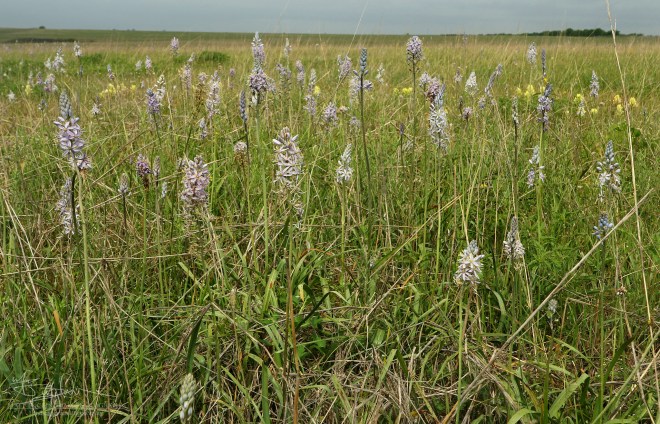
The beauty of a vast prairie abloom with wildflowers is a thing of pure beauty.  Few species are as showy as the Prairie Hyacinth (Camassia angusta) blooming en masse.  This prairie dweller is a close relative of the more familiar Wild Hyacinth (Camassia scilloides), and is best differentiated by bloom time, and the persistent sterile bracts present on C. angusta.

4N1A4952

Scenes like this prairie with thousands of Prairie Hyacinths in bloom provide a glimpse into what once was.

Our journey through the prairies of North-Central Texas ends much as it began, pondering their past, present and future.  Caro and I had spent a few glorious spring days in these prairies, and before we returned to the forests of East Texas, we stopped at one final meadow, adorned with blooming shooting stars.  I made an effort to immerse myself in the moment; to take in all aspects of the prairie:  Her sights – gently swaying hues of pink, green, and brown; Her smells – damp earth and chemical compounds exuding from fragrant leaves; Her sounds – the subtle tune of grass in the breeze and a distant Meadowlark’s song.  Moments like this stir something within me.  They inspire me, and they make me feel a deep connection to the natural world.

4N1A5082

Eastern Shooting Star

4N1A5127b

Storm clouds build over a prairie decorated with thousands of shooting stars in bloom.

As I sat there, watching the shooting stars sway in the wind as storm clouds coalesced and darkened the distant sky, I imagined the countless dramas that unfolded over the expanse of this prairie.  I imagined that surely a tornado or two passed over this spot.  It was hard to imagine such a placid place turned deadly by such an awesome force of nature capable of ripping the very grass from the ground.  And though I preferred to dwell on dramas natural in their nature, my mind couldn’t help but wander to those dramas wrought by man.  Like the wanton, systematic elimination of the American Bison – an icon that helped shaped our nation essentially extirpated in a single generation.  And they weren’t alone.  It was hard to miss the disappearance of wolves, bears, and mountan lions.  Less obvious were the prairie chickens that slowly vanished, or the Upland Sandpipers and other migratory birds that became less numerous each summer until one year they simply failed to return.  And we will never what botanical wonders were lost before they could ever be documented.  It was easy to despair and wish for what was once and will never again be.  But it was also easy to hope.  On our prairie tour, Caro and I had seen many incredible things – inspirational results from dedicated conservation efforts; rare plant communities that were thriving; and promising signs that some species that have vanished from our Texas prairies may one day soon return.

If prairies are important to you, as they are to me, please consider donating to conservation organizations like The Native Prairies Association of Texas and The Nature Conservancy in Texas.

Wintering Waterfowl in North-Central Texas

4n1a3226b

A Hooded Merganser swims through water reflecting remnant fall color in Post Oaks lining a wetland in North-Central Texas.

“Why am I doing this?” I couldn’t help but ask myself as I lay flat on my side in the muck, piles of duck feces inches from my face.  I was cold and wet, and tired – so very tired.  We woke up at 3:30 that morning and were on the road by 4, just so that we could arrive at our destination at first light.  I had come all this way and endured all this suffering for the chance to take pictures of ducks.  To many, ducks are those familiar, pesky waterbirds that harass them during a day at the park or a picnic near a pond.  To me, however, they are a diverse, fascinating group of some of the most beautiful birds on the planet with incredible life histories full of harrowing journeys, dramatic performances and tales of incredible hardship.  Yes, the world of ducks extends beyond the familiar Mallard and its domesticated descendants.  In this blog I will explore a slice of the diversity of ducks that spend the winter in North-Central Texas.
In Texas, the northern portion of the Blackland Prairies and Cross Timbers serves as an important wintering ground for a variety of waterfowl.  Wetland complexes adjacent to the Red and Trinity Rivers provide excellent habitat within a matrix of woodlands and prairies.  It is also located near the boundary of the Central and Mississippi flyways.  These factors help make the region a haven to ducks and geese that have traveled from as far as the Arctic Circle.

So this winter, I took three trips to the region in hopes of observing and photographing some of these beautiful birds.  I researched the region extensively, looking for promising locations.  We took our first trip on a grey, bitterly cold day in late December.  We would end up seeing many ducks at a few different locations, but the light was not with us.

Disappointing light aside, I did leave with a few image of one of my favorite ducks, and a species I had long wanted to photograph – the Canvasback (Aythya valiseneria).  With it’s long, broad black bill, characteristically sloping forehead, rusty head and bright white wings and flanks, the drake Canvasback is one of our most elegant ducks.  A black bib and tail help complete its dapper plumage.

There are four basic tribes of ducks: dabbling (Anatini), diving (Aythyini), sea (Mergini), and stiff-tailed (Oxyurini) ducks.  Canvasbacks are diving ducks.  Members of this tribe have legs set farther back on their bodies to aid in diving.  They feed by diving and foraging from the bottom of waterbodies.  Canvasbacks feed heavily on underwater tubers as well as snails, mollusks, and other aquatic invertebrates.  Most Canvasbacks winter in and around the Chesapeake Bay, and are generally uncommon elsewhere along the coast and inland.

4n1a2834

Drake Canvasback

4n1a2912a

Drake Canvasback

On our next trip in early January, Caro and I were up and out hours before the sun came up.  My main target for this trip was the Hooded Merganser (Lophodytes cucullatus), my favorite duck and in my opinion, one of the most beautiful birds in the country.  We arrived at our first location, a forested pond in the Cross Timbers, for the day just as the sun was cresting the horizon.  Sure enough, there we spotted a pair of mergansers along the distant shoreline.

I made my way to the water’s edge and lied in wait.  Unfortunately, the drake never warmed up to my presence, and stayed well away.  The image below is the only time he ever raised his crest, and after just a few minutes he took off and never returned.

4n1a3384ab

Drake Hooded Merganser

The hen remained, however, and eventually she and the other ducks in the pond became accustomed to my presence.  She swam in close and provided several nice looks at her understated plumage.

4n1a3530a

Hen Hooded Merganser

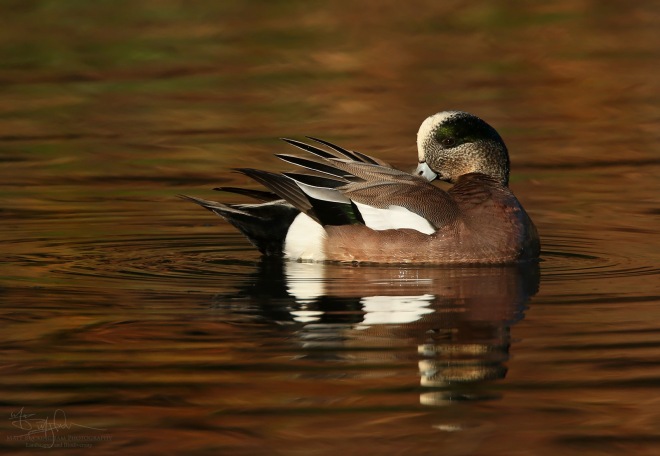
As I was admiring the merganser, a group of American Wigeon (Anas americana) flew in.  I had recently photographed these stunning ducks near Austin on Christmas Day.  Not one to pass up a good photo op, I captured the drake below mid-preen, as he showed off his wing coverts, scapulars, tertials, and just a hint of that iridescent speculum.

4n1a3494a

Drake American Wigeon

The sky was cloudless that day, and soon the sun was too high and the light too harsh for photography.  So we grabbed lunch and traveled east, to a series of prairie ponds.  Here we found a variety of ducks, including both of our Scaup species.

Scaups can be tricky to differentiate, but there are a few good characteristics to look for.  Despite bearing the descriptors “Lesser” and “Greater”, size is generally not a reliable method to differentiate species, unless they are seen together.

In general, the Lesser Scaup (Aythya affinis) is smaller, however it is more readily identified by head shape and plumage detail.  Lessers generally have a more raised forehead, often having a crest-like appearance with the point near the back of the head.  The barring on Lesser Scaup’s feathers also extend all the way down its flanks.  Other, less reliable characteristics for identification include the iridescent sheen on the head, which is generally purple in Lesser Scaups, and the black at the tip of the bill, which is generally less extensive in Lessers.

Lesser Scaups are a common winter resident on waterbodies throughout the Lonestar State.  I photographed the drake below as it swam through waters reflecting the brilliant blue skies, with the muted browns of prairie grass in the background.

4n1a3600a

Lesser Scaup

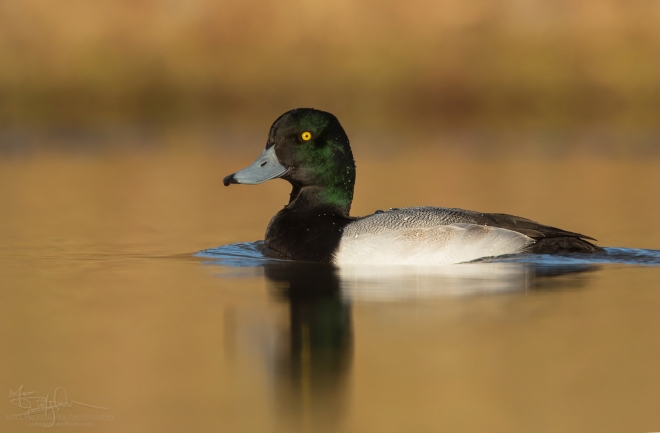
Much less common a winter visitor is the Greater Scaup (Aythya marila).  In Texas, they can be found sporadically along the coast in winter.  Inland, they are only observed with any regularity in a small area in north-central and northeast Texas.  They have journeyed here from the far north, where they breed in small ponds on the tundra and in the boreal forest.

True to their name, they are larger than Lesser Scaup, though this is only a useful diagnostic when both species are observed together.  They are more reliably differentiated by their more rounded heads, pure white flanks, broader bill with more prominent black marking at the tip, and greenish sheen to the feathers on their heads.
After spending some time among the scaups, and fruitlessly stalking a Bufflehead pair, we returned home, tired but satisfied from a long day in the field.

4n1a3971b

Greater Scaup

An alternate name for this blog post could have been “My Quest for a Hooded Merganser”.  Since I was a child I have been enamored with this peculiar yet spectacular sea duck.  They lack the brilliant colors and iridescence of other species, but their bold black, white, and chestnut patterns along with that remarkable crest that is raised during courtship rituals sets them ahead of the pack.  It also doesn’t hurt that they are one of just a few duck species to breed in forested wetlands and nest in tree cavities.

I don’t see Hooded Mergansers very often, and most sightings consist of them rapidly disappearing on the wing after having spotted me at a great distance.  Though I had captured a few images on my previous visit, I wasn’t successful in getting the image I wanted – a drake with his crest raise, displaying the full glory of his breeding plumage.  So despite already having made the 6-hour round trip just twice in as many weeks, I rose again before 4 AM, and hit the road to the Cross Timbers.  This time I was joined by my good friend and photo buddy James Childress.

We arrived before first light, to a shallow pond nestled within a Post Oak – Cedar Elm woodland.  We donned our camo and settled in, laying flat in the mud at the water’s edge.  It wasn’t long before the ducks started coming in.  And sure enough, we spotted a lone drake Hooded Merganser.  Unfortunately he was sitting at rest, eyes barely open and crest laid flat.  Much to our disappointment, he would spent most of the morning in this state.

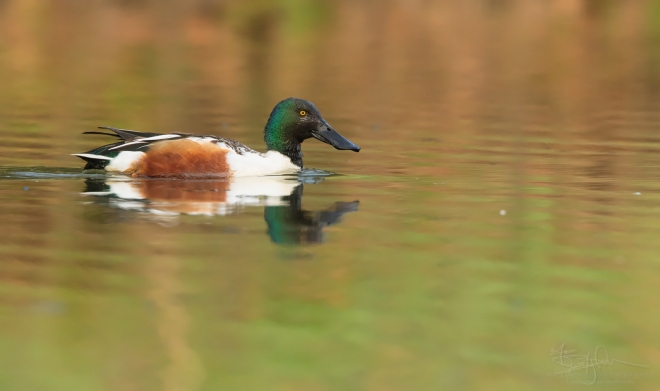
But he was not alone.  And there were plenty of other gorgeous ducks to occupy our time.  One of the most striking was the Northern Shoveler (Anas clypeata).  A few drakes passed by fairly closely in waters reflecting the browns of dried leaves and greens of evergreen vines lining the shore.

4n1a6036a

Northern Shoveler

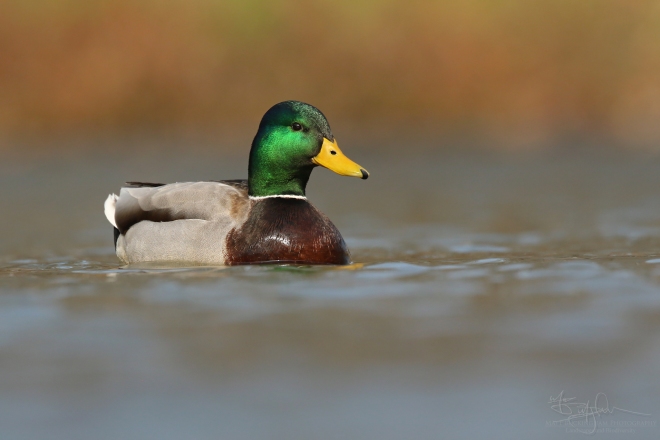
I also took this opportunity to photograph a species I had long avoided, the ever present Mallard (Anas platyrhynchos).  It’s not a lack of beauty that kept me from photographing them, as they are undeniably striking birds.  Instead, it was the prevalence of domestic ducks, descendants of Mallards bred in captivity that have since escaped, or been released, and are now naturalized throughout much of the country.  I simply have no interest in photographing feral domestic descendants, and many are virtually indistinguishable from the wild type.  There are still plenty of wild Mallards in the country, however, though there are concerns that the gene pool is being diluted by these free ranging domestics.  The birds we saw that day seemed to fit into the wild phenotype, and I was fairly confident and hopeful that the animals I photographed were from wild, naturally migrating populations, but there is really no way to be sure.

4n1a6260

Mallards

4n1a7184

Mallards

The real star of the morning however, was the American Wigeon.  Some of the beautiful drakes passed close providing us with a variety of settings in which to photograph them, each better than the last.  Wigeons are known for their bully-like behavior, and despite being much smaller than the Mallards, they chased them out of the best feeding grounds.  In some cases they act like pirates, stealing hard-earned meals from diving ducks who, unlike the wigeons, are equipped to swim to the bottom of the pond to choose the most succulent, nutrient rich aquatic plants like Wild Celery (Vallisineria americana) We enjoyed their antics and the constantly whistle like call of the drakes.

4N1A7327.jpg

American Wigeon

4n1a7349

American Wigeon

4n1a6800

American Wigeon

The sun was getting high, pushing the envelope of what I consider good light and I was beginning to worry that I would again be heading home without a decent Hooded Merganser shot.  But just as we were starting to give up hope a second drake flew in.  This caught the attention of our first male, and both became active, diving in search of prey, and actively preening.  In the same moment a wispy veil of clouds crossed the sun, creating one of my favorite qualities of light.  I captured them in some truly bizarre, yet interesting poses.

4n1a6615

Hooded Merganser

4N1A6848.jpg

Hooded Merganser

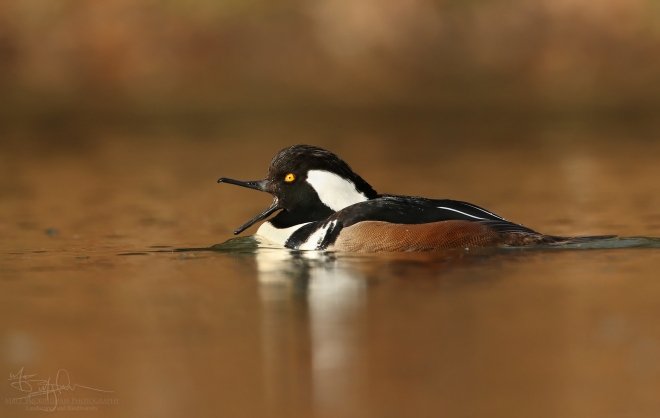
I captured one of the drakes as he yawned, showing of the narrow, serrated bill specially adapted for capturing fish, crustaceans, and small aquatic animals.  I was certainly capturing some memorable images, but I still had failed to capture a pose with the crest raised.  I missed out on two opportunities as my camera’s auto-focus failed to lock onto the subject.

4n1a7020

Hooded Merganser

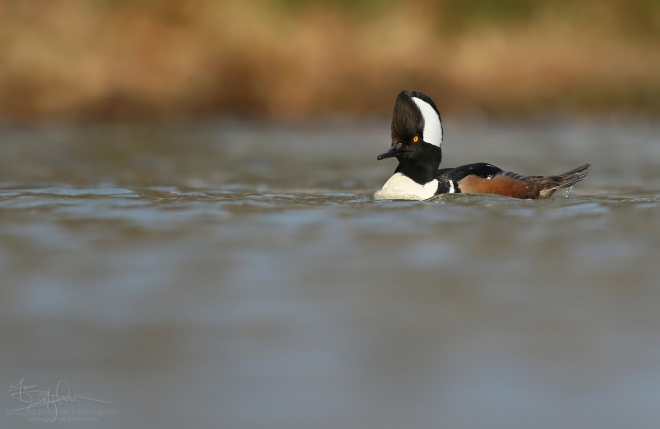
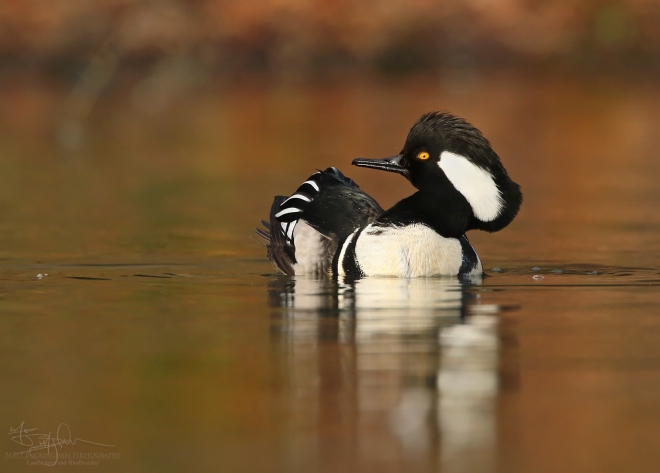
And then it happened.  After a short preening session, one of the drakes raised its crest and began to really show of its spectacular plumage.  It continued to preen and raise up to flap its wings and dry off its feathers.  I was thrilled to check off a subject that has been on my photographic bucket list for years.

4n1a7215a

Hooded Merganser

4n1a7256ab

Hooded Merganser

4N1A7260.jpg

Hooded Merganser

While one drake was putting on a show in the distance, the other passed by close, and I was able to capture the image below in still, flat water – perhaps my favorite of the trip.

4n1a6882

Hooded Merganser

“That’s why I’m doing this!” I thought to myself with a smile.  It’s easy to lose sight of the prize while suffering in the cold and wet, and while every muscle in your body is screaming from the awkward contorted position you’ve taken up to get the perfect angle on one of the ducks.  But all of the misery seems to fade away while these beautiful animals appear within range of the lens, and the suffering seems a small price to play for these images that we may enjoy and reflect on for a lifetime.  I dare say, that these moments of unpleasantness only serve to enhance the experience, and I don’t think I would be rid of them, even if I could.