South Texas Part V: A Stop for a Sand Sheet Endemic

IMG_1308

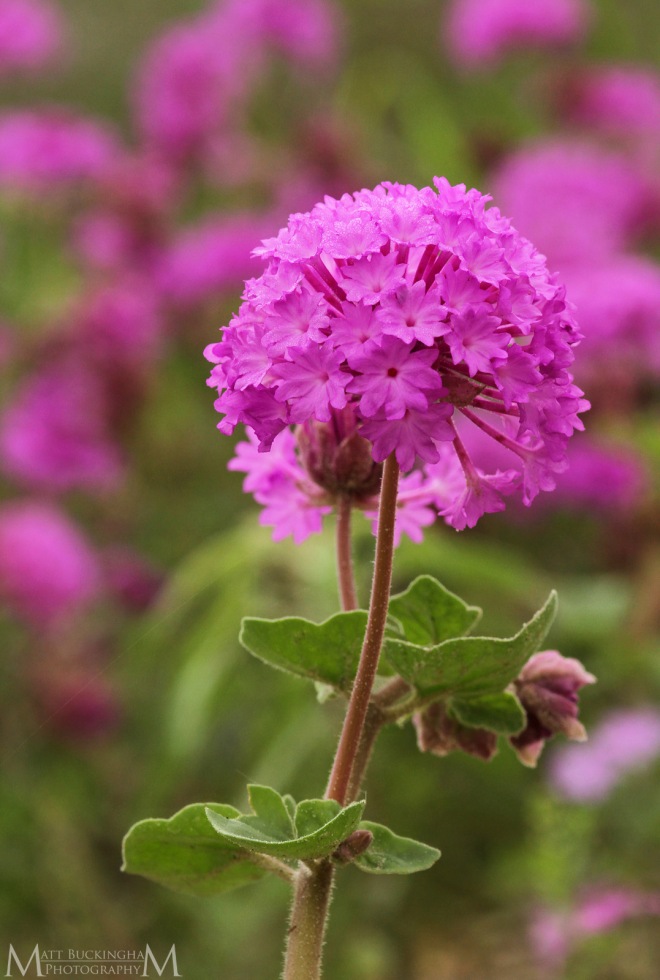
Amelia’s Sand Verbena blooms in the South Texas Sand Sheet

The South Texas Sand Sheet occurs across a handful of South Texas counties.  It consists of layer of loose sand that was blown inland from the Gulf of Mexico in the Holocene.  The sand sheet is home to a suite of endemic plant species.  Perhaps the most spectacular is the Amelia’s Sand Verbena (Abronia ameliae), which can be found nowhere, save the South Texas Sand Sheet.

IMG_1294

Amelia’s Sand Verbena

While returning home from the Rio Grande Valley we passed through the sand sheet.  I began seeing splashes of a deep pinkish purple passing as a blur at 75 miles per hour.  Finally after seeing a large field of pink I shouted “STOP!”  And my dad, despite his better judgement pulled over into the right of way of the busy highway and backed up to the spot that caught my eye.

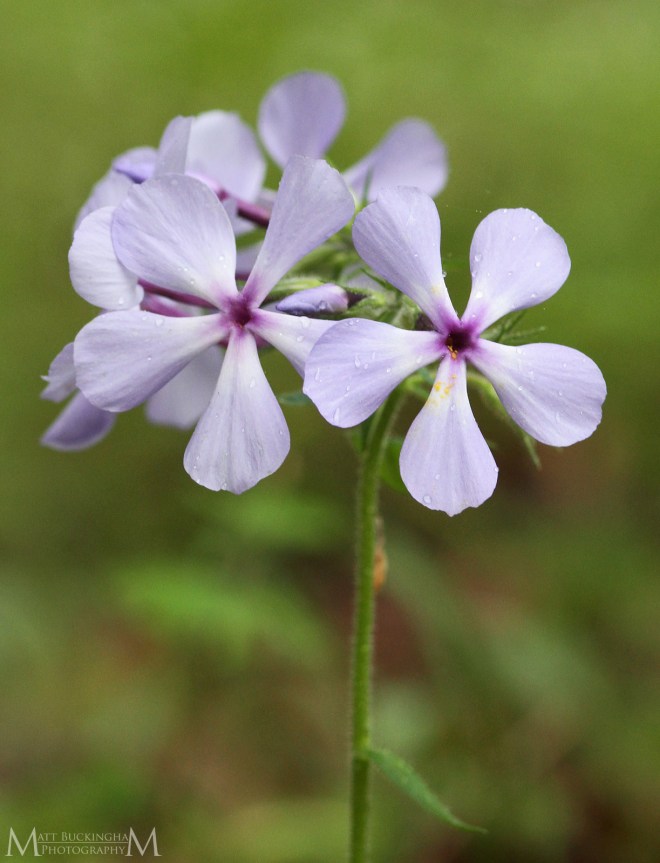
The Amelia’s Sand Verbena was blooming en masse.  It was great to see such a rare, range-restricted plant thriving.  Recent rains may have helped provide such a spectacular bounty of flowering plants.  Growing among the sand verbena were a number of other South Texas specialties, including Rio Grande Phlox (Phlox glabriflora).

IMG_1277

Amelia’s Sand Verbena

IMG_1302

Amelia’s Sand Verbena and Rio Grande Phlox bloom in the South Texas Sand Sheet

It was a cool, overcast morning, so there were not many pollinators around.  We did however notices a stealthy predator nestled within the amble flowers on the inflorescence of one of the sand verbenas: a Crab Spider.

IMG_1317

A Crab Spider hidden in the blooms of an Amelia’s Sand Verbena awaits a meal

Seeing these South Texas Sand Sheet endemics was the perfect ending to an incredible trip full of biodiversity.  I was sad that it was coming to an end, but I took comfort in the fact that there were many other natural wonders still waiting to be explored.


South Texas Part IV: Star Hunting

IMG_0163

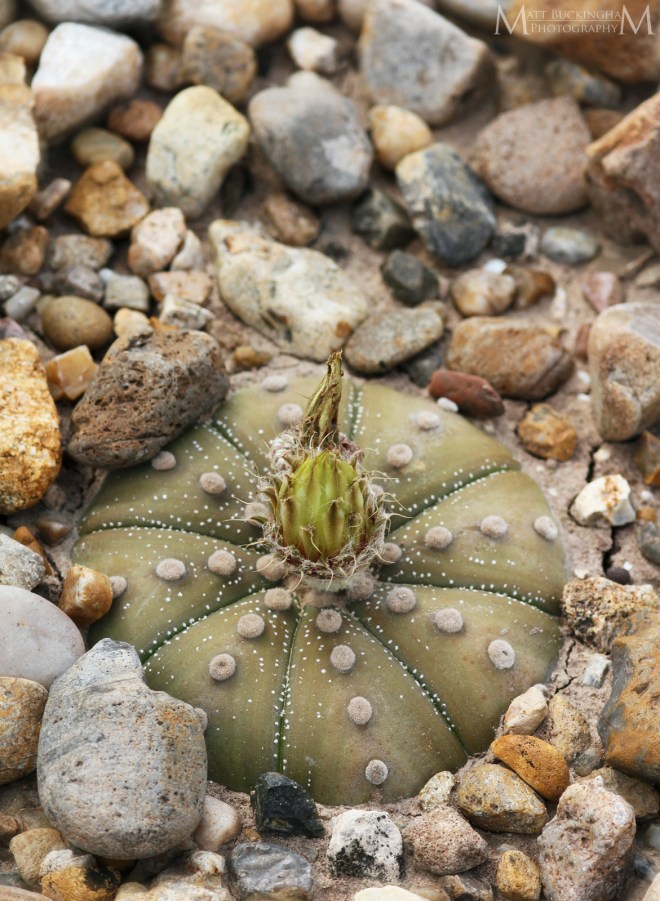
Star Cactus

The Star Cactus (Astrophytum asterias) may be the rarest, most unique cactus in the country.  It is known from only a handful of sites in the Tamaulipan thornscrub of extreme southern Texas and northeastern Mexico.  It is so imperiled that it has been listed as Endangered by the U.S. Fish and Wildlife Service.  It is severely threatened by land use conversion and habitat loss.  Fortunately The Nature Conservancy in Texas acquired the property that may have the largest remaining Star Cactus population in the country.  Here they undertake conservation measures and reintroduction efforts to ensure that this iconic cactus remains for generations to come.

I have donated a number of photographs to The Nature Conservancy in the past.  When we decided on traveling to South Texas I reached out to them to see if I could arrange a visit to see and photograph these imperiled cacti.  They graciously approved my request, and we met with volunteer Paul Bryant, who gave us an excellent tour of the property.  Having previously worked for a non-profit land trust similar to the Nature Conservancy, I know how heavily we relied on our volunteers.  I also learned to recognize the good ones, and I had no doubt that Paul was a valuable asset to the Nature Conservancy.

IMG_0204

Star Cactus

Though many were growing in the open, the star cactus was extremely difficult to spot.  When its not flowering, it is inconspicuous, blending in with the scattered rocks covering the gentle slopes where it grows.  Also known as the Sea Urchin Cactus, Sand Dollar Cactus, and False Peyote, it is a spineless cactus that lies relatively flat against the surface in times of drought.  Following rains, however it swells with water and can appear quite plump.  I had hoped to photograph the bright yellow blooms, but it was not to be.  We saw a number of plants that had recently blooms, and others that were preparing to, but we weren’t fortunate to catch any in the act.  That was ok though, it was a wonderful experience just to get to see them in their element.  The plant itself is beautiful, and made for some interesting photographs even without its bloom.

IMG_0335

Star Cactus

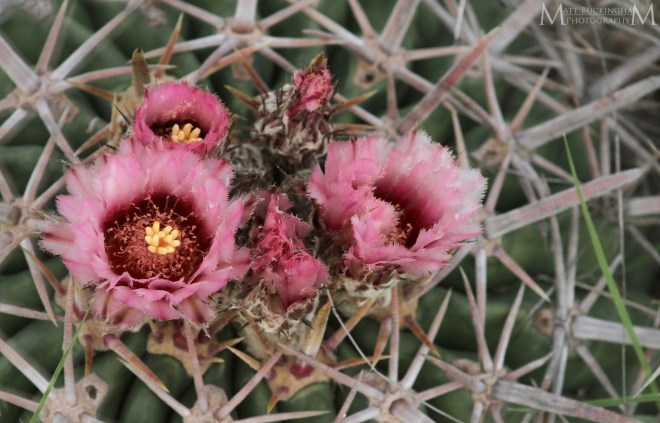
There were several other cacti growing in the vicinity of the Stars.  The most conspicuous was the aptly named Glory of Texas (Thelocactus bicolor).  In Texas this species only occurs in the extreme western and extreme southern portions of the state.  Though the populations are disjunct in Texas, they are more or less connected through Mexico.  We saw many of their bright pink blooms, both in the open and at the base of nurse plants.

IMG_0415

Glory of Texas

IMG_0057

Glory of Texas

IMG_0144

Glory of Texas

We also saw a few of the formidable Horse Cripplers (Echinocactus texensis) in bloom.  Looking at these beasts, its not hard to see how they got their name.

IMG_0348

Horse Crippler

IMG_0353

Horse Crippler

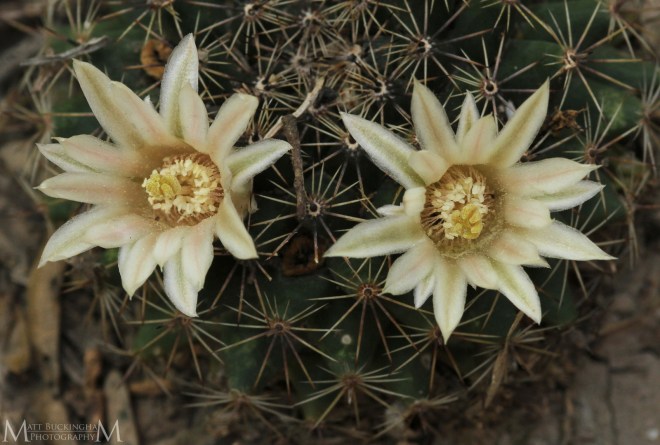
I only saw one Runyon’s Pincushion Cactus (Coryphantha pottsiana) in bloom.  Though not as scarce as the Star Cactus, this species is also rare in Texas, where it is known from only three counties along the Rio Grande.

IMG_0174

Horse Crippler

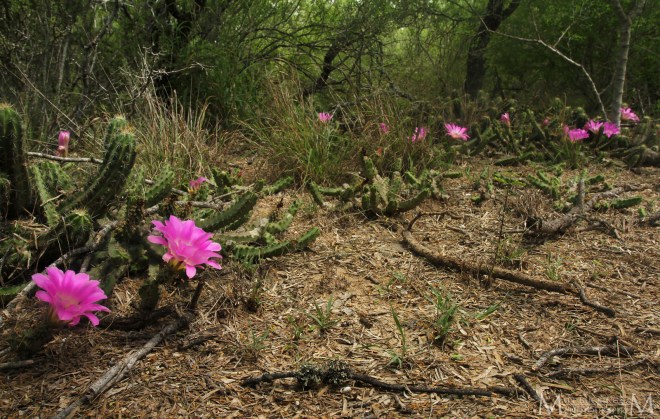
And then there were more Lady Fingers (Echinocereus pentalophus).  Though these proved to be fairly common during the trip I never tired of seeing them, and could not resist every opportunity to photograph them.

IMG_0379

Lady Finger Alicoche

IMG_0230

Lady Finger Alicoche

I found one particularly robust flowering specimen growing among a clump of Varilla (Varilla texana).  I came to learn that where Varilla grows, there are usually other interesting things to be found.

IMG_0294

Lady Finger Alicoche

IMG_0271

Lady Finger Alicoche

We also observed several Strawberries Pitayas (Echinocereus enneacanthus), Fitch’s Hedgehog Cactus (Echinocereus fitchii), Heyder’s Pincushion Cactus (Mammillaria heyderi), and a few Peyote (Lophophora williamsii) on the property, however these weren’t in bloom.  I had hoped to photograph Peyote this trip, but a suitable opportunity did not present itself.

There were plenty of other flowering plants to admire, however.  Perhaps the most striking was the Berlandier’s Nettlespurge (Jatropha cathartica).  It seemed to prefer the same gravelly slopes as the cacti.

IMG_0999

Berlandier’s Nettlespurge

While on my knees looking for Peyote I spotted a group of tiny yet striking blooms.  The Glandular Milkwort (Polygala glandulosa) occurs in only a handful of South Texas Counties.

IMG_0202

Glandular Milkwort

It was hard not to stop and admire the Guayacan (Guaiacum angustifolium), which was blooming throughout the thornscrub.

IMG_9795

Guayacan

After arriving at the property, we split up to scour the area.  Seth soon came to find me.  He had an excited grin and told me that he had something to show me.  He led me to a large Texas Tortoise (Gopherus berlandieri) that had crawled halfway down its burrow.  I wanted so badly to photograph it, but despite waiting for some time, it refused to show its face, and we had to continue our hunt for the Star Cactus.  I was luck enough to photograph another South Texas Treasure, the orb-weaver Argiope blanda.  A. blanda occurs in the United States only in extreme southern Texas.

IMG_0041

Argiope blanda

Though I did not get to photograph the Star Cactus in bloom, it was a day full of natural wonder spent in good company, and I left with a real sense of contentment, both in the things I had seen and photographed, and in the knowledge that organizations like the Nature Conservancy exist to protect our planet’s great biodiversity.


South Texas Part II: Into the Thornscrub

IMG_0715

Common Pauraque

Beyond the South Texas coastal dunes, marshes, and prairies lies a unique, biodiverse community dominated by a variety of shrubs and small trees.  Variably referred to as South Texas brush country, mezquital, and Tamaulipan thornscrub, this semi-arid, subtropical community occurs in South Texas and the Mexican states of Tamaulipas, Nuevo Leon, and Coahuila.  It is home to plants and animals found nowhere else on earth, and in South Texas, marks the northern extent of several Latin American species that just barely enter the United States.

IMG_0772

Tamaulipan Thornscrub with blooming Lady Finger Alicoche alongside Strawberry Pitaya.

The Tamaulipan thornscrub in the Rio Grande Valley of South Texas is one of the United State’s premier birding locations.  My parents and I have made a number of birding trips here in the past, drawn in by the promise of catching a glimpse of one of these South Texas specialties.  During this trip the birding was fairly slow, but we did see many of the typical Rio Grande Valley species including Plain Chachalacas (Ortalis vetula), White-tipped Doves (Leptotila verreauxi), Green Jays (Cyanocorax yncas), Long-billed Thrashers (Toxostoma longirostre), Altamira Orioles (Icterus gularis), and Olive Sparrows (Arremonops rufivirgatus).  Unfortunately these species did not present me with any good photo ops.  I did luck out, however, when we found another Valley specialist, the Common Pauraque (Nyctidromus albicollis) roosting alongside a trail.  These members of the nightjar family are nocturnal and rely on their camouflage to roost on the ground during the day.  It was nearly invisible among the dried leaves and sticks littering the earth.  I utilized the dense natural debris to create the window effect seen on the photo at the start of this blog entry.

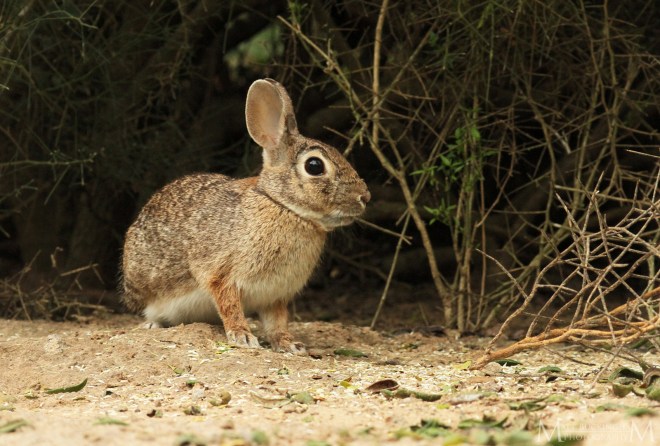
Many mammal species also reach the northern extent of their range in deep South Texas.  Unfortunately many of them are now gone.  The last Jaguar (Panthera onca) in Texas was killed in the Tamaulipan thornscrub in the 1940’s.  There are some that still hold onto hope that there may be a few Jaguarundi left in the Rio Grande Valley.  Though there have been no verified sightings in many years, there have been unverified reports.  Ocelots (Leopardus pardalis) are still hanging on in the brush country, though they are now rare, and protected under the Endangered Species Act.  In our explorations of the thornscrub we observed a number of mammals including White-tailed Deer (Odocoileus virginianus) and Collared Peccaries a.k.a. Javelinas (Tayassu tajacu).  The only mammal I was able to photograph was the little Eastern Cottontail (Sylvilagus floridanus) pictured below.

IMG_9081

Eastern Cottontail

There are many reptile and amphibians whose United States distribution is also limited to the Rio Grande Valley.  Being an amphibian enthusiast, I was disappointed that we missed the heavy rains that brought out such rarities as the Mexican Burrowing Toad (Rhinophrynus dorsalis) and White-lipped Frog (Leptodactylus fragilis) by just a couple of days.  These species are explosive breeders that emerge to breed after heavy rains.  I did spend some time looking for the beautiful Speckled Racer (Drymobius margaritiferus), a primarily Latin American species that is known from only a couple of sites in South Texas.  I struck out on the snakes, but was able to photograph a couple of the areas conspicuous lizards: the Texas Spiny Lizard (Sceloporus olivaceus) and the Rose-bellied Lizard (Sceloporus variabilis).

IMG_9769

Texas Spiny Lizard

IMG_9995

Rose-bellied Lizard

The Rio Grande Valley is also world famous for its butterflies.  While we observed many species, the only one I obtained a decent photo of was the Common Mestra (Mestra amymone).

IMG_9816

Common Mestra

The Tamaulipan thornscrub is named for the typically thorny shrubs and small trees that dominate the community.  Typical species of this community include Mesquite (Prosopis gladulosa), Chaparro (Ziziphus obtusifolia),  Whitebrush (Aloysia gratissima), Texas Paloverde (Parkinsonia texana), Texas goatbush (Castela erecta), Saffron Plum (Sideroxylon celastrinum), Blackbrush Acacia (Vachellia rigidula), Corona de Cristo (Koeberlina spinosa), Guayacan (Guaiacum angustifolium), and Ebano (Ebenopsis ebano).  These shrubs form often impenetrable thickets.  On some sites, particularly as one moves further west in the Rio Grand Valley the shrubs may become more scattered, forming dense clumps with areas of exposed gravel and caliche.  It was in areas such as this where we observed the rare Baretta (Helietta parvifolia).

IMG_9634

Texas Paloverde

IMG_9740

Texas Paloverde

Occasionally growing in the crooks of mature Ebano, a real botanical treasure can be found.  The epiphytic bromeliad Tillandsia baileyi, commonly known as Bailey’s Ball Moss barely enters the United States in South Texas, where it is rare.  It is much more striking than other members of its genus, which includes the familiar Spanish Moss (Tillandsia usneoides).

IMG_9662

Bailey’s Ball Moss

IMG_9700

Bailey’s Ball Moss

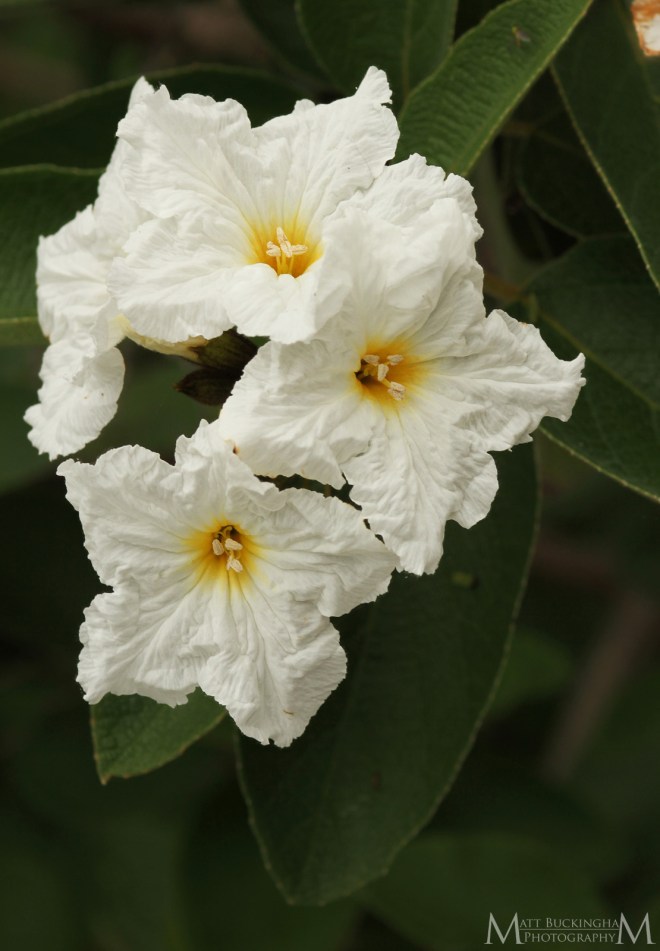
A conspicuous component of the South Texas brush country is the Anacahuita or Mexican Olive (Cordia boissieri).  Its bright blooms illuminate the native brushlands, and it is a popular native ornamental in South Texas.  The tree was reportedly utilized by native cultures and Spanish settlers to make jellies and dyes.  The leaves can be brewed in a tea that may help with rheumatism and various ailments of the lungs.

IMG_9390

Anacahuita

IMG_9405

Anacahuita

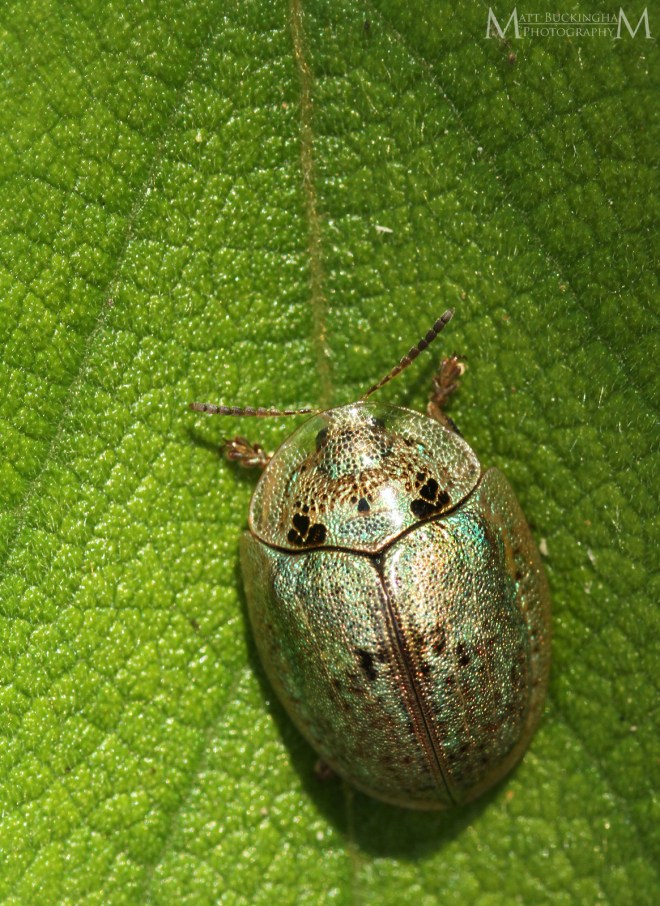
Many invertebrates can be found utilizing Anacahuita leaves and flowers.  The Wild Olive Tortoise Beetle (Physonota alutacea) is found exclusively on these small trees.

IMG_9958

Wild Olive Tortoise Beetle

IMG_9902

Wild Olive Tortoise Beetle

Many pollinators also frequent the blooms.  They due so at their own risk, however, because predators lurk beneath these flowers.  We observed this crab spider (Mecaphesa sp.) awaiting an unsuspecting victim.

IMG_9919

Crab Spider

South Texas is also home to a variety of native lantana species.  Brushland lantana (Lantana achyranthifolia) could occasionally be found scattered about the thornscrub.

IMG_9639

Brushland Lantana

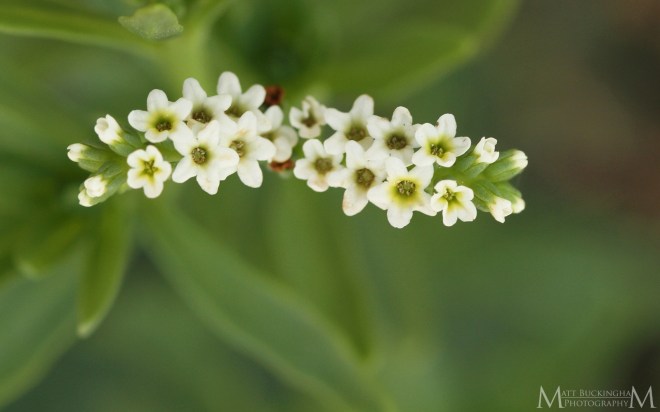
We also observed a couple of species of heliotrope, including the widespread Seaside Heliotrope (Heliotropium curassivicum), and the more range restricted Scorpion Tail (Heliotropium angiospermum) which occurs in South Texas and southern Florida.

IMG_0745

Seaside Heliotrope

IMG_9451

Scorpion Tail

Fiddleleaf Tobacco (Nicotiana repanda), a species of central and southern Texas, was also fairly common.

IMG_9653

Fiddleleaf Tobacco

Shrubby Blue Sage (Salvia ballotiflora) occurs in the U.S. only in southern and western Texas.

IMG_9711

Shrubby Blue Sage

Over the millennia, the meanders of the Rio Grande has slowly changed course, leaving in their wake old depressional oxbow scars.  The scars eventually filled with rainwater and runoff and developed a unique flora.  Known as Resacas these unique wetlands provide habitat for a host of rare plant and animal species.  We observed many Least Grebes (Tachybaptus domincus), another bird species whose U.S. distribution is restricted to South Texas in them.  We also observed the rare Runyon’s Water-Willow (Justicia pacifica) here.

IMG_9842

Runyon’s Water Willow

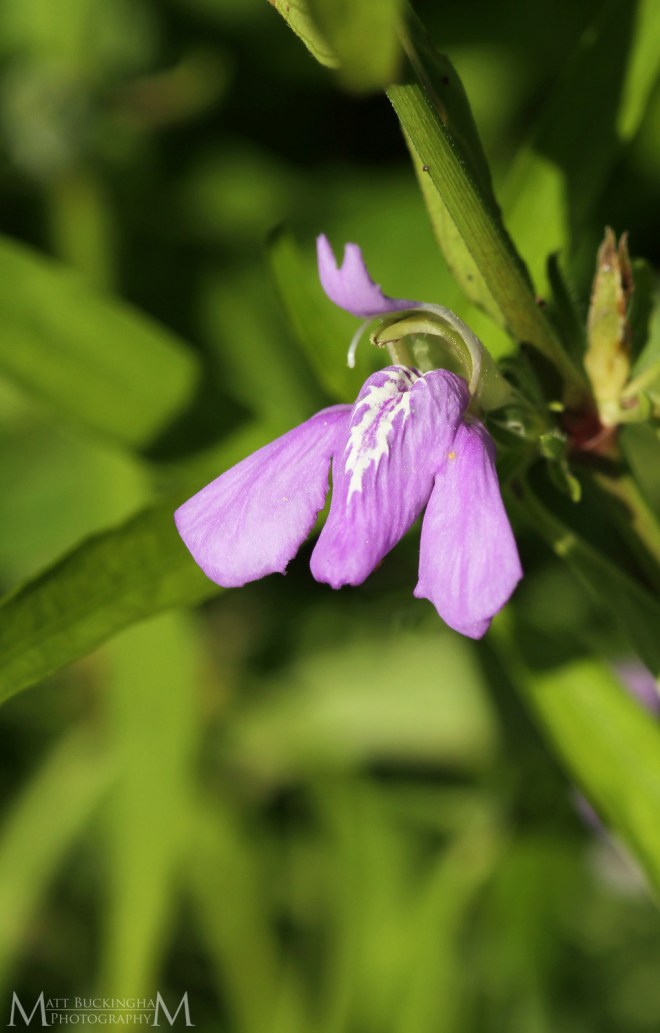
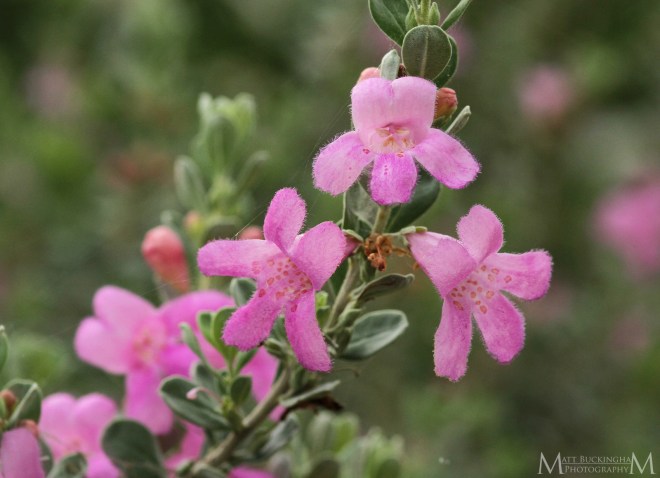
As one moves further west along the valley, one begins to notice more and more of a desert influence.  I observed many familiar species that I have photographed in West Texas including Snapdragon Vine (Maurandella antirrhiniflora) and Cenizo (Leucophyllum frutescens).  The latter blooms in response to rainfall and humidity.

IMG_1215

Snapdragon Vine

IMG_1255

Cenizo

I observed Purple Groundcherry (Quincula lobata) here.  These showy groundcover primarily occur in the southwestern United States.

IMG_0070

Purple Groundcherry

I also observed Bearded Prairie-Clover (Dalea pogonathera) here.  This member of the pea family is primarily a species of the Chihuahuan Desert.

IMG_0097

Bearded Dalea

South Texas is also home to a few woodsorrel species that do not have the typical “lucky clover” leaf.  Pictured here is Peonyleaf Woodsorrel (Oxalis dichondrifolia).

IMG_0965

Peonyleaf Woodsorrel

The open caliche hills were home to the beautiful Berlandier’s Nettlespurge (Jatropha cathartica), which is restricted to South Texas and adjacent Mexico.

IMG_0316

Berlandier’s Nettlespurge

The most spectacular element of the Tamaulipan thornscrub, however, were the cacti.  These famed succulents were my main target in South Texas, and I was fortunate to observe many species.  Though my next two blog posts will be dedicated to the incredible diversity of South Texas cacti, I have decided to provide a preview of things to come below.

IMG_0760

Lady Finger Alicoche (Echinocereus pentalophus)

IMG_0150

Glory of Texas (Thelocactus bicolor)

IMG_0894

Heyder’s Pincushion Cactus (Mammillaria heyderi)

Are we in East Texas or Appalachia?

IMG_8081

False Rue Anemone

I’m going to break my own rule again and make a post that is not about a species on my 2017 list of biodiversity goals to tell you about what may be, in my opinion, the nicest patch of forest in all of Texas.  A couple of years ago Carolina and I were fortunate enough to meet Susan and Viron through a mutual friend.  We joined them on a hike through the Sabine National Forest and it became clear that we were meant to be friends.  They shared our love for exploring wild places.  During our hike they talked about the property they owned in East Texas.  They mentioned some plants that they had on their property including bloodroot and trout lily, and naturally my ears perked up.  We parted ways with a promise to explore their land to see what other treasures it might hold.

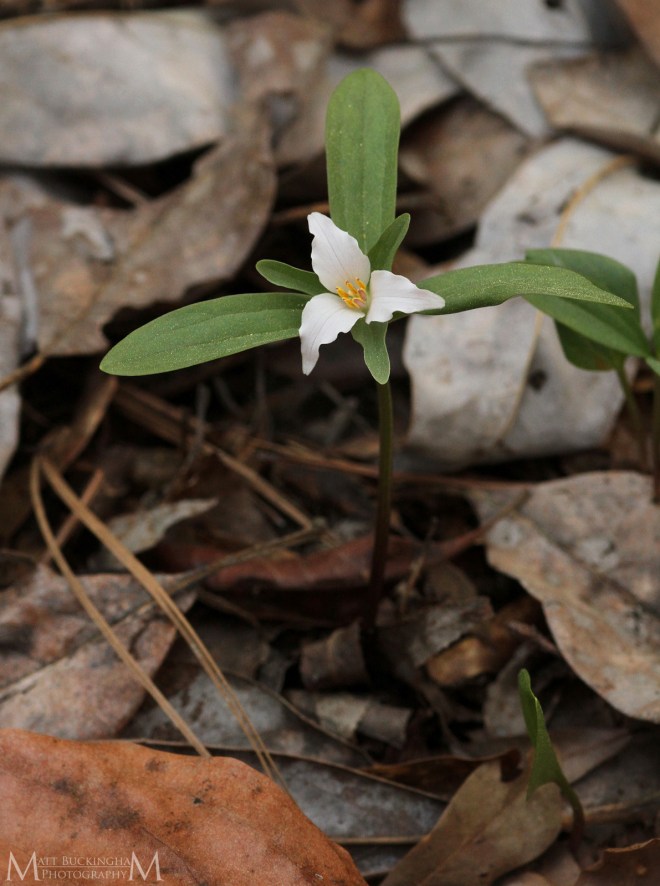
We got our chance the next spring, and visited them at their home – a log cabin that they built themselves – nestled on a high ridge overlooking a steep, scenic slope.  As we approached the house I could already begin seeing drifts of Yellow Trout Lily (Erythronium rostratum) and clumps of Sabine River Wakerobin (Trillium gracile).  After visiting for a while we set out to explore.

IMG_0530

A mesic calcareous slope on private land rich in spring ephemeral forbs that are rare in Texas. Taken in March 2016

They took us down a trail that lead away from the house.  It climbed to the top of a hill covered in Mayapple (Podphyllum peltatum), and as we crested the ridge I was not prepared for the view that lay before me.  I saw a steep slope that was literally carpeted with thousands of spring ephemeral herbs that were flowering in spectacular profusion.  Thousands of Yellow Trout Lilies and Cutleaf Toothworts (Cardamine concactenata) had opened their blooms.  Both species are rare in Texas.  The scene seemed more appropriate for the slopes of the Great Smoky or Blue Ridge Mountains than East Texas.

There was also a species growing among them that I did not immediately recognize.  It turned out to be False Rue Anemone (Enemion biternatum), and I was unsure if it had been previously documented in Texas.  After returning home that evening I sent an e-mail to Jason Singhurst, the state botanist with TPWD and began doing a little research.  It turned out to be the second documented population in the state.  Having found the only other population, Jason was anxious to get out and explore the property to document this population and see what else this wonderful land might harbor.

IMG_8085

False Rue Anemone

He got his chance a couple of days ago on a warm, rainy spring day.  Jason and a group of excellent botanists joined me on the property, and while it rained on and off throughout the day, I could not find it in me to complain about the weather.  To me, days like this are the epitome of spring in the eastern forests.  Like me, Jason and the others could not believe their eyes.  After arriving we soon located the False Rue Anemone which was blooming by the thousands.

The mesic, calcareous slopes turned out to be far more extensive than I originally thought, stretching for acres across the property.  Perhaps the most dominant spring ephemeral forb was the Yellow Trout Lily, which had sent up hundreds of thousands of leaves.  While there were several blooms they remained closed throughout the day, as they only open under warm, bright conditions.  Fortunately I was able to photograph this species at the site the previous year.  Yellow Trout Lily is rare in Texas, known only from a few high quality mesic forests.  It is one of a few yellow-flowered in Eastern North America.  It is easily differentiated by the others by its erect flowers and tepals (combination of petals and sepals) that are not reflexed.

IMG_0611

Yellow Trout Lily. Taken in March 2016

Perhaps even more rare than the Yellow Trout Lily is the Cutleaf Toothwort.  It too was blooming by the thousands here.  This rare member of the mustard family (Brassicaceae) is a typical flower of eastern deciduous forests that is only known from a few locations in Texas.  It is one of the hosts for the Falcate Orangetip (Anthocharis midea).  Though we saw many of these beautiful butterflies during our visit, they were impossible to photograph as they refused to pause while bouncing from flower to flower in their quest for nectar.

IMG_0852

Cutleaf Toothwort. Taken in March 2016

Several flowering groups of Wild Blue Phlox (Phlox divaricata) were also present.  This showy phlox is rare in Texas, where it reaches the southwestern periphery of its range.  However it can be downright abundant in the hardwood forests of the Appalachians and eastern North America.

IMG_8052

Wild Blue Phlox

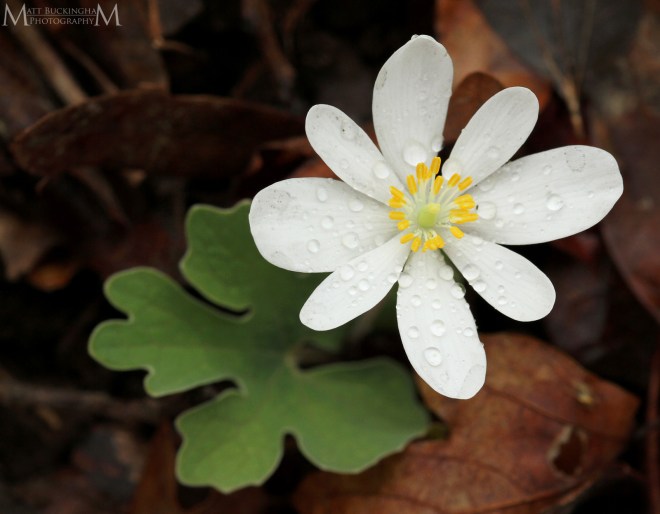
The rain presented several unique photographic opportunities.  The day must have been just warm enough for the Bloodroot (Sanguinaria canadensis) to open.  We found several of this quintessential forb of the eastern deciduous forest.  I captured this photogenic plant with fresh raindrops on the petals.  Like so many of the other plants at this site, Bloodroot is rare in Texas.  Probably never particularly common, it has suffered through more than a century of habitat destruction and over-collection for its medicinal properties.

IMG_8150

Bloodroot

Growing among the Bloodroot were several Southern Twayblade Orchids (Listera australis).  It was the only orchid species we located during our visit, but there is certainly potential for more to be out there.

IMG_0789

Southern Twayblade Orchid.  Taken in March 2016

The Sabine River Wakerobin was also up in force.  This attractive trillium is endemic to the Pineywoods of East Texas and western Louisiana.

IMG_2032

Sabine River Wakerobin.  Taken in March 2016

The understory was also full of flowering shrubs and small trees.  Perhaps the most notable were the thickets of Red Buckeye (Aescuslus pavia).  They seemed to have all bloomed in unison, and painted the understory red with their beautiful flowers.

IMG_8191

Red Buckeye

IMG_8218

Red Buckeye

The Flowering Dogwoods (Cornus florida) were also in bloom.  To me, this plant, more than other, represents the essence of spring in East Texas and eastern North America.

IMG_1986

Flowering Dogwood.  Taken in March 2016

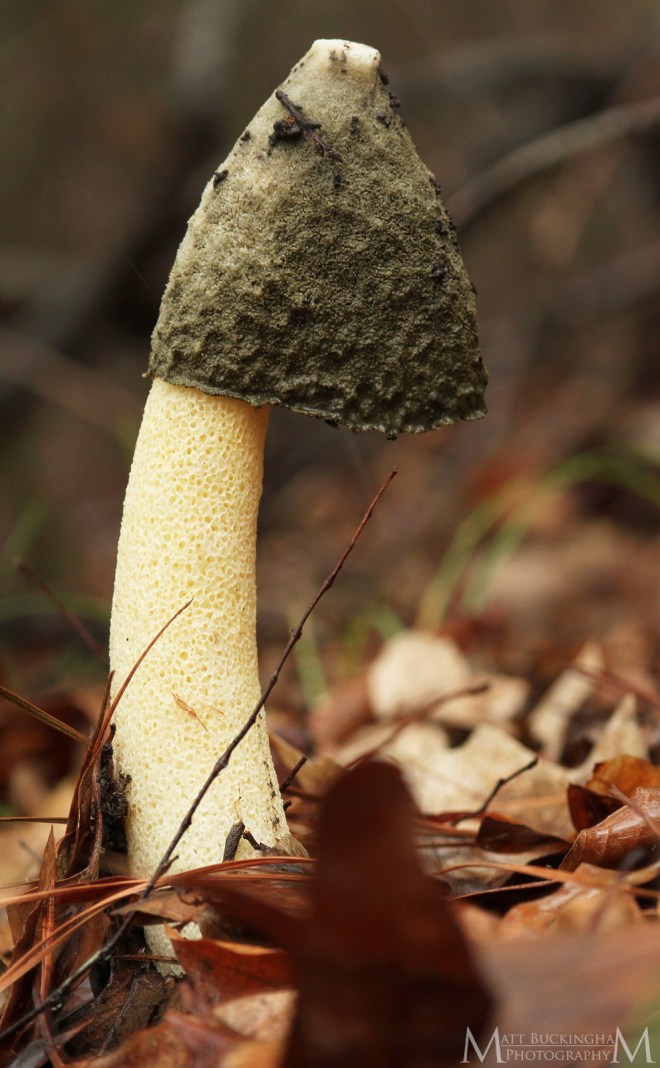
We took a break from searching for plants to admire this particularly robust Ravenel’s Stinkhorn (Phallus ravenelii) pushing up from the leaf litter.

IMG_8163

Ravenel’s Stinkhorn

There were many other rare plants that were not yet in flower including Indian Pink (Spigelia marilandica), Virginia Strawberry (Fragaria virginiana) and one species on my 2017 list: Starry Campion (Silene stellata).  The presence of these botanical treasures provided an added incentive to return, however in truth the only reason we need is the opportunity to spend a day in the woods with our good friends Susan and Viron.  After a long day, botanists and landowners parted ways content in seeing a bit of paradise nestled deep in the Pineywoods.


A Tale of Two Trillium

trillium-for-blog

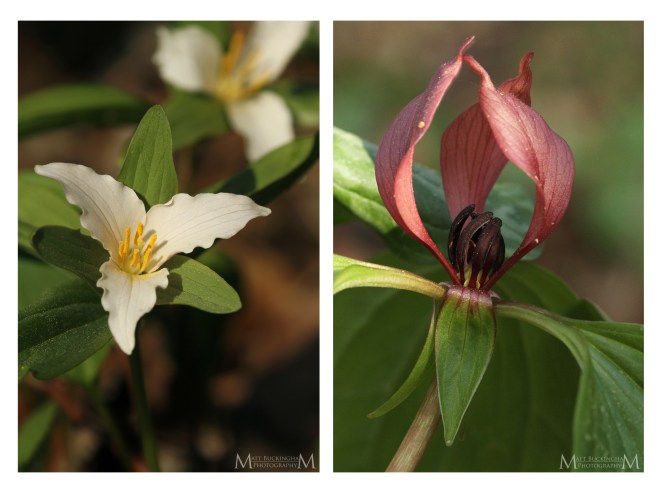
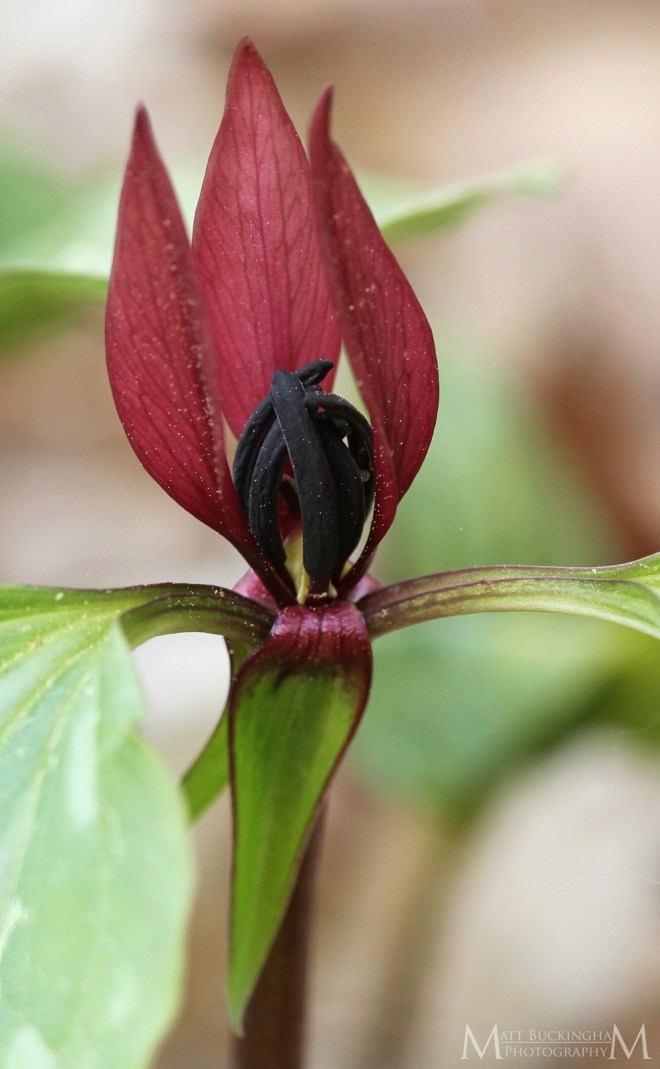
Left: Texas Trillium (Trillium texanum).  Right: Bloody Butcher (Trillium recurvatum).

This post does not include any of my 2017 biodiversity targets, however I had such a good time on a recent outing looking for two species of trillium in East Texas that I couldn’t resist posting about it.  Both species are also very rare in Texas and are certainly worthy of their own treatment in my blog.

Last Thursday was Texas Independence Day.  Working for the state I get all kinds of obscure holidays off.  Even so, I decided to go into work in the morning to rack up a few hours of comp time and left a little before lunch.  I set out in pursuit of two members of one of my favorite genera.  Their populations are within a half an hour of one another, and I figured I could visit both in an afternoon, despite my tendency to lose track of time.

img_7053

Texas Trillium

Texas Trillium (Trillium texanum) is one of the pedicillate trilliums (subgenus Trillium).  Members of this group have uniformly green bracts and flowers separated from the leaf-like bract by pedicels.  It is the only member of this group in Texas.  It was formerly considered a variety of Trillium pusillum.

trillium-texanum

County level distribution of Trillium texanum from http://www.bonap.org.  Yellow counties indicate that the species is present but rare.

Texas Trillium is extremely rare, occurring in only a few populations in East Texas and western Louisiana, though I recently heard from a botanist friend that it had been discovered in southwest Arkansas.  While other trillium species in Texas generally occur on rich, mesic slopes, Trillium texanum occurs in forested seeps, growing from permanently saturated ground amid sphagnum moss in the shade of Sweetbay Magnolia (Magnolia virginiana) and other tree species typical of these communities.

img_7096

Texas Trillium

I found thousands of plants in my short visit, however only a small fraction of them were in bloom, with most plants only put up single bracts.  The flowers were all fresh.  As they age they will gradually turn a deep shade of pink before the petals weather away.

img_7133

Texas Trillium

Growing near the Texas Trillium were several groups of Primrose-leaved Violet (Viola primulifolia).  This tiny violet is similar to Viola lanceolata but can easily be differentiated by its leaves.  It grows in similar saturated environments.

img_7164

Primrose-leaved Violet

After spending an hour or so with the Texas Trillium I was ready to move on to the next Trillium species.  As I’m driving I frequently glance on the roadside in search of any interesting plant that might catch my eye.  While travelling between the two trillium sites I glimpsed a large patch of Carolina Vetch (Vicia caroliniana), an uncommon denizen of rich forests that barely enters Texas in the eastern part of the state.

img_7181

Carolina Vetch

Trillium recurvatum has a number of common names, including Prairie Trillium and Red Trillium.  My favorite, however, is Bloody Butcher – no doubt a reference to the deep red flowers.  Bloody Butcher is one of the sessile-flowered trilliums (subgenus Phyllantherum).  These differ from the subgenus Trillium by having variously mottled bracts and sessile flowers.  Trillium recurvatum can be easily differentiated from the other sessile-flowered trillium of Texas by its petiolate bracts.

img_7255

Bloody Butcher

Trillium recurvatum is a fairly widespread species.  It is common throughout much of its range, but rare on the periphery, which includes Texas.  In contrast to the mucky seep where I found Trillum texanum, I found Trillium recurvatum growing on a rich mesic calcareous slope with a variety of mesophytic hardwoods and calciphilic forbs.

trillium-recurvatum

County level distribution for Trillium recurvatum from http://www.bonap.org.  Yellow counties indicate that the species is present but rare.

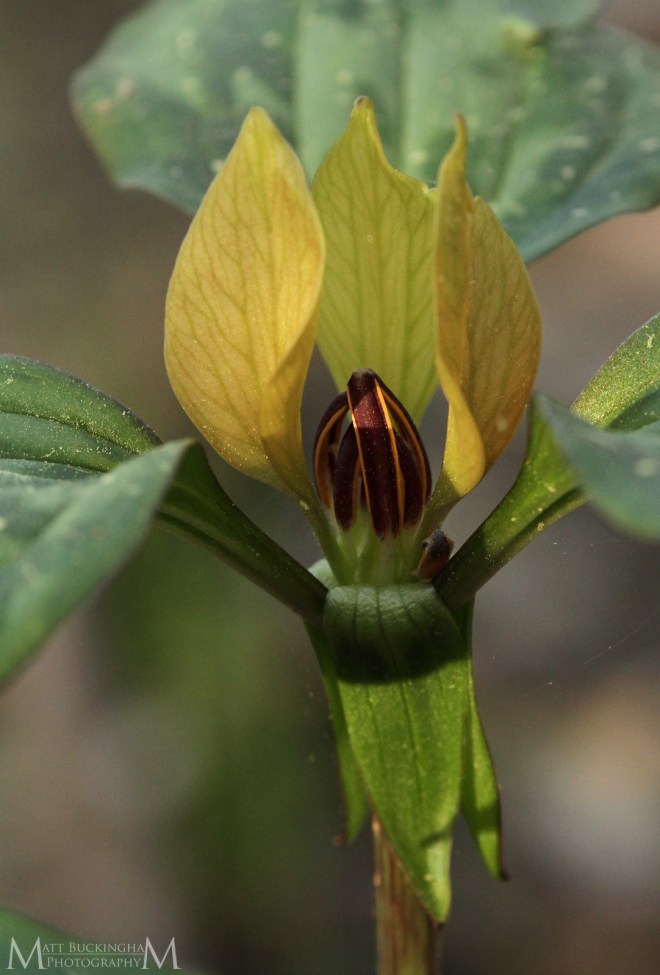
The majority of the plants I observed had deep maroon flowers, but a few were pale yellow.  In the past I have also observed individuals with lemon-yellow blooms at this site.  As is often the case with these East Texas rarities, at the few sites in the state that Trillium recurvatum does occur, it can be quite abundant.  I was fortunate enough to observe hundreds of blooms.

img_7301

Bloody Butcher with pale yellow flowers

img_7317

Bloody Butcher with pale yellow flower

Once again while driving I caught sight of an irregularity on the roadside.  This time it was not a plant, but one of our most spectacular insects: the Luna Moth (Actias luna).  Luna Moths may have as many as three generations per year in East Texas with the first emerging in early spring.  The individual pictured is a male, identifiable as such by its extremely feathery antennae.  These antennae are loaded with receptors that can detect the pheromones of a female from miles away.  They are members of the giant silk moth family (Saturnidae), and are among the largest moths in North America.

img_7214

Luna Moth

I ended the evening in the floodplain of the Attoyac River admiring a particularly expansive patch of Butterweed (Packera glabella).  The light was perfect, and I tried to capture a landscape image that showcased the beauty of these early spring wildflowers.  Growing among them were Springcress (Cardamine bulbosa) and hundreds of violets.  It was the perfect ending to a perfect afternoon.

img_7340

Butterweed in the Attoyac River floodplain


Cure-All

Target Species: Yellowroot (Xanthorhiza simplicissima)

img_7600

Yellowroot

I wasn’t sure that I’d be able to check this one off my list.  I first learned that Yellowroot occurred in Texas while looking through Geyata Ajilvsgi’s book Wildflowers of the Big Thicket.  I then saw it mentioned in a couple of scientific publications and decided to do a little research.  There are very few records from Texas, and those that exist are fairly vague as to the species’ location.  Looking at the publications I had an idea where to look, but I had no idea if the plant would be common at that location, easy to see, or when it might bloom.  I tried my best to guess the bloom time in East Texas based on the species’ phenology in other states.

A couple of weeks ago I caught a break.  While attending the Texas Black Bear Alliance meeting I was chatting with a friend that works for a large timber company who happened to be a naturalist and plant enthusiast.  He has access to hundreds of thousands of timber company lands and a penchant for exploring wild places.  I casually asked him if he has ever seen yellowroot on timber land, and he said that he had, though he hadn’t seen it in bloom.  We talked about getting out to look for it, and finally made it happen yesterday.

xanthorhiza-simplicissima

County-level distribution of Xanthorhiza simplicissima from http://www.bonap.org

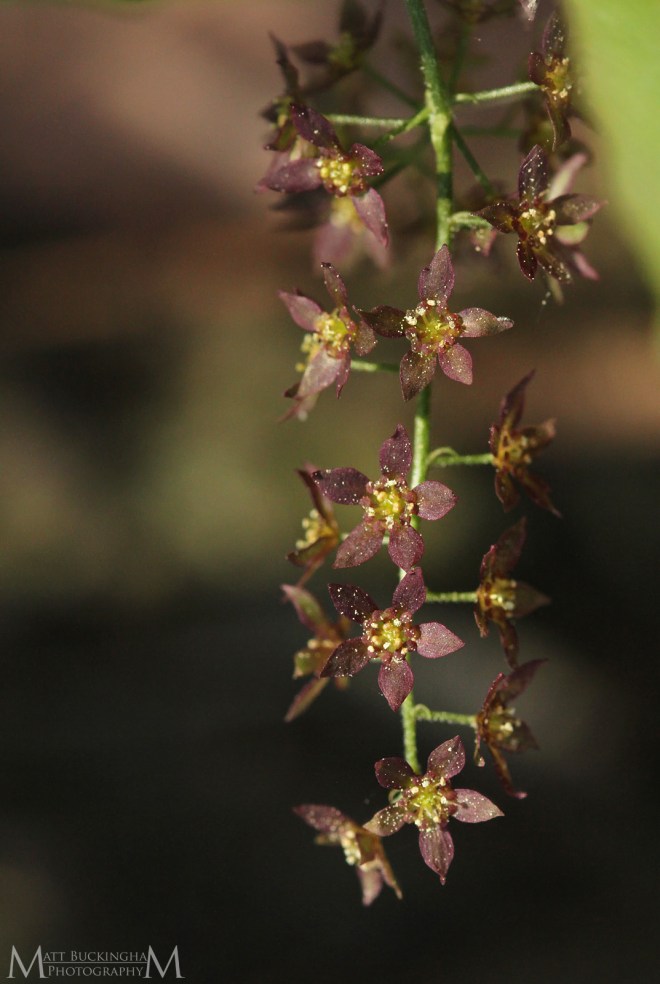
Yellowroot is a subshrub that primarily occurs in the southern Appalachians.  There is a disjunct population in East Texas and western Louisiana.  Here it is very rare, occurring at only a handful of sites.  It’s tiny flowers hang on drooping, branched panicles originating from the main stem.  It grows on the banks of small streams that wind through sandy, acidic soils.

img_7549

Yellowroot Panicles

My friend first took us to a site that I have visited before.  We were joined by another friend with a love for the outdoors.  We found many plants growing along the margins of a clear, spring fed stream just before it poured from a 20-foot waterfall.  Seeing it here, one wouldn’t expect it to be so rare in the state.  The sandy stream edge was lined with thousands of plants, many of them in full bloom.

img_4760

East Texas Waterfall.  Photographed in July, 2016.

Yellowroot is so-named for it’s bright yellow roots which contain berberine, an alkaloid with numerous medicinal properties.  Native Americans and settlers used Yellowroot as a die and as a cure for a variety of ailments.  Yellowroot tea was used to treat sores and other issues in the mouth and gums, congestion, allergies, stomach ulcers, upset stomachs, and indigestion.  Crushed roots were used in salves that treated sores, cuts, rashes and swelling.  Contemporary research has shown that Yellowroot has the potential to lower blood pressure and improve liver health and function.  Advocates of homeopathic remedies still utilize Yellowroot tea as a natural cure-all.

img_7558

Yellowroot Flowers

Perhaps these medicinal properties helped spell doom for Yellowroot populations in East Texas.  It is entirely possible that over collection, along with habitat loss contributed to its current scarcity.

The tiny flowers are really striking, though they require some magnification to appreciate.  We saw blooms ranging from brown to purple to greenish yellow.  We wandered along the creek for a while enjoying the warm spring air and cold, clean water.

img_7568

Yellowroot Flower detail

After leaving the falls we traveled to another site where we found Xanthorhiza simplicissima growing in great abundance.  This site is also home to a slew of other plants that are exceedingly rare in Texas, including Silky Camelia (Stewartia malacodendron) and Common Serviceberry (Amelanchier arborea).

img_7597

Typical Yellowroot habitat along a clear, springfed stream.

My friend has a great knowledge of East Texas culture, history, and pre-history.  He regaled us with stories of Native Americans and recent residents.  It was fitting that while in search of a plant so important to native cultures that we would find an artifact alluding to a time long ago before East Texas was colonized by Europeans.  We found this arrowhead along one of the streams we were exploring.  Not a day goes by that I don’t long to see the East Texas that the native tribes experienced.

IMG_7586.JPG

Arrowhead

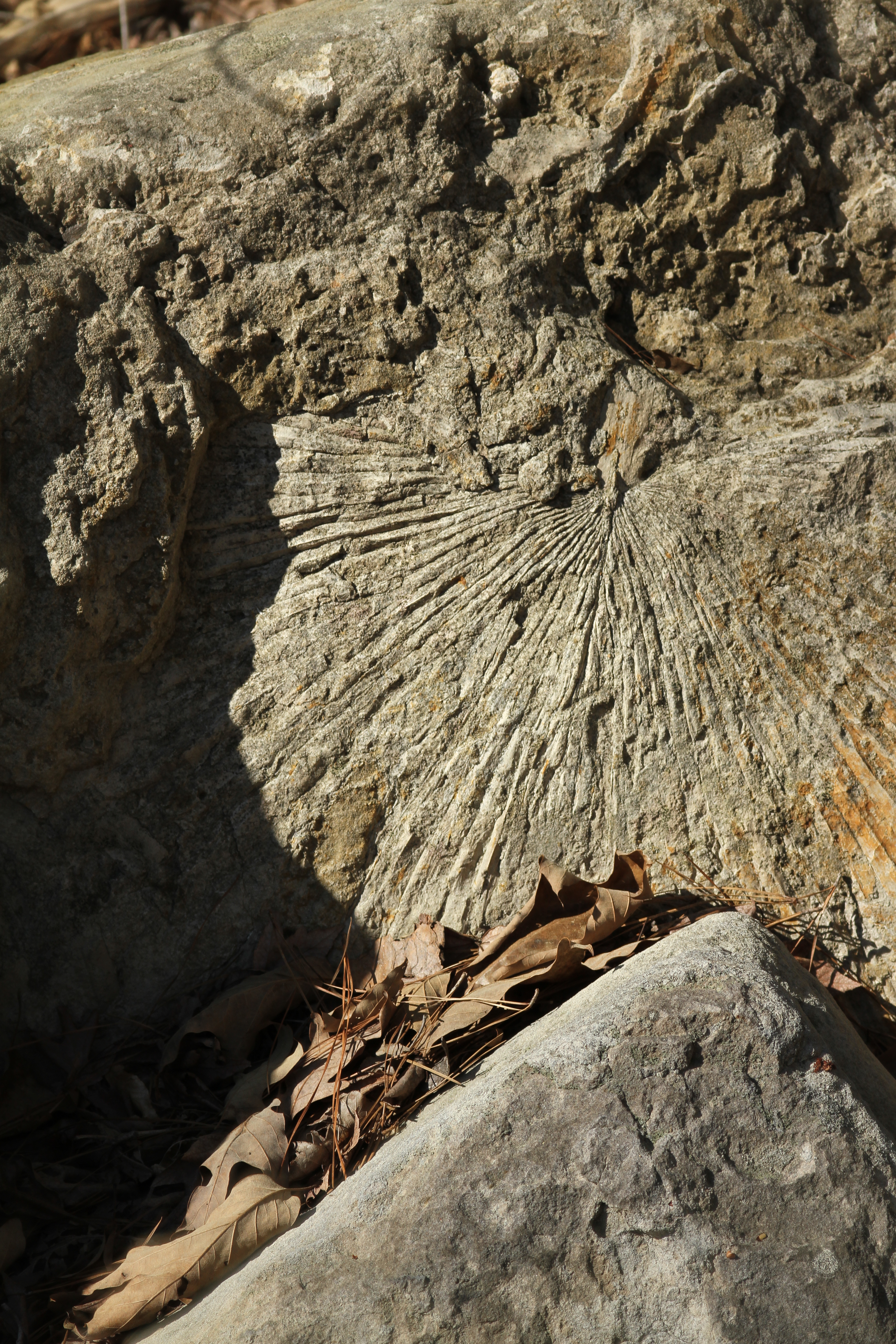
Before going our separate ways, my friend had one final surprise in store for us.  He took us to a relict dating even further back, to a time prior to human habitation, and possibly predating the speciation of Homo sapiens.  This ancient palm fossil lies on exposed boulder of the Catahoula formation.  It was a fine day spent in fine company.  I learned a lot, particularly about the history of the region.  I look forward to returning soon to find what other treasures this country is hiding.

IMG_7610.JPG

February – Chronicles of an Early Spring

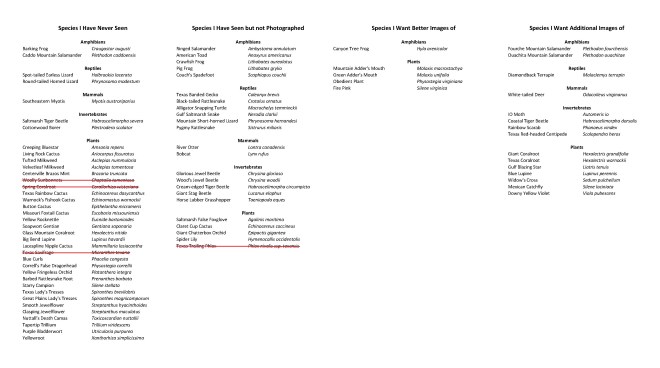
Thanks in part to an exceptionally early spring this year, I have been able to get a good start of my list, knocking off four species in February.  These species include:

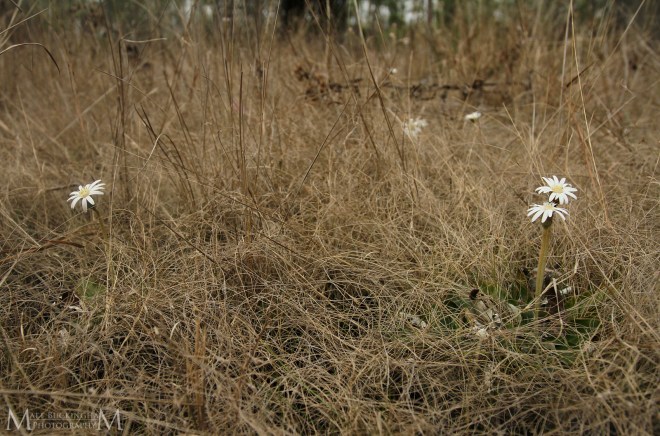
Woolly Sunbonnets (Chaptalia tomentosa)

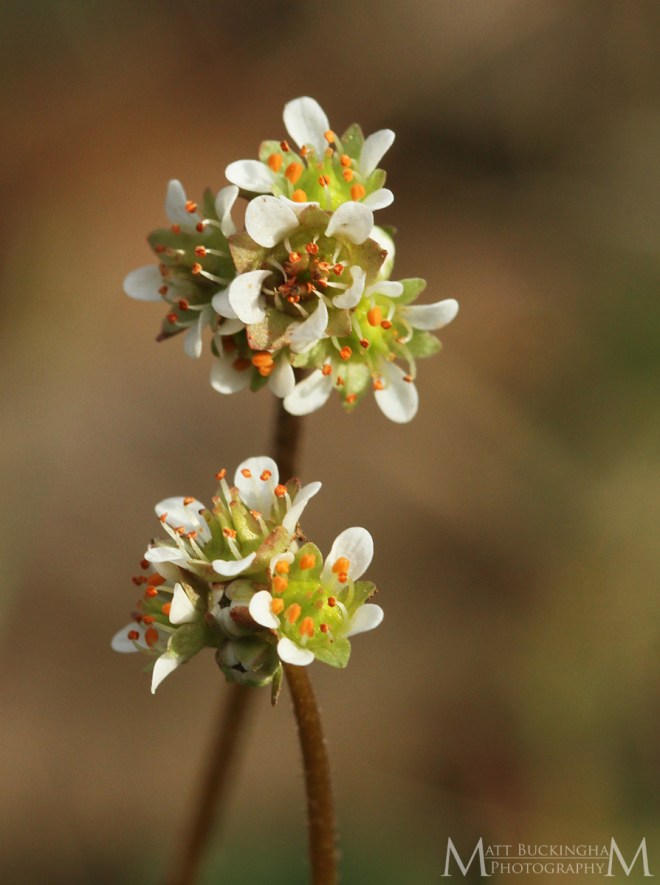
Texas Saxifrage (Micranthes texana)

Texas Trailing Phlox (Phlox nivalis ssp. texensis)

Spring Coralroot (Corallorhiza wisteriana)
2017GoalsFEb.jpg

I’m slowly making progress on my 2017 Species List

Though tracking down the species on my list has become a priority in my explorations of the natural world, I could never neglect the special places and familiar species that I have come to love over the years.  I look forward to seeing them each year, and regardless of how many photos of a given species I might have, I can never resist the urge to try and capture new details, compositions, and natural history aspects.

I spent much of early February exploring the woods with my good pal James Childress.  On one such outing we were lucky enough to find a gravid Smallmouth Salamander (Ambystoma texanum) under a log in a false bottomland.

img_4801

Smallmouth Salamander

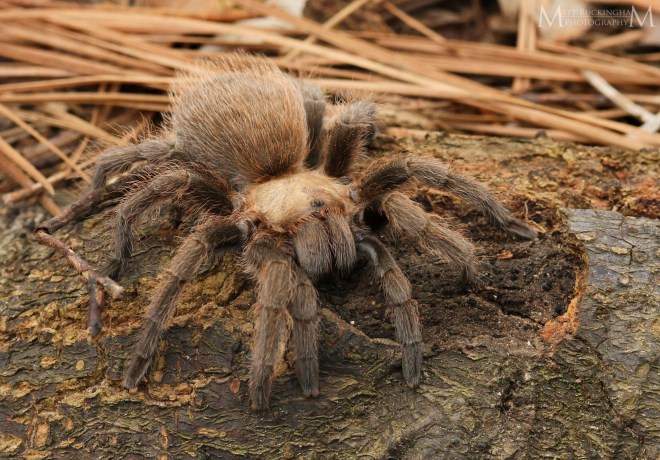
A few days later I received a text message from James that included a photo of a seldom seen sight: an East Texas tarantula.  Tarantulas are typically associated with deserts, however the Texas Brown Tarantula (Aphonopelma hentzi) ranges as far east as East Texas and western Louisiana, Arkansas, and Missouri.  It is an unexpected thing to see one in the forests of the West Gulf Coastal Plain, but here they persist, though their populations seem to be declining.  I have spoken to lifelong residents of the area who remember seeing many as children, and few to none in the past 20 years.  James found this female, identifiable as such by its large abdomen, crawling in his driveway one evening.  He was kind enough to hold onto it so that I may photograph it.  It’s only the fourth tarantula I have seen in the Pineywoods, and the only female.
img_5008

Texas Brown Tarantula

img_5021

Texas Brown Tarantula Portrait

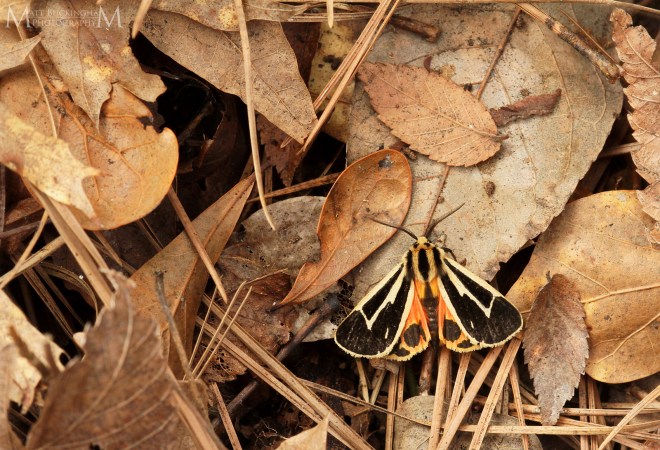
When I met James for our tarantula photo session he brought another surprise with him – a Banded Tiger Moth (Apantensis vittata) that had been attracted to his garage lights.  This boldly patterned moth is equipped with bright hindwings that it will flash in an attempt to intimidate a potential predator.
img_5082

Banded Tiger Moth

After admiring these invertebrates we went on to visit a rich mesic stream bottom that supports a variety of spring ephemeral herbs.  Representing what is essentially the southwestern limit of the range of eastern deciduous forests, East Texas is on the periphery of the range of a suite of spring ephemerals.  Spring ephemerals as a group are adapted to deciduous, hardwood forests, where they can carry out the majority of their life cycle in the early spring, when an abundance of sunlight reaches the forest floor prior to leafout of the canopy.  Species are generally less common on the periphery of their range.  As a result of this coupled with habitat loss over the past century and a half, several of these species have become rare in East Texas.  These eastern forest elements are perhaps my favorite part of the Pineywoods.

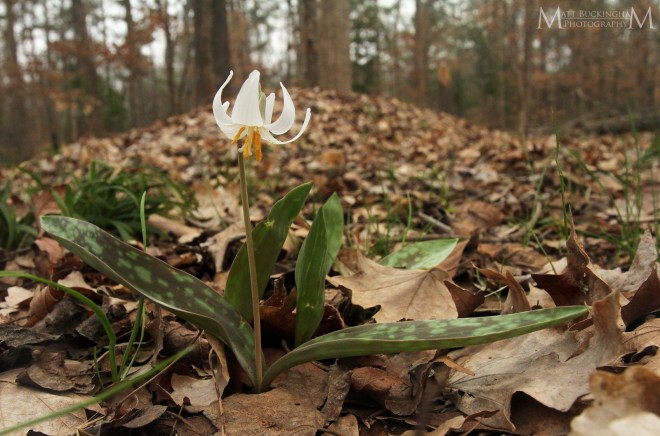
The White Trout Lily (Erytrhonium albidum) is one such spring ephemeral.  It’s leaves begin to emerge by early February and are mostly gone by late April.  Members of the genus Erythronium are known as trout lilies in the eastern U.S. due to the resemblance of their leaves to the skin of the brook trout.  In the western U.S. they are often known as fawn lilies, as the leaves look like the spotted pelage of young fawns.  In Europe, they are usually referred to as dogtooth violets, a reference to the shape of the underground bulb.  Erythronium albidum is rare in the Pineywoods, with larger populations in the Post Oak Savannah and Dallas region.
img_5117

White Trout Lily

One of my all-time favorite flowers is the Bloodroot (Sanguinaria canadensis).  Another characteristic spring ephemeral of the eastern deciduous forests, it too is rare in Texas.  In a typical year I can expect to see Bloodroot blooming at this site around February 20.  This year many were already in fruit on February 10.  Bloodroot is named for the thick red sap that oozes from it’s root when injured.  This sap has a myriad of health benefits, and its abrasive nature makes it a good ingredient in toothpaste.  These desirable properties have likely led to over collection of this species, adding to its rarity in the state.

img_5229

Bloodroot

One of the more difficult to spot spring ephemerals is the Southern Twayblade Orchid (Listera australis).  It’s tiny brown stems and flowers are practically invisible against the leaf litter.  They are only betrayed by two green leaves near the base of the stem.

img_5250

Southern Twayblade Orchid

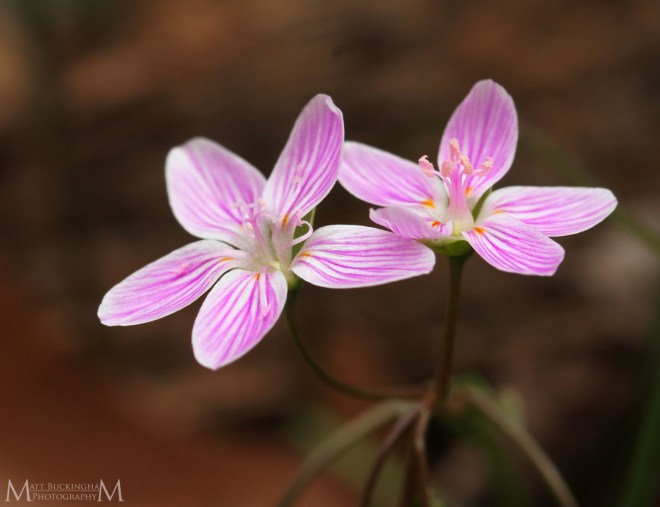
Spring Beauty (Claytonia virginica) is an abundant spring ephemeral throughout much of East Texas.  Though it is easiest to find on lawns and other cleared areas, I prefer to photograph the individuals deep in the forest, where they are less commonly seen.
img_5178

Spring Beauty

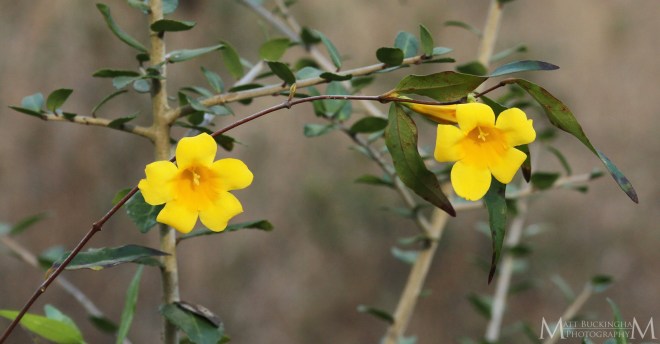
Carolina Jessamine (Gelsemium sempervirens) is a common woody vine of the southeastern U.S.  It slowly works its way from the ground to the canopy, and in early spring it paints the forest yellow with its large, tubular flowers.
img_5604

Carolina Jessamine

It is interesting just how many species have Carolina in their common name, or some variation of it in their specific epithet.  The reason is because many species native to the eastern U.S. were initially described in the far east, including the Carolinas.  Virginia also frequently occurs in taxonomic vernacular.  I take it as a good sign that my wife lends her name to so many pretty things.

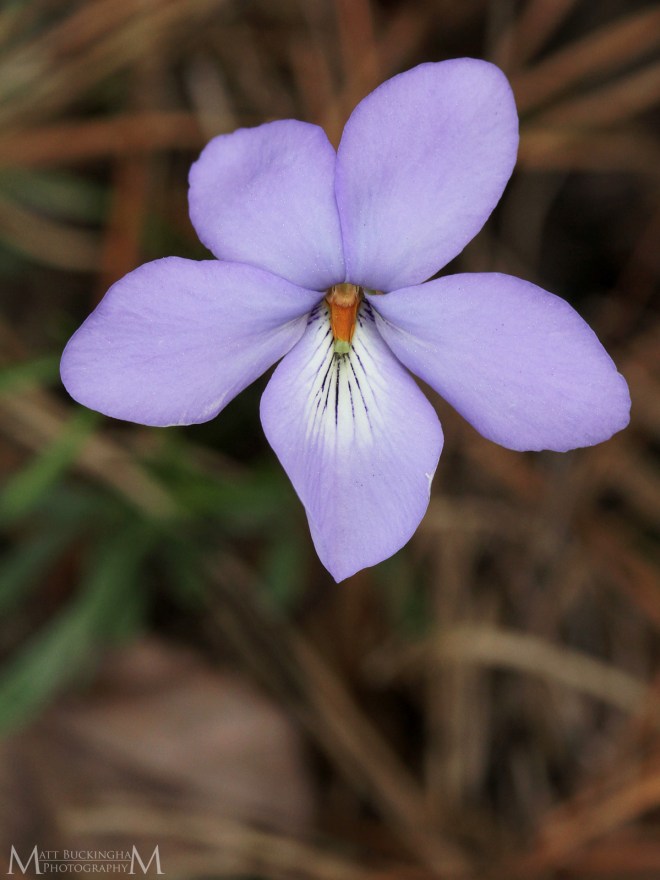
Last Sunday Carolina and I had a very productive outing chasing after spring ephemerals in Deep East Texas.  We covered a lot of ground and saw a lot of species.  One of the most striking was the Birdfoot Violet (Viola pedata), named for its leaves which bear a superficial resemblance to bird’s feet.  These are our largest violets, easily twice the size of the more common species.  It occurs in scattered populations in East Texas, where it favors open dry mesic mixed pine-hardwood forests.
img_6730

Birdfoot Violet

The Wood Violet (Viola palmata) prefers slightly moister sites with a greater hardwood element.  With a few exceptions (Birdfoot Violet being one of them) the flowers of East Texas’s violets are difficult to differentiate.  Wood violet is identified by its deeply lobed leaves.

img_6787

Wood Violet

Violet Woodsorrel (Oxalis violacea) was also blooming.  This native is often mistaken for the much more common Pink Woodsorrel (Oxalis debilis), a native of South America.

img_6743

Violet Woodsorrel

The occurrence of the Louisiana Wakerobin (Trillium ludovicianum) in Texas was only recently discovered, as botanists closely examined a group of unusual-looking sessile-flowered Trillium.  They had long been masquerading as the Sabine River Wakerobin (Trillium gracile).  Differentiating the two species is a painstaking task that requires close examination of the flowers.

img_6812

Louisiana Wakerobins

Trilliums are classic spring ephemeral flowers that occur in rich woods across much of the country.  Their center of diversity, however, is in the eastern deciduous forests.  Trillium ludovicianum occurs on rich mesic slopes dominated by American Beech and other hardwoods.  Since its discovery in Texas, the Louisiana Wakerobin has only been found at a handful of sites.

img_6818

Louisiana Wakerobin

img_6890

Louisiana Wakerobin

While exploring the rich woods I stumbled upon this scene, and could not resist.  The perfect clump of trillium with the similarily rare Wild Blue Phlox (Phlox divaricata) in the background represents to me, what is most magical about spring – exploring rich forests in search of ephemeral forbs and other interesting things that are awakening following a long period of dormancy.  To me, the forest feels most alive in the springtime, and so do I.  This shot ended up being one of my favorites from 2017 thusfar.

img_6838

Rich mesic forest with Trillium ludovicianum and Phlox divaricata

This site is also one of the few areas where Wild Blue Phlox can be found in Texas.  It too is a typical denizen of the rich eastern deciduous forests that reaches the southwestern extent of its range in East Texas.  And like so many of the previously mentioned species it is rare here.

img_6822

Though one might not think it so if they were to visit this particular spot, where it blooms in spectacular profusion on the banks of a clear East Texas stream.

img_6930

Flowering trees are at their peak this time of year, and many species are beginning to decorate the understory with splashes of white and pink.  Pictured below is one of the hawthorns (Crataegus sp.).  Though habitat gives some clue, identification to species is difficult without the leaves present.

img_6949

Hawthorn in Bloom

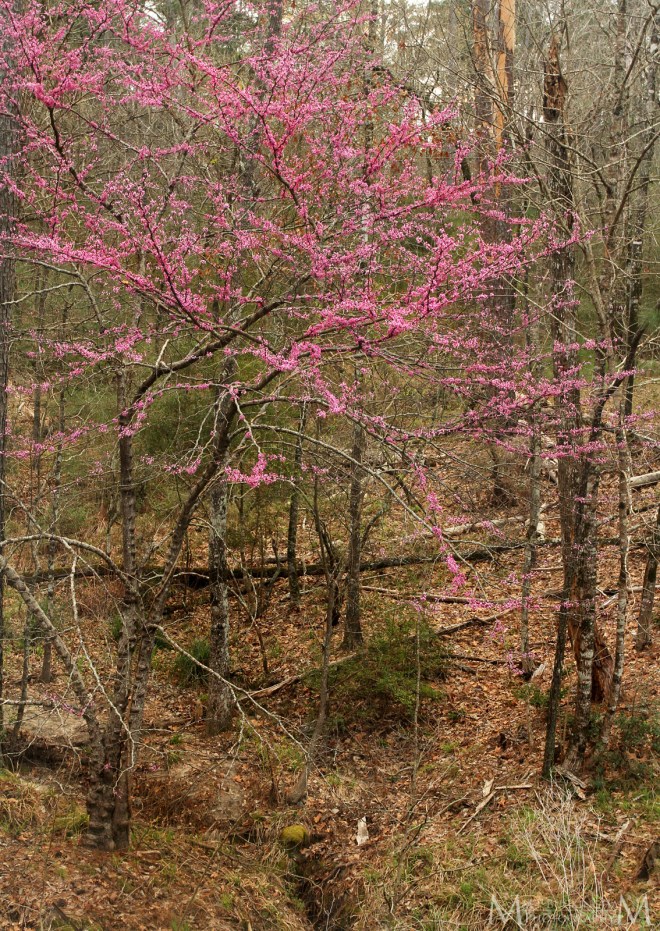
Near the hawthorn, Carolina and I stopped a moment to admire this beautiful redbud along a small ephemeral stream.  Though it was getting late and the day was growing dim, the pink blossoms of the Eastern Redbud (Cercis canadensis) brightened the woods around us.
img_6971

Eastern Redbud

I spent February busily pursuing plants, but I have not neglected the other taxa of my list.  Carolina and I continue to visit the local otter population on a weekly basis.  Though we have not yet seen them, Carolina’s remote camera captured some incredible video of a male scent marking.  Unfortunately I’m unable to upload it here, but I will leave you with the following image, otter tracks along a stream near the Trillium ludovicianum and Phlox divaricata site.  Though I have yet to capture one on camera, the elusive river wolf continues to make its presence known.

img_6941

American River Otter Tracks


Gem of the Pinewoods

Target Species: Texas Trailing Phlox (Phlox nivalis ssp. texensis)

img_6126

The Federally Endangered Texas Trailing Phlox (Phlox nivalis ssp. texensis)

The day broke to a bleak, gray scene.  Dense clouds blotted the sun and a gentle spring rain had begun to fall.  It was not exactly the scene I was hoping to wake to, as I was planning to stop to look for one of my 2017 targets on the way down to visit my parents in Houston.  But it was hard to be disappointed.  Despite the problems they pose to photography, these are my favorite kind of spring days.  Warm and gray, they gift a cool, nourishing rain to the earth – one that the plants will no doubt make good use of in the days to come.  Despite the dreary conditions, we were not deterred.  Carolina and I packed up and began heading south.  The further south we traveled the lighter the sky became until slivers of sun began to filter through the gray.

phlox-nivalis

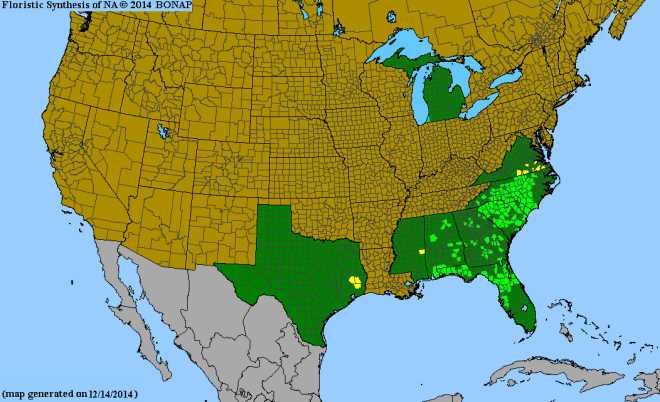
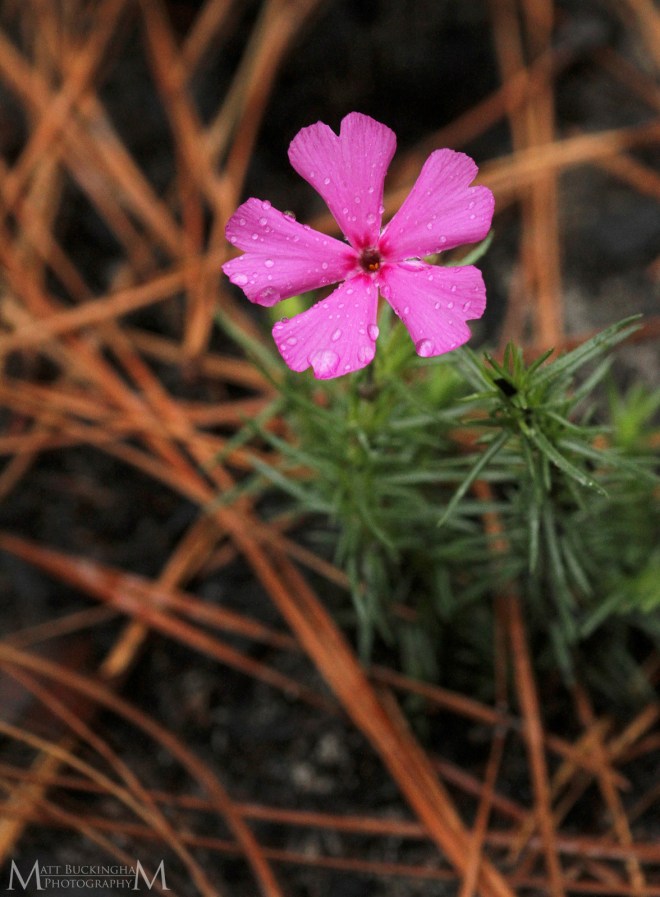
To me, including this beautiful little phlox in my 2017 biodiversity goals was a no brainer.  Though I had seen the plant before, I had never seen it in bloom.  Phlox nivalis is primarily a species of the Eastern Gulf Coastal Plain, where it can be relatively common in some areas.  The disjunct population in Texas, however is anything but.  Recognized as a subspecies of the broader ranging Phlox nivalis, Texas Trailing Phlox occurs in only three counties, where it is known from only a couple of sites.  Here it can be found on deep sands in longleaf pine savannahs and certain open longleaf pine-hardwood forests.  It is evergreen and fire-dependent.  Though the above ground portion of the plant may be scorched by a passing fire, the plants thrive from the flames’ affect on opening the understory and providing rich nutrients to the soil.  This plant is so rare and its habitat in such peril that it has been listed as Endangered under the Endangered Species Act by the U.S. Fish and Wildlife Service.

img_6191

Texas Trailing Phlox Flower Detail

We stopped first at one of the very few remaining extant natural populations.  I did not know what to expect in terms of phenology for this species, other than accounts that I read claiming they bloom primarily in March and April.  With everything being so early this year, I was 50/50 as to whether or not there might be a few blooms. We had reached the population, which is located within the Big Thicket National Preserve.  Though the leaves are distinctive, when not in bloom the plants themselves can be very difficult to detect.  We spent several minutes scouring the area to no avail, until I finally caught sight of a few bright pink blooms.  After regaining my composure I excitedly began photographing them, a task made difficult by the fluctuating light conditions and sporadic wind gusts.  In all I counted 6 plants in the area, only 2 of which were in bloom.  Another was in early bud.

After admiring the natural population, we set out to explore an area within the National Preserve where the phlox had been reintroduced.  By now it had began to rain again, and the air was filled with the fresh, rejuvenating scent of the woods on a wet spring day.  The reintroduction site was large.  It consisted of at least a couple of acres, where we counted hundreds of plants.  Though only a few were in flower, I left feeling very satisfied that the efforts by the U.S. Fish and Wildlife Service, National Park Service and other conservation groups was paying off, helping to save this Endangered Species from the brink.

img_6284

Texas Trailing Phlox.  Note the needle-like evergreen leaves.

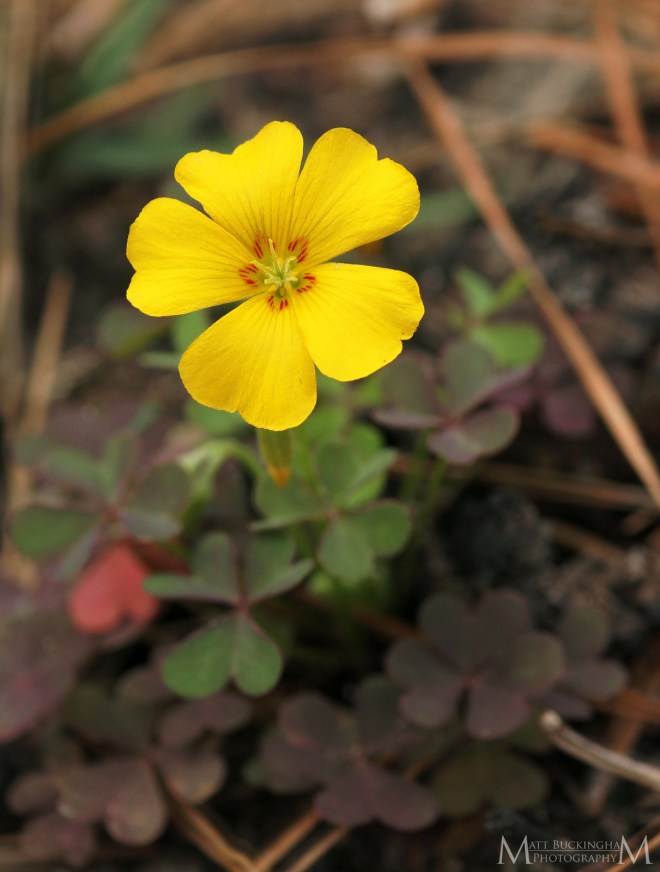
Texas Trailing Phlox is only a small part of these interesting communities.  We observed many other natural wonders during our afternoon in the Big Thicket, including Texas Woodsorrel (Oxalis texana) which occurs in sandy woodlands primarily in Texas, Louisiana, and Arkansas, with a rare, disjunct populations in Alabama and Florida.  The bright yellow flowers of Oxalis texana are very large compared to other woodsorrels, and are decorated with red lines near the center of the corolla.

img_6206

Texas Woodsorrel

img_6209

Texas Woodsorrel

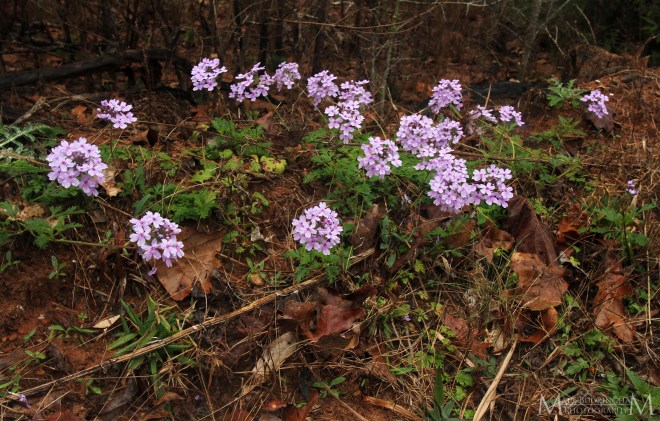
A habit I am trying to break myself of is my tendency to pass over the most common botanical subjects.  Take Rose Mock Vervain (Glandularia canadensis) for example.  In the spring it is one of the most abundant wildflowers along forest roadways in East Texas.  I suppose that for this reason I take it for granted and never really took the opportunity to photograph it.  However this day I could not ignore the many clumps scattered about recently burned patches within the longleaf pine savannahs.  Here they literally seems to be rising from the ashes.

IMG_6236.jpg

Rose Mock Vervain

While exploring an open spot within the forest that I thought might harbor some interesting flora, I heard my wife excitedly call out for me to come to her, quick.  As usual her keen eyes found an incredible sight.  A mating pair of Pipevine Swallowtails (Battus philenor) in one of the patches of Glandularia.  Rightfully thinking that this find would be hard to top, we decided to call it a day and continue our trip south to spend some time with family.  Yet I must confess, that as soon as the longleaf pines disappeared in my rearview mirror, I was already contemplating the next species on my list.

img_6267

Copulating Pipevine Swallowtails

Beauty in the Barrens

Target Species: Texas Saxifrage (Micranthes texana)

img_5861

Texas Saxifrage

Some reading this may wonder why I chose to include this tiny, not particularly showy flower on my 2017 species list.  I have always been fascinated with rare, unique ecological communities and the flora and fauna that reside in them.  The Texas Saxifrage grows in some particularly unique communities.  It tends to prefer places with harsh soil conditions that create an environment where most plants would struggle to survive.  By utilizing these habitats it helps avoid competition from other plant species that would try to monopolize its resources.  In the Pineywoods of East Texas it has been recorded in two particularly interesting communities: Catahoula Barrens and Weches Glades.

img_5901

Texas Saxifrage

I set out to find this species alone.  And while I missed Carolina’s company, I treasure alone time in nature.  It is far and away the best way for me to clear my head and put things in perspective.  On a warm, mostly sunny February day I set out to an extensive Catahoula Barren less than an hour from home.  Catahoula Barrens were probably never abundant on the landscape.  They occur on coarse, shallow soils over the Catahoula formation.  These soils are acidic, and often high in aluminum content.  Taken together these conditions are not favorable for tree growth.  That is not to say, however, that trees do not occur here.  Widely scattered Longleaf Pines, and Bluejack and Blackjack Oaks can be found as stunted, gnarled versions of their counterparts elsewhere.  An old growth Longleaf Pine here, for example, may be little more than 10 inches across and thirty feet tall.

img_3613

Typical Catahoula Barren.  I captured this image in July, 2016.

Catahoula Barrens are home to a rich, diverse flora that is not observed anywhere else in East Texas.  Many of these species are globally rare, and others are rare in the state.  Typical species include Nuttall’s Rayless Goldenrod (Bigelowia nuttallii), Yellow Hedge-Hyssop (Gratiola flava), Least Daisy (Chaetopappa asteroids), San Saba Pinweed (Lechea san-sabeana), Maryland Milkwort (Polygala mariana), Smooth Phacelia (Phacelia glabra), Barbara’s Buttons (Marshallia caespitosa), Sunbright (Phemeranthus parviflorus) and Blazing Star (Liatris mucronata).  Rare species found here include Texas Sunnybells (Schoenolirion wrightii), Navasota Fox Glove (Agalinis navasotensis), Gulf Blazing Star (Liatris tenuis), and Texas Saxifrage.

img_5765

Texas Saxifrage

I had visited this Catahoula Boulder many times in the past, but never so early in the year.  I worried that these miniscule plants would be elusive, however it didn’t take me long to find them among the dried grasses and fallen oak leaves.  Though tiny, I find the flowers of Micranthes texana to be quite beautiful.  Their tiny size, however makes photographing them a real challenge.  The slightest breeze makes focusing on the anthers, a standard practice of wildflower photography, almost impossible.

img_5932

Texas Saxifrage

After spending some time with this remarkable plant, I set out to see what else might be blooming in the barrens.  As one might expect so early in the year, blooms were sparse, however I was able to locate a few other wildflowers in the area.  I observed several Carolina Anemone (Anemone caroliniana) blooms on the barren’s margins.

img_5969

Carolina Anemone

Yellow Hedge-Hyssop is endemic to eastern Texas and extreme western Louisiana.  This tiny plant is scarcely 3 inches tall, and if it weren’t for its propensity to grow on exposed Catahoula boulders, it would be all but invisible.

img_6001

Yellow Hedge-Hyssop

After spending the afternoon in the barren I ventured over to the adjacent longleaf pine savannah.  Here I sat and watched a colony of Texas Leafcutter Ants (Atta texana) busily tending to their maze of subterranean tunnels and chambers, and harvesting bits of leaves by the thousands.  They do not actually consume the leaves, but rather store them in an underground chamber to cultivate a fungus that will feed the colony.  I have always been fascinated with these invertebrates, and usually try my luck at photographing them every year.  It is a challenge, but the results can be extremely rewarding.

img_6042

Texas Leafcutter Ant

With another 2017 target under my belt, I left the woods to return to civilization, if only to plan and ponder my next opportunity to escape it.


Fun in the Sun

Target Species: Woolly Sunbonnets (Chaptalia tomentosa)

img_5379

Woolly Sunbonnets in a Wetland Pine Savannah

Spring came early this year, with many wildflowers blooming as much as three weeks earlier than in an average year.  It has made planning botanical outings to find species on my 2017 target list a challenge.  Fortunately I had some help with Chaptalia tomentosa, the first species that I would check off the list.  Someone on a Facebook group I moderate (Texas Flora) posted an image of one looking for help identifying it.

chaptalia-tomentosa

County Level Distribution of Chaptalia tomentosa from http://www.bonap.org

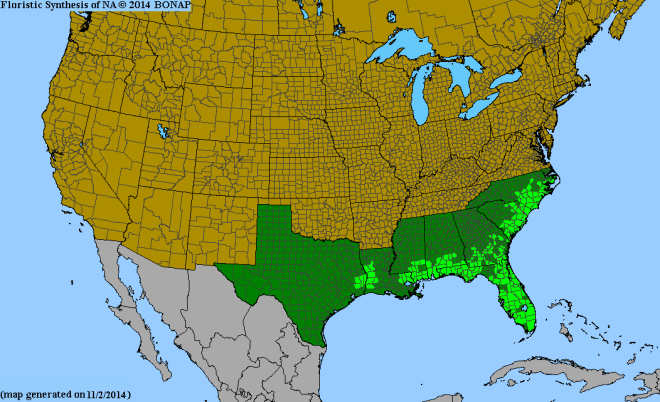
Woolly sunbonnets is a species of the coastal plain, ranging from North Carolina to extreme eastern Texas.  It occurs in herbaceous seeps and wetland savannahs where highly acidic soil remains perpetually saturated.  These communities are typically associated with longleaf pine uplands.  In East Texas longleaf pine typically occurs on sands of moderate depth.  Rainfall quickly percolates through the coarse sand, however if, on its journey through the soil, it encounters a dense clay layer, it will sit or gently flow, as clays are much more difficult to pass through.  Where these clay layers meet the surface, the water may pool or seep out forming a unique vegetative community.  The movement of water through these areas leaches essential nutrients and organic material tends to accumulate over time.  These harsh, damp habitats are home to interesting species including a variety of carnivorous plants and orchids.

img_5360

Woolly Sunbonnet

I have spent considerable time exploring wetland pine savannahs and forested seeps in East Texas, but never in the early spring.  Spurred by the image posted on Facebook my wife, Carolina, and I visited some locations of specimen records and other areas that I knew had suitable habitat.  I am lucky to have such a great adventuring companion.  Carolina not only makes for great company, she also has excellent eyes and spots my targets more frequently than I do.

img_5282

Woolly Sunbonnets

Also known as the Pineland Daisy, Chaptalia tomentosa is a member of the sunflower family (Asteraceae).  The white blooms open midday under warm, bright conditions.  This is an adaptation shared by many plants in order to maximize exposure to potential pollinators.  At night and on cool days when most pollinators are not active, the flowers close in order to protect the pollen and the plants’ sexual structures.  We were lucky to find many open flowers on our outing, and mostly cloudy skies made for ideal photographic conditions.

img_5576

Woolly Sunbonnets

Chaptalia tomentosa was not the only species active in the bog.  Fresh spring pitchers of the Pale Pitcher Plant (Sarracenia alata) were beginning to emerge and the unmistakable red rosettes of sundews (Drosera spp.) covered the ground.  One particularly quirky plant, the Small Butterwort (Pinguicula pumila) was blooming alongside the sunbonnets.  This tiny carnivorous plant has concave leaves lined with hairs coated in sticky enzymes.  When an unsuspecting ant or other small invertebrate comes into contact with the enzymes they find themselves stuck as the leaf envelopes them like a hot dog bun.

img_5551

Small Butterwort

White Bog Violets (Viola lanceolata) were also blooming.  This attractive little flowers are common in areas with saturated soil.

img_5472

White Bog Violet

While walking through one of the wetland pine savannahs Carolina called out that she had spotted a frog.  Sure enough, at least 50 feet away was a Green Tree Frog (Hyla cinerea).  Resting on the bleak winter vegetation, it stuck out like a sore thumb.

img_5499

Green Tree Frog

After an eventful day photographing vernal bog flora Carolina and I ventured to the adjacent longleaf pine uplands to enjoy the sun’s final rays and the day’s retreat into night.  There is something about a high quality longleaf pine forest and its associated seepage communities that provide me with a feeling of wonder and excitement that is sought after yet elusive for so many.  As the light faded away we returned home, content in a day spent in some of our state’s most biodiverse habitats.

img_5612

Longleaf Pine Savannah