
2024 was a significant year for my little family. In February I embarked on a new chapter when I started a position with the U.S. Fish and Wildlife Service working with protected species in east Texas and beyond. It was a really hard decision to leave the Texas Department of Transportation. I really came to love my little team of biologists, and that job brought me more joy than I ever thought it would. But it was the right move for my career and my family, and the new position has been fantastic. In 2024 we were also able to bring our son to Argentina to meet my wife’s side of the family for the first time. It was truly a gift to watch him interact with his abuelos, tios, y primos. While there, we were also able to experience wild places and biodiversity, and I managed to sneak in some photography that resulted in dozens of images I was really happy with.
This past year was especially productive photography wise. I started the year focusing on common native plants close to home, capturing species that I normally might overlook. This resulted in several images I really liked, but none made this short list. I spent most of the summer and early fall focusing on native pollinators and the biodiversity of insects and arachnids in our native garden and a variety of wild places nearby. This was a really fun project for me, and I managed to photograph dozens of new species, many of which I had no idea existed until I tried identifying them from the photos. Some of these images did make this list, including a number that I have not yet shared to social media.
I capped of the year with our family trip to Argentina, where I reconnected with family and with wildlife and landscapes that I hadn’t seen in over 10 years. It felt great to be back, and I created so many images I was incredibly happy with that it was hard to narrow them down to just a few. I came back a couple of weeks before the rest of my family, and took the opportunity to spend some time camping along and photographing the white-tailed deer rut in northern Texas. It was perhaps my most productive year yet photographing whitetails, which I think it’s safe to say have become my favorite photographic subject.
I hope you enjoy viewing the 24 images below, presented in chronological order, as much as I enjoyed capturing them. Every year I am more and more inspired by the natural world. There is so much beauty, diversity, and fascination to be found by those willing to explore it.
Please note that the blog initially shows images brighter and less contrasty than they are. To see the best version of each image, hover your cursor above them for about a second.
Moral Support
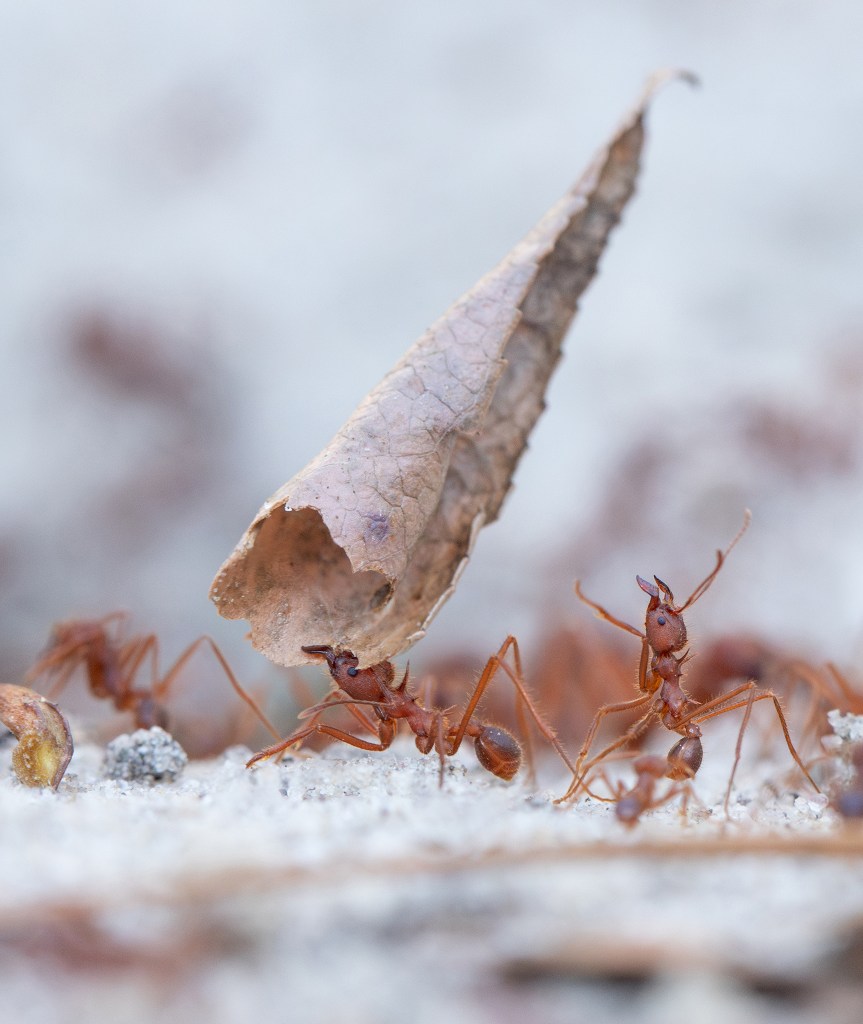
January 1, 2024 found us in an east Texas longleaf pine forest. Each year I try to make a few images of Texas leafcutter ants (Atta texana). I just think they’re so cool looking, and they have fascinating life histories! It’s so much fun to observe them as they cut leaves and haul them across the forest floor to the entrances of their colonies. Here, an ant hauls a leaf much larger than itself to fuel the underground fungus garden that will feed its colony. To me, it looks like the second ant is acting as a safeguard, ready to catch the payload should it fall backwards. In actuality I believe this ant may have been in a defensive posture, perhaps in response to my presence. Head up and mandibles open it seemed ready to defend this precious cargo.
Green Ghost

In April we found this rough green snake (Opheodrys aestivus) in one of our favorite local green spaces. These colorful creatures may be encountered on the ground or in trees, where they tend to blend in with the spring forest and even sway as they move as does a branch or a leaf in the wind.
Swamp Candle

Spring and early summer songbird photography wasn’t a big priority for me this year. I embarked on just a couple of outings with these subjects in mind, and fortunately one paid off where I managed to capture this beautiful male Prothonotary Warbler (Protonotaria citrea) as he moved about the red maples lining the margins of a cypress swale in the Big Thicket.
Irisscape

Not far from where I photographed the above warbler I spotted several zigzag iris (Iris brevicaulis) in bloom. They were growing in a wet swale within some oak flatwoods. I really like these types of images that showcase native plants in their habitat, but pass on the opportunity to create them far too often. I’m glad I stopped and spent a few moments photographing this scene so I can transport myself back to that lovely spring day, when the irises were blooming and the Prothonotary Warblers were singing.
New Hope
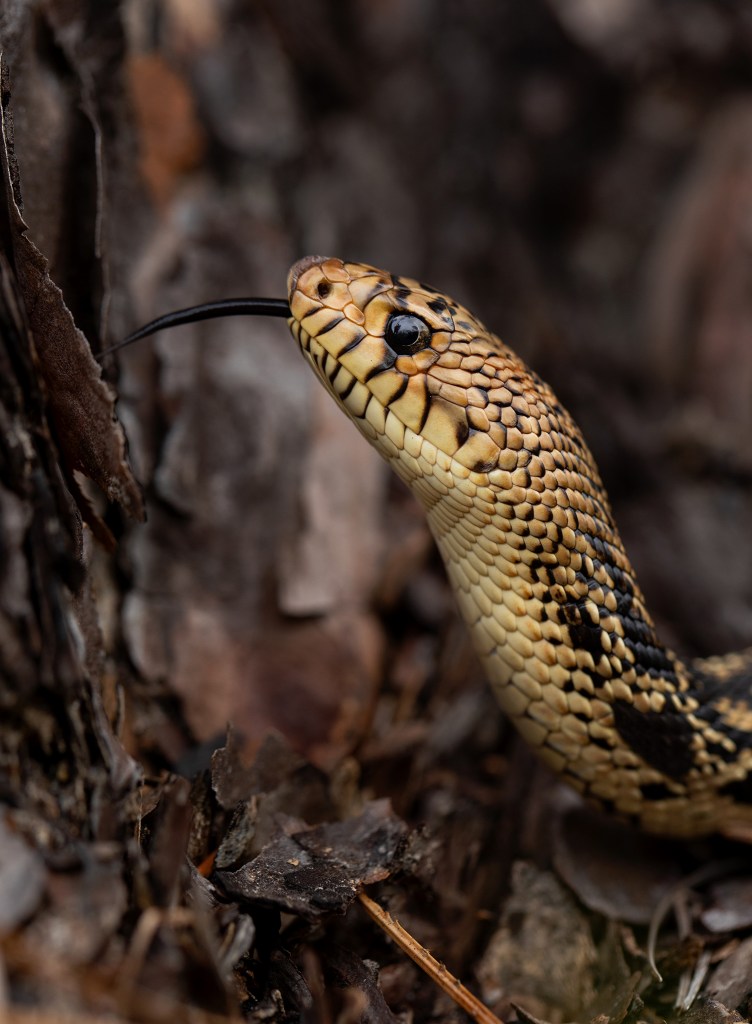
In May I was fortunate enough to participate in an incredible conservation effort – the release of captive bred Louisiana pine snakes (Pituophis ruthveni) back into their native range in the longleaf uplands of the Kisatchie National Forest in Louisiana. This release was part of an on going effort between various zoos, the U.S. Forest Service, and the U.S. Fish and Wildlife Service. The snakes we released this day were hatched and reared at the Fort Worth Zoo. Louisiana pine snakes historically ranged in sandy uplands of the West Gulf Coastal Plain from central Louisiana to east Texas. They primarily occurred within the longleaf belt, occupying sandy longleaf pine uplands and xeric sandhill communities where extensive Baird’s pocket gopher (Geomys breviceps) burrow systems were present.
Today their range has been greatly reduced due to a variety of factors including the loss and degradation of longleaf pine uplands, changes in historic disturbance regimes (i.e., fire suppression), and habitat fragmentation. They are currently presumed to persist in a few isolated areas in Louisiana and Texas, though there have not been detections in the Lone Star State for several years.
The reintroduction effort in Louisiana has been met with some success. Several released individuals have been captured in subsequent years and confirmed offspring of released snakes have been found, proving that the introduced snakes are reproducing in the wild.
Here one of these young snakes investigates its first longleaf pine. I hope that some of the snakes we released will survive and contribute to this growing population.
Blue Shank
Later in May I joined Texas Parks and Wildlife Department for some western chicken turtle surveys at a site near where I spotted a few basking individuals in 2021. We’re currently conducting a 12-month review on the western chicken turtle to determine if federal listing may be warranted. Unfortunately we did not find our target during this trip, but we did enjoy a good variety of other interesting encounters.
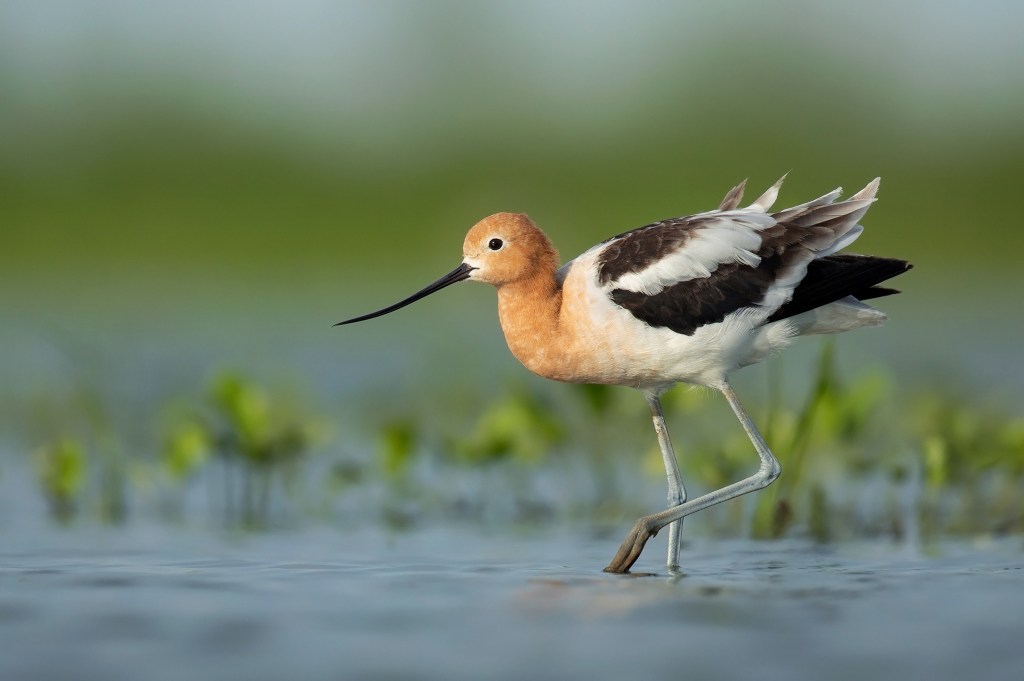
The top of that list was spending an evening with a group of American Avocets (Recurvirostra americana). After conducting systematic surveys earlier in the day, we spent the evenings in search of good chicken turtle habitat in hopes we might be able to spot a few out and about and help inform future survey efforts. We stopped to investigate a shallow freshwater wetland, and spotted dozens of avocets foraging within. It was the tail end of the spring shorebird migration in Texas, and the birds were looking sharp in their breeding plumage.
The rest of the group indulged me as I crept to the water’s edge and laid flat in the mud. I was rewarded with several avocets passing by in close proximity. For my money, these are among North America’s most beautiful, unique birds.
Imbibe
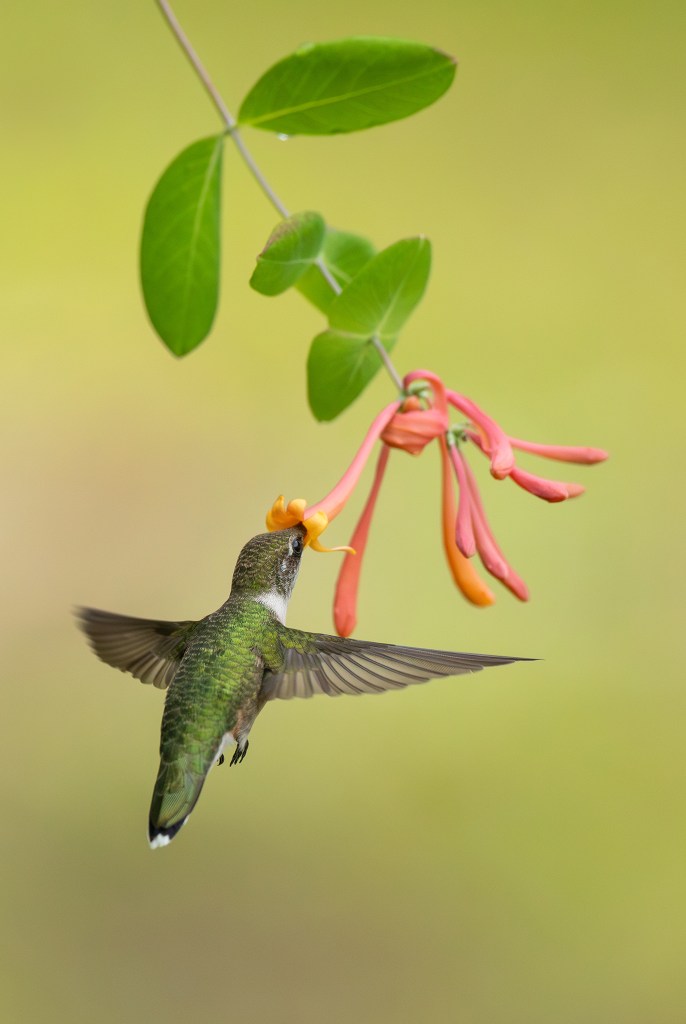
One evening in late June while pulling into my driveway after work I noticed a Ruby-throated Hummingbird (Archilochus colubris) feeding on the native coral honeysuckle (Lonicera sempervirens) that covers the fence along the side of the house. I quickly ran inside, said hello to my wife and son, grabbed my camera and ran back out to see if I could make an image. Luckily the bird was still there and after a few minutes visited the one bloom that had a clear and distant background. I was really thrilled with the result and this turned out to be one of my very favorite images of the year.
On another note, this honeysuckle has been an incredible addition to our garden. We started with a small plant rescued from the graded side of a county road and over a few years has completely overtaken one section of fence. It blooms fairly consistently from March to October, with a definite peak early in the year, and sporadic blooms through the summer and early fall. Hummingbirds are infrequent visitors, and I was thrilled to be able to capture this one, which I suspect has a nest in the area.
Apex
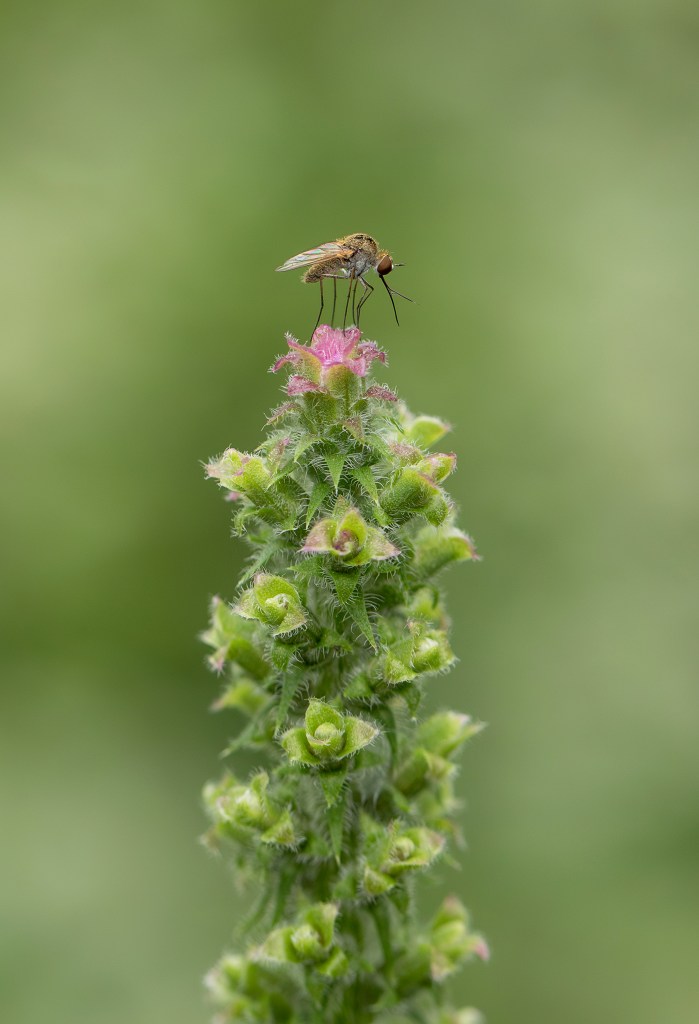
Between July and late October I captured several thousand images of various pollinators. I spotted this bee fly (Geron sp.) on prairie blazing star (Liatris pycnostachya) at a native demonstration garden near my office. Though it may look like a mosquito, this is actually a member of the Bombyliidae. Bombylid larvae are parasitic on other insects, and Geron apparently specializes in moth caterpillars. Adults feed on nectar and can be identified by their “hump-backed” appearance.
Nectarine

The prairie blazing star in our native garden started blooming in late July. It’s not our most popular nectar plant, but it still sees visitation from a number of bees and other pollinators. To me, bumblebees, like this eastern common bumblebee (Bombus impatiens) make especially engaging photo subjects. They are widespread and familiar. I expect that for many, it is a bumblebee that comes to mind if they are asked to picture what a bee looks like.
B. impatiens is the most frequently observed species in our garden. I can expect to see at least a few every time I step outside. Their abundance has allowed me to capture a variety of different images, and this turned out to be my favorite.
Pastel
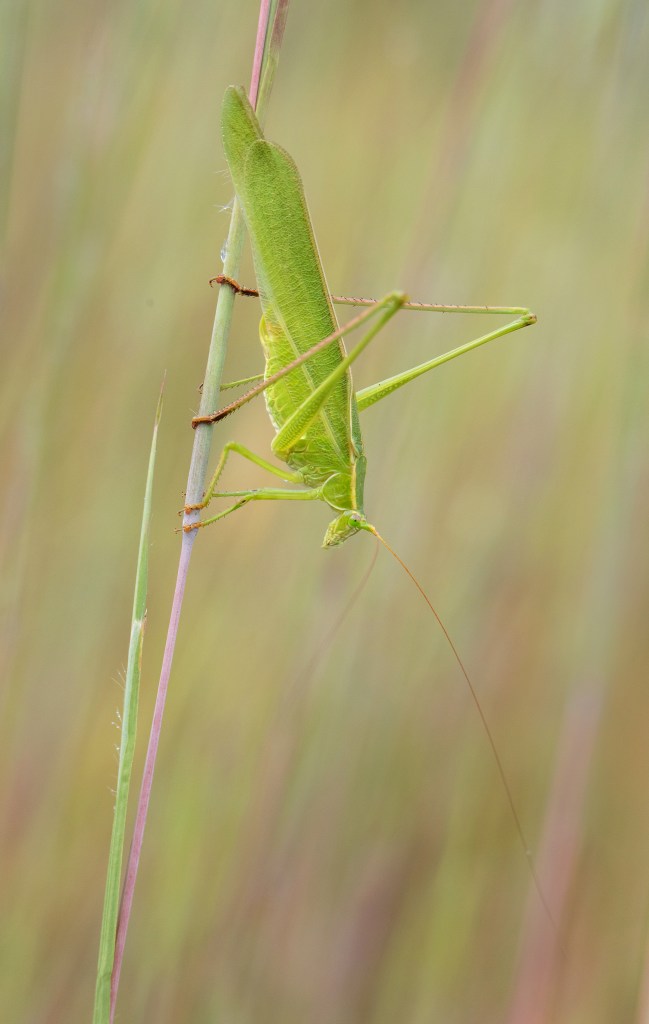
In late August I was invited by the U.S. Forest Service to visit some backland prairie remnants on the Sam Houston National Forest. The Forest Service has been working to restore these prairies and they were looking great. The little bluestem (Schizachyrium scoparium) was especially loverly and colorful, and made for a great perch and background for this katydid.
Flower Guard
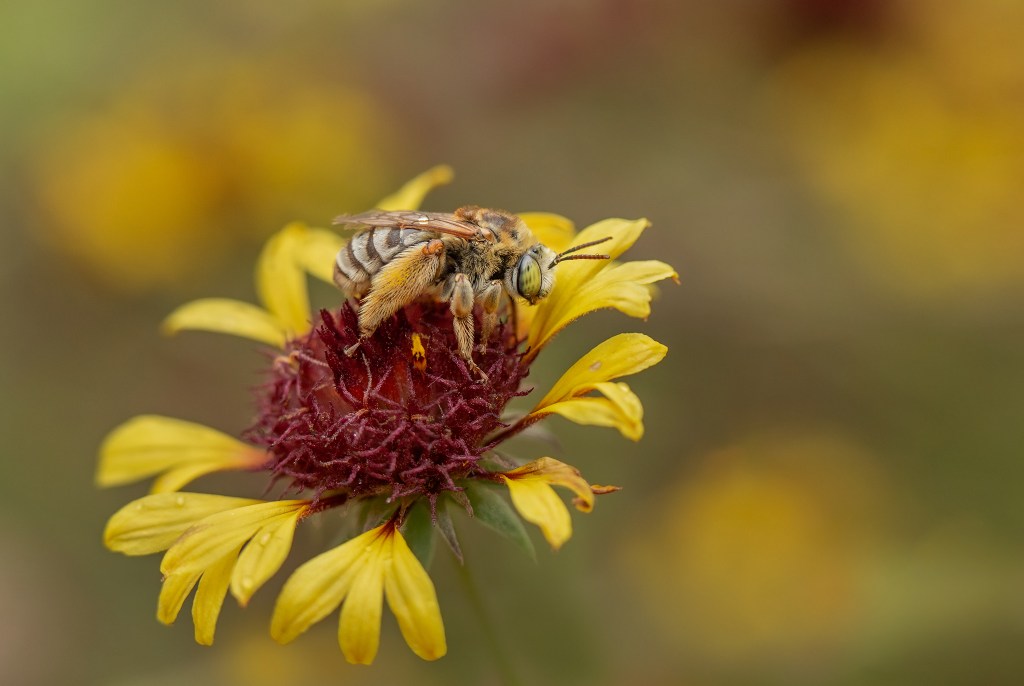
During my photographic pursuit of pollinators I was thrilled to capture an image of this female Svastra petulca, a long-horned bee, on a blanket flower (Gaillardia aestivalis). These native bees are so striking. They’re big, nearly the size of the smaller bumblebees, very fuzzy, and their bright green eyes are beautiful.
Cryptic

As late summer transitioned to early fall the yellows of golden rods (Solidago spp.) began to paint roadsides, pastures, and fallow fields. I visited several patches of these lovely plants, and found that they were almost always swarming with pollinators. The presence of so many nectar seeking insects invariably attracts predators. By mid-September nearly every goldenrod plant had at least one jagged ambush bug (Phymata sp.). I really liked this image that I captured of one of these ambush bugs that had captured a sweat bee (Lasioglossum sp.). I spotted the bee first, and it took a moment to spot the predator. I think this image shows off its incredible camouflage.
Solar

Swamp sunflower (Helianthus angustifolius) also blooms in the late summer and early fall. One evening in early October we went on a family hike to enjoy these striking wildflowers and I managed to photograph numerous pollinators. May favorite image from that day was of this long-horned bee (Melissodes sp.). This photo just makes me feel warm, like I’m taking in some sunshine on a chilly autumn day.
Turquoise
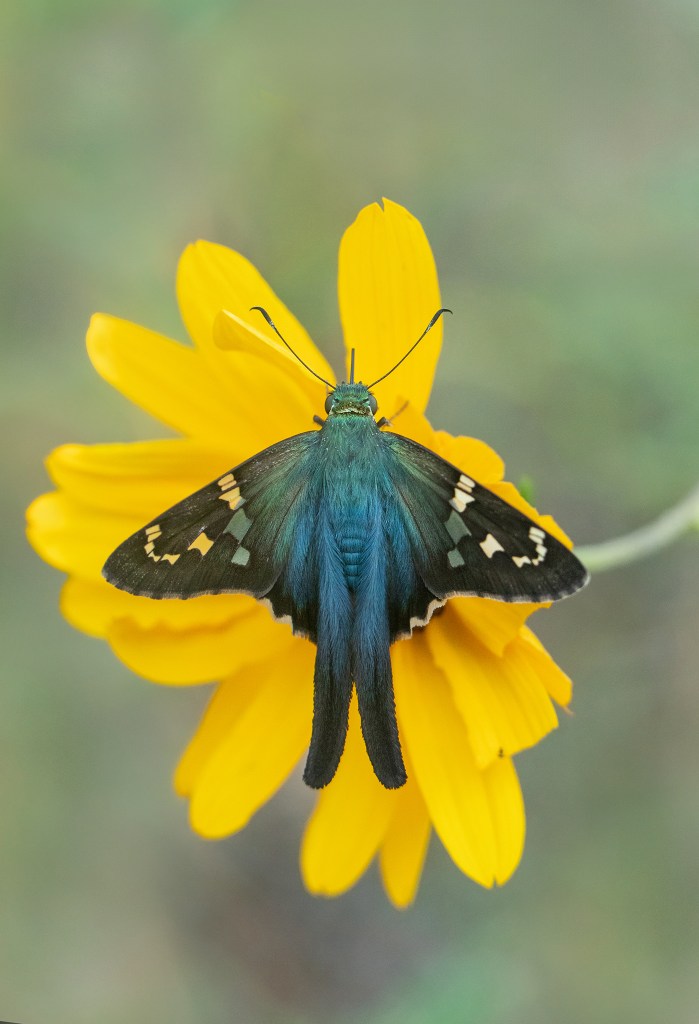
Shortly after photographing the bee above I spotted a long-tailed skipper (Urbanus proteus). These pretty butterflies are fairly common in east Texas during the summer and fall. I’ve photographed a number over the year, but always capture them with their wings folded, as this is how they typically rest. I’ve long wanted to capture an image of one resting with open wings to capture their brilliant metallic blue coloration, which is hidden when the wings close. Things finally worked out in my favor this day when this particular butterfly rested for several seconds showing off this beautiful coloration.
Las Lechucitas Vizcacheras
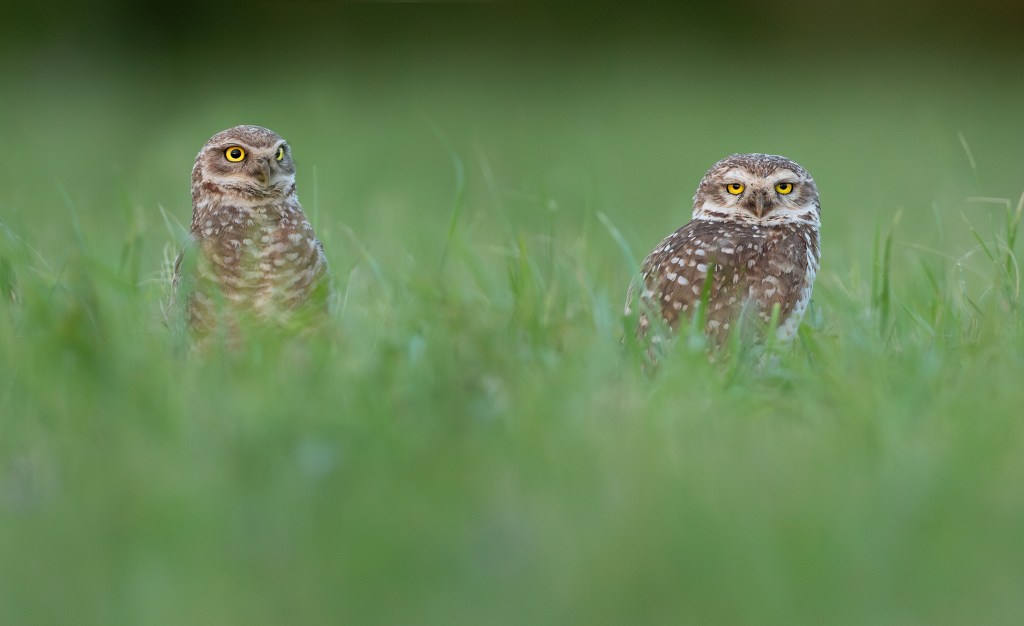
In early November we travelled to Argentina. I’m not sure I’ve discussed it much on this blog, but I lived in a research station on northeastern Argentina for almost a year while conducting my masters research back in 2010. While there I met Caro, my future wife. Following the completion of my thesis research I made frequent trips to visit Caro and her family. In 2014, Caro moved to the states and I had not returned since. This year marked 10 years since the last time I set foot in this beautiful country, and it was great to be back. We brought our son down to meet his Argentine family and it was so great to see everyone again and watch them interact with him.
Caro’s parents live in a relatively rural part of Entre Ríos, the province north of Buenos Aires. There is plenty of open land around their home, and after a solid night’s sleep, we spent a part of our first full day in Argentina wandering around my wife’s childhood home. The pastures and green spaces there are full of Burrowing Owls (Athene cunicularia). They were nesting when we visited and very protective of their burrows. I watched as many a stray dog was dive bombed by the diligent little owls. In Argentina they often use burrows excavated by viscachas, hence the colloquial name lechucita vizcachera.
El Ciervo de los Pantanos

After spending several days in Caro’s home province, we took a trip with Caro’s parents to the Iberá wetlands – the second largest wetland complex in South America. I visited this magical place when I was living in Argentina when my parents came to visit for a couple of weeks. I was blown away by the biodiversity, and couldn’t wait to return.
When I did return this November, it was even more special than I remembered. As soon as we entered the boundaries of the Iberá Provincial Park we spotted this large marsh deer (Blastocerus dichotomus) buck just next to the road. It was a species I was really hoping to photograph, and within minutes of arriving I was able to capture frame filing portraits.
The marsh deer is a vulnerable species native to the central portion of South America. Today populations have been reduced to a fraction of their former range, and occur in isolated pockets in Argentina, Brazil, Bolivia, Paraguay, Uruguay, and Peru. They are slightly larger than white-tailed and mule deer. Unlike these species, marsh deer do not exhibit a specific rutting season, and their reproductive cycle is often linked to the dry/wet season cycle. Males are generally non aggressive toward each other and do not fight for breeding rights. Their antlers may be shed at any time of the year, and may be carried for nearly two years
El Pirincho

While visiting Iberá we stayed in a nice ecolodge in the community of Carlos Pellegrini, which is nestled right next to the wetlands, just a few short kilometers from the National and Provincial Parks. While not out exploring the parks or relaxing at the lodge, I wandered around the property’s grounds and the streets of Carlos Pellegrini. A diversity of birdlife abounds here, and I had photo opportunities within minutes of our door.
One species I was really hoping to photograph was the Guira Cuckoo (Guira guira), which I had encountered previously but always found them difficult to approach. I found a cooperative group near a campground in town. They are incredibly prehistoric looking, and unfortunately this image doesn’t show off their long tail, which completes their dinosaur-like visage.
I really like the light in this image. The sun was getting a bit harsh, but this individual hopped onto a tree branch illuminated by dappled sunlight. There it snatched a caterpillar and I was able to capture a few frames.
El Yetapá de Collar
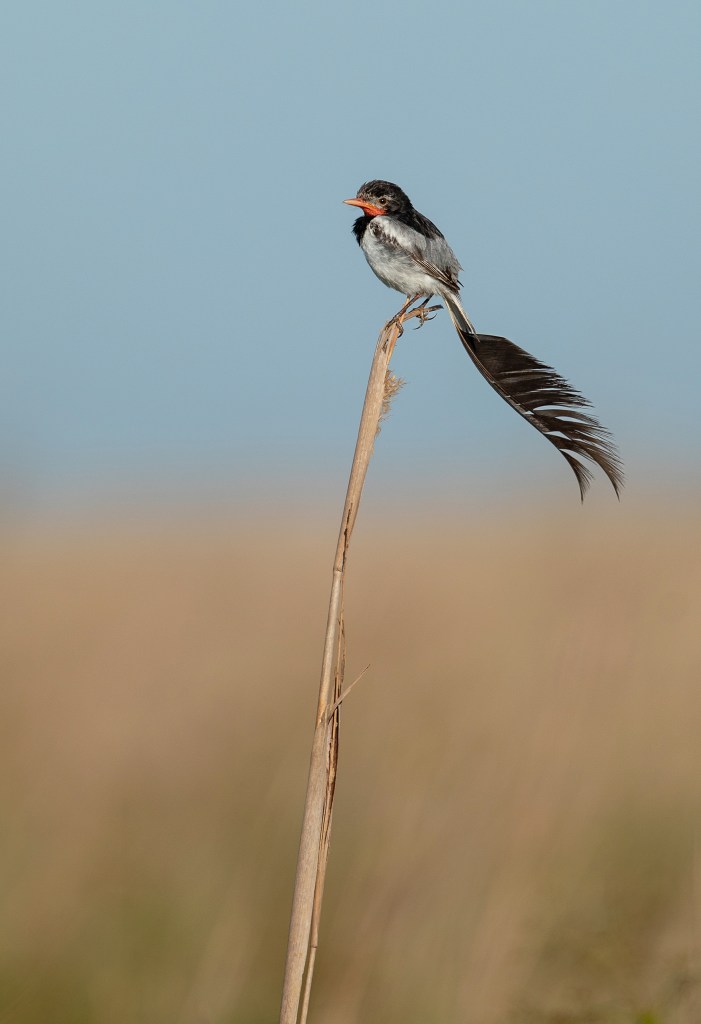
Iberá National Park was established in 2018 and protects over 1.3 million acres of wetland, grassland, and woodland habitat in the Iberá region. It is adjacent to the Iberá Provincial Park/Reserve which protects over 3 million acres. Combined, they form the largest area of protected land in Argentina.
Perhaps the most iconic species of this region is the Yetapá de Collar – the Strange-tailed Tyrant (Alectrurus risor). This bird is truly spectacular. During the breeding season, the males develop a bright red throat and two massive comb-shaped plumes on their tail. These plumes are used in mating displays.
The Strange-tailed Tyrant inhabits high quality grasslands where males perch on the highest perches to survey their territory. They are found in northern Argentina, Paraguay, Uruguay, and Brazil. Their range has decreased significantly, and today they are known from relatively few, mostly isolated populations Iberá is largely regarded as the best place to observe them, and we found them to be quite common in appropriate habitat. On our last morning in the area, as we drove the road the cut through the park, we spotted several males, though most were at a great distance. Finally I spotted one close the road and shouted “STOP!”. My father-in-law slammed on the breaks and we came to a halt in the perfect position to capture this male perched high on his grass look out tower.
El Tuyango

During our last evening in Iberá, a front blew in, bringing with it strong winds and rain. The next morning as we drove out through the national park, the vegetation in the grasslands was still wet.
We spotted this Maguari Stork (Ciconia maguari) in a wetland off the road. It was just finishing swallowing what looked like a freshwater eel. This is one of three stork species found in the area, and I was hoping to photograph one. Luckily I got my chance in the eleventh hour as it slowly made its way from the brush and crossed the road in front of us, allowing me to capture this portrait.
The song “Psycho Killer” by Talking Heads runs through my head when I look at this image. The stork looks somewhat deranged, with its plumage ruffled by the weather. It’s bladelike bill adds to the impression, with the natural red coloration near its tip appearing like a blood stain, and actual drops of blood visible above it. What a bird – a phrase that came to mind often during this trip.
Pharos
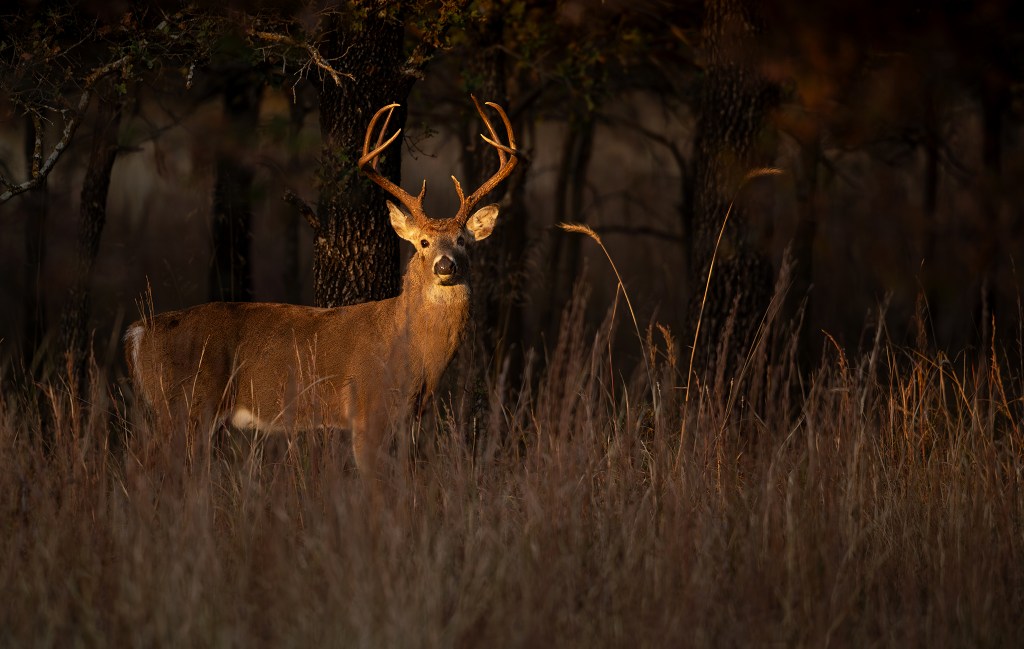
I returned from Argentina in mid-November, drawn back by work commitments, while my wife and son remained for a couple more weeks to soak up as much family time as possible. Every free day I had during this time I spent in the whitetail woods to photograph, and otherwise soak up the rut. This included several days I had off over Thanksgiving. In all I spent six nights camping in north Texas. By day six I had logged 20 miles or so through the backcountry. I had experienced numerous incredible encounters with multiple bucks and witnessed some quintessential rut behaviors. Would my trip have ended there, it would have been a good one – but I still hadn’t captured the shot I was really after. Over the previous days I clocked a few brief encounters with a handful of big, mature bucks that I really hoped to have good photo ops with. But with time running short, it was looking like that wouldn’t happen.
That morning felt especially cold as I crawled from my sleeping bag and suited up. My legs and back voiced their disproval, in their way, as they longed for a rest after lugging around heavy gear for miles on uneven ground over the last several days. I ignored their pleas and stepped out into the frigid predawn. As was my daily ritual, I began boiling water for coffee in the darkness. I mixed in a packet of Swiss Miss for good measure, and watched the world come alive around me. That particular morning, as I looked up after taking a sip, my headlamp caught the tapeta lucida of several eyes 30 yards or so from where I stood in my campsite. There were at least six does there. I watched them as I finished my coffee, and before long I spotted another set of eyes approaching, rather quickly, from the timber. I bumped up the intensity of my headlight and could see it was a buck. After a few minutes of observation I realized it was one of my target bucks, a big 8-point with chocolate antlers that I spotted briefly as it crossed a trail two days prior. After all my wandering, here he was, in the open, just before me. It would have made for an incredible image, were it not for the fact that it was still completely dark.
So I watched him, and as luck would have it, or so I thought, he stuck around as the sky began to turn from black to gray. I could see without my headlamp now as he moved about the does, apparently checking each one to determine their reproductive readiness. “Just stick around for another 15 minutes” I remember thinking. At that point, though perhaps not ideal, the light would be usable. Of course, as it always happens, about five minutes later the does scattered and he moved off back into the woods. I wasn’t giving up though, and I grabbed my camera and set out after him. For the next 20 minutes or so I followed him. At times I would lose him, and try to anticipate where he might emerge based on the terrain and the direction he was moving.
Eventually the day brightened enough that I would be able to capitalize, should he provide the opportunity. I lost him again, but moved ahead in the general direction he was moving to a clearing where a doe was feeding. Sure enough, a few minutes later he appeared at the woods’ edge. I could tell that he was interested in that particular doe, and began to allow myself to hope that I might get a shot at him. Just then, the first rays of sun began filtering through the autumn foliage of the tallest post oaks. Then the doe caught wind of the buck and set out across the clearing. “Ok,” I thought to myself. “This might be it. If he breaks for her I might just get a chance.” And then he did.
The big 8 broke from the timber and moved across the clearing. And then, like an actor hitting a mark, he paused in the one beam of light that had managed to penetrate the clearing. He looked at me for what felt like an eternity, though it must have only been a few seconds. I remember my hands shaking as I pressed the shutter button, and hoping against hope that I got the shot. As soon as he emerged, he was gone, tearing through the brush after the doe. As I looked at my LCD screen to review the images, I was hit by the emotion of it all. I’m incredibly happy with the photo, not only for its qualities, but also for the memory of that magical moment in time where all the hard hours of pursuit paid off. I had the image I was after, and despite covering miles and miles of prairie and woodland, it happened within earshot of my tent. It was one of nature’s incredible gifts that I feel so very fortunate to have received.
Apparition

Mature whitetail bucks are like ghosts haunting the woods. They may leave signs of their presence, yet they are so seldom seen. Even in areas where does and young bucks may be easy to observe, the big, mature bucks remain elusive. As I was moving through an area littered with deadfall from intense storms earlier this year, this buck materialized before me, its gray pelage blending in seamlessly with the trunks of oaks. I managed to shoot through dense tangles of the crowns of downed trees to create a sense that he is appearing through the mist. This image also feels cold to me – perhaps because it was quite cold when I captured it, or perhaps the gray tones remind me of winter in the Pineywoods. He gifted me a second or two to capture this image, and then he vanished, bounding through the trees and out of sight with barely a sound, and the woods were as if he was never there.
Dissolve
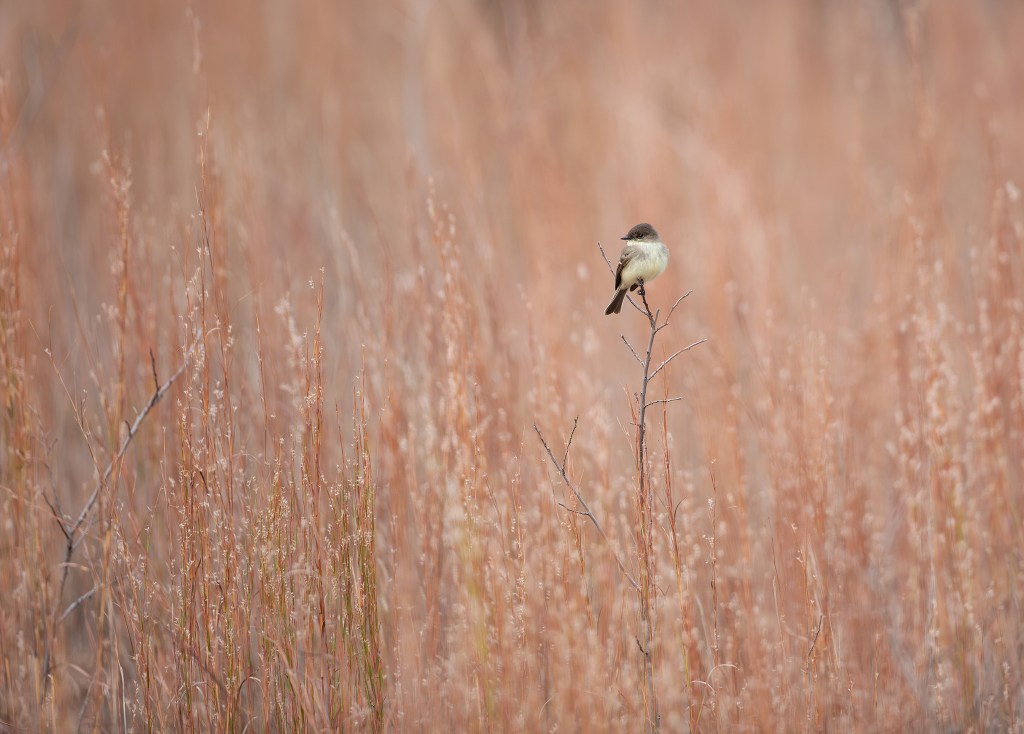
Eastern Phoebes (Sayornis phoebe) are very common in my part of the world, and any given day I can usually find several close to home. Despite this, I have long struggled to capture an image of the species I was happy with. That changed last month, while in pursuit of whitetails I came across this individual in a meadow full of little bluestem, and captured this small in frame image of it among the grass.
A Beast in the Bluestem

This deer was my number one target during the rut. I first photographed this huge buck in 2022, when he looked to be in prime condition. I found him again last year, and though he appeared to have regressed a bit, both in antler size and body condition, he was still an impressive animal. This year, however, he was really something to see. He’s a tank of a deer with a unique set of antlers.
The story of how I spotted him is a fun one. I was actually following a different buck through the tall grass, when it paused at the crest of a small knoll. He alternated his gaze between me, and something behind him, just downslope and out of view. Then I began to see what had caught his attention. First the tines appeared, and then the head, and in an instant, this beast materialized from the bluestem. I had really hoped to see him, though I wasn’t sure if he was around, or even alive until this moment, and I was filled with excitement as he appeared before me.
With the light fading, I stalked him through the grass and brush. I watched as he exhibit typical dominant buck behaviors, and stood in awe of how the other bucks, some of respectable size themselves, paid him the respect he had undoubtedly earned. Here I captured him lip curling among the grass. It’s amazing how such a large animal can nearly completely disappear in the tallgrass prairie.
Down in the Duff
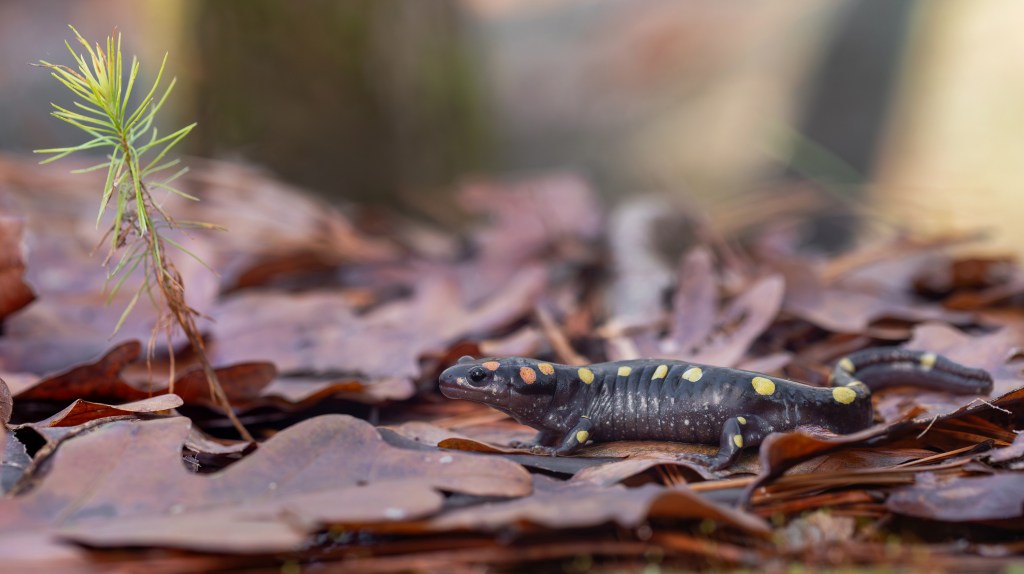
During the last days of 2024 east Texas was drenched by several powerful fronts that brought torrential rain. Normally this might trigger mass amphibian migrations this time of year, however I speculate that we haven’t seen enough cold days this winter, and as a result, the salamanders in particular, have not yet experienced their main breeding events. For that reason I felt particularly lucky to turn up this male spotted salamander (Ambystoma maculatum) close to its breeding pond. The spotted salamander is one of my all time favorite animals, and I never tire of seeing them. I think they’re one of the most beautiful organisms around and feel lucky that I can find them close to home.
Thank you for joining me for this tour of my favorite images of 2024. As I said at the start of this post, narrowing it down to 24 image was incredibly difficult. If you’d like to see more of my work from 2024 please visit my Flickr or Instagram pages. I wish you all a very happy and prosperous 2025.
 A Naturalist's Journey