I’ve never wanted to be one with the animals – not really. In fact, it’s our differences that have always drawn me to them. Many children have dreams of being able to speak with animals, to understand their language. I had these dreams as well, but for me they were more like nightmares. Even at an early age I felt that having that ability would remove the sense of wonder I feel while observing, learning, and experiencing biodiversity. Each species is unique and should be, at least in my opinion, revered on its own merits, not those that we can liken to ourselves. That’s not to say I don’t feel empathy. Quite the opposite actually – I feel empathy to all creatures, great and small – revered and reviled. And though it’s clear that different species experience the world in different ways, I still try to imagine what life might be like were I born another creature.
I think that’s part of what fascinates me about insects. Their morphologies and life histories are so very different than ours. Imagine, for example, you were no less than a half inch long and weighed a fraction of a gram. Despite this, you still had to navigate the world – a world much much larger and more dangerous than the one we know.
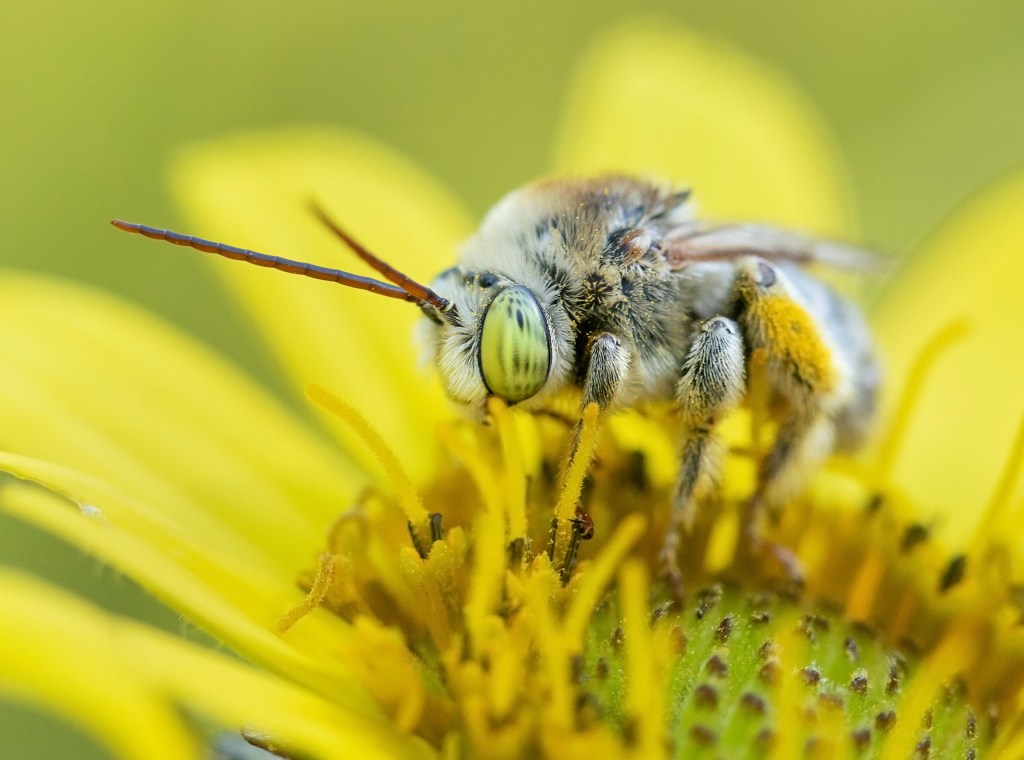
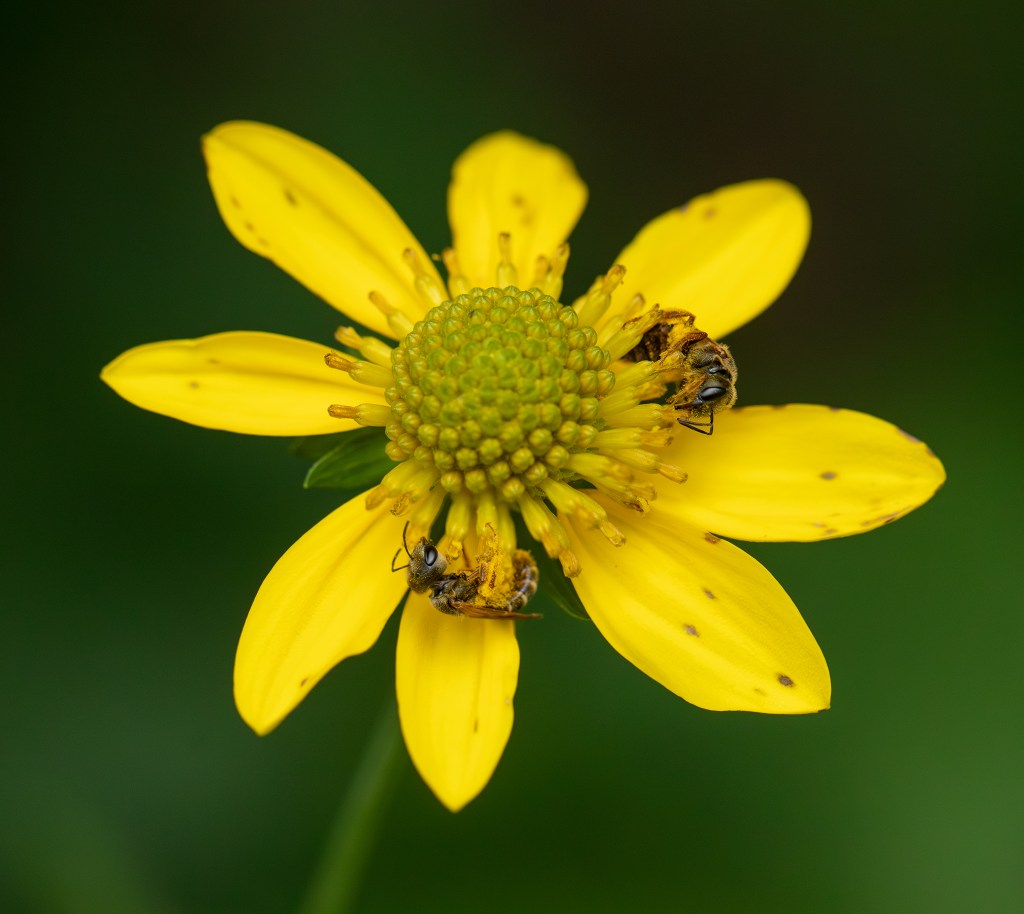
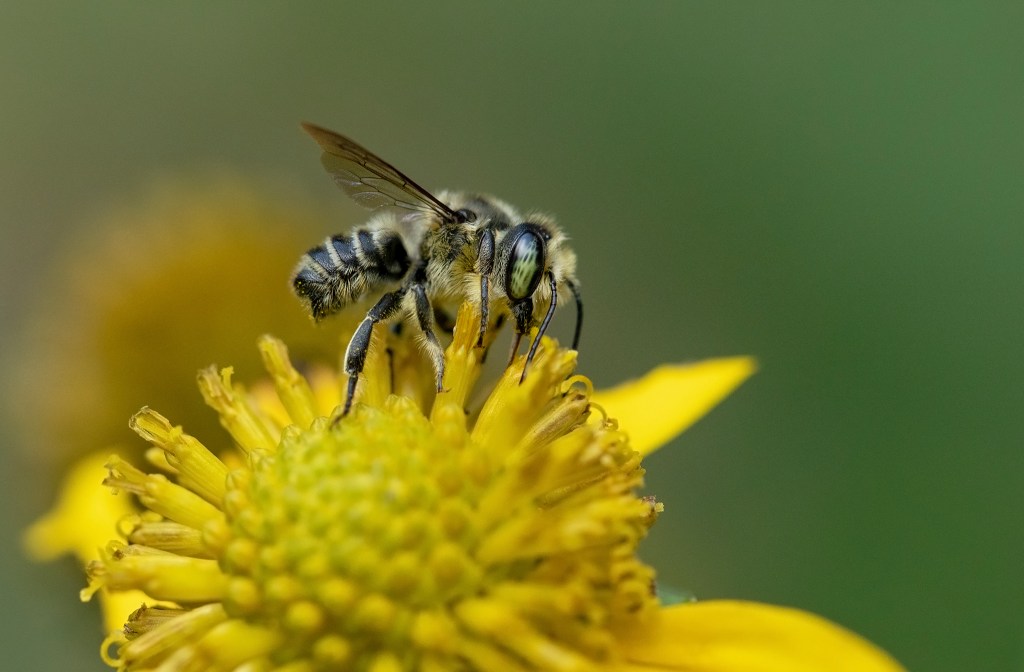
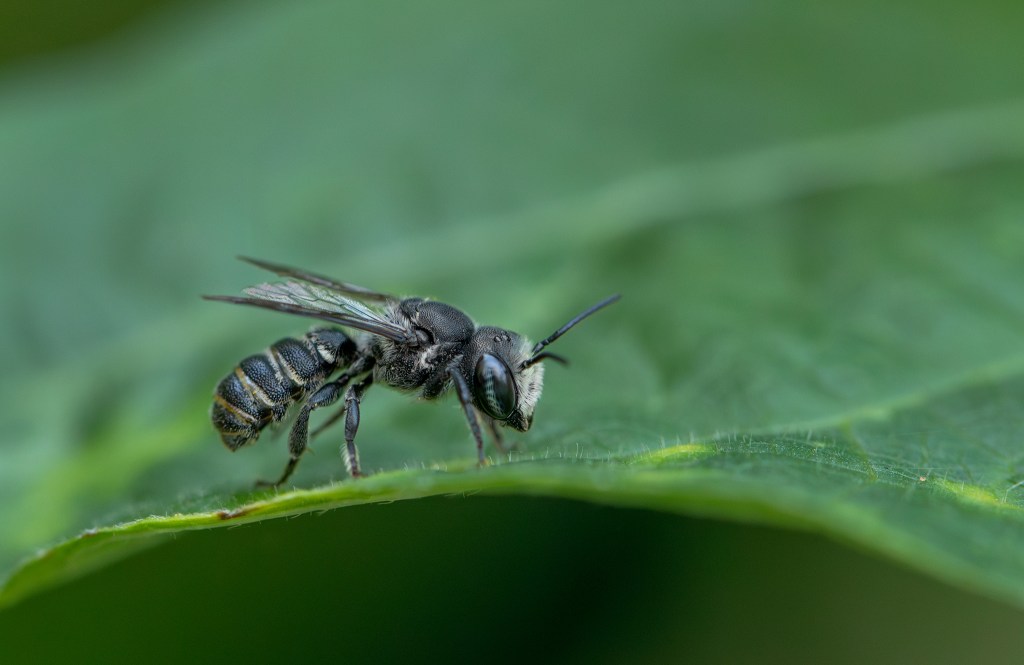
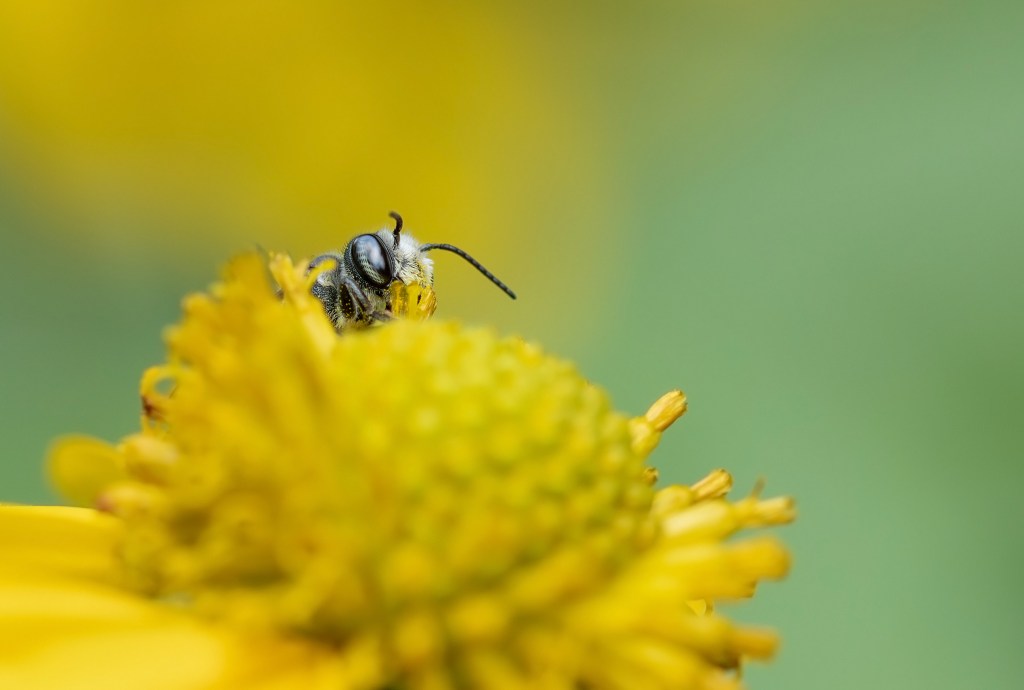
I was plunged into this state of contemplation today during my lunch break. Fortunately my office is a couple of blocks away from the Pineywoods Native Plant Center in Nacogdoches, Texas. I frequently wander the grounds during lunch and enjoy the abundant blooms, birds, and bugs. Today while admiring some late summer/fall blooming plants I spotted a male longhorn bee sleeping on a sunflower (Helianthus sp.). I’m still not sure which species, but have been trying to compare phyllaries to possible suspects and will update once I figure it out. ***Edit – after looking into it further, I now believe the flower belongs to Silphium asteriscus***. I was planning to continue my treatment of Hymenoptera today by moving onto the wasps, but today’s experience inspired me to focus on a single species – a single individual no less worthy of our admiration.
When I first spotted him and realized he wasn’t moving, it was instantly clear that he was sleeping. This isn’t unusual, and bees frequently take catnaps on flowers during the day. This was different though, and this little long-horned bee seemed to find the perfect little bed.
Admittedly I haven’t tried very hard to identify him to species yet. I believe he is a member of the genus Sastra. I have seen both S. petulca and S. obliqua at this site. I suspect this due to his antennae that, while long, seem shorter to me than those of other similar genera of Eucerini (refer back to my first installment of this summer pollinator series for more information on long-horned bee taxonomy). This individual looked a bit different, however. Particularly his coloration. He was very light, with light gray hairs that seemed to have an ever so slight bluish hue on the abdomen.
I watched him for around half an hour and he never left this flower. Occasionally he would stir from his slumber and walk circles around the disk flowers forming the bloom’s center, lapping up nectar with his glossa (tongue-like mouthpart). Then he would stop again, catch a few more minutes of z’s, and get back to eating. He even took a moment to play a game of peek-a-boo with me (or more likely just to use the hairs of his foreleg to clean bits of pollen and other debris from his compound eyes).
I really enjoyed this experience, and it brought me more joy than one might expect half an hour of staring at a lazy bee might (forgive my anthropomorphism of an animal that is anything but lazy). The natural world never ceases to amaze me, and there really is endless wonder to be found in observing our planet’s incredible biodiversity. From the drama of the elk rut, where massive warriors weighing hundreds of pounds and adorned with lethal weaponry clash and may meet their deaths, to the beauty and tranquility of a tiny bee clad in an adorably fuzzy exoskeleton allowing me a glimpse into his life from mere centimeters away, countless experiences await those willing to seek them out. It brings me great joy and comfort that in my forty years, which have been filled with more time in nature than most, I haven’t even scratched the surface of the fascinating life forms that call this planet home.
Today’s post continues my coverage of the more common native bees of my area. Please enjoy this tiny subset of our incredibly rich apifauna.
*Note – on some monitors images may initially appear “washed out”. Please scroll over each image to see its intended presentation
Family Colletidae
This diverse family contains a variety of solitary bees with common names like cellophane bees, polyester bees, and plasterer bees. This name comes from secretions that dry to form a plastic like barrier and are used to line their nests. There are five genera in the U.S.
Colletes sp.
Cellophone bees of the genus Colletes can be identified by their unique mouth parts which include a “tongue” that is forked and shorter than most bees. Colletes are ground nesting bees that line their nests with a cellophane like material that is waterproof. We haven’t seen any Colletes in our garden, but when photographing wasps with James at Childress Farm, this individual landed on his hand, presumably to lap up the sweat generated in the sweltering July heat.
Family Halictidae
This diverse family includes bees that occupy a wide range of habitats and carry out a variety of different life histories. Its species exhibit a wide range of sociality, from solitary to eusocial, though the eusocial species may vary their behavior depending on a variety of factors, being solitary in some conditions and establishing colonies with defined castes like queens and workers in others. While worker honey and bumblebees are sterile, worker Halictids can assume reproductive roles if a queen is lost. Most species are ground nesters, though a few nest in rotting wood. Some members of this family are brightly colored, displaying metallic greens.
Tribe Halictini
Halictini includes the sweat and furrow bees. Sweat bees are so named for the propensity to land on human skin and lap up sweat for its sodium content. It should be noted that they are not the only bees to do this, as evidenced by the Colletes sp. pictured above.
Halictus ligatus
This small bee was incredibly common in our garden in July. It is widespread across North America and is polylectic, visiting many different plant species for pollen. They nest in the ground and rotting wood and individuals may utilize the same nest site multiple years assuming it remains in tact and the surrounding habitat remains suitable.
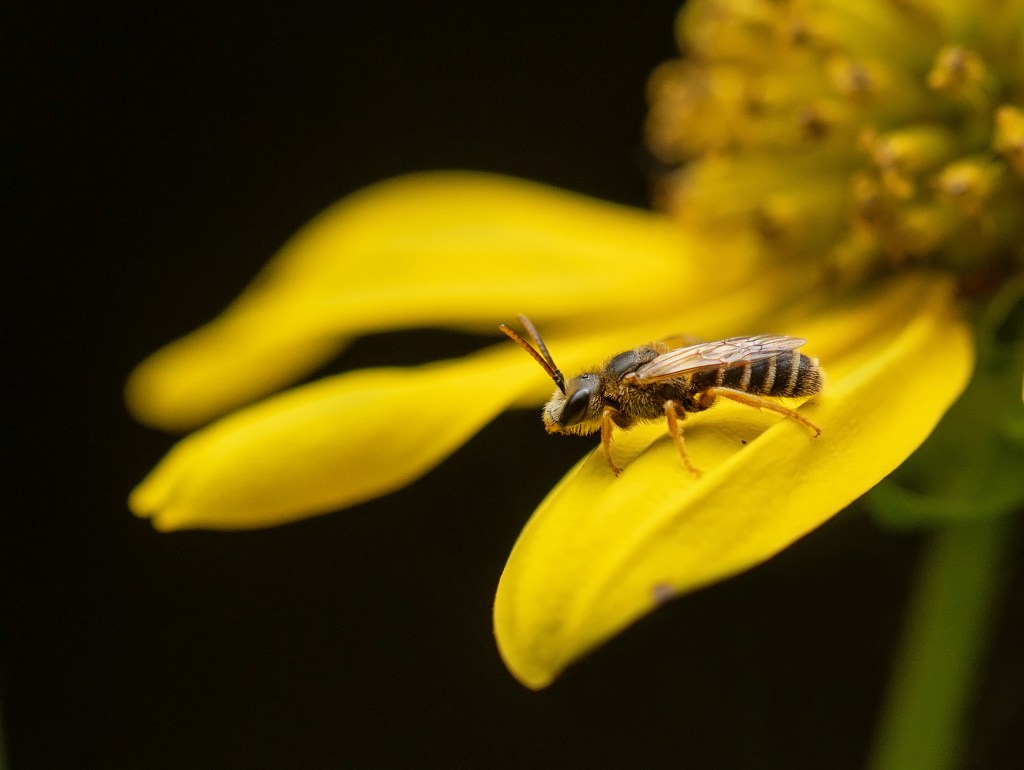
H. ligatus is a dark bee with well defined bands on the abdomen. Like many bee species, H. ligatus is sexually dimorphic. Males (above and below) have a long, slender look to them and have proportionately longer antennae. The lower portion of the clypeus and the mandibles are yellowish.
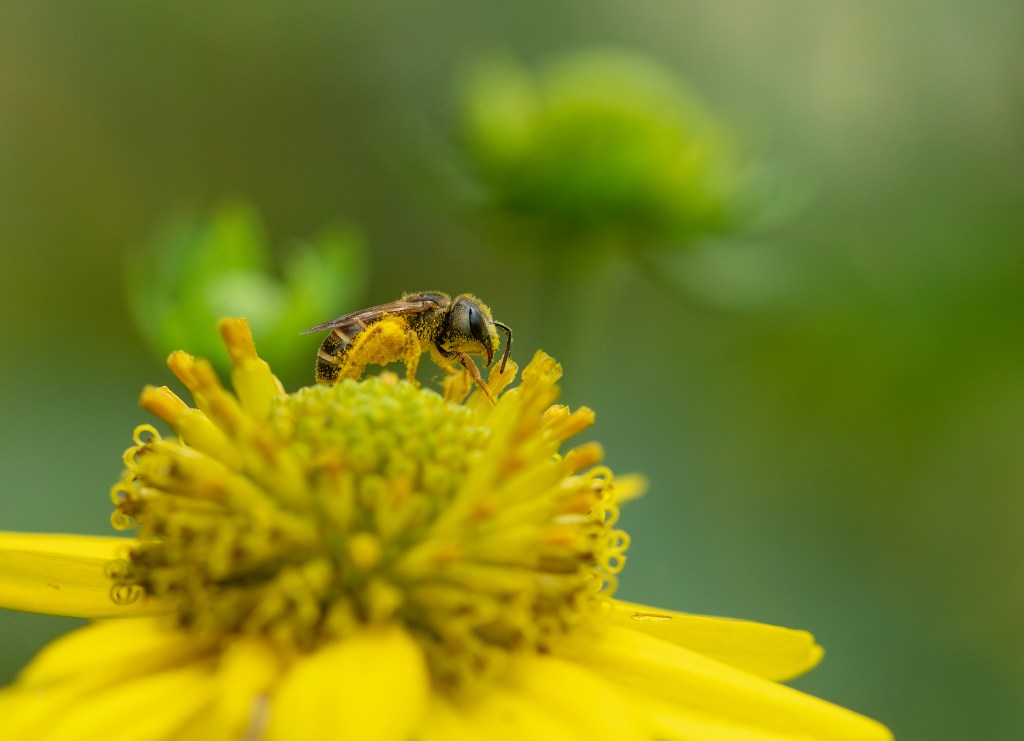
Females (below) have large, blocky heads. They have noticeably long mandibles and a tooth-like projection on the bottom of the head near where it connects with the thorax. The females have harrier legs which are efficient at collecting pollen (see the image below).
H. ligatus is one of the primitively eusocial Halictids. In “poor” conditions, such as harsh climates and extended periods of harsh weather conditions, the species may be solitary or form very loosely structured colonies with little division of labor. Under optimal conditions, however, large colonies with defined roles can develop. These are different from truly eusocial bees as individual bees may facultatively assume or abandon specific roles. Colonies are established by a foundress, which is analogous to a queen, and large colonies may have multiple queen-like egg producing bees. Worker-like bees collect food and tend to the colony, but are also capable of reproducing and in some situations may produce significant numbers of eggs.
A similar species, H. poeyi was split from H. halictus based on differences in mitochondrial DNA. They are visually identical, but fortunately their ranges do not overlap in our area. H. poeyi is restricted to the east Coast.
Lasioglossum
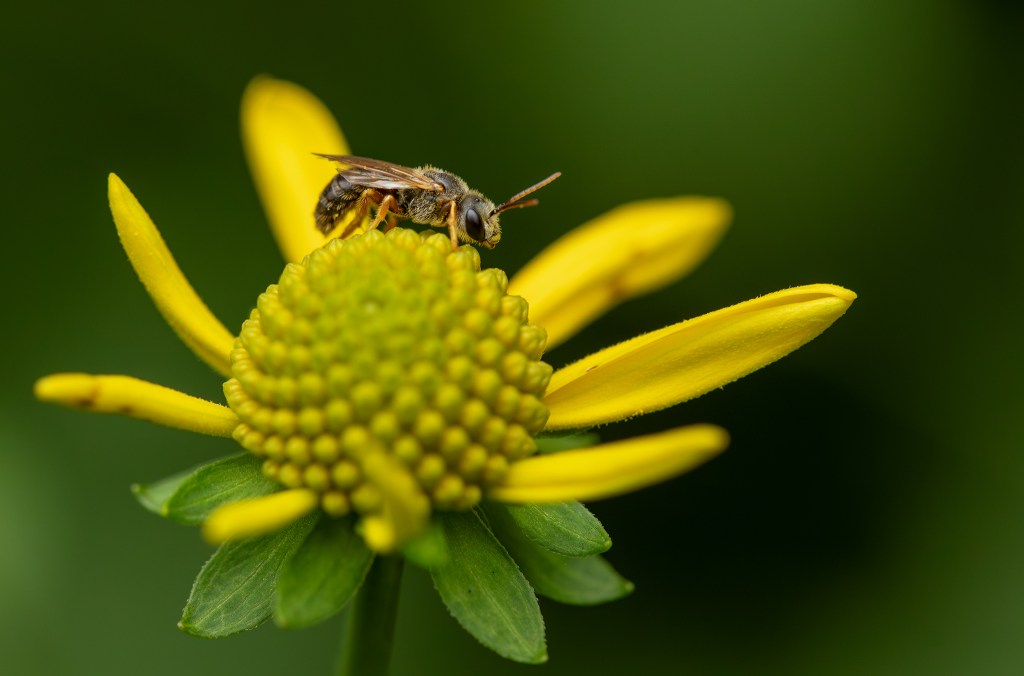
I’ve read that Lasioglossum is the most diverse of all be genera. There are nearly 300 species in North America and 1800 species worldwide. Many of these are tiny, with some measuring just a few millimeters in length. Differentiating the species is a daunting task and can require microscopic examination of the texture of the thorax and pattern of wing venation. I believe we had at least two species in our garden this summer.
The more common of the two is a metallic bronzy green (pictured above on Rudbeckia laciniata and below on Conoclinium coelestinum). Like Halictus, Lasioglossum exhibits a wide range of sociality. I believe that bee so tiny do not forage far from their colony, so I spent a fair amount of time seeking out potential sites to no avail.
When looking at bees, our gaze is immediately drawn to their large compound eyes. These eyes are made up up numerous “simple eyes”, which contain lenses and light detecting cells. Compound eyes allow them to interpret their surrounding, detect objects and sense depth. Bees (and wasps) also have three eye like structures on the top of their head known as ocelli (visible in the image of Lasioglossum sp. below). Ocelli don’t allow them to see detail, but sense light and movement and are helpful in flight.
Below is another species of Lasioglossum from our garden. It is less common, larger, and more robust than the individuals pictured above, and is matte black in color rather than metallic green. Admittedly, the relative size could be related to social status as well, however I still suspect it is different.
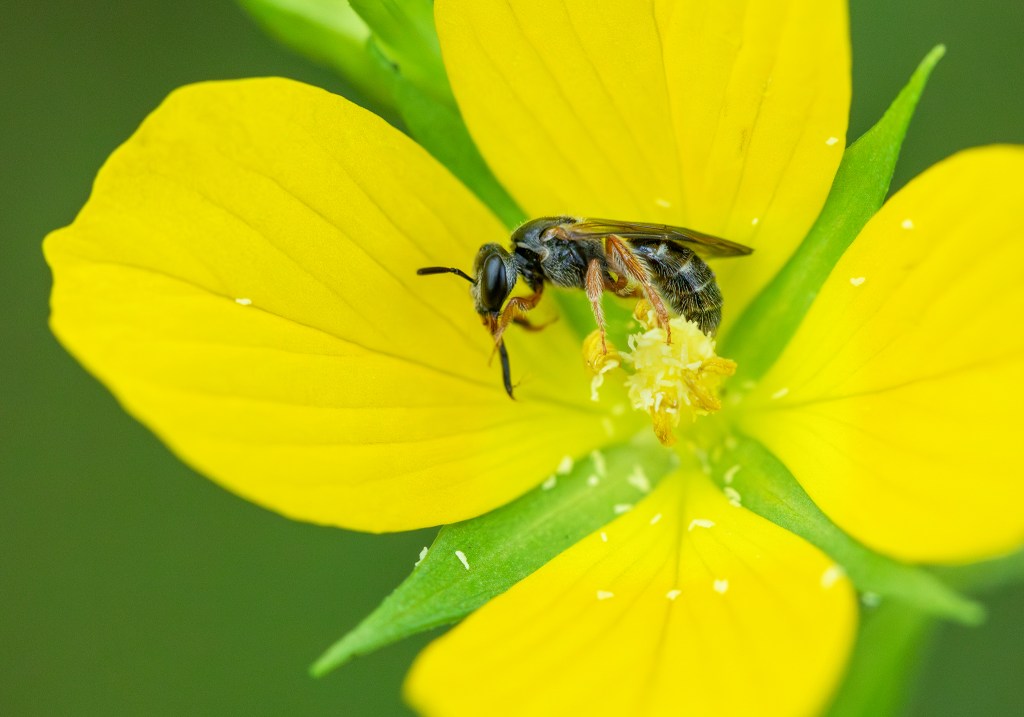
Below is yet another species of Lasioglossum – at least I think it’s a different species. Some species can be somewhat variable making identification all the trickier. This one is nectaring on a Ludwigia sp. bloom in the Davy Crockett National Forest. I regularly see bumblebees and carpenter bees visit Ludwigia. Those species span nearly the entire flower and frequently knock the petals off while feeding. Lasioglossum on the other hand look tiny in the blooms’ centers.
Family Megachilidae
This highly diverse family contains bees of a variety of shapes and sizes. The family name references the large mouthparts. Some construct nests in wood while others “squat” in burrows of other insects, or in crevices such as pine cones. Members of this family may heavily utilize “bee houses”, which are generally collections of hollow sticks.
Tribe Anthidiini
This tribe contains a variety of mostly small but stout bees. Many are wasplike in appearance with few hairs on the legs and body. Like many Megachilids, females of many species have scopa on their bellies to collect pollen, however some, like the species below are kleptoparasitic, meaning that they don’t feed on a host, but rather steal food from them (think kleptomaniac!)
Stelis louisae
This uncommon bee is a kleptoparasite of other bees in its own family. As promised in last week’s post, today we’re diving deeper into kleptoparasitism (sometimes spelled cleptoparasitism). Females lay their eggs in a host nest as its being built, and the female of the host species will eventually seal them in with their own eggs. The S. louisae then hatch and the larvae kill the eggs or larvae of the host and feed on the pollen stores left by the host female to provision her own larvae.
As they don’t collect pollen to feed their larvae, S. louisae are not hairy and can be easily mistaken for small wasps. I first noticed hem in our garden a few years ago. They seem to be fairly common, and I can usually find a few from mid June to mid August.
Tribe Megachilini
This tribe includes species with common names like leafcutter, resin, and sharptail bees. It is the most diverse tribe within the family Megachilidae.
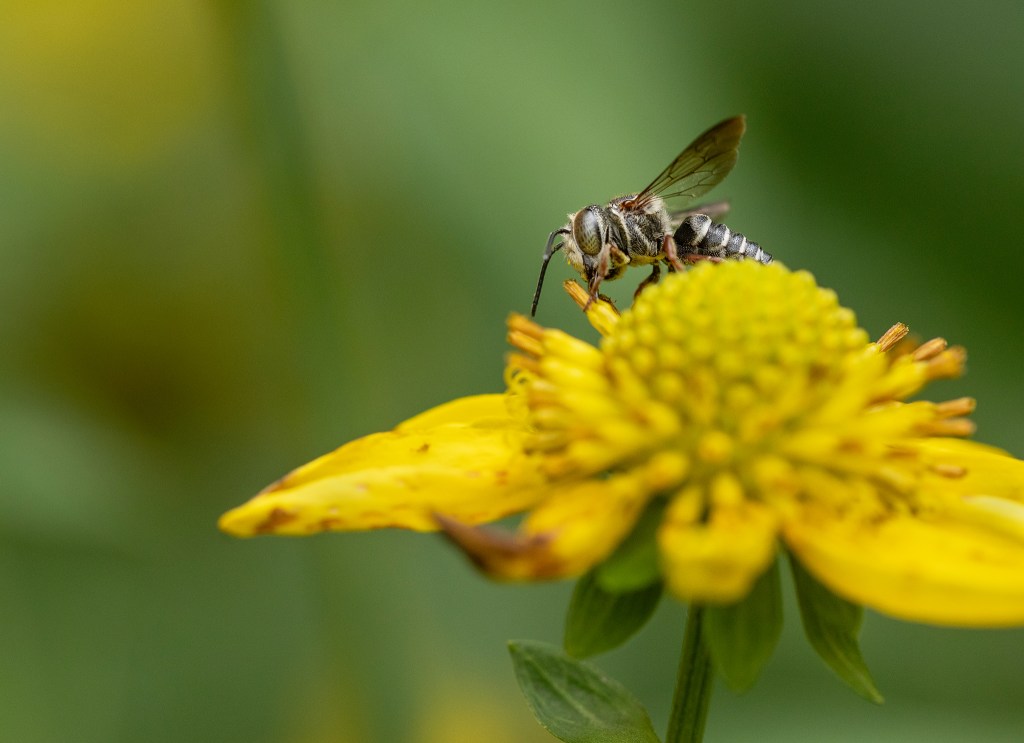
Coelioxys mexicanus
Members of the genus Coelioxys are commonly referred to as sharptail bees or cuckoo leafcutter bees. Like the Stelis louisae above, they are kleptoparasites of other bees in their family. They also lack dense pollen collecting hairs. C. mexicanus is widespread in the southeastern U.S., and extends into Central America.
This is an example of a group of bees I was unaware of until I started paying closer attention earlier this summer. Initially I mistook them for true leafcutter bees (Megachile), but when examining the images I noted several morphological differences, notably the pointed tails and general lack of dense hairs.
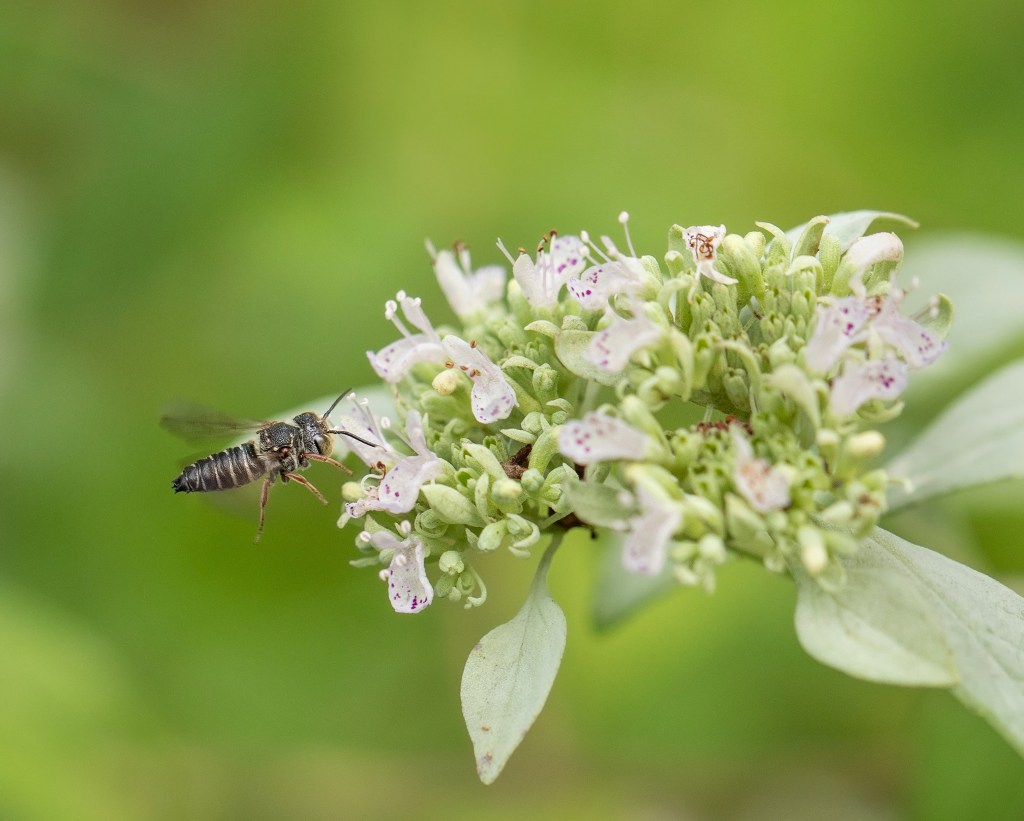
C. mexicanus is uncommon in our garden. It’s not a species that’s present every day (or at least, not at the times I went out to look), though with diligent searching I could usually find a couple in a given week. I also observed a few at the Pineywoods Native Plant Center foraging on Pycnanthemum albescens (below). Though they do not collect pollen, the adults still feed on nectar.
Megachile
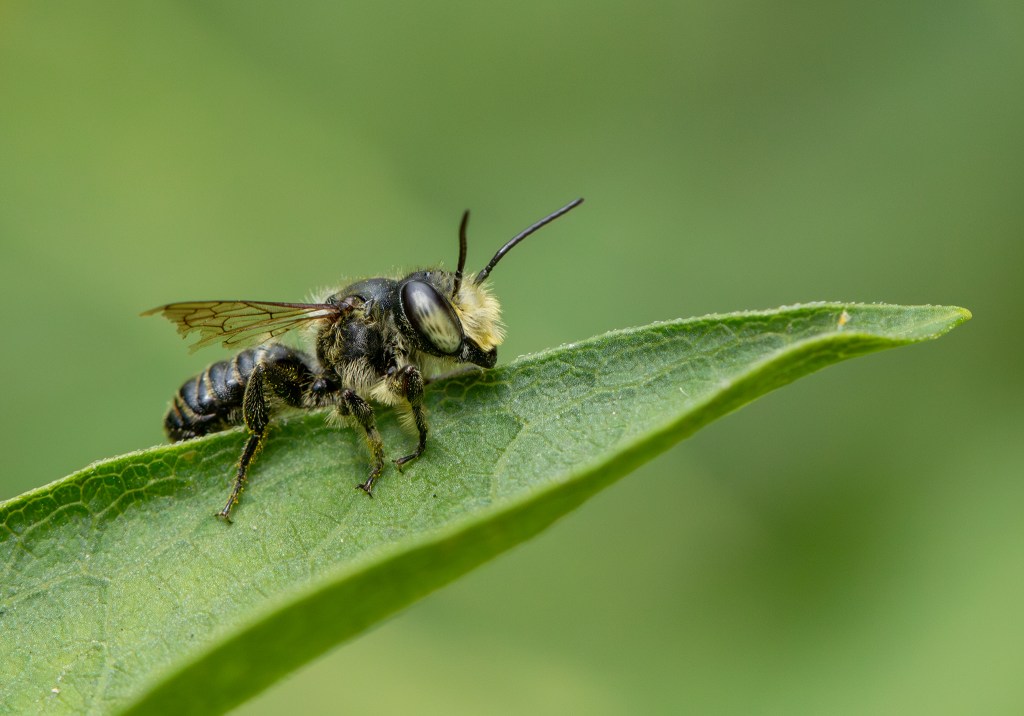
This genus includes the leafcutter and resin bees. They are very common and can be found on a variety of flower species. I struggled to identify many of these to species, so I’m including a collection of images that may or may not be members of the species. Females collect pollen via dense scopa on the “belly” (bottom of the abdomen). Males often have very hairy “faces”.
Flying around in constant search of nectar and pollen takes its toll, and most bees live short lives. Eventually wing damage, like in the individual pictured below, can ground them, causing them to lose access to valuable food sources. This individual was still capable of flying, though not as effectively as its cohorts.
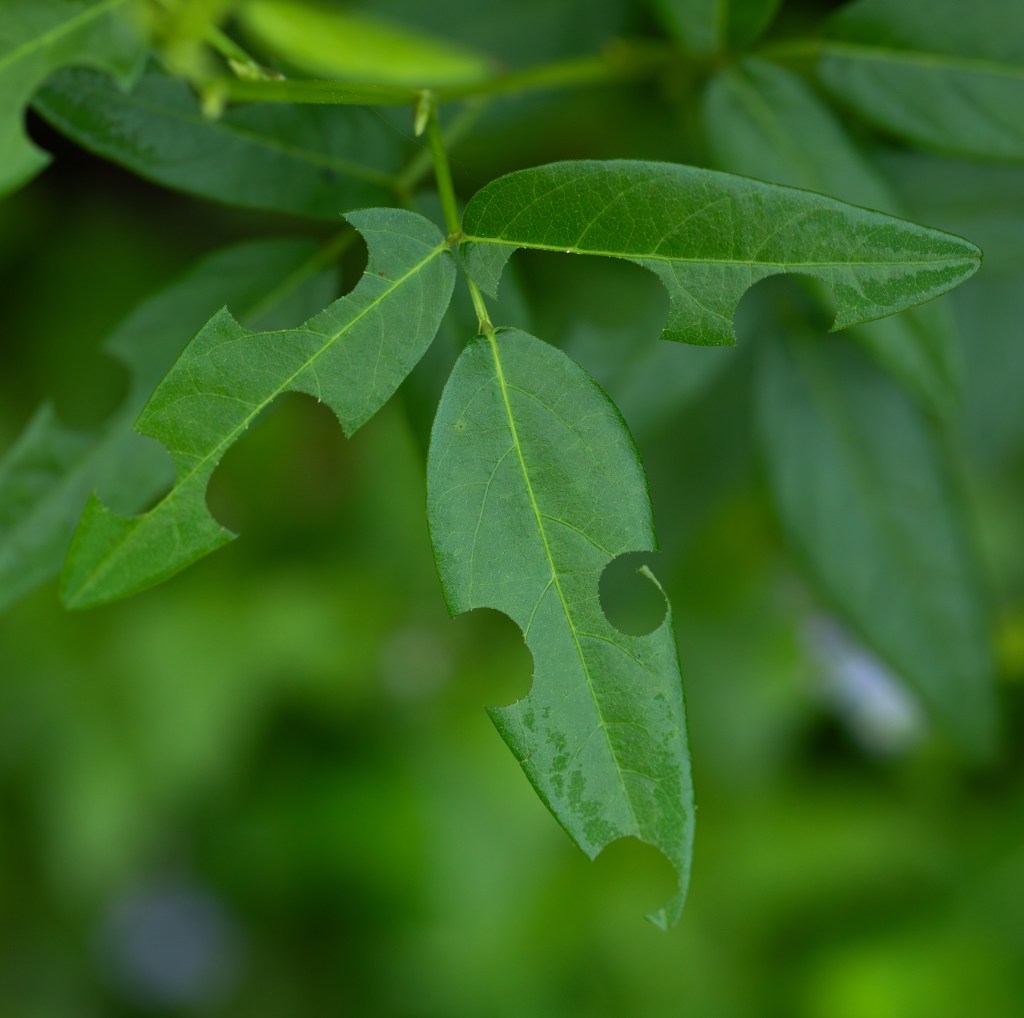
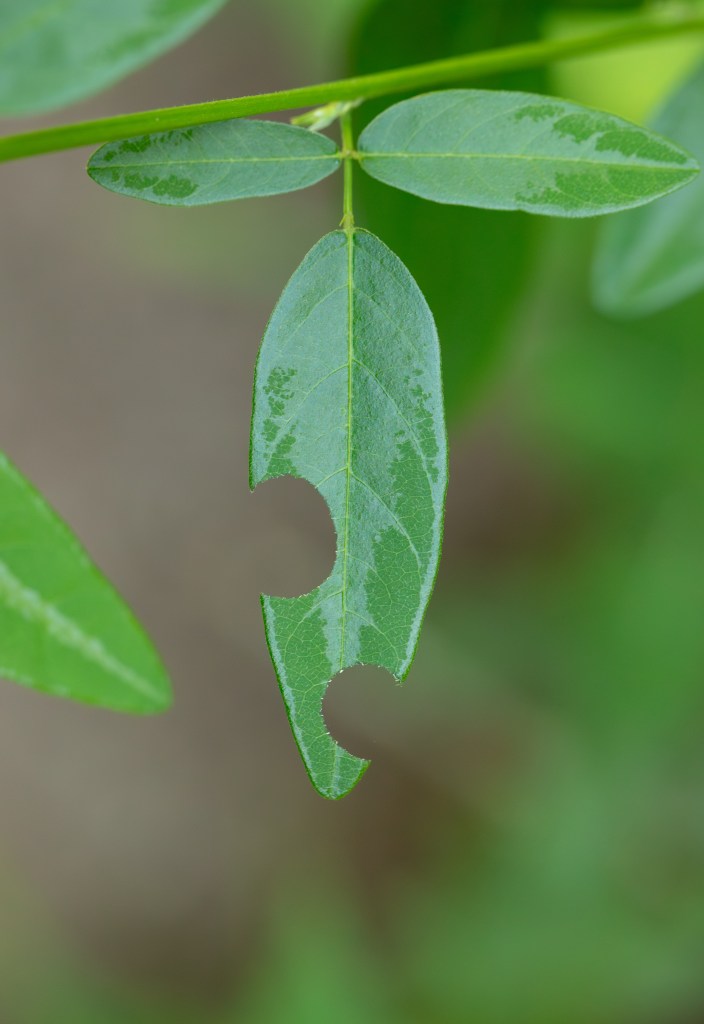
Leafcutter bees are so named for the females’ leaf collecting behavior. With large, powerful mandibles, they cut circles out of leaves and use them to partition egg chambers in their nests, which are established in hollow stems or subterranean burrows. (Note the yellow color on the bottom of the abdomen in the image below. This is caused by pollen stuck to the scopa, which will be used to provision each egg chamber.)
In our yard, Megachile seem to show a preference for Desmodium (Fabaceae; following two images) and Vitis (Vitaceae). They often cut nearly perfect circles or ovals. Though there is ample evidence of their activity throughout our yard, try as I might I have only observed them actually cutting their leaf pieces a handful of time, and have struggled to photograph it.
Megachile xylocopoides
Some Megachile are fairly easy to identify and M. xylocopoides is one of them. The specific epithet xylocopoides refers to the similar appearance to large carpenter bees (Xylocopa). They are large and dark. Females are entirely black, while males, like the one pictured below, often have yellow hairs on the head, thorax, and abdomen.
Males also have enlarged, hairy basitarsi (the basal part of the tarsi, which also include the skinny tarsomeres, to which the pronged foot is attached). These structures are used to cover the eyes of females during mating.
This striking male M. xylocopoides is the only individual to have visited our garden. We saw him a couple of times over the course of a single day. We have observed other individuals at some of our local green spaces in previous years.
Tribe Osmiini
This tribe includes the mason bees, so named for the tendency of some species to use earth and mud in the construction of their nests. Not all species in this tribe make earthen nests, however, but rather exhibit a wide range of nest building behaviors.
Heriades sp.
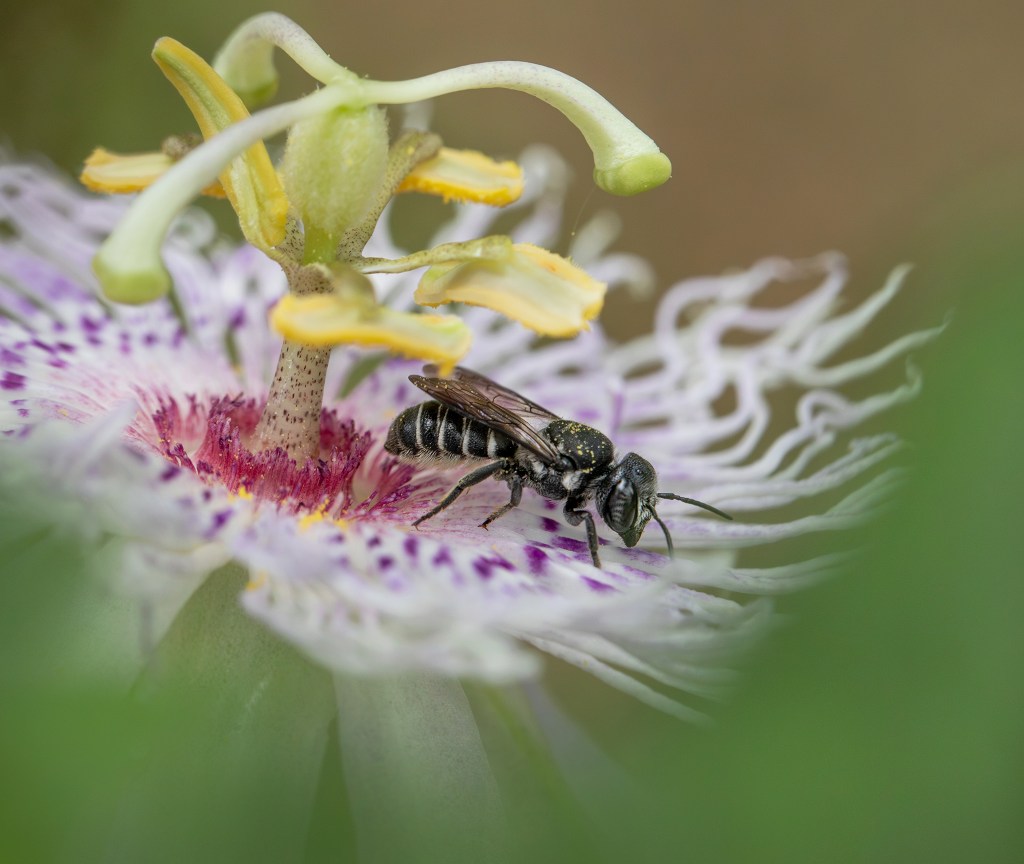
Heriades is one of several polyphyletic genera commonly referred to as resin bees. Instead of using leaf pieces or mud to construct partitions in their nest chambers, they use plant resin. They have a long, slender look and their abdomens often appear curled downwards. There are only a few species in the eastern U.S., however they are very difficult to separate.
Heriades are fairly common in our garden. They visit a variety of flowers, and I have seen them on Amorpha, Liatris, Rudbeckia, and Passiflora (below). When feeding on Passiflora, the bees clung to the androgynophore (the base of the large structure emerging from the flower that supports the reproductive structures) and dug their mouthparts deep into the nectaries beneath the flowers’ deep pink center.
One afternoon while observing pollinators in the garden I noticed a common on one of the Rudbeckia laciniata blooms. There I saw three Heriades bees grappling. I believe this is a “mating ball”, where multiple males attempt to mate simultaneously with a single female.
Utilizing a macro lens has really allowed me to appreciate the compound eyes of these bees and other insects. The compound eyes in particular can be truly stunning, with rich colors and intricate patterns.












 A Naturalist's Journey