
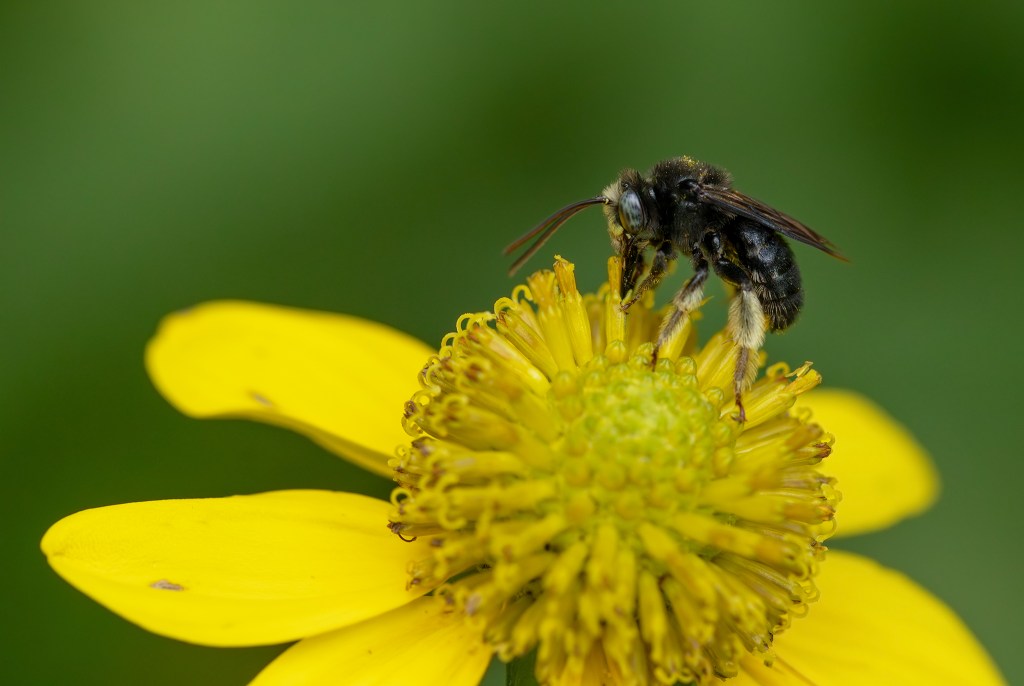
I think it’s safe to say that visiting East Texas during the height of summer is on very few people’s bucket list. Sure, we have our tragically large reservoirs that might draw a few boaters, anglers, and swimmers, but by and large the weather is just too brutal. Days of stifling humidity and temperatures of 95 or even 100°F are the norm rather than the exception. For a naturalist there are some cool things to see. Some of our showiest flowers like Lilium michauxii, Silene subciliata, and a few different orchids in the genus Platanthera bloom during this time, but I’ve already spent my fair share of time with those characters, and though I’d love to see them again each year it’s currently a little harder for me to justify disappearing all day to trek through the sweltering, mosquito filled woods with a little one at home. That’s why this year I was thrilled to really put the time into discovering and chronicling the incredible biodiversity that exists much closer to home.
Over the years we (and by we I mean mostly Caro) have established an impressive native pollinator garden, stocked with regional plants that were either salvaged from development sites or from seed collected from local populations. Caro has a green thumb and enjoys gardening with native plants. She has played around with planting, seeding, composting, watering, and everything else that goes into establishing a garden, and now our little green space is thriving. Highlights include several species of Rudbeckia, including R. laciniata, R. maxima, R. grandiflora, R. triloba, and R. hirta. Some early bloomers include Ribes curvatum, Zizia aurea, Viola sororia, Phlox pilosa, Tradescantia hirsutiflora, and T. ohiensis. We have some species that are uncommon in the region such as Silene subciliata, Eutrochium fistulosum, and Manfreda virginica. We also have showstoppers like Physostegia digitalis, P. pulchella, and Silphium radula along with native garden staples including Liatris pycnostachya and Echinacea purpurea. The latter is admittedly not from East Texas stock, but we do also have Echinacea sanguinea from Angelina County and E. pallida from Bowie County. In all we have over 70 native plant species in a little patch of around 500 square feet or so. In the past I have spent some time observing the pollinators here, specifically focusing on some of the more obvious and well known species like the American bumblebee (Bombus pennsylvanicus), but it wasn’t until this year that I really paid attention and realized the fascinating tiny world that existed just outside our kitchen window.
It’s been a long time since I found something in the natural world that sparked my fascination so and sent me back into that wonderful childlike sense of experiencing things for the first time. For weeks it seemed like I was learning about some new creature every day. Seeing (or rather observing) each one for the first time, photographing it, and then pouring through resources to try and identify it and learn about its life history. I really did feel like a kid again.
Soon I decided to branch out, and began bringing my camera with me the days I went to the office in Nacogdoches. I spent my lunch breaks at the Pineywoods Native Plant Center, where several demonstration gardens with a variety of native plants are open to the public. Here I found a different cast of pollinating characters than the one presently in my back yard. I also took the family over to the Childress Farm, where we went exploring with James and Erin Childress (whose names regular readers of the blog will recognize). There we found another different pollinator community! Each time I saw a new species visit a flower before me I could hardly contain my excitement as I trained my camera on it and hoped I might be able to capture a worthy image.

It really was fascinating. For example, at my house, where the main blooming plant during the height of summer is Rudbeckia laciniata, established from the only known site in Texas, the community is very bee heavy. I documented 14 species of bee, three species of wasp, six species of fly, and three species of butterflies and moths. In this context, documented means that I captured what I consider a high quality photograph of the species. There were numerous other species of each group that evaded my lens. At the Pineywoods Native Plant Center I documented three bee, five wasp, three fly, and one butterfly species. Most of these were feeding on Pycnanthemum albescens. Lastly, at Childress farm I documented 10 wasp, one bee, and three fly species, primarily on Nekemias (Ampelopsis) arborea blooms. Admittedly I only spent one afternoon here, and observed several other species, including a variety of bees. The diversity and abundance of insects visiting the peppervine growing along their pond and fencerows was staggering.
This is the first in a series of blog posts will highlight the species I’ve documented over the past few weeks. I started preparing a massive post but soon realized I had amassed a cast of over 50 species. It’s really amazing how much biodiversity can be found close to home. Most of these species were photographed at the three locations above, however some were captured during various outings around eastern Texas. I try to note these in the text. While I’m confident in the identifications I’ve made for most species, some of these taxa are incredibly difficult to pin down to species, and some are even difficult to key to genus. I fully admit there may be some errors made here, and would welcome any corrections from those more experienced with these groups. I’ve more or less broken it down by taxonomy and provided information such as family and tribe where it makes sense. Most of this information has come from the incredibly helpful bugguide.net. With that, please enjoy this small subsection of an incredibly diverse community of east Texas pollinators.
*Note – on some monitors images may initially appear “washed out”. Please scroll over each image to see its intended presentation
Order Hymenoptera
Hymenoptera is one of the most diverse insect orders, with over 150,000 described species worldwide. It includes sawflies, bees, wasps, and ants. Like butterflies and beetles, Hymenopterans undergo complete metamorphosis, with distinct life phases of larva, pupa, and adults. They exhibit a broad range of life histories, and some species have evolved incredibly complex social structures that include unique morphologies of individuals to complete specific tasks for the colony. There are some 17,000 to 18,000 species recognized in North America.
Bees
Bees are the quintessential pollinators. While wasps, flys, beetles, butterflies, birds, and a variety of other groups can and do incidentally pollinate plants as they move from flower to flower, bees have evolved specifically to carry pollen. This is because they feed pollen to their developing larvae. While honeybees produce that familiar sweet substance we all know and love, our native bees are not honey makers. Instead most develop tasty pollen balls that are placed in the nest with their young. And while we’re familiar with the sociality of honeybees, most of our native bees are solitary. There are nearly 4,000 species of native bees in the U.S., of which approximately 1,000 occur in Texas, with diversity increasing as one moves west. While most collect and deliver pollen to their young, there are some nest parasites, most notably the cuckoo bees, which lay their eggs in the nests of other bees, leaving the rearing of their larvae to strangers.
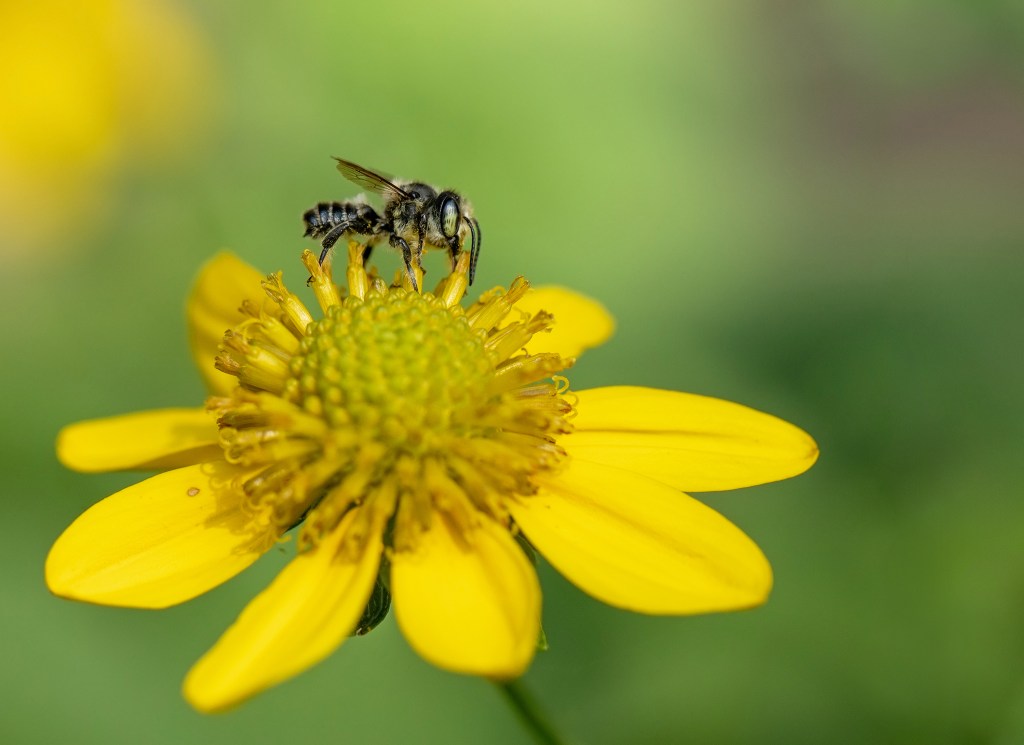
Though most people cite colony collapse and the plight of honeybees as a significant ecological issue, it should be noted that the western honeybee (Apis mellifera) is not native to North America. The species was introduced by early colonists in the 17th century. Marked declines in recent decades have been observed in many of our native bees. This is a phenomenon primarily driven by habitat loss, though other factors such as global warming, which can affect flower phenology, is a serious issue, especially for some of our specialist bee species. Many of our bees are polylectic, meaning that they collect pollen from a variety of plant families. Some, however are oligolectic, meaning that they collect pollen from a narrow range of plants, typically only a single family, a single genus, or even a single species. For these species, shifting a host plants bloom time by even a couple of weeks could be detrimental.
Family Apidae
This family includes some of our most familiar bees, such as the dutiful honeybees and bumblebees, the teddy bears of the bee world. They are generally very hairy and range in size from tiny Ceratina carpenter bees to gargantuan queen bumblebees.
Tribe Bombini
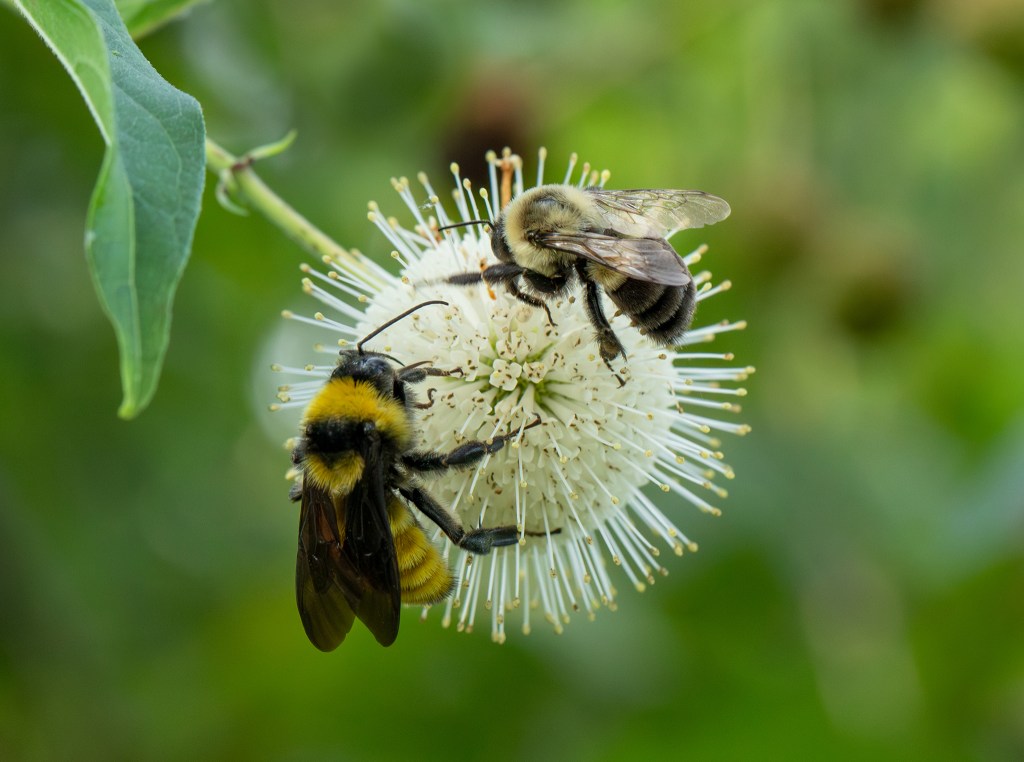
I’d wager most people would consider bumblebees to be archetypical bee – fuzzy, with varying bands of black and yellow. Bumblebees are among the few native bees that are eusocial – meaning a single female produces the offspring of a colony. Bumblebee colonies are much smaller than those of honeybees – on the scale of hundreds of individuals compared to thousands or even tens of thousands. They are comprised of a queen, sterile female workers that collect pollen and tend the nest, and males who leave the nest in search of other queens to breed with. Females can be identified by the “pollen baskets” on their legs, and by having six abdominal segments compared to seven in males. Below an American bumblebee male (drone; left) can be seen alongside a common eastern bumblebee worker (right) on buttonbush (Cephalanthus occidentalis) in the Davy Crockett National Forest.
Bumblebees, along with many other bees, are capable of “buzz pollination”. This is a technique in which a bee will grasp a flower and rapidly vibrate its flight muscles to dislodge stubborn pollen held tightly to anthers. Some familiar plants that require buzz pollination are blueberries, tomatoes, and eggplants. Though honeybees are important pollinators, they are incapable of buzz pollination. This makes bumblebees and many other types of native bees important pollinators of some of our favorite food crops.
Bombus impatiens
The common eastern bumblebee (Bombus impatiens) is the most common bumblebee in my area, and one of the most commonly seen bees in our garden. There are a variety of factors that can be used to help identify bumblebees. This includes the coloration on the thorax and abdominal segments (known as terga or herbal segments), the color of the face and vertex (back of the head/top of the neck), the color of the wings, and the malar space (similar to a cheek). In B. impatiens the thorax is primarily yellow with a broad area of dark hairs in the center. The first tergum is yellow and the rest are black. The vertex is yellow and the wings are clear.

B. impatiens start their day earlier and end it later than most of the bees in my garden. I’ve observed them foraging on a variety of flowers at the three sites where photos were captured for this blog. Examples include Liatris pycnostachya (above), Helianthus spp. (below), Rudbeckia laciniata, Pycnanthemum albescens, Hydrolea ovata, Amorpha fruticosa, Chamaecrista fasiculata, and many more.
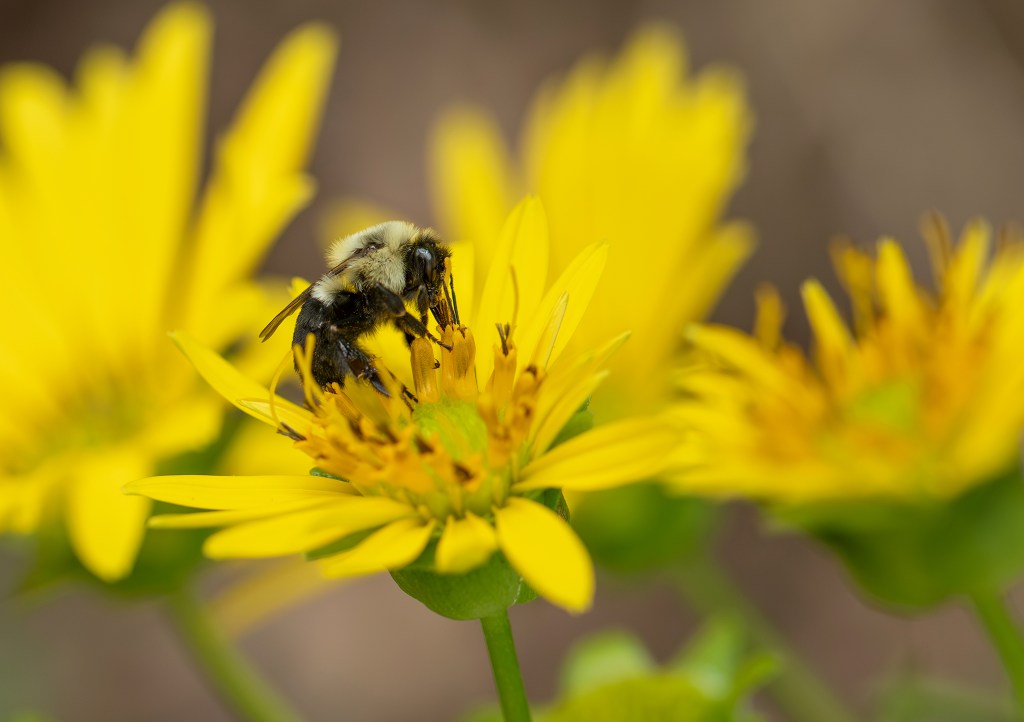
I can always count on there to be a few B. impatiens around when I head out with my camera. This abundance allows me to try and capture a variety of unique compositions, including looser ones that showcase the animals small in frame and incorporate some of the surrounding plant. An example of this is the image below of B. impatiens foraging on Pycnanthemum albescens.

Below is another example of a looser composition that I really liked. This is actually a gyne, or newly emerged queen (more on this in the next species entry). I thought the framing of the fully open Rudbeckia laciniata bloom among two that were just beginning to open made for an interesting image.
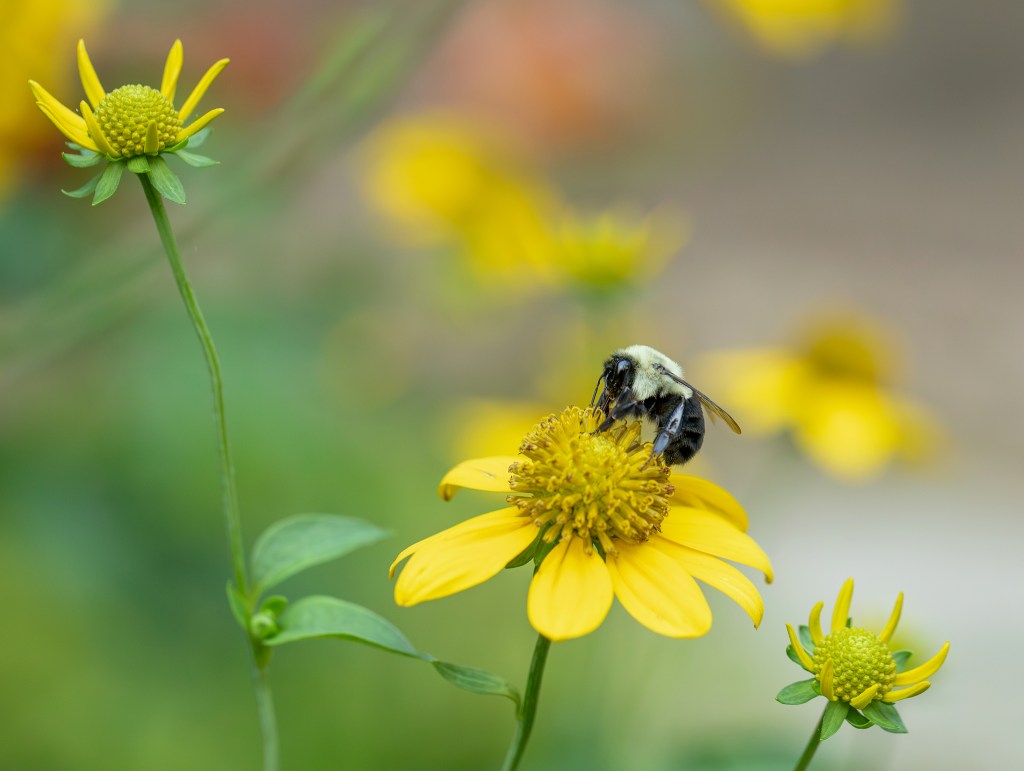
I also enjoyed playing around with tigher portraits and poses, including the head on look below as the bee emerged over the top of a blooming Liatris pycnostachya.

Bombus griseocollis
The brown-belted bumblebee (Bombus griseocollis) appears, at first glance, quite similar to B. impatiens. Closer examination, however, reveals a number of differences. Like B. impatiens, B. griseocollis has a primarily yellow thorax. Instead of a broad area of dark hairs in the thorax center, B. griseocollis has a small hairless patch that looks almost like a hole at the thorax center. B. griseocollis also has yellow on the first tergum and yellow, brown, or a mix of both on the second tergum. The vertex of B. griseocollis is blacks, and the wings are black, and not as transparent as those of B. impatiens.
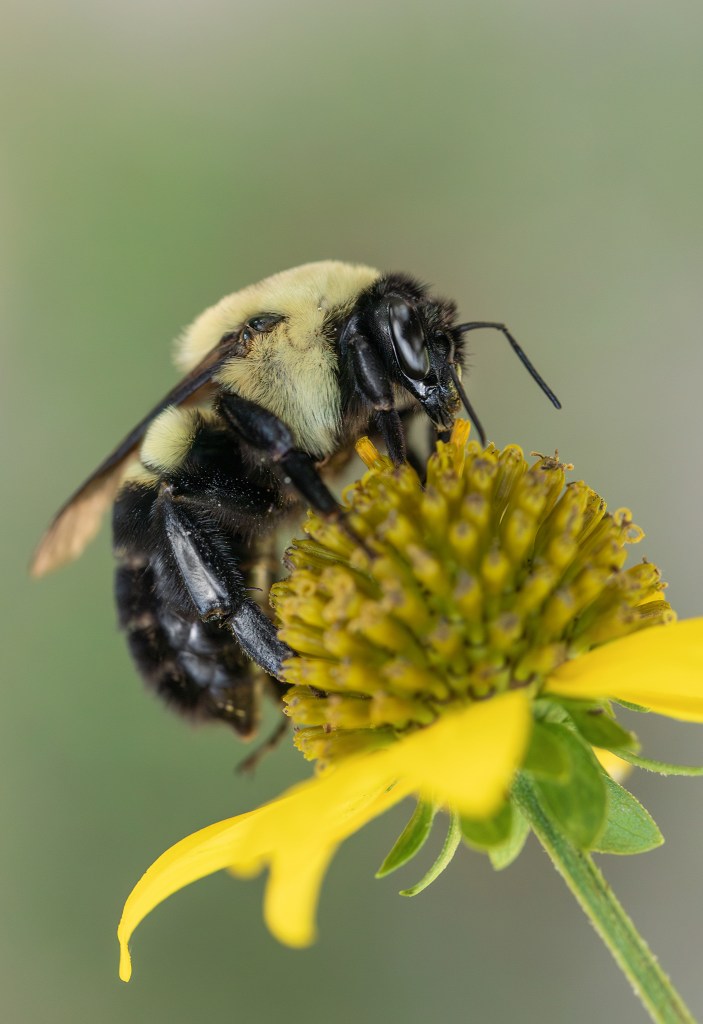
Queen B. griseocollis are among the first bees to emerge in the spring. As in most bumblebees, the queen, who mated the previous year and overwintered in her nest, begins collecting pollen as the days grow longer and the temperatures warm. She builds a few brood cells where she lays eggs. A few weeks later they emerge as sterile adult female workers that tend to the nest and collect pollen for the colony. Later in the summer the queen begins producing reproductive male bees known as “drones”, and finally new queens known as “gynes”. The drones and the queens set out to mate. The drones die shortly thereafter, and the gynes will overwinter, destined to become queens of their own colonies the following year. In all, the life cycle of a bumblebee nest is about a year.
The gyne pictured here is the only B. griseocollis that I’ve seen in our garden. She came flying through late one morning in early August. She was absolutely huge, easily one of the largest bees I can remember seeing. I followed her around the garden for some time, trying and failing to capture an image until she landed on a Rudbeckia laciniata bloom and promptly fell asleep. I frequently observe bumblebees taking micro naps in the garden, but it was special to have her rest mere inches from me. After a few minutes she slowly began to wake up and I was able to capture a few images as she stretched and prepared to continue on her way. I never saw her again, but hope she found a drone and a good nest site nearby so that perhaps I might see a few more B. griseocollis in the yard next year.

Bombus pennsylvanicus
The American bumblebee (Bombus pennsylvanicus) is common and widespread in the eastern half of the United States, with a range that expands into Mexico and southern Canada. Though not as common as B. impatiens, they are regular visitors to our garden and I frequently see them both in wilderness and more developed areas. They are distinctive and unlikely to be confused with any other species in my area. The anterior half of the thorax is yellow and the posterior half is black, and there is yellow on the first three terga. They are the largest bumblebees in East Texas.

B. pennsylvanicus has become a species with significant conservation concerns in recent decades. While numbers in Texas seem to be holding, elsewhere significant population declines have been recorded. This has been especially severe in the northern portion of its range. In Michigan, for example, populations appear to have declined by as much as 98%. Factors contributing to this decline include habitat loss and degradation, the use of certain pesticides that are harmful to bees, and the spread of pathogens from introduced European bees. Due to these concerns, the species is currently under review by the U.S. Fish and Wildlife Service to determine whether or not listing under the Endangered Species Act may be warranted.
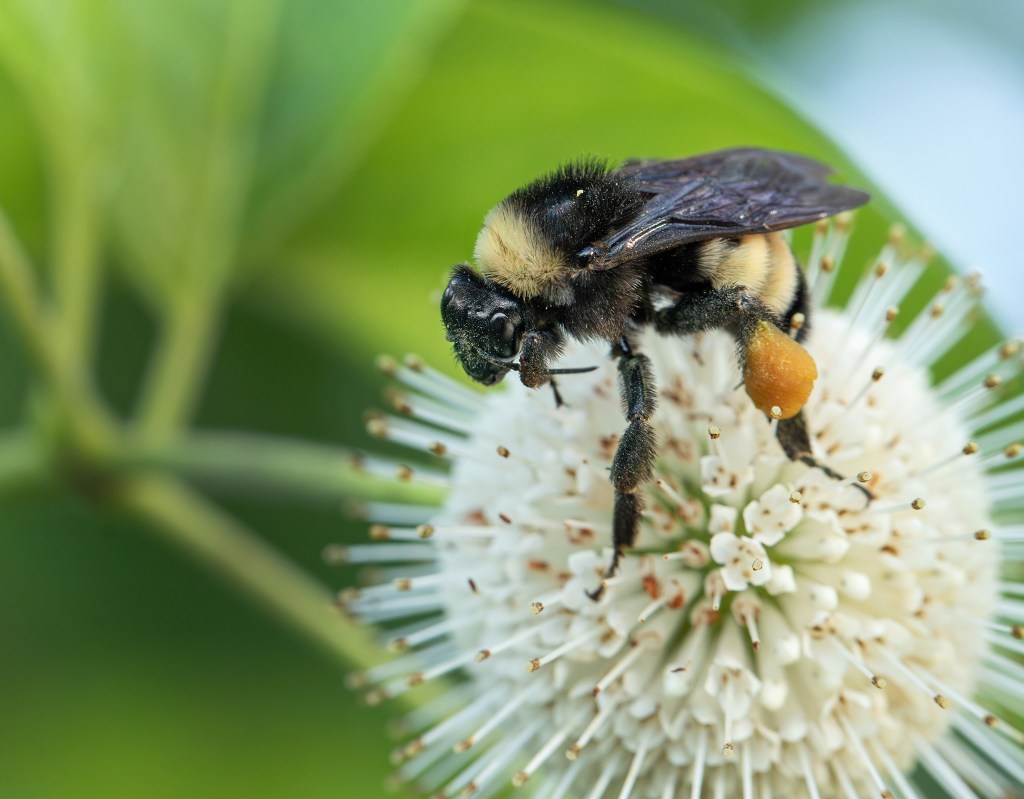
Similar to honeybees, bumblebees carry pollen in structures in their hind legs called corbiculae, or “pollen baskets”. These structures are comprised of hairs around a portion of the tibia that are arranged into a concave basket-like shape. The bees keep the corbiculae and the developing pollen balls moist, and frequently pass their leg over their body, where their dense hairs have been collecting bits of pollen from the numerous flowers they visit. The image below shows a well developed pollen ball on the corbicula of a preening B. pennsylvanicus on Cephalanthus occidentalis in the Davy Crockett National Forest.
I tend to try and capture images of bees from angles that I think are most engaging. This usually involves a clear view of the eyes taken more or less at eye level. These angles aren’t always the best for identification purposes. If you’re inclined to photograph bees (and especially if you hope to contribute data to citizen science networks), it’s important to try and capture images from a variety of angles. For bumblebees, a clear view of the thorax and abdomen are important. The image below of B. pennsylvanicus on Liatris pycnostachya in our garden is an example of an angle that can be useful for identification purposes.

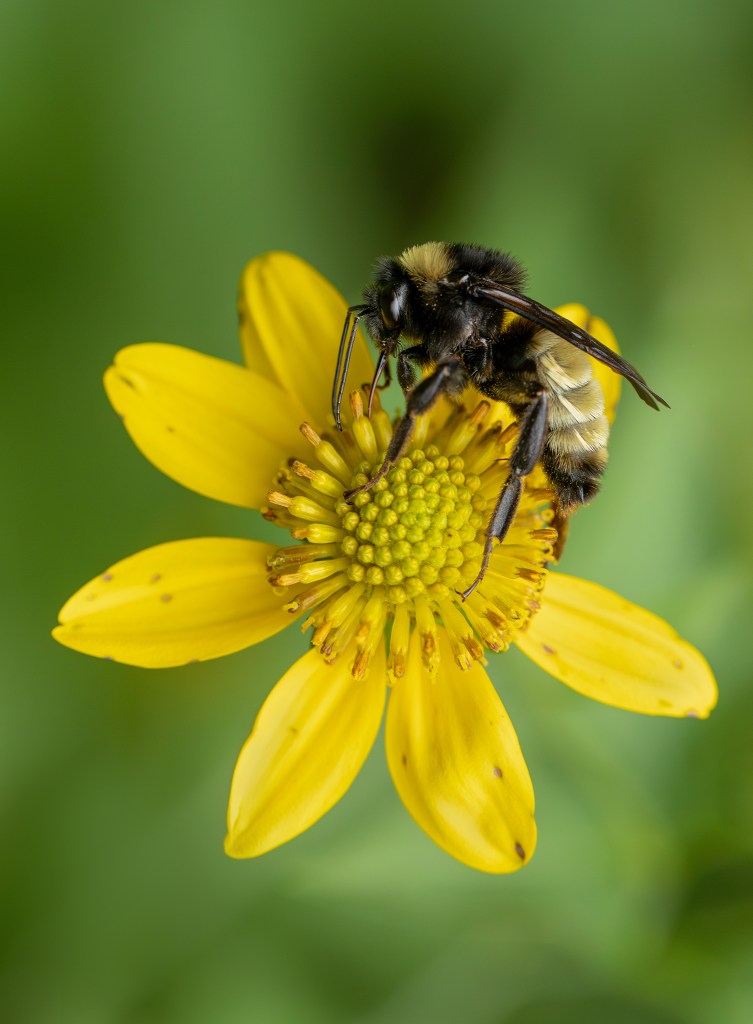
Though B. pennsylvanicus typically only has yellow on the first three tergal segments, there can be some variation. Some individual, like the one pictured below can have more extensive yellow on the abdomen. They can also occasionally have some yellow in the posterior portion of their thorax. This is especially common in males, but can be seen in females as well (see the image below and the image of B. pennsylvanicus and B. impatiens on Cephalanthus occidentalis in the description of Tribe Bombini above).
Tribe Eucerini
This tribe is the most diverse in the family Apidae and contains the various genera of “long-horned bees” as well as squash bees. They are so named for the proportionately long antennae of males. Most species collect pollen with dense, feather-like pollen collecting hairs known as scopa on the hind legs. There are over 200 species in North America.
Melissodes bimaculatus
The two-spotted longhorn bee (Melissodes bimaculatus) is one of the more distinct Eucerini. They are generally black with two white spots on the end of the abdomen. Males have white hairs on the face and legs and a yellow clypeus, the shield like structure between the compound eyes and above the mouth. They also have noticeably long antennae.

B. bimaculatus is polylectic, feeding on flowers of a variety of different families. In our garden they fed heavily on Rudbeckia laciniata. Like many other bee species, they sleep while gripping plant stems with their mandibles, occasionally in congregations.
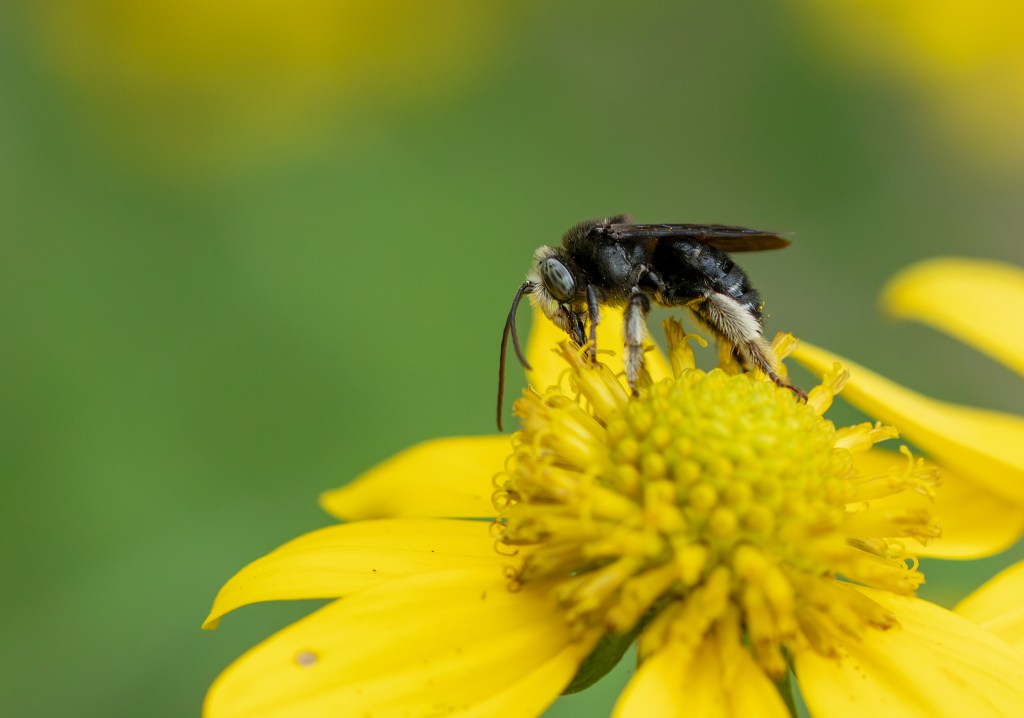
Female B. bimaculatus have shorter antennae and a black clypeus. Their fore and mid legs are black and their hind legs have dense brown scopa. They nest in the ground, and like most of our native bees they are solitary, though multiple females may nest in the same general area. Each nest may contain multiple chambers. The female lays a single egg in each chamber and fortifies it with a pollen ball.

Svastra petulca
Sastra is another genus of long-horned bees. To me they look particularly “furry”. It’s a relatively small genus, with less than 20 species in the U.S, five of which occur in the east. S. obliqua is the most widespread, however I believe this is S. petulca based on the broad banding on the abdomen and lack of dark patches on the thorax. Note the short antennae and dense scopa on the hind leg of the female below.
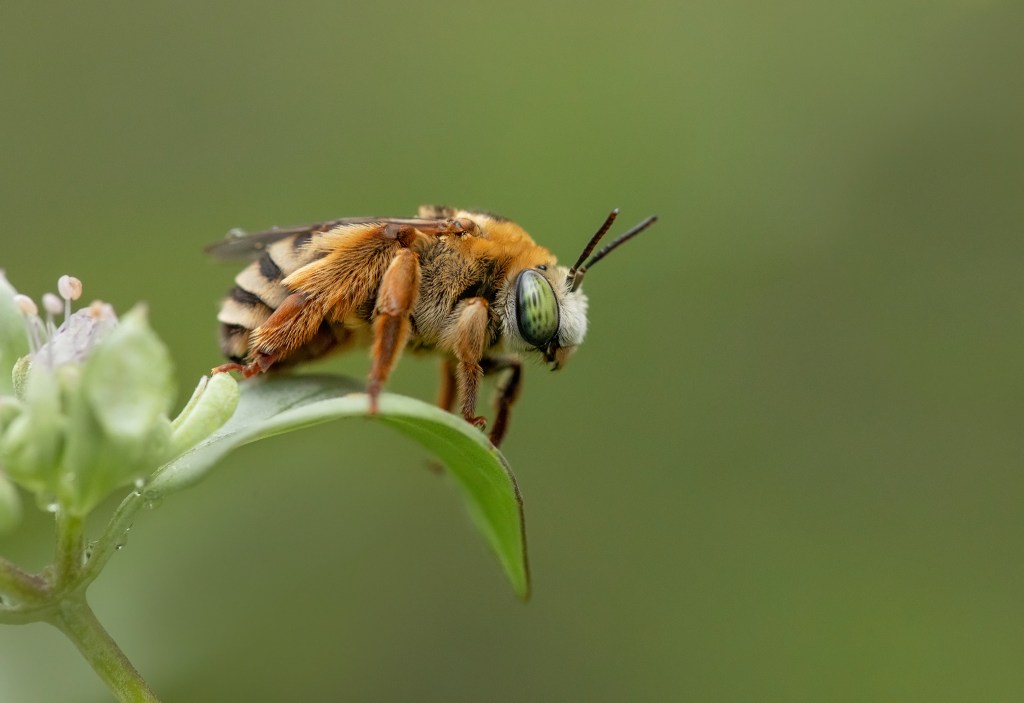
The male below was observed following a rain shower and looked a little worse for the wear. To us rain seems such an innocuous thing, but I imagine to insects an afternoon shower can be a harrowing affair. Note the longer antennae and the lack of feathery scopa on the hind legs.

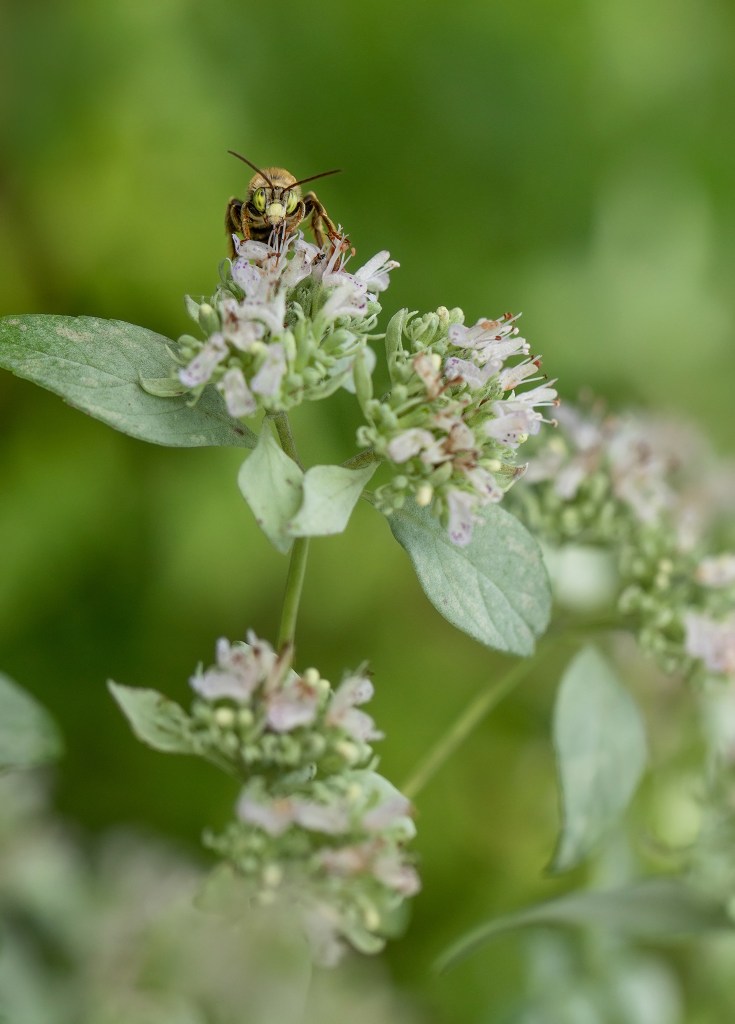
I find these bees to be particularly attractive, especially the eyes. Unfortunately we don’t get these in our garden. All of these were photographed on Pycnanthemum albescens at the Pineywoods Native Plant Center.
Tribe Epeolini
Epeolini is a tribe in the subfamily Nomadinae, which includes the diverse kleptoparasitic cuckoo bees (more on kleptoparasitism later). As they do not collect pollen to feed their young, they lack the dense hairs of most other bees and appear wasplike as a result.
Triepeolus sp.
As my interest in bees grew over the last couple of months, I dug back through my photo archives and found an unprocessed image of a bee sleeping while grasping a twig captured in the Angelina National Forest in October of 2018. It was a long-horned cuckoo bee. As best I can determine it’s a member of the genus Triepeolus, possibly T. lunatus, though Triepeolus can be difficult to differentiate from Epeolus. Triepeolus are kleptoparasites of long-horned bees (Tribe Eucerini), and Epeolus are kleptoparasites of bees of the genus Colletes.

Subfamily Xylocopinae
This subfamily includes the small carpenter bees (Ceratina; Tribe Ceratinini), which are among the smallest bees in the country, and the large carpenter bees (Xylocopa; Tribe Xylocopini), which are among the largest. Xylocopa nest in dead wood – typically old stumps, however they can occasionally nest in the wood of manmade structures. They are capable of chewing their own holes into wood. Ceratina nest in dead standing stems of woody and semi woody plants such as Sambucus and Rhus.
Ceratina sp.
There are around 25 species of Ceratina in North America, many of which are difficult to differentiate. They are small, and typically black or iridescent blue or green. Their small size and active nature makes them difficult to photograph.

Note the pollen aggregated on the hind leg of the individual below. We began seeing Ceratina in our garden in mid July, and by early August they were gone. They were never particularly abundant, and most days I could only locate one or two individuals.

I photographed most of the bees in our yard on Rudbeckia laciniata, and found this to get a bit redundant. One interesting aspect of this, however, is that it allows for some size comparison. For example the minuscule Ceratina is barely as long as one of the disk flowers, while the beefy bumblebee can span nearly the entire breadth of the inflorescence.

Xylocopa virginica
Despite being common in our area, we’ve only seen a couple of X. virginica in our garden. They are very large and superficially resemble bumblebees. They can be differentiated by their abdomens, which are shiny and much less hairy in carpenter bees. Males can be identified by their white clypeus (visible in the image below, which I captured in May when this individual visited our blooming Amorpha fruticosa).

Carpenter bees can be intimidating, as males patrol the vicinity of nests and may buzz humans that approach too closely. The males can’t sting, however, and it’s all for show. The females can sting, however they are not aggressive. They may nest singly, or a few females may share a nest. In the latter situation there may be a loose partitioning of roles, with the oldest female laying most of the eggs. A younger female may lay some eggs, but also cares for the brood and the nest. The youngest female may simply utilize the nest in her first year, and will assume additional roles in the next season.
Though having carpenter bees excavate nests in the wood of one’s home is concerning, they don’t eat the wood like some other pests. That said, extensive nests can compromise the integrity of certain structures. Using treated wood and providing more desirable nest sites near the home are effective ways at preventing damage.
The image below shows a female X. virginica feeding on Hyptis alata at the Houston Arboretum and Nature Center.

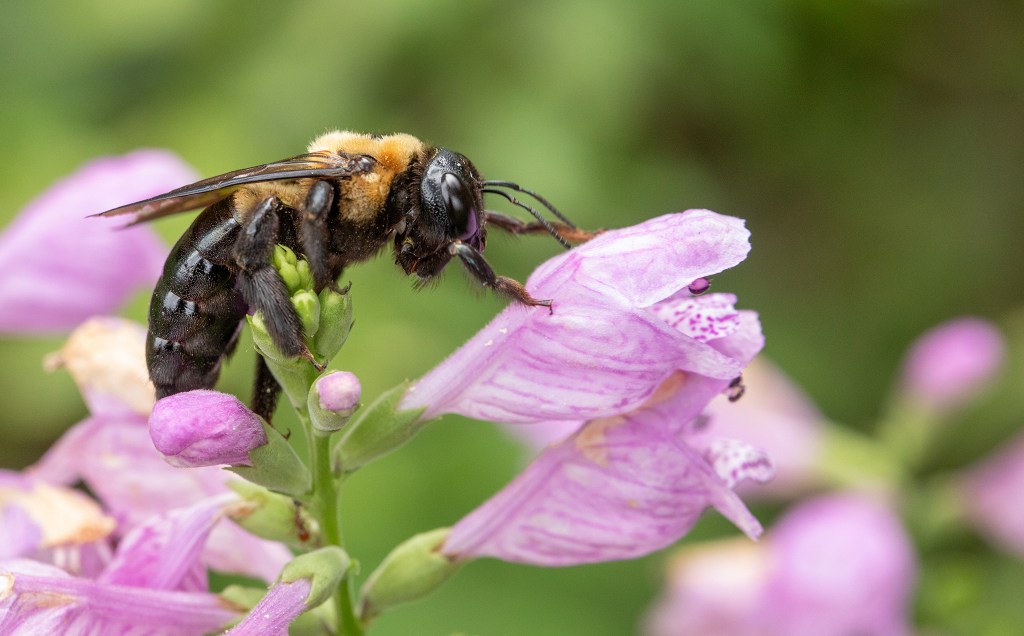
Carpenter bees will sometimes “cheat the system” when feeding on nectar. On plants where the nectaries are difficult to reach, like the Physostegia virginiana pictured below, they will use their powerful mandibles to chew a small hole near the base of the flower to gain access to the nectar, foregoing contact with the anthers and therefore not aiding in pollination.
Xylocopa micans
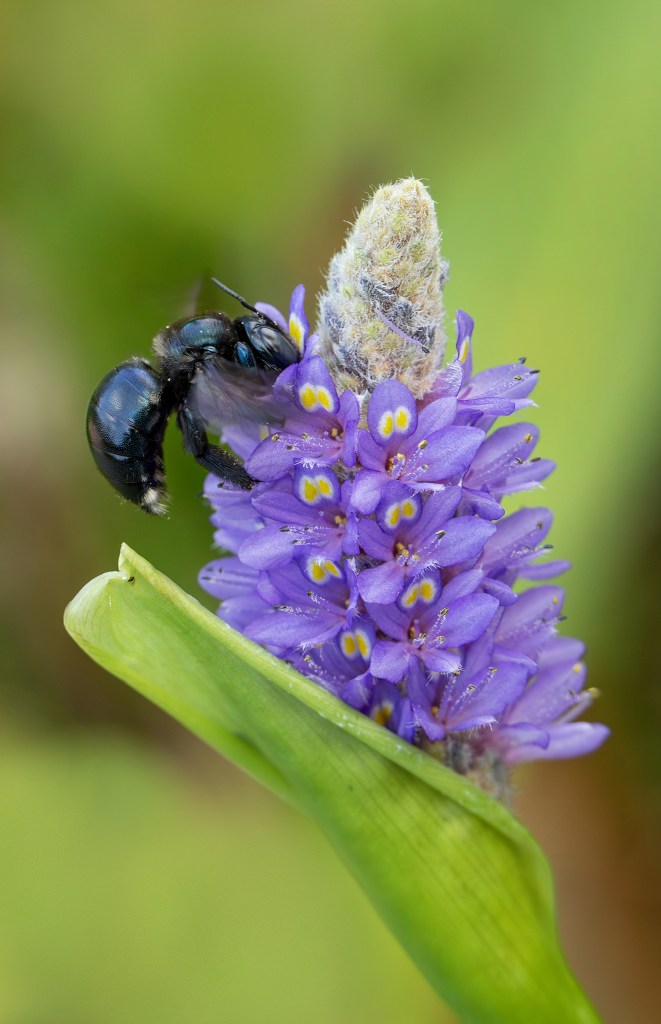
The “southern carpenter bee”, X. micans is very similar to X. virginica. Their ranges overlap in the southeastern U.S. where separating the two species can be tricky. X. micans can best be identified by its bluish to purplish sheen, visible over the entire body of the dark females (like the individual below feeding on Pontedaria cordata below), or on the abdomen of the males, which have yellowish hairs on the thorax and the first tergum.
After watching several large carpenter bees visit blooming P. cordata, I believe I witnessed them engaging in buzz pollination. I’m not sure if this plant requires buzz pollination, and it certainly seemed like the anthers were accessible, however the bees would periodically vibrate their wings vigorously as if trying to shake loose bits of pollen from within the flower. I have read that P. cordata exhibits tristyly, a condition where flowers of a species exhibit different morphologies that include styles, and typically stamens of different lengths. In this case, they may be located deep in the flower, and buzz pollination would likely be required to extract the pollen.
To be continued…
 A Naturalist's Journey